When the Nguyễn Dynasty came to power in 1802, there was a Confucian Temple (Văn Miếu 文廟) in Long Hồ hamlet, outside the imperial citadel. In 1807, Emperor Gia Long ordered that a new Confucian Temple be constructed in the nearby An Ninh hamlet.
That same year, Emperor Gia Long also ordered that a shrine dedicated to the father of Confucius (Khải Thánh từ 啓聖祠) be constructed.
By that time, the institution of the Confucian Temple already had a very long and complex history in China, dating back to the fifth century BC. Over the centuries various additional individuals had been enshrined in the temple, and the shrine dedicated to Confucius’s father was only first established in 1530.

The Confucian Temple that Emperor Gia Long ordered constructed in 1807 honored over 100 individuals, from Confucius to Ming Dynasty scholar Wang Yangming. All of the people honored in this temple were “Chinese,” and all of them could be found in Confucian Temples in “China.”
Two years after ordering the construction of a new Confucian Temple in Hue, Gia Long learned that the Confucian Temple in Hanoi included two individuals who could not be found in Confucian Temples in China.

In 1809, one of Gia Long’s officials submitted a memorial from Hanoi in which he noted that the Confucian Temple there also honored Shi Xie/Sĩ Nhiếp (137-226) and Chu Van An (1292–1370), two figures that were not honored in Confucian Temples in China.
Shi Xie/Sĩ Nhiếp was a Han Dynasty official who reportedly introduced [the Classic of] Poetry and [the Classic of] Documents to the Red River Delta region, which was believed by Vietnamese scholars in later centuries to mean that Shi Xie/Sĩ Nhiếp had introduced to the region the elite culture of writing and Confucian morality that they so valued.
Chu Van An, meanwhile, was a famous Vietnamese Confucian scholar-official.

Gia Long asked his officials to discuss the matter of the position of these two individuals in the Confucian Temple in Hanoi. Their response was that the Confucian Temple in the capitol of Hue should be taken as the standard.
Shi Xie/Sĩ Nhiếp and Chu Van An were removed from the Confucian Temple in Hanoi, but were allowed to be worshipped (with imperial support) in separate shrines outside of Hanoi.

There have been many English-langauge studies that have tried to argue that what is important to see in Vietnamese history are the “Vietnamese” or “Southeast Asian” elements that have supposedly countered “imported,” “Chinese” ideas or cultural practices.
This approach has been shared more widely by scholars in the field of Southeast Asian Studies who have argued that what is important to see in Southeast Asian history is how people have “localized” outside ideas and cultural practices.
This approach to the past is one which the officials at Gia Long’s court in 1909 would not have understood.
It is clear that they believed in the opposite.
What they valued was “orthodoxy,” not “local” variations.
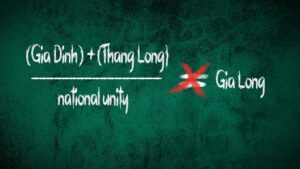
The obvious question which the blog post’s conclusion provokes is as to why did officials at the Gia Long court value “orthodoxy” instead of “local” variations.
The Vietnamese text incorporated in the post indicates that the inclusion of Sĩ Nhiếp and Chu Văn An in the Confucian pantheon occurred during the Lê dynasty. That might have been one of the reasons explaining their removal from the Confucian Temple in Hà Nội by the Nguyễn court.
Being a ruling house whose right to rule was suspect in the eyes of many locals who remained loyal to the overthrown Lê dynasty, the Nguyễn court’s preference for things “orthodox” or “Chinese” appeared to be politically calculated as well comprehensive, covering, among other things, historiography and law.
According to a recent study, reviewed by Liam C. Kelley, the Nguyễn court decided to tackle the legitimacy problem aforementioned by, inter alia, completely banning many Lê dynasty historiographies, while “resorting to ancient histories and classics from China, which although foreign, were relatively less controversial than histories from the Lê period. Underlying this decision, as demonstrated by [Philippe] Langlet, was the pragmatic concern to circumvent intellectual dissent. Thus, ‘the preference for Chinese books,’ Langlet notes, ‘was not the result of contempt for national history, but rather due to the difficulty to evoke it without recalling that the advent of the Nguyễn dynasty was based on a contested legitimacy.'”
In an even more recent study, a prominent Vietnam historian has also pointed to pragmatic considerations behind the Nguyễn dynasty’s decision to discard the Lê Code as the law governing their realm and to promulgate in its stead a code that was largely a copy of the Code enacted by the Qing dynasty in the Northern empire: The Qing Code – to employ the parlance of this blog post – was sufficiently de-localized to be acceptable to both the locals who resented Nguyễn rule and the locals who supported it.
If embracing “orthodoxy” could enable Nguyễn monarchs to evade “local” difficulties, then it would seem logical that they actually did so to advance their self-interest.
Thanks for the comment!! And it’s good to see you again!!!
Ok, so statements like this: “resorting to ancient histories and classics from China, which although foreign, were relatively less controversial than histories from the Lê period. . .” with terms like “resorting to” and “although foreign” literally scream out to me “modern bias/perception.”
Let’s try this: “resorting to the Bible from Israel, which although foreign, was relatively less controversial than histories from the Roman period”. . . “resorting to the Koran from Saudi Arabia, which although foreign, was relatively less controversial than histories from the Ottoman period.”
Did members of the educated elite in say Europe in the 19th century “resort to” citing the Bible? Did they see it as “foreign”? Were their references to it simply “political calculations”?
I would argue that when we think and write about the past in this manner is when we leave the past behind (or we never enter it in the first place).
Yes, orthodoxy intersects with politics, but not because people decide to “embrace” orthodoxy for political purposes. It starts with BELIEF, and then people defend their actions based on the ideas from their belief system. Educated Europeans in the nineteenth century BELIEVED in the Bible. It was TRUTH to them. It was not “foreign,” nor was it something that they “resorted to” citing.
This is, I think, easy for us to understand. Anyone today who has read writings in English from the nineteenth century has had the experience of being surprised at how different (how religious) the worldview at that time was. For Vietnam, however, this does not happen. By and large the modern historians who have written about the Vietnamese past simply can’t accept/acknowledge/recognize that Vietnamese thought differently in the past (just as everyone else in the world thought differently in the past). Anything that has to do with “Chinese stuff” is precisely that – “Chinese stuff” – and it needs to get explained away using our current ideas about things like “politics.”
Ok, but how did “politics” actually work in Nguyen Dynasty Vietnam? It was an absolute monarchy. There was no “public sphere.” No newspapers. No books. . .
If taking Si Nghiep and Chu Van An out of the Van Mieu in Hanoi but assigning people to care for their shrines in villages in the north was essential for countering the Nguyen’s “contested legitimacy,” how exactly would that have worked? What (politically) might have happened if Gia Long didn’t order this change?
I would argue that Langlet, and many other historians, have fallen into the trap of seeing a library as a society. Yes, today we can read the works that the Nguyen Dynasty produced (because they are in our libraries) and we can think about how they might have related to “politics” (because that is how we see the world today) but those texts were not “publicly” available in the past (and therefore we have to be very careful about what we equate the information in those texts to).
So, for instance, if you were someone who “contested” the Nguyen Dynasty’s legitimacy, you would have had no idea what was in the Kham dinh Viet su thong giam cuong muc or the Dai Nam thuc luc or the Dai Nam hoi dien su le, etc (none of which were available to members of the court until the second half of the nineteenth century anyway). So how can we say that the information in those texts was somehow politically calculated to counter the ideas of an audience that never saw what was in those texts?
It’s only in the colonial period that those “restricted” texts became “public.” With that transformation, historians have slipped into viewing their libraries as a mirror of Vietnamese “society” in the past, and have “resorted to” using historically “foreign” ideas to explain that past.
I’m rambling here, but I don’t think taking Si Nghiep and Chu Van An out of the Van Mieu has anything to do with “politics.” It’s all about orthodoxy. Is orthodoxy important for legitimacy? Of course! If you look at where this information comes from – the Dai Nam hoi dien su le – it is surrounded by page after page of information about all of the temples and rituals that had to be maintained/performed. Orthodoxy is essential for ritual performance, and in a world like nineteenth century Vietnam, the correct performance of rituals was seen to be essential for maintaining the dynasty.
It is in that context that Si Nghiep and Chu Van An were “kicked out” of the Van Mieu in Hanoi. The Nguyen did this not because they were worried about “political” opponents, but because they were concerned with “orthodoxy.” They believed that doing everything in an orthodox manner was necessary to maintain their dynasty. And yes, doing everything in an orthodox manner was “proof” of their legitimacy. But they didn’t need to “demonstrate” that to anyone beyond the people at their court/ritual performances, because no one else saw anything anyway.
Your elaborate response to my comment compels me to wonder whether Charles Wheeler is also one of those historians who have fallen into the trap of seeing a library as a society.
(For readers who might come across my reply to your response, but who are not familiar with Wheeler’s work, I shall briefly summarize it below.)
In his exploration of the polity ruled by ancestors of Nguyễn monarchs, Wheeler has recounted how at the end of the seventeenth century, Lord Nguyễn Phúc Chu had sought to consolidate his political power by, yes :), embracing the Buddhist Dharma, the orthodoxy in his realm at the time…
When Nguyễn Phúc Chu was enthroned as the new ruler in 1691, he inherited from his predecessor a sprawling polity where Buddhism was the dominant religion both at the court and among the populace. In order to solidify “institutional control over his expanding territory and his growing and diversifying population,” he would make use of the fierce sectarian struggle between the Caodong and the Linji Chan schools in South China to unite in his person both the royal authority and that which the Buddhist Dharma could bestow upon him.
Monks from both the Caodong and the Linji school were active as missionaries in the Nguyễn state, where they were known to “Vietnamese” as Chan masters from, respectively, the Tào Ðộng and the Lâm Tế school. Among other things, the Nguyễn court sought to co-opt these monks in its efforts to maintain order in the country, encouraging and enabling them to renovate and build Buddhist temples “in the politically sensitive areas of the kingdom where rebellions had taken place.”
By the final decade of the seventeenth century, a Caodong monk named Xinglian Guohong had managed to become the Master of the Realm, that is to say, the highest religious official at the court of Lord Nguyễn Phúc Chu.
While Caodong and Linji missionaries were evangelizing the Dharma in his realm, the longtime rivalry between their schools back in the homeland reached a new milestone in 1693, when Shilian Dashan, a Caodong abbot in Guangzhou, completed and published a treatise which his master had initiated decades earlier in the context of this rivalry. The treatise, as Wheeler has explained, drew on “a clever manipulation of Chan master-disciple genealogy” to move “all Caodong monks five generations closer to the Buddha than their Linji contemporaries,” thereby providing the basis for Dashan’s own claim “to rank in the twenty-ninth generation of Chan masters, rather than the thirty-fourth.”
The publication of this treatise, Wheeler continues, provoked a storm of controversy among Dashan’s sectarian rivals, since the genealogical method employed therein “would effectively raise Caodong status, and deny Linji monks access to Chan abbacies, congregations and properties.”
In light of the fact that Xinglian, Lord Nguyễn’s Master of the Realm, was a disciple of Dashan, and given the intensive trade contacts between South China and his polity, the Vietnamese ruler was unsurprisingly very well-informed about the religious situation up in the North. He saw in the new development an opportunity to enhance his authority over his subjects, and acted quickly to exploit it. In the spring of 1694, hardly a year after the disputed Chan genealogy had been published, Dashan received an embassy from Nguyễn Phúc Chu that had come to his abbey in Guangzhou to invite him to embark upon an evangelical mission to the South…
Arrived in the Nguyễn polity in 1695, Dashan would conduct in Huế on the Buddha’s Birthday of that year a ceremony in which he made Lord Nguyễn his first Vietnamese disciple, conferring upon him the status of a thirtieth generation Zen master, “a full four generations ahead of leading monks in the kingdom.”
In the whole realm, there was then only one other monk, Xinglian, who ranked higher than Lord Nguyễn in terms of seniority, but who, as Wheeler notes, would conveniently disappear from history that very same year, leaving the claim to be the most senior monk of the land to the Lord himself.
Wheeler concludes:
“Religious authority now reinforced royal authority. This dharma status clearly mattered to the monk-monarch, who thenceforth often stated his credentials in these terms. Dashan’s genealogical claim might have been controversial back home, but they helped a Vietnamese monarch to achieve his political ends.”
To a political junkie that I am, Wheeler’s argument looks recognizable and, therefore, appealing, as did Langlet’s argument.
But I get the impression that your objection to the case made by Langlet is applicable to Wheeler’s as well: Wheeler seems to have projected modern ideas about politics onto a seventeenth century polity.
If (1) pre-modern Vietnamese rulers sincerely believed in orthodoxy, as you have argued, and (2) Langlet’s and Wheeler’s account of their actions are factually accurate, then we have situations in which their sincere beliefs in orthodoxy almost completely coincided with their political self-interest.
In order to demonstrate in a conclusive manner the supremacy of beliefs, I suggest that you dedicate a future blog post to a case in which a premodern Vietnamese (ruler) acted in a way that was contrary to his self-interest but consistent with his belief in ideas deemed orthodox at the time.
Hegel would approve such a blog post 🙂
_ I would give a diferent explanation for the ” demotion ” of Si Nhiêp an CVAn ; confuceans have a deepest sense of hierarchy and these two persons whatever their merits have not made it to get to the level of saints or sages .
_ ” văn ” in Văn Miếu is short cut for “Văn Tuyên Vương” , Confucius ‘ posthumous title ( văn = hòa nhã, ôn nhu ; tuyên 宣 = to lớn ) ; ” văn ” has nothing to do with literature . However , in the English and French Wikipedia , the temple is called ” temple of literature ; thanks ( sic ) to Wikipedia ,the grievous error is repeated ad infinitum among Vietnamese and tourists . The source of the error is the French colonists who had contact only with low class Vietnamese , their servants or their interpreters who have the shallowest knowledge of their ancient culture ;
today Vietnamese learn from the past from such ” luminaries “