

The more I work with LLMs in my research, the more it seems to me that we need to think more carefully about what exactly we are interacting with when we use something like ChatGPT, Claude, DeepSeek, etc. We tend to talk about “models,” and certainly the model is extremely...
Read More
LLMs Can Now Conduct Research
Yet another milestone has been reached. ChatGPT (and Claude) can now conduct archival research in a digitized archive. A month and a half ago, I tried to get ChatGPT to investigate a topic by employing digitized materials in the French National Library (BnF; https://gallica.bnf.fr/). The results were quite impressive; however,...
Read More
The Founders of Indonesia and AI Video History
I don’t spend much time on Instagram, but I like what the algorithm there sends me. My “dream world” is one where aesthetics and history merge, and that is definitely what I see on my Instagram feed. While most of what I see is more focused on retro vibes, I...
Read More
Claude, Language, and Work
In the late 1990s, I remember that I used the Netscape browser. Then Microsoft Internet Explorer came along and then Firefox. . . At some point I “jumped ship” and stopped using Netscape, but I remember that before I did that, there was a time when I knew that another...
Read More
Who Were the Hồi Kê? (aka Historians! It’s Over!!!)
After a break for a few months, it’s difficult to get into the mood to write a new blog post. I have plenty of ideas, but when I think of the time and mental effort that it would take to organize those inchoate ideas into coherent posts, I hesitate. ....
Read More
The View of AI Is Clearly Changing, but Not for the Humanities
I like to use X/Twitter as a means to gain a sense of how people view a certain issue. This is because as polarized as most media is today, there is still enough diversity on X/Twitter for one to get a sense of the different views on a topic, particularly...
Read More
ChatGPT Is Haunted
I knew it would come to this. . . When photography was first invented, there were people who claimed that it was able to capture images of ghosts, the dead, etc. I’ve low-key been waiting for something like that to happen with LLMS. . . and today it finally did....
Read More
Curating Knowledge in the Age of AI Scholarship
So, I have been experimenting. I have been trying to see what happens when one takes the kind of article that appears in journals such as the Journal of Asian Studies, the Journal of Southeast Asian Studies, and many others, and asks: could an LLM help produce something like this...
Read More
Various Thoughts on Why I’m Fine with LLMs Being Better Than Me
I recently wrote a brief post in which I admitted something that still feels a little strange to say out loud: LLMs can now do much of the work that I do as a historian better than I can. They can read faster, write more fluently, translate more accurately, and...
Read More
I Need to Meditate on the AI Future. . .
For the past few months, I have been working heavily with ChatGPT (the paid version). It’s open all day long as I work on various things, and I repeatedly turn to it for various tasks and queries. Up until recently, that is how I have seen and used LLMs, as...
Read More
Editing, Researching, and (Eventually) Writing with AI
Over the past few years, I’ve seen the same pattern repeated over and over regarding statements made about LLMs. Someone will say something about the capabilities of a given LLM, and then someone else will respond with a dismissive comment to the effect of, “Well, I just ask ChatGPT, Claude,...
Read More
The Potential of AI Films for Southeast Asian History
In the early 2000s, when I started teaching, I developed a course called “The World of the Mekong” that was about the histories of what is now Thailand, Cambodia, and Laos (with some Burma and southern Vietnam as well). My development of that course coincided with a kind of “golden...
Read More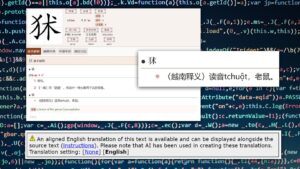
AI and the Coming of “Universal Knowledge”
In the past week, I’ve had a few “Wow!” moments related to LLMs, AI, and digital knowledge, and so I thought I’d document that here. The comments I will make refer to the paid version of ChatGPT (now with Thinking 4.2) and the free version of Grok, and I also...
Read More
An Example of How Helpful LLMs are Becoming
I’m in the process of translating a fourteenth-century text, Wang Dayuan’s 1349 Brief Treatise on the Island Barbarians (Daoyi zhilue 島夷誌略), and I do this by putting passages in Grok, and then checking its translations. Today I was working on a section on “Jiaozhi,” the area of the Red River...
Read More
The Decline of the Sense of Scholarly Self-Worth in the Digital and AI Ages
I recently wrote a blog post on how in the 2020s, what we can call activist/progressive scholarship has largely come to dominate in certainly the North American variety of Asian Studies/History as well as in various Humanities and Social Sciences fields. One big question then is why has this happened?...
Read More
Why I like Grok – Knowledge in the AI Age
When it comes to LLMs, I have always had a positive view of Grok. The other day, I asked the free version of Grok using its “thinking” mode the following question: Who are the scholars who have argued that Shepo/She-p’o 闍婆 was on the Malay Peninsula? Shepo is the name...
Read More
How Digital-Age Scholarship is Different
All fields are different, but the field I am most active in now (looking at early Southeast Asia through Chinese sources) is very different today than it was just 10 years ago, and it is different because of the digitization of sources. This is something which I think people who...
Read More
The Gradual Advance of AI
When technology advances gradually, we tend to not fully appreciate the scale of the transformation that it brings. This is because we adapt to its gradual changes, and lose track of how far those changes have moved us away from the place we were before the technology emerged. I saw...
Read More
Infinitely Scrolling Through the Past
Last night I was looking through documents from British North Borneo and came across a record from 1886 about the murder the previous year in Palawan, then under Spanish rule, of a British subject by the name of J. W. Allen. In this document, we learn that Mr. Allen lived...
Read More
Grokipedia and the Hồng Bàng Dynasty
On October 27, 2025, Elon Musk’s company xAI released the first version (version 0.1) of an alternative to Wikipedia, called Grokipedia. It appears that the creation of Grokipedia was the result of an offhand comment made at an event Musk participated in this past September, the All In Summit. At...
Read More
James A. Anderson’s “The Dong World”: An AI Reading
A while ago I became aware that historian James A. Anderson has published a new book entitled The Dong World and Imperial China’s Southwest Silk Road: Trade, Security, and State Formation (UW Press), which is available in open access form here (https://library.oapen.org/handle/20.500.12657/92971). I promptly downloaded it, and saved it in...
Read More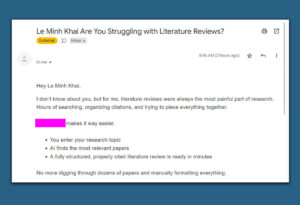
They’re Coming!!
When I was working in the US, I never got an email from a predatory/scam journal. Then I went to work at a university in Southeast Asia, and I immediately started to get emails from such journals on a regular basis. I got the above email because I tried to...
Read More
You Don’t Think AI is a Threat, but You are Also Using the Wrong Model
I see a lot of academics brushing off AI, thinking that it’s not a threat. How do they reach that conclusion? As far as I can tell, in many cases they go on free versions of AI platforms, like ChatGPT, try a few things out, get back some hallucinations, and...
Read More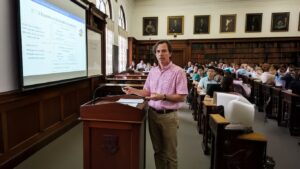
Professors Will be Eliminated by Progressive Logic
The other day an opinion piece from The Conversation popped up in my news feed with the title, “Some unis are moving away from in-person lectures. Here’s why that’s not such a bad thing.” This piece begins by referencing recent events in Australia. In particular, students and some staff have...
Read More
Long-Form Immersive Literacy is Coming to an End
The other day, I went into a bookstore. There was a section on “classics,” which was essentially a section of works of nineteenth and twentieth century literature. I saw volume after volume of books I’d read before in my youth, from The Brothers Karamazov to The Plague, and as I...
Read More
What Students are Learning but Many Profs Perhaps Still Aren’t
A few years ago, I used to teach a session on “writing a literature review” for a general “methods” course that was offered to incoming graduate students in various humanities and social sciences field. I always found teaching this somewhat nonsensical because 1) if you read scholarship, you can see...
Read More
More on “History is Toast” – An Explanation
I have been arguing that History cannot survive AI, and some people have been offering contending views, such as the idea that AI can’t do certain things that certain historians can. I agree, but I still think that History is toast. Let me explain. I do not see evidence that...
Read More
AHA’s “Guiding Principles for Artificial Intelligence in History Education”
The American Historical Association has issued some “Guiding Principles for Artificial Intelligence in History Education.” If you have read any of my posts on the future (or what I see as the lack thereof) of the History profession in the AI age and think that I am being alarmist, then...
Read More
I Have Never Read “Orientalism”. . . But LLMs Can
I have been thinking about books and reading as we enter the AI/LLM age. There are a couple of books that were hugely influential when I was a graduate student in the 1990s: Edward Said’s Orientalism and Benedict Anderson’s Imagined Communities. These books were considered “essential reading.” Edward Said’s 1978...
Read More
History is Toast – The Current History Profession Can’t Survive AI
There is a new study that came out recently called “Working with AI: Measuring the Occupational Implications of Generative AI.” This study was carried out by a group of Microsoft researchers and the purpose of the study was to investigate how people are actually using generative AI, and to try...
Read More
Vietnam has an AI Image Problem
A little over a year ago, I started learning about AI image generation. There are a lot of tools for creating AI images. Perhaps the most popular is Midjourney. You have to pay for Midjourney, but it produces very high-quality images without the need to know much about what you...
Read More
Creating an Historical Family with AI
AI filmmaking is still in its infancy, but it is developing very rapidly. As a historian, I would like to be able to use AI to bring the past to life, and video is one way to do this. However, at the moment, it is still very difficult. To make...
Read More
Using AI to Imagine Life at the Crocodile Pit in Early-Twentieth-Century Borneo
I came across the above picture in the British Colonial Office archives. It is of Chinese miners in the early twentieth century in Borneo at a place called “Lobang Buaya,” which means “crocodile pit.” That does not sound like a safe place to be mining, and looking at the blurry...
Read More
“Savages” in Vietnamese History: An [AI] Tale of Borders and Beliefs
In 2017, I wrote a blog post about a tool (AntConc) that can be used to search through texts, and I talked about how we could use that tool to engage in research on Vietnamese history using the chronicle, the Đại Việt Sử Ký Toàn Thư. One topic that I...
Read More
History Is Over. So, Let’s Get Started.
Just about a year ago, I wrote a blog post in which I talked about ways in which AI can make life exciting and productive for historians. It was an optimistic perspective on the potential of AI, and I still feel the same way about using AI in my own...
Read More
History in the AI Age: A Self-Reflection
In the spring of 1994, during my first year of graduate school, I took a seminar on Chinese Intellectual History. In that seminar, in addition to weekly readings and discussions, we had to write and present a research paper. I chose to research a paper on “the Confucianization of Vietnam.”...
Read More