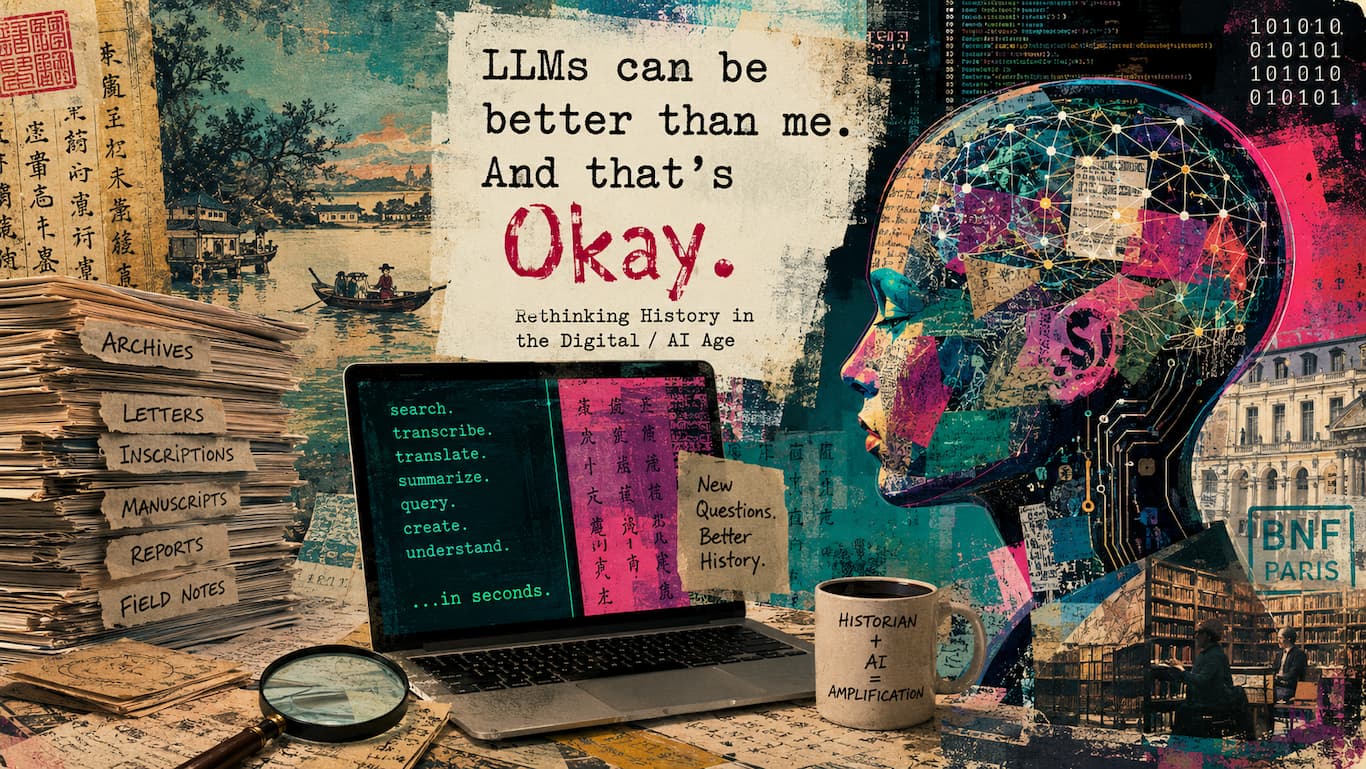
I recently wrote a brief post in which I admitted something that still feels a little strange to say out loud: LLMs can now do much of the work that I do as a historian better than I can. They can read faster, write more fluently, translate more accurately, and think through certain issues more perceptively than I can.
So, what does that mean?
Is this the end for historians? Is it the end of the history profession? Am I supposed to be distraught?
Actually, I’m fine with it.
More than that, I can already see many things that I can now do that I simply could not do before. Projects that once seemed impossible, or at least impossibly time-consuming, now look achievable. Sources that once sat beyond my reach because of language, location, format, or sheer volume can now be approached in new ways.
As for the history profession, I would say something more blunt: it has already been struggling for the last twenty years. Even if AI had never emerged, I do not see what would have reversed that trend. The profession’s refusal to adapt seriously to the digital age had already sealed much of its fate.
If anything, AI offers what may be a final opportunity for what remains of the profession to rethink and revitalize itself. I doubt that this will happen on any large scale, but it would be wonderful if a university or two recognized the potential of combining AI and history in a serious way. Done properly, this could finally allow history to leave the analog age behind and join the rest of humanity in the digital/AI age.
What follows are some thoughts about that possibility. They are still raw, because I am still trying to make sense of the changes taking place. But the basic point is simple: AI is not the greatest threat to history. The greater threat is the profession’s continued attachment to old forms of prestige, old methods of production, and old ways of communicating with the public.
AI/LLMs for DIY Digital Humanities
The need to rethink and revitalize history and the humanities has been discussed for a long time. In the 2010s, that was precisely the hope attached to the “digital humanities” (DH). DH promised to bring the humanities into the digital age. It promised new methods, new audiences, new archives, and new forms of collaboration.
But it did not succeed, at least not in the transformative way that some of us hoped it would.
I became aware of the digital humanities in the early 2010s and immediately saw its potential. I started experimenting, posted about those experiments and my thoughts on DH on a blog (https://dseasia.wordpress.com/), and co-taught a graduate seminar on digital history.
At that time, I was also serving as the undergraduate advisor for a history department, and I was watching the number of majors decline precipitously. As a parent, I could also see how different the world of young people was becoming. They were growing up in a world shaped by the internet, YouTube, and social media.
Putting those two observations together, one thing seemed obvious to me: the text-focused world of history had to change.
Early DH seemed to offer a way forward. Some early projects were carried out in the spirit of “public history.” They involved webpages connected to archives, interactive exhibits, or databases in which experts curated information about the past and made it accessible to the public.
At the time, this struck me as a logical way to bridge the expanding gap between the analog, text-based world of academics and the digital, online world inhabited by everyone else.
But just as quickly as I saw the potential of DH, I also became aware of its limitations.
1) The first limitation was structural.
For the humanities to become “digital,” information first has to be digitized. But digitization has been uneven, expensive, and slow.
In general, digitization requires scanning texts, OCRing them, checking the OCR, creating a database, hosting the database, maintaining it, and making it searchable. All of that takes time, money, expertise, and institutional support.
To date, for much of the field of Southeast Asian History, very little along these lines exists. Yes, there are some websites that host scanned images of texts or inscriptions. But many of these materials are not OCRed, are not searchable, and are not integrated into publicly available databases.
What has prevented the creation of such databases is, above all, time and cost.
LLMs now greatly reduce both.
The OCR capabilities of LLMs are already extremely good. I can now transcribe and translate many types of texts very quickly. I can then create a rough but usable form of database by uploading them to something like NotebookLM.
Is it perfect? No. If you want perfection, time is still needed to check everything. But if you want a “quick and dirty” database that will get a job done, then that can now be created with astonishing speed and ease.
That is a major change. For fields like Southeast Asian History, where so much material remains undigitized, unsearchable, or trapped in difficult formats, this is not a small development. It is transformative.
2) The second limitation of DH was intellectual.
DH emerged at a time when interest in the humanities at universities, at least in the Anglo world, was beginning to decline. It was seen as a way to inject new energy into the humanities. But I would argue that, in many cases, the opposite happened.
As I noted above, some of the first people to experiment with DH did so in a public-history spirit. But over time, DH was increasingly adopted by academics who used digital tools and methods to produce ever more obscure forms of research. Rather than bridging the gap between the ivory tower and the outside world, much DH work ended up reinforcing it. I recently wrote about that here: https://leminhkhaiblog.com/why-digital-humanities-doesnt-work/.
This, I think, is where the biggest challenge to the history profession lies.
The challenge is not AI.
The challenge is the intense reluctance of historians to do anything other than what they are already used to doing.
The Model That Historians Still Worship
The tradition of historical scholarship that I know best is the American one. In that tradition, the monograph—the single-authored scholarly book—is considered the pinnacle of historical achievement.
There is also a particular way in which such a monograph is supposed to be produced. A historian travels to libraries and archives, often in different countries. They spend months or years collecting materials. They take notes. They return home. They write. The entire process can take years and cost a great deal of money.
This model begins in graduate school. Doctoral students ideally receive fellowships that allow them to devote themselves fully to research and writing. Later, professors rely on sabbaticals and fellowships to continue the same process.
There is also a great deal of prestige attached to this model. You can see it in the acknowledgements section of books. The more archives one mentions, the more librarians one thanks, the more colleagues one names, the more significant and prestigious the book appears to be.
Has this model worked?
Probably better in some fields than in others. But in the case of Southeast Asian history, as I have pointed out many times on this blog, many of the key monographs that have been produced have left plenty of room for improvement.
Part of the reason has to do with the model itself. We expect scholars to access information in analog archives in foreign countries. But when one has only limited time in an archive, omissions are inevitable. When one takes handwritten notes from difficult sources under time pressure, errors are inevitable. When one works alone across multiple languages and archives, misunderstandings are inevitable.
That may have been the best option in the analog age. But it does not always make sense in the digital age.
I wrote a post a while ago about David Marr’s Vietnamese Tradition on Trial (1981) [https://leminhkhaiblog.com/the-east-asian-modern-vietnam-thats-waiting-for-researchers-in-paris/]. Many of the sources for that book were held at the National Library of France (BNF). Marr spent time there and wrote down notes by hand.
Those sources, and countless others, have now been digitized. And, as I pointed out in that post, when we consult those works directly, we can find errors and misunderstandings in Marr’s text. That is not surprising. It is exactly what one would expect from a book based on handwritten notes taken during a limited-duration visit to an analog archive.
My point was not simply to criticize Marr. It was to say that works like Vietnamese Tradition on Trial can and should now be revisited by consulting the digitized sources directly.
I wrote that post in 2020. Now, with AI, the situation has changed even more dramatically. One can locate, search through, summarize, translate, and query those same sources in seconds. One can also create a DIY database from those sources and search across the texts in ways that were previously impossible or prohibitively time-consuming.
As such, one could now rewrite Vietnamese Tradition on Trial in, say, a semester sabbatical.
Would scholars accept that as legitimate?
I doubt it.
Why? Because it is not the “proper” and prestigious way to research and write a monograph. Think of what the acknowledgements section would look like:
“I’d like to thank OpenAI, my partner, and our dog, Spodie. Love you guys so much!!”
But why should that matter?
Marr researched and wrote his book in the proper and prestigious way, and as a result, there are many ways in which it can be improved. Meanwhile, one could now produce a stronger work from home, in a few months, with the assistance of AI, and at a much-reduced cost.
What is more, if a university or foundation invested in making such a book open access—a cost far lower than a fellowship to travel to a foreign archive for months—then its contents and arguments would be picked up by future LLMs. It would therefore have a much higher chance of contributing to human knowledge than a book locked behind a paywall.
So what matters more?
Following the traditional process?
Or producing the most accurate historical scholarship possible?
If the answer is the latter, then we should allow, and indeed encourage, people to research and write with AI when the sources allow for it.
What LLMs Are Currently Good For
What are LLMs most helpful for right now?
In my case, the answer is simple: they help me get through texts.
I have no idea how other people’s brains process texts, but my brain does it very slowly. I do not know why. It might have something to do with my eyesight, or my brain, or the fact that I did not read much as a child. Whatever the reason, I am a slow reader.
Reading in a foreign language slows the process down even more. And when it comes to classical Chinese, I do not think anyone reads especially quickly. I remember studying with a retired professor of premodern Chinese literature. If you handed him a text in classical Chinese, he would hold his thumb next to the text and slowly work through it, character by character.
It is just a slow process.
So what happens when you find, through search, an important piece of information buried in the middle of a long passage of dense text?
Before LLMs, I would slowly read through the passage and look up key characters to make sure I understood it. Now I can have an LLM quickly translate the whole thing. I can then check the translation, examine the original, and see whether there is anything else in the passage that I might otherwise have missed.
This does not replace expertise. It extends it. It allows the historian to move through material more quickly, identify what matters, and then slow down where slowing down is necessary.
A Project That AI Could Rescue
Here is a concrete example.
In the late 2000s, I got the idea of writing a book on the history of writings about Viet(namese) origins. I located relevant information in classical Chinese texts from before the twentieth century, as well as writings in Vietnamese from the 1940s to the present. But the project stalled when I tried to research writings produced during the colonial period.
If I had started the project ten years earlier, in the 1990s, that section would have been relatively easy. I could have written it based on a small number of French-language sources in my university library.
But in the 2000s, the French National Library began to digitize and share its holdings. Suddenly, I found more than fifty relevant sources. That was wonderful, but it also created a problem. My French at the time was weaker than it is now (still a struggle, actually). The BNF’s OCRed text contained many errors. Google Translate also had significant limitations.
So I spent much of a summer locating sources, finding relevant passages, correcting OCRed text, and then putting the corrected text into Google Translate to make sure I understood what the sources said.
Then a new semester started. Other projects came up. And now, some sixteen years later, that “new book” folder still sits on my computer. . .
Today, using an LLM, I could locate those sources, transcribe and translate them, and write up the information in probably a few working days.
In other words, there would no longer be any good reason for that project not to be finished.
This is one of the most exciting things about AI for historians. It does not simply help us begin new projects. It can also rescue abandoned ones. It can help us mobilize research that has been sitting, unused, on hard drives for years.
Mobilizing the Information We Leave Behind
Every historical project leaves behind a mass of unused information.
When we research a topic, we always use only a tiny fraction of the material that we consult. The rest remains in our notes, in our photographs, in scanned PDFs, in folders on our computers, or in archives that we never had enough time to fully explore.
My dissertation was on poetry that Vietnamese envoys wrote when they traveled across China to present tribute.
In that work, I cited only a small percentage of the total number of poems in the sources. Many of the poems were landscape poems. I did not focus on them because I structured the dissertation around poems about famous places that virtually every Vietnamese envoy wrote about. That allowed me to compare their thoughts and see what themes emerged.
The landscape poems were simply too numerous to copy by hand during my limited time in the archive. They were also not what interested me at the time.
A few years after I completed the dissertation, a multi-volume work reproducing many manuscripts of Vietnamese envoy poetry was published in China. In the years since, several scholars in China have written dissertations on Vietnamese envoy poetry, including dissertations on the landscape poems.
In other words, the simple act of making those works available as scans led to an expansion of scholarship on that topic.
Now people can do even more, and do it faster. One could use an LLM to OCR the published volumes of envoy poetry—there is a digital copy floating around on the internet—create a DIY database, and query that database to identify commonalities, themes, places, terms, and patterns. One could then ask the LLM to translate selected poems, compare them, summarize them, and help draft an analysis.
Again, this does not eliminate the historian. It changes the historian’s role.
In this kind of work, the historian becomes more like a curator: someone who works with the sources and an LLM to determine what information is significant, how it should be organized, how it should be interpreted, and how it should be presented. The historian also checks, verifies, corrects, and contextualizes.
That, to me, is a very plausible future direction for historical scholarship.
Communicating History
If we accept that historical scholarship can be created together with AI/LLMs, then we can produce an enormous amount of useful work. And if those works are open access, they can contribute to “AI knowledge,” which is clearly where much human knowledge will increasingly be concentrated and retrieved.
But scholarship alone is not enough.
History as a field and a profession can survive only if people outside the profession remain interested in it and support it. I do not see that interest and support in the way I once did. To me, that is a bigger threat than AI. And that problem began in the digital age, before AI emerged.
I remember how, whenever I used to see a doctor or dentist, he—they were all men—would ask me what I did. When I said that I was a history professor, he would get excited and start talking about how much he loved history.
The last time this happened was probably around 2015. A doctor who was getting ready to retire had a young intern helping him. Like so many doctors before him, he became excited when he found out that I taught history. When I mentioned that I taught about Southeast Asia, he started talking about the Khmer Rouge.
Then he turned to the intern and asked, “Do you know about the Khmer Rouge?”
The intern had absolutely no clue.
That was the last time a doctor talked to me about history.
In the analog age, history reached the public in two main ways. Some professors wrote books for a popular audience. And, in the case of the US where I used to work, there was the History Channel.
Of those two, I would argue that the History Channel was far more influential. In the early 2000s, the history courses that filled up the fastest at my university were Ancient Rome, the Roman Empire, the Civil War, Nazi Germany, and the Holocaust. Why? Among other reasons, because those were the topics frequently covered on the History Channel.
As undergraduate advisor, I would ask every new major why they were interested in history. “Oh, I like watching the History Channel” was probably the most common answer.
But just as the rise of the internet led to a decline in book reading, the rise of YouTube and social media led to a decline in television viewing.
By the 2010s, there was a desperate need for new ways to communicate historical information to the public. I thought DH would, or at least should, take the lead by integrating video, podcasts, social media, and public-facing digital work.
That did not happen.
For a time, I experimented a lot with video. I stayed very niche and did not really try to reach a wide audience. But if I were to return to video now, there are many AI tools that would make the process easier while also expanding the possibilities for presenting historical information creatively. That expansion of possibilities actually makes things more difficult, but in an enjoyable and satisfying way.
As one example, I recently wrote about the excellent work Matthew Phillips is doing in creating short AI films [https://leminhkhaiblog.com/the-potential-of-ai-films-for-southeast-asian-history/]. Creating historical films with AI should be part of every History program.
And in the absence of popular historians and television shows, history also needs influencers.
Recently, a series on the Bujang Valley appeared in my Instagram feed. It is made by a “traditional clothing girl” named Pudds. I think she does a great job of presenting a serious topic in a light, engaging, and respectful way.
But for such influencers to exist, and for them to do good work, information has to be out there for them to build on.
That is another reason why open, accessible, AI-assisted historical scholarship matters.
What Needs to Change
There are a million things that we can now do with history. But we still have a profession that values one analog-age model for producing historical knowledge above all others. That model has always been imperfect. Now its limitations are becoming impossible to ignore.
I am not saying that we should completely abandon analog archival research. We should not. There will always be sources that require physical access, specialized handling, and deep contextual knowledge. There will always be forms of historical work that cannot be done from digitized materials alone.
But there should be much more space for other forms of historical scholarship, including scholarship produced together with AI. We should also encourage historians to communicate historical information in new ways.
We are decades into the digital age, and there is still far too little of that.
If people want to create a hierarchy, then fine. They can continue to place analog archival research at the top. But I think that approach will gradually diminish in both quantity and significance for two reasons.
First, LLMs will facilitate much more scholarship from digitized sources, and they will also facilitate the digitization of sources that remain inaccessible.
Second, many historians who are required to produce an article a year to meet a KPI simply do not have the time to engage in the slower process of traditional analog archival research.
Personally, I would be much happier to see someone produce an article a year with AI that corrects flaws in existing scholarship, or documents a new topic in digitized sources, than wait seven to ten years for that same person to produce a monograph based on archival research.
Adapting to this world is relatively easy for people who are already in the historical profession, at least for those who are willing to experiment.
The much harder question is how we train people who are new to the profession.
What does historical training look like when LLMs can read, translate, summarize, search, compare, and draft? What skills should graduate students learn? What counts as expertise? What counts as evidence? What counts as original research? What does it mean to “know” a source when an LLM can process thousands of pages, but only a trained historian can judge what matters?
These are not reasons to reject AI. They are reasons to rethink historical training from the ground up.
A Last Chance
The current moment offers one last chance to embrace the changes that DH failed to bring about: to create historical knowledge in new ways, to make it accessible, to communicate it beyond the academy, and to reconnect history with the wider world.
That is why I am fine with LLMs being better than me at many of the things I do.
Because if they are better than me at reading faster, translating faster, summarizing faster, and drafting faster, then that does not make me useless.
It gives me the chance to do what I have always wanted to do: ask better questions, reach more sources, revisit flawed scholarship, finish abandoned projects, and communicate the past in ways that people might actually care about.
That, to me, is not the end of the field/profession of history.
It might be one of the few things that can still save it.