
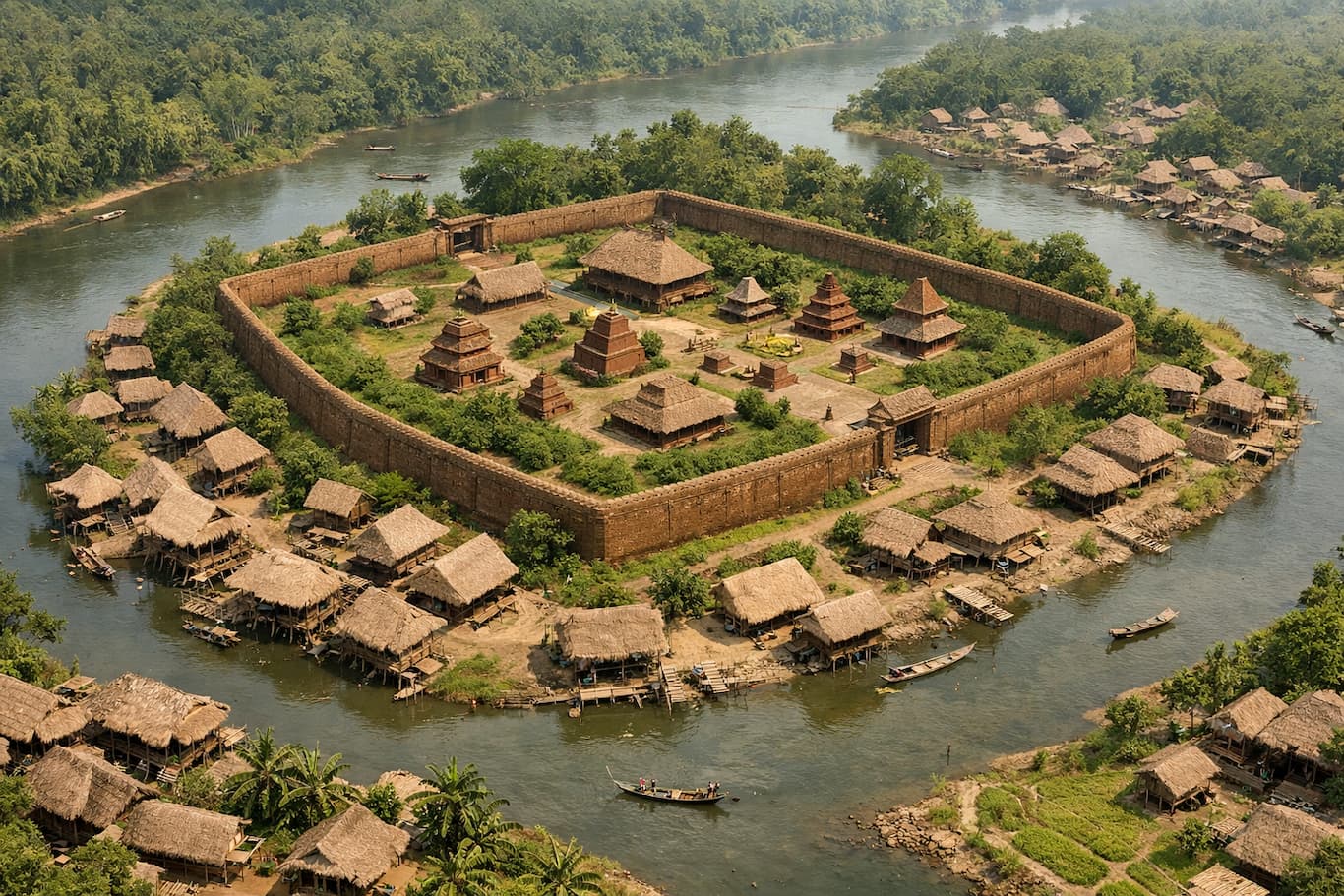
In 2021, archaeologist Pierre-Yves Manguin published an article entitled “Srivijaya: Trade and Connectivity in the Pre-modern Malay World.” At the beginning of the article, Manguin traces the history of the archaeological study of southern Sumatra as the site of “Srivijaya.”
It is worth citing this section at length as it clearly reveals various problems in Manguin’s approach to studying Srivijaya, the Chinese sources, and the archaeology of Palembang and Jambi.
He begins as follows:
Contemporary geographers and travellers described the Malay polity of Srivijaya, after its foundation in the 670s, as a prosperous polity whose powerful rulers held sway over the wealthiest Asian maritime trade route, until its power waned in the thirteenth century, as it progressively lost its ascendency in favour of other states, both regional and distant. To this day, despite its undeniable prominence in pre-modern Southeast Asian history and notwithstanding considerable progress made during the past decades in the fields of epigraphy and archaeology, Srivijaya remains for historians a notoriously elusive political system.
Here is the first problem: “Contemporary geographers and travellers” described Srivijaya as “a prosperous polity whose powerful rulers held sway over the wealthiest Asian maritime trade route” and yet “Srivijaya remains for historians a notoriously elusive political system.”
Manguin does not specifically refer to Chinese sources, however, it is Chinese sources that have provided the most information for the points Manguin makes here.
First of all, in using the records of travelers and geographers to locate Srivijaya, the sources that have been cited the most are Chinese sources, and in those sources, there are not multiple “travelers” that left information about Shilifoshi and Sanfoqi. There was only one traveler, the Tang dynasty monk, Yijing. Similarly, there were not multiple “geographers” who recorded information, only the Tang dynasty geographer, Jia Dan, who recorded information about an itinerary through the region.
Recently, I have written a series of blog posts on Yijing and another series on Jia Dan, and have pointed out how the ideas that scholars have of their writings are flawed.
Second, the idea that Srivijaya was “a prosperous polity whose powerful rulers held sway over the wealthiest Asian maritime trade route,” comes primarily from information about Sanfoqi in the History of the Song. Again, Chinese sources have played a central role in the creation of ideas about, and a history for, Srivijaya.
Third, Hermann Kulke was able to write an entire article on the political system of Srivijaya from inscriptions, so what exactly is “elusive” to historians?
What Manguin is referring to here is the fact that historians have encountered countless problems in attempting to get the historical sources, particularly the Chinese historical sources on Shilifoshi and Sanfoqi, to make sense as indicating a place in southern Sumatra and as documenting its history.
That is what remains “elusive” to historians, and it remains elusive because those places were not in southern Sumatra.
Manguin, however, believes that they were, and he explains why he believes the Chinese sources indicate that Shilifoshi and Sanfoqi were on Sumatra in the following paragraph, where he states that,
After its ‘discovery’ on paper by George Cœdès in 1918, Srivijaya nurtured for decades a considerable amount of debate and controversy, based on scholarly as well as on overtly nationalistic arguments (its activity encompassed three modern nations of Southeast Asia: Indonesia, Malaysia, and Thailand, whose scholars claimed her centre to have been in their own region or country) (Cœdès 1918; 1930; 1964). Mainstream historians and archaeologists, following Cœdès, nevertheless always maintained that Srivijaya was founded in the late seventh century ad in south-east Sumatra, where a vast majority of inscriptions, statuary, and the remains of temples were discovered over the years, along the Musi and Batang Hari Rivers. The same scholars also maintained that Palembang, a major port city and the capital of the modern South Sumatra province, which yielded the principal seventh-century inscriptions and many contemporary statues, was where the new state was born and where it thrived during the first four centuries of its history, notwithstanding a com plex and still poorly understood relationship with outlying areas on the Thai-Malay Peninsula and with parts of Java and Borneo.
Again, Manguin does not specifically refer to Chinese sources here, however they have played a central role in the efforts of scholars to locate Srivijaya at Palembang, especially historian O. W. Wolters.
In his 1967 Early Indonesian Commerce: A Study of the Origins of Śrīvijaya, Wolters wrote that “A few attempts have been made to upset the view that Palembang was the original headquarters and to look for it in the Malay Peninsula, but this form of heterodoxy has never found favour with the veterans” (22).
Manguin has been repeating this line, in various forms, for his entire career. In doing so, he excuses himself from actually looking at, and investigating the problems with, the Chinese sources.
In making the above comment, Wolters ignored the most serious critique of the Chinese sources that were used to write about Srivijaya, a critique that had been made in 1933 by R. C. Majumdar. Majumdar was one of the most prominent and influential Indian historians of the 20th century, and as such, I’m not sure what makes him “non veteran” or “non mainstream” other than the fact that he pointed out flaws in George Cœdès’s original argument about Srivijaya, one of which, the idea that Shilifoshi and Sanfoqi were the same place, Cœdès himself admitted he did not have evidence to support.
In any case, Manguin has been convinced his entire career that Srivijaya was at Palembang, not because of any scholarly investigation of the topic, but simply because in 1967, O. W. Wolters said so.
Moving on to the next paragraph, it states the following:
The major difficulty encountered by the promoters of its location in Palembang was due to a major (but misconceived) heuristic gap: the hypothetical capital city of the Srivijaya rulers remained largely untraced by archaeologists. No urban area was discernible in South Sumatra that could compare, for example, to the city of Angkor, in neighbouring Cambodia, nor any concentrations of religious monuments built in solid materials, with which historians were then generally satisfied to locate Southeast Asian ‘kingdoms’. For a long time, research was indeed hampered by the obsession of earlier scholars with durable, stone-built monumental archaeology, and by their incapacity to apprehend a rich and powerful port city, of world economic stature, that would have left only a few tangible traces above ground. Moreover, a sovereign who appeared to be a key economic actor in Asia could then only be perceived as governing an ‘empire’, whose ‘territory’, ‘provinces’, and other administrative divisions had to be clearly circumscribed in the Southeast Asian landscape and placed under his direct control or under that of ‘vassal’ sovereigns. One needed therefore to escape from the exclusive narrative discourses maintained for decades by historians, philologists, and, following them, by archaeologists, all of them pre occupied by a quest for monumental buildings and urban structures believed to inscribe in the landscape the orthogonal signs of the hierarchical superiority of a strong political and economic power.
Manguin does not directly state key the issue here, but it is that the first archaeological investigations at Palembang were carried out in the 1970s, and they concluded by declaring that there was no evidence of an urban center there and that Srivijaya must have been someplace else.
What Manguin argues above is that this conclusion was the result of a “major (but misconceived) heuristic gap.” In particular, he says that scholars were looking for “durable, stone-built monumental archaeology” and “an ‘empire’, whose ‘territory’, ‘provinces’, and other administrative divisions had to be clearly circumscribed in the Southeast Asian landscape.”
However, the reality, according to Manguin, was different, and in the following paragraph he explains how he, and others, “escape[d] from the exclusive narrative discourses maintained for decades by historians, philologists, and, following them, by archaeologists.”
Only in the 1980s, under the leadership of historian Oliver Wolters, did archaeologists abandon their quasi-obsessive quest for a new Angkor in Sumatra, and started reappraising Srivijaya as a Malay port city whose urban structure needed to be defined in its own terms. The better known early modern port cities of the Malay world were built using mostly perishable materials, with wooden houses erected on stilts, along the shifting banks of rivers or coastlines. They were not surrounded by permanent, walled enclosures, and grew into their natural environment without permanently modifying it, progressively merging on their periphery into ‘rurban’ landscapes (Wolters 1979; 1986; Reid 1980; 2000; Manguin 2000; 2001). Only a few religious monuments were built with solid materials, on prominences protected from tides and floods. Due to the lack of stones in coastal environments, the Malays usually made use of bricks for such shrines, whose ruin was fast, and the mate rials were constantly reused, to this day.
First of all, it is important to note that after seeing that there was no archaeological evidence of Srivijaya at Palembang, O. W. Wolters abandoned his previous belief in its location there, and then started to develop ideas of Srivijaya as a “Malay port city” that was “built using mostly perishable materials, with wooden houses erected on stilts, along the shifting banks of rivers or coastlines.”
In other words, Wolters only took a “leadership” position after his previous belief was proven by archaeology to be false. Further, that earlier belief that the Chinese sources located Shilifoshi and Sanfoqi at Palembang was upheld by ignoring the critiques of that argument that had been made earlier by Majumdar.
Hence, those who follow “the leadership of historian Oliver Wolters” do so at their own peril, and Manguin has chosen to follow that perilous path, as Wolters’ claim that Srivijaya was a Malay port city made of perishable materials is contradicted by the evidence in the Chinese sources about Shilifoshi and Sanfoqi, the very placenames that Wolters believed indicated Srivijaya.
Descriptions of Shilifoshi and Sanfoqi in Chinese Sources
While the descriptions of Shilifoshi and Sanfoqi are limited, there is some information that is repeated, and which directly contradicts the idea that the center of those polities were made of perishable materials.
First, in an annotation to his Mulasarvastivada-ekottarakarmasataka 根本說一切有部百一羯磨, Yijing wrote that: “Within the outer wall of Foshi are more than 1,000 monks” (此佛逝廓下僧眾千餘).
The term that I have translated as “outer” wall is guo 廓 (= 郭), and it was a term that only made sense if there was an “inner wall” of a citadel, cheng 城, as well.
Further, Chinese documented when walls were not made of stone, therefore, we have every reason to believe that at (Shili)Foshi there was a stone citadel and a stone outer wall surrounding it.
Second, the account of Shilifoshi in the New History of the Tang says that it had fourteen citadels (有城十四).
Third, the account of Sanfoqi in the History of the Song states that “They have stacked bricks to build a citadel, with a circumference of several tens of li. They roof their houses with coconut leaves, and the people live scattered outside the citadel.” (累甓為城,周數十里,用椰葉覆屋,人民散居城外。) It also says that it administered fifteen regions (所管十五州).
Do any of these sources indicate the existence of monumental architecture like at Angkor? No. The only way one could get that idea would be by not reading the sources and just imagining/fantasizing that.
Do any of these sources indicate a Malay coastal polity that was “not surrounded by permanent, walled enclosures”? No. Again, the only way one could get that idea would be by not reading the sources and just imagining/fantasizing that.
What then do the sources indicate? The sources mention citadels and walls, that is, “permanent, walled enclosures.”
Manguin has built a career by declaring (via Wolters) that the Chinese sources provide evidence that Srivijaya was at Palembang and by also ignoring what the Chinese sources actually record. In this article, the fact that he only speaks in general terms about historians rather than the sources they have worked with is an attempt to conceal that contradiction.
He wants the Chinese sources about Shilifoshi and Sanfoqi to be about Palembang/southern Sumatra (as Wolters claimed), but he doesn’t want to follow the information that is in those sources. . . Whether this is because he realizes that there is no archaeological evidence that corresponds with what is recorded in the Chinese sources or because he is simply unaware of what is recorded in the Chinese sources is unclear to me.
Either way, the idea that Manguin promotes, that 1) “mainstream historians” (i.e., O. W. Wolters) have always maintained that Srivijaya was at Palembang (and he did so primarily by employing Chinese sources to make that argument) and 2) that it was a Malay port city made of perishable materials, is false.
The Chinese sources repeatedly mention “permanent, walled enclosures” and no such structures have ever been found by archeologists in the Palembang and Jambi areas.
Yes, archaeologists have found perimeter walls around temples at Jambi, but that is not what the Chinese sources record. They point to protective walls around urban/royal centers.
And no, this is not some “bias” or “misunderstanding” on the part of Chinese writers. They did not see a wall made of wood and say that it was made of “bricks” because that is what they were familiar with.
Chinese knew what wood was, and they knew what bricks were.
In conclusion, it is completely logical to assume that there once was a Malay port city made of perishable materials at/near Palembang, and Pierre-Yves Manguin’s work has pointed to archaeological evidence supporting that idea.
However, that is not what the Chinese sources on Shilifoshi and Sanfoqi record, so in addition to all of the textual evidence that indicates that Shilifoshi and Sanfoqi were not in southern Sumatra, the absence of archaeological evidence of permanent, walled enclosures (a constant detail that we find in the records on Shilifoshi and Sanfoqi) also indicates that these places were not in that area.
Therefore, one cannot combine the archaeology of Palembang/Jambi/southern Sumatra with the information about Shilifoshi and Sanfoqi in the Chinese sources. This is where Manguin’s scholarship is flawed, as he attempts to use the Chinese sources to locate Srivijaya in southern Sumatra, but then he ignores the information in those sources about permanent, walled enclosures and claims that Srivijaya was a Malay port city made of perishable materials.



What is the archaeological evidence like for permanent walled enclosures of the requisite size in the rival locations for Sanfoqi that you suggest?
Martin Polkinghorne and Yuni Sato say in “Early Modern Cambodia and Archaeology at Longvek” (in The Angkorian World) that “The visible archaeological features within Longvek include a series of earthen embankments that form a 7-square-kilometre rectilinear citadel. Along its edge are fortified bastions and wooden palisades that may have surrounded the entire enclosure. Judging from the number of ponds, available occupation space, and other settlement infrastructure, Longvek accommodated a much smaller population compared to Angkor. (597-598)
https://www.academia.edu/121951597/Early_Modern_Cambodia_and_Archaeology_at_Longvek
They cite for this information Evans, D., 2016. Airborne laser scanning as a method for exploring long-term socio-ecological dynamics in Cambodia. Journal of Archaeological Science 74, 164–175.
I don’t see evidence that anyone has actually excavated those “earthen embankments.” Obviously, that should be a next step, and if they find bricks. . . then I think we will have found Sanfoqi.
Could it just be Angkor Borei? There are alreay evidence of brick or laterite walls there already dug.
Thanks for the comment.
1) It would really help if we had solid archaeology on these places.
Here is a comment from Stark and Fehrenback, “Earthenware Ceramic Technologies of Angkor Borei, Cambodia.”
“Once settled, Angkor Borei may never have been abandoned: pre-Angkorian and Angkorian artifacts and features dot the site and its environs. Angkor Borei reached its political and economic apex during the protohistoric period (c. 500 BCE – 500 CE), when Chinese emissaries visited the Mekong Delta and described the Funan kingdom.” (111)
Say what? Archaeologists are determining when a place reached its political and economic apex based on Chinese sources?? What about the archeology? What does that tell us? Isn’t one of the main points of archaeology that it is supposed to provide us with an alternative to historical sources?
2) In the Tang-Song period, the term Luoyue 羅越, or something similar, gets mentioned. That seems to indicate Longvek, although I don’t when we first have evidence of that name from other sources.
The Songshi is one of the less perfect dynastic histories, having been somewhat hastily compiled before the end of the Yuan in 1345. The phrase 累甓為城 appears for the first time in the Zhufan zhi (1225), the phrase 所管十五州 comes, probably, from the Wenxian tongkao (1317). Hope this helps.
PS: There is an article published a few years back (after 2013?) in the IIAS newsletter where some young scholars refuted a claim made by John Miksic about the size of a settlement in Sumatra (Palembang?) based on archaeological evidence. He had suggested a population of 100,000 while they came up with less than half of it. I do not have the print edition any longer, unfortunately. Anyway, it seems to confirm that pots do not necessarily say much about people or populations.
Thanks for the comments. Yes, I use the History of the Song as an easy reference point, but I understand that the information there came from other sources. I wasn’t aware that the phrase about governing regions might come from the Wenxian tongkao though, so thanks for that!
Miksic’s dissertation was on port settlements along the Deli River valley in northeast Sumatra. So, that’s probably what they were countering.
On the topic of pots and what they can tell us, I came across a 2010 Master thesis from Leiden University called “Śriwijaya: Myth or Reality?” by a certain Roy-William Bottenberg. https://studenttheses.universiteitleiden.nl/handle/1887/18901
I looked this guy up to see if he is in academia and found that he is “Senior Specialist Compliance in TM/FEC/AML/Crypto/Compliance.”
That’s probably for the better, because as will become clear below, he would not have been welcomed into the field by “the powers that be.”
Bottenberg assumed that all the information from the Chinese source is correct, so there was nothing new there. However, he had some interesting critiques of the archaeology.
Here is an AI summary of that. I uploaded the thesis to ChatGPT and asked, “What are this author’s critiques of the archaeological studies of Palembang?”
Yes. In this thesis, Bottenberg is fairly critical of how Palembang archaeology has been used in the Śriwijaya debate.
His main critiques are these:
First, he says earlier scholarship on Śriwijaya was driven too much by texts and theory, and archaeology was expected to confirm an already-formed idea of a great maritime empire. In his view, scholars were “trying to find artifacts to prove the theory of Śriwijaya,” instead of starting from the material record itself. That criticism applies directly to how Palembang was interpreted.
Second, he treats Bronson’s work [the guy who participated in and wrote about the first excavations in the 1970s] as important precisely because it exposed that problem. He says Bronson’s 1975 and 1979 investigations at Palembang found no great quantity of pottery or other artifacts and therefore challenged the idea that Palembang had clear archaeological evidence for a vast thalassocracy. In other words, Bronson showed that the textual model was not archaeologically secure.
Third, even when he discusses Manguin’s later excavations more positively, he still does not accept them as proof of a long-lasting maritime empire. Manguin’s excavations showed that Palembang really was an important occupied center, with very large quantities of pottery, earthenware, and glazed ware. But Bottenberg’s broader argument is that this proves a significant polity or hub at Palembang, not necessarily the kind of six-century thalassocratic empire older scholars imagined.
Fourth, he explicitly points to a methodological flaw in the archaeological record used for dating: much of the Chinese pottery from Southeast Asia had been recovered through surveys or surface finds rather than controlled excavations with context and stratigraphy. So even when Chinese ceramics are useful chronologically, he warns that the evidentiary basis is often weaker than it appears.
More broadly, his critique of Palembang studies is that they have been over-read. For him, Palembang archaeology supports occupation and importance from about the 7th century onward, but not the older maximal claim that Śriwijaya was a powerful maritime empire ruling the Straits of Malacca for centuries. He wants interpretation to move from “thalassocracy” toward a model of regional polities with stronger hinterland connections.
So the shortest summary is: Bottenberg does not reject Palembang archaeology, but he criticizes the way it was made to serve a preconceived Śriwijaya narrative. Bronson exposed the weakness of that narrative; Manguin restored Palembang’s archaeological importance, but Bottenberg still thinks the evidence falls short of proving a vast, long-lived maritime empire.
My comment: 1) I am not an archaeologist, and not to denigrate the intelligence of an MA student, but if someone at that step in the educational process can identify all of these issues, then that suggests that they are not all that difficult to see. It’s probably more the case that simply no one has bothered to think about these issues, because everyone is so invested in the idea that Palembang was home to Srivijaya, “a prosperous polity whose powerful rulers held sway over the wealthiest Asian maritime trade route” (to quote Manguin), and 2) on the idea that “scholarship on Śriwijaya was driven too much by texts,” if Bottenberg had understood the problems with the texts he would have realized that the situation is much worse as the archaeology has relied on flawed understandings of texts, because the early Sinologists got so much wrong. Shilifoshi and Sanfoqi were not places on Sumatra, so the entire narrative that scholars created from Chinese texts is absurd, and then they tried to find evidence of it in the archaeology at Palembang. . .
I’m still getting confused, professor. If this Sanfoqi was Kambuja/Longvek, and Zhenla is another polity in Cambodia, what did the Chinese write about Angkor itself then?
Zhenla is Angkor. The only problem is that there is only one account of anyone ever travelling all of the way to Angkor (Zhou Daguan’s Zhenla fengtu ji [The Record of the Conditions and Customs of Zhenla). He made that journey in the late 1200s by heading inland from the east, probably up the Mekong. Prior to that time, and for probably 200 years after that time, I can’t find any reference to people using the Mekong.
So, when the Chinese court recorded that it got tribute from “Zhenla,” what did that mean? Does it mean that someone travelled all the way from Angkor to China? Or, for most situations, was it the case that some place closer to the coast engaged in tributary relations with China, and the Chinese called that place “Zhenla,” because on the rare occasions when anyone actually went all the way to Angkor, like Zhou Daguan did, they “entered its territory” from the eastern coast of the Indochinese Peninsula.
When Zhou Daguan reached that coast and started to head inland, he said precisely that, that it is at that point that you “enter its territory,” however, he then made it clear that you passed through various vassal states and territories before actually reaching Angkor. So, again, when Chinese dealt with Zhenla, were they always dealing with Angkor (I don’t see evidence of that), or were they usually dealing with some vassal of Angkor close to the coast? My guess is the latter.
Those are the questions/issues I have. What this means is that I don’t think we can equate every mention of “Zhenla” in Chinese sources directly with Angkor.
Prof., to be clearer, should it be: as far as we know, in Chinese texts prior to some premodern point in time
The place of Angkor was actually mentioned / closely contacted only under the name of Zhenla (even: only in that particular text by Zhou Daguan). The name of Angkor (or any endonym of the place) was not even recorded.Reversely, Zhenla (name, place) could be any polity in the Cambodian world (most probably near the coast of mainland SEA). Roughly around Zhou Daguan’s time, Zhenla probably referred to the place of Angkor.The name of Zhenla could sometimes refer to the Angkorian empire.
I have, with interest, read your posts on the precarious identifications of Southeast Asian locations by more than three generations of Southeast Asianists. Questions emerge upon your redirection of trade routes through the Malay Peninsula/Shepo and southern Indochina/Sanfoqi. Where is western maritime Southeast Asia and what are the designations for Sumatra and Java in Song dynasty texts? Do I understand correctly that you think that these were only at a much later time known to the Chinese, like the Yuan and Ming periods?
That’s right. I see the Zhu fan zhi as being perhaps the first text to do so. It mentions Palembang, Jambi and Lamuri, and the section on “Sujitan” is about island Java and island’s to its east. The information in that section on “Sujitan” is a bit confusing, and Zhao Rukuo clearly wasn’t confident about it. There is one passage where he decides that Sujitan must be somehow related to Shepo because the people use “Shepo gold” and he says “aha! This must be Shepo” (but in the section on Shepo, they don’t use such a currency), and he calls the place a “branch kingdom” 枝國 of Shepo. However, in “Sujitan” there is also a place called “Da Shepo”. . .
The information about the islands to the east gradually gets clearer in later texts. However, there is also the issue of the section on Zhuawa/Zhaowa in the History of the Yuan, where the compilers say that they don’t know anything about its customs. What all of this shows is a gradual expansion of knowledge about Java and places to its east. It’s not a coincidence that the Yuan attacked Java and no Chinese before them.
I’ve also wondered if the “Touhe” in the New History of the Tang is “Java.” That account describes an established kingdom, but it then “disappears” from Chinese sources. If that is indeed Java, then it looks like various pieces of information started to enter Chinese knowledge during the Song dynasty period, but that it was only during the Yuan that it firmly became part of the knowledge that the Chinese had of the region.
https://leminhkhaiblog.com/more-evidence-of-two-javas/