
So, I have been experimenting.
I have been trying to see what happens when one takes the kind of article that appears in journals such as the Journal of Asian Studies, the Journal of Southeast Asian Studies, and many others, and asks: could an LLM help produce something like this today?
I do not mean every kind of article. I mean a very common type of article in the humanities and social sciences: one that draws on a body of secondary scholarship, examines a limited number of primary sources, and then makes an interpretive intervention. Sometimes the article is built around several primary sources. Sometimes it is built around one especially important source. In either case, the work depends on knowing the field, identifying a meaningful problem, reading the sources carefully, and framing the argument in relation to existing scholarship.
What I have found is that if you have digital versions of the primary sources you want to use—even scans are enough—you can now produce a paper resembling many of the articles published in such journals in a matter of days.
In fact, you can often produce a stronger version.
The time-consuming part is not the writing itself. The time is spent preparing the materials, gathering the sources, deciding what you want the LLM to examine, learning how to prompt it effectively, and then inspecting, correcting, and refining the results. The part that the LLM does may take only minutes. If OCR is needed, it may take longer, but even then we are talking about hours, not months.
As part of this experiment, I uploaded one of my own published articles to ChatGPT: “From Moral Exemplar to National Hero: The Transformations of Trần Hưng Đạo and the Emergence of Vietnamese Nationalism.” Yes, the title is long. I asked ChatGPT whether it could write such a paper today and, if so, what it would need.
Its answer was revealing:
“What I would most need from you would be: a clear research question; scans or transcriptions of all primary sources; bibliographic metadata; your preliminary translations; a list of terms to track across sources; and your desired historiographical intervention. With those, I could help produce a serious article. Without them, I could only produce a plausible-looking but unreliable imitation.”
That struck me as exactly right.
But it also struck me that almost everything on that list, apart from the scans themselves, can now be produced in dialogue with an LLM. An LLM can help transcribe texts from scans or audio. It can suggest research questions based on the primary and secondary sources you provide. It can notice recurring terms or concepts that may be worth tracking across a corpus. It can suggest historiographical contexts in which the material might make an intervention. It can help generate translations, compare versions of a text, identify patterns, and test possible arguments.
What this means is that the scholar’s role in the AI age will change.
The scholar will become less someone who slowly extracts one article from a pile of materials and more someone who curates a process of knowledge production: selecting sources, setting questions, defining standards, checking evidence, shaping interpretation, and deciding what counts as a meaningful contribution.
I also asked ChatGPT how my Trần Hưng Đạo article could be improved, and how it might be rewritten using the same evidence to make a stronger argument. For anyone interested, the exchange is here: https://chatgpt.com/share/6a17cc2e-230c-83eb-891a-a79ccd2858b3.
What I found most striking was not that ChatGPT could summarize the article. That is no longer surprising. What struck me was that its suggestions for how the paper could be rewritten were, in some ways, more perceptive than my own. I agreed with them. I even found myself wishing that I had written that version of the paper.
So yes, I admit it: ChatGPT is now, in certain respects, smarter or more capable than I am.
At least, it can do some things better than I can do them alone.
With experience, scholars will become much faster at setting up these workflows. They will know how to prepare sources, how to prompt, how to ask for comparisons, how to test interpretive possibilities, and how to check the results. A year from now, I suspect that many papers that currently take months to research and write will be possible to draft in a day or two, at least once the materials are assembled. And, as my experiment suggests, some of those papers may be better than what many of us produced in the past.
This is going to have enormous consequences.
At present, many universities in Asia have publication KPIs for faculty in the humanities and social sciences. These are often around one or two publications a year. However, I recently heard about a highly ranked university in an Asian country that is strongly pushing AI use and has set a KPI of four publications a year.
If administrators realize that an article can be produced with LLM assistance in a day or two, what happens next?
I would not be surprised to see more universities raise publication expectations. I would also not be surprised to see some institutions, especially for full-time research staff, push the number even higher.
In the 2010s, the internationalization of higher education and the pressure to rise in global rankings helped produce a wave of publications. It also helped create the conditions in which predatory journals flourished. We may now be on the verge of another publication wave, but this time the scale could be much larger.
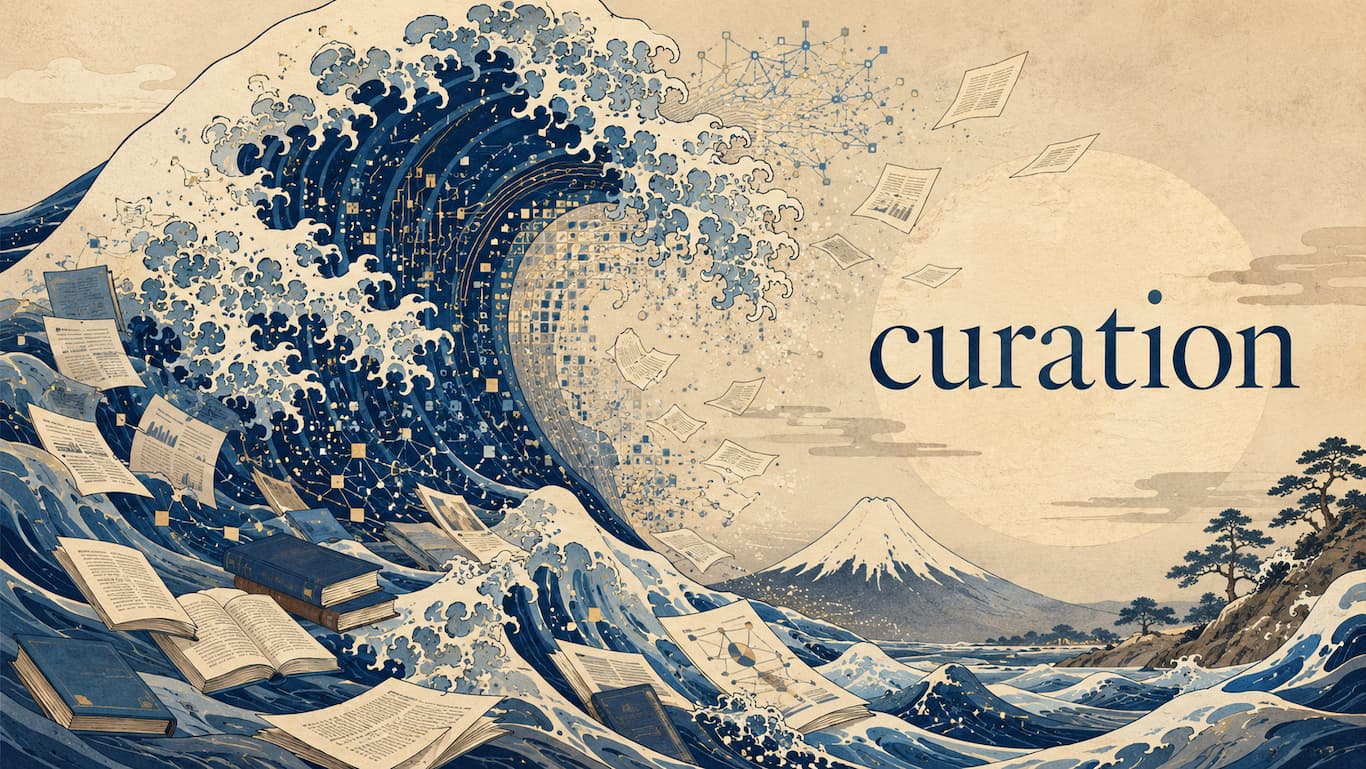
Indeed, a tsunami of AI-assisted scholarship is coming.
There is, however, an important difference between the coming wave and the earlier one. Previously, even a mediocre article required a significant investment of time. One had to read, take notes, draft, revise, and struggle with the prose. Now the labor has shifted. What matters is whether one knows the field, understands the sources, can identify a real problem, and can guide the LLM toward a meaningful contribution.
This is why I think the key skill of the AI age will be curation.
By curation, I do not mean simply collecting materials. I mean the scholarly ability to organize a body of knowledge so that it can be examined, questioned, interpreted, and presented in a coherent form. The curator-scholar knows what is out there. They know what matters. They know which sources have been ignored, which questions have not been asked, which terms should be traced, which assumptions need to be challenged, and which connections might produce a new understanding.
Many scholars already possess this kind of knowledge. They know their fields. They know the primary sources. They know that there are important materials “out there” that have never been fully examined. But until now, they have been constrained by time, linguistic ability, and the sheer scale of the archive.
That constraint is beginning to disappear.
Going forward, I can imagine individuals or small teams using LLMs to examine bodies of sources that were previously too large for any one scholar, or even any normal research group, to read and interpret systematically. These would not simply be summaries. They would be structured, iterative acts of inquiry. Scholars would ask the LLM to identify themes, track terms, compare genres, locate shifts in vocabulary, map networks of people and ideas, and produce interpretive summaries that human experts could then evaluate.
There is a Vietnamese term that now seems newly relevant: khai thác. In Chinese, the related term is kaituo 開拓. It can mean to open up, develop, exploit, or mine. In Vietnamese historical scholarship, people often speak of “khai thác nguồn sử liệu,” meaning to make use of, mine, or exploit historical sources.
I have never liked that phrase very much. It has always sounded a bit too extractive to me.
But in the AI age, it suddenly makes sense.
LLMs give us new ways to “khai thác” historical sources. They allow us to open up bodies of material that have long been known but never fully used. They allow us to mine them, not simply for facts, but for patterns, silences, concepts, voices, and structures of thought.
Take, for example, the Vietnamese journal Phong Hóa from the 1930s. Everyone who works on modern Vietnamese history knows that it is important. There have been studies that use it. But the journal contains far more than any existing scholarship has been able to address. It is a vast source for studying humor, satire, nationalism, gender, urban culture, language, visuality, colonial modernity, and changing ideas of social life.
Now imagine a group of scholars working with an LLM and with a clear interpretive plan to “khai thác” Phong Hóa in a comprehensive way.
They could examine every issue. They could track recurring terms. They could map debates. They could compare cartoons, essays, advertisements, serialized fiction, and reader correspondence. They could study how political critique appears indirectly through humor. They could trace how women, peasants, officials, modern youth, and colonial authority are represented. They could create a body of knowledge far beyond what we currently possess.
This would not take a day or two. But it would be manageable in a way that it was not manageable before.
In other words, LLMs may make possible a new kind of scholarship: not merely faster versions of the individual article, but large-scale interpretive engagements with bodies of material that have always been too extensive, too multilingual, or too unwieldy to examine fully.
At present, academic publishing produces an endless stream of handbooks: The Oxford Handbook of this, The Routledge Handbook of that, The Cambridge Companion to something else. Many of these volumes are useful, but they often repeat and repackage existing knowledge. They summarize fields that already exist.
Why not use LLMs to create something different?
Why not produce a Handbook of Phong Hóa?
Or a Handbook of Nam Phong?
Or a Handbook of a colonial archive, a missionary periodical, a corpus of court documents, a collection of inscriptions, a visual archive, a body of early quốc ngữ newspapers?
Such works could introduce sources, themes, concepts, genres, debates, and interpretive possibilities that have not yet been systematically examined. They would not merely summarize existing scholarship. They would generate new fields of inquiry.
Before LLMs, such projects were almost impossible. There were not enough scholars with the necessary time, languages, and stamina. Even if such a project were attempted, the results would likely be uneven because each contributor would approach the material differently and with different levels of ability.
Now, however, a single scholar, or a small group guided by one or two editors, could direct such a project. The editors could establish shared standards for how the sources are prepared, queried, translated, summarized, and interpreted. They could require every chapter or section to answer a consistent set of questions. They could check the outputs against the sources. They could ensure that the work has coherence rather than becoming a loose collection of unrelated essays.
In this model, the editor becomes something more than an editor. The editor becomes a curator of scholarly knowledge.
That, I think, is where things are headed.
The initial response of many scholars and publishers has been to oppose the use of LLMs in scholarship. I understand why. There are real dangers: hallucination, fabricated citations, shallow synthesis, plagiarism, intellectual laziness, and a flood of mediocre writing. Those dangers are serious.
But opposition will not stop what is coming.
In some parts of the academic world, KPI pressure will push scholars toward LLMs whether they want to use them or not. In other parts, scholars will quietly use LLMs because they discover, as I did, that these tools can help them improve their work. At first, much of this use will be hidden. People will not want to admit it. But eventually the practice will become normal.
At some point, major publishers will begin accepting scholarship created in collaboration with LLMs, provided that the work meets standards of evidence, transparency, originality, and scholarly accountability. The question will not be whether AI was used. The question will be how it was used, who guided it, what sources it worked from, and how the final claims were verified.
That said, most people will probably use LLMs to do what scholars have always done: write individual articles on individual topics.
But the more interesting possibility is that LLMs could help us do something new. They could help us produce knowledge about bodies of information that were previously too large, too scattered, or too linguistically difficult to access at scale.
That will require expertise. It will require judgment. It will require skepticism. It will require source criticism. It will require all the old scholarly virtues.
But it will also require curation.
The future of scholarship may not belong simply to those who can write the best article. It may belong to those who can organize the best encounter between sources, questions, machines, and human interpretation.
That is where I see knowledge production going.


開拓舎 or 開拓社 may be a good name for a group. I like the idea.
By “group,” I’m assuming this is what you meant. If so, I totally agree!!
Are you the one in the front? Ah yes, good ol Loft in shinjuku… many blurry memories there. Am familiar with Gauze and gism but not this mob. Were/are they any good?