
In the history of Burma, scholars have written about what they have perceived as a people who inhabited parts of Upper Burma in the first millennium AD that they refer to as the “Pyu.” However, this name is problematic as it rarely appears in historical sources, and when it does, it never signifies a people or a place at the level of a kingdom.
Meanwhile, in Tang dynasty-era sources, the term “Piao” 驃 is used to refer to a polity in the area of Burma, and scholars have linked this with “Pyu,” however there are various issues regarding the information in Chinese sources that scholars have not adequately addressed.
There is one brief passage in particular, in both the Old History of the Tang (945) and the New History of the Tang (1060), that scholars have repeatedly discussed. Gordon H. Luce briefly discussed this passage in a short article on “Names of the Pyu” in 1932, then in more detail in a 1937 article entitled “The Ancient Pyu.”
Still later, the same topic is covered in his posthumously published 1985 work, Phases of Pre-Pagan Burma: Languages and History, where in a chapter on “Tircul, Pyū, P’iao” it says:
The section on P’iao in the New T’ang History (AD 1060) begins as follows: “The P’iao were formerly Chu-po (*tsiu-pwâ). In Chinese they are called P’iao. They call themselves t’u-lo-chu (*t’wet-lâ-tsiu). The Javanese call them t’u-li-chu (*d’uo-lyi-tśiwät). (47)
Luce was actually combining the information in the two Tang histories here. Before proceeding further, let me translate the passage as it appears in both texts, and using the Pinyin romanization.
1) Old History of the Tang:
華言謂之驃,自謂突羅成,闍婆人謂之徒里掘。
In Chinese, it is called “Piao.” It refers to itself as Tuluocheng 突羅成. Shepo 闍婆 people call it Tulijue 徒里掘.
2) New History of the Tang:
驃,古朱波也,自號突羅朱,闍婆國人曰徒里拙。
Piao is the ancient Zhubo 朱波. It refers to itself as Tuluozhu 突羅朱. People of the Kingdom of Shepo 闍婆 call it Tulizhuo 徒里拙.
Luce then went on to note that some Perso-Arabic writings mentioned a place called T.sūl or T.rsūl which he equated with the terms t’u-lo-chu [Tuluozhu] and t’u-li-chu [Tulizhu] above. Finally, he noted that an 1102 Old Mon inscription about ceremonies surrounding the building of a temple at Bagan referred to “Burmese singing (jiñjeḥ mirmā), Mon singing (jiñjeh remñ), and Pyu singing (jiñjeḥ tircul). (47)
We can see here that Luce developed a circular explanation: Piao was how the Chinese wrote Pyu. Meanwhile, the people themselves called themselves Tuluozhu. That is like the Perso-Arabic T.rsul, which in turn is like the “tircul” in the 1102 inscription, so that must mean that the inscription was referring to the Pyu, etc.
In his short 1932 article, Luce wrote that this term, “tircul,” had troubled scholars, and that Duroiselle had suggested that it might be “an infixed form of Cola,” while Blagden noted that “Cola reduplicated would be circul, not ticul.”
Luce then wrote that “I cannot help but thinking that Tamil music would be a little out of place on this occasion. Surely if we must have another national music, what would be so likely as the Pyu? I suggest therefore that the tircul of the Mon is the *t’ulcut of the Chinese: and that we have here approximations to the actual name of the Pyu for themselves.” (90)
More recently, this passage has been discussed in “Studies in Pyu Epigraphy, I” by Arlo Griffiths, Bob Hudson, Marc Miyake, and Julian K. Wheatly, where they write the following:
Pelliot (1904: 174) and Luce (1932: 1 and 1985: 46-47) remarked that in the Chinese Jiù Táng Shū (舊唐書, Old History of the Tang, juàn 197, p. 5285) and the New History of the Tang (juàn 222 xià, p. 6306), the Piao are said to call themselves by names transcribed in Chinese as 突羅成 (MC dwot-la-dzyeng; MSC tūluóchéng) and 突羅朱 (MC dwot-la-tsyu; MSC tūluózhū) and are said to have exonyms in Java transcribed in Chinese as 徒里拙 (MC du-liX-tsywet; MSC túlǐzhuō) and 徒里掘 (MC du-liX-gjut; MSC túlǐjué). These names in MC pronunciation all contain a syllable-final -t that often corresponded to foreign -r (e.g., in 突厥 [MC dwot-kjwot; MSC tūjué] for *türküt, an early Chinese name for the Turks roughly contemporaneous with Piao and also containing the character 突) and was pronounced [r] in the mid- and late Tang capital dialect (Coblin 1994: 55). Moreover, in an Old Mon inscription from the 11th century, describing ceremonies in connection with the building of Kyanzittha’s palace in Pagan, three sets of singers are mentioned: the mirmā, the rmeñ, and the tircul. The first are, presumably, the Burmese and the second, the Mon. The third, in Luce’s reasoning, is likely to be the name used by the Pyu themselves, and Luce continued to use it to designate the language and the script used for writing it. Tircul is not a likely name for a people whose language has no syllable-final consonants; but given what we now know, that the language has both syllable-final <r> and <l>, Luce’s proposal looks much more feasible. The difference of connotation between the terms Tircul and Pyu remains an open question. (56-57)
This is obviously a more sophisticated linguistic analysis, however, I find that everyone who has written about this passage has focused on the trees (or gotten lost in the weeds) by looking at individual words, when there is key information in the view of the forest that we can obtain by looking at the texts.
The View of the Forest
I think I first came across this topic about 20 years ago when I was reading Michael Aung-Thwin’s The Mists of Ramanna: The Legend that was Lower Burma. In that work, Aung-Thwin wrote that:
Yet according to other Chinese sources, the P’iao did not refer to themselves as such, but as t’u-lo-chu [Tuluozhu], while the Javanese were also said (by the same Chinese sources) to have used the same ethnonym, calling them on tu-li-ch’u. The term seems to have been the same as that found in contemporary Arabic accounts (one dated to 880 AD) regarding the people apparently of that area whom they called T.rsul. This word was finally anglicized in the twentieth century by modern scholars as Tircul, and is now understood as the name by which we think the Pyu referred to themselves.
I remember that when I read this, having never read either passage in the Tang histories, I immediately thought to myself, “Why on earth would the Chinese record how the Javanese referred to a people in Burma??!!”
Isn’t it extremely common sense and obvious that something is wrong there?
The only possible explanation would be an absurd scenario like what Edward Harper Parker described in his 1893 work, Burma: With Special Reference to Her Relations with China. To quote:
The Javanese (i.e. the emissaries of Hindu kingdoms in Java) who visited China said that the Piao or Pyû called themselves Dulichu (or some such word), and that their territory was bounded by Cambodgia, East India, Yunnan, and the sea. Evidently therefore the Burmese or Pyû State must have been nearly as extensive then as it was first found in our own days. (11)
Really?? Stuff like that happened? Can you show me other examples?. . . Of course not.
And there is something similarly wacky in Luce’s comment that reference to Tamil music would be out of place in a Mon inscription, and that the only “national music” that could possibly fit that context would be that of the Pyu.
So, then I looked up the passage in the Tang histories and saw that it doesn’t mention “Java.” It mentions “Shepo” 闍婆, a place which scholars assume is Java.
At that time, I did not know how to resolve this issue, but now I understand it. In the late Tang and early Song dynasty periods, Shepo was an exonym used by Arabs and Chinese to refer to the area of the trans-peninsular crossing in the greater Lake-Songkhla area. In earlier time periods, there had been a similar-sounding name for that region, sometimes written as Zhubo 朱波, the name that the New History of the Tang claims was an older incarnation of the Kingdom of Piao. These names, although sounding something like “java/jaba” at the time, did not refer to the island of Java.
In fact, the accounts of the Kingdom of Piao in the two Tang histories can help us see this, and taking a wider view of those passages rather than focusing on single words can help resolve the issue of what the names “Tuluocheng/Tuluozhu” might have referred to.
The Texts
The key point to understand is that the account of Piao in the Tang histories is made up of information from different sources. Some of those sources were clearly about a place called Piao. However, one of the sources was an itinerary, perhaps from a place called Tuluocheng/Tuluozhu, and not knowing what exactly that was, but seeing that it was somewhere in the area of Piao, the compilers of the Tang histories equated that place with Piao.
Prior to the compilation of the two Tang histories, important information about Piao was mentioned in an itinerary recorded by Jia Dan in the late eighth century, and in Fan Chuo’s 樊綽 late-ninth-century Manshu 蠻書, a work about the “savages” in the southwest of the Chinese world.
驃國
驃國,在蠻永昌城南七十五日程,閣羅鳳所通也。其國用銀錢,以青磚為圓城,周行一日程。百姓盡在城內,有十二門。
. . .
與波斯及婆羅門鄰接,西去舍利城二十日程。
Piao Kingdom
The kingdom of Piao lies seventy-five days’ journey south of the savage citadel of Yongchang, on the route communicated with by Geluofeng. That kingdom uses silver coinage. It has a circular citadel made of blue-green bricks, with a circumference that takes one full day to travel around. All the common people live within the city, which has twelve gates.
. . .
It connects with Bosi 波斯 [Persia] and Poluomen 婆羅門 [Brahman], twenty days to the west from Sheli Citadel 舍利城.
Sri Ksetra, an ancient city that was located near the modern city of Pyay (historically Prome), in western Bago Region, on the eastern bank of the Irrawaddy River, was surrounded by a generally circular brick wall. This makes it the most likely site for Sheli Citadel.
Let us know look at what the 945 Old History of the Tang recorded about Piao.
驃國,在永昌故郡南二千餘里,去上都一萬四千里。其國境,東西三千里,南北三千五百里。東隣真臘國,西接東天竺國,南盡溟海,北通南詔些樂城界,東北拒陽苴咩城六千八百里。往來通聘迦羅婆提等二十國,役屬者道林王等九城,食境土者羅君潛等二百九十部落。
The Piao Kingdom is located more than 2,000 li south of the former commandery of Yongchang, and 14,000 li from the Upper Capital. Its territory extends 3,000 li from east to west, and 3,500 li from north to south. To the east it borders Zhenla; to the west it adjoins eastern India; to the south it reaches the great sea; to the north it connects with the territory of Xiele Citadel in Nanzhao; and to the northeast it is 6,800 li from Yangjumie Citadel. It exchanges envoys with twenty kingdoms, including Jialuopoti 迦羅婆提 and others. Subject to its authority are nine citadels, including that of Daolinwang 道林王, and within its territory there are 290 tribal settlements, including those of Luojunqian 羅君潛 and others.
We’ll say more about this passage below, but in general what we see here is a world in which Piao had an inner territory inhabited by 290 tribal settlements that it controlled through nine subordinate citadels, and that beyond the central area ere 20 kingdoms that Piao maintained relations with.
其王姓困沒長,名摩羅惹。其國相名摩訶思那。
. . .
其羅城構以塼甃,周一百六十里,濠岸亦構塼,相傳本是舍利佛城。
. . .
華言謂之驃,自謂突羅成,闍婆人謂之徒里掘。
Its king bears the surname Kunmozhang and is named Moluore. The chief minister of the state is named Mohesina [Mahasena]
. . . [skipping information about how the king travels about, and his many consorts]
Its walled city is built of brickwork, with a circumference of 160 li. The banks of its moat are also faced with brick. It is traditionally said that this was originally the city of Śāriputra [The Sheli 舍利 Citadel in the previous text, which could just mean “Sri Citadel,” is here called the Shelifo 舍利佛 Citadel, which could be translated as Śāriputra, one of the Buddha’s disciples] .
. . . [skipping information about Buddhist temples, the customs of the people, etc.]
In Chinese, it is called “Piao.” It refers to itself as Tuluocheng 突羅成. Shepo 闍婆 people call it Tulijue 徒里掘.
The account than goes on to record how Piao sent a representative in 802, and it ends with a somewhat philosophical discussion about how even barbarians as far away as a place like Piao can still grasp the righteousness of presenting tribute.
However, what is important to note is that the statement about what Piao is called is tagged on at the end, after a discussion of things like customs and clothing. The preceding sentence is “Among ruler and minister, father and son, elder and younger, there is proper order.”
Hence, there is something strange about that line. What does Shepo have to do with Piao? Where did that information come from?
Let us know look at the account of the Kingdom of Piao in the New History of the Tang.
驃,古朱波也,自號突羅朱,闍婆國人曰徒里拙。在永昌南二千里,去京師萬四千里。東陸真臘,西接東天竺,西南墮和羅,南屬海,北南詔。地長三千里,廣五千里,東北袤長,屬羊苴哶城。
Piao is the ancient Zhubo 朱波. It refers to itself as Tuluozhu 突羅朱. People of the Kingdom of Shepo 闍婆 call it Tulizhuo 徒里拙. It is located 2,000 li south of Yongchang, and 14,000 li from the capital.
To the east by land it borders Zhenla; to the west it adjoins Eastern India [Tianzhu 天竺]; to the southwest is Duheluo; to the south is the sea; to the north, Nanzhao. Its land is 3,000 li long and 5,000 li wide. It stretches long from northeast to southwest and is connected with the city of Yangjumie.
So, what do we see here? We see that statement about what the kingdom was called that was tagged on near the end of the account in the Old History of the Tang is now the first statement. What is more, an additional detail had been added that Piao is the ancient Zhubo 朱波.
A word of advice, anytime you see a passage about a place in a Chinese text begin with a statement like “A is the ancient B, and it is also called C,” that should immediately trigger an alarm in your brain.
Often what this means is that the compiler was trying to link disparate information. Further, that linking was often based on guesswork rather than evidence. While this is particularly common in the writings of later periods, such as the seventeenth century, I can clearly see it happening here as well.
Why would the compiler claim that Piao was the ancient Zhubo? To understand that, we need to read this account further. This is how it continues.
凡屬國十八:曰迦羅婆提,曰摩禮烏特,曰迦梨迦,曰半地,曰彌臣,曰坤朗,曰偈奴,曰羅聿,曰佛代,曰渠論,曰婆梨,曰偈陀,曰多歸,曰摩曳,餘即舍衞、瞻婆、闍婆也。
In all, it has eighteen subordinate states: Kaluobati, Moliwute, Jialijia, Bandi, Michen, Kunlang, Jienu, Luoyu, Fodai, Qulun, Poli, Jietuo, Duogui, Moye, and the remainder are Shewei, Zhanpo, and Shepo.
凡鎮城九:曰道林王,曰悉利移,曰三陀,曰彌諾道立,曰突旻,曰帝偈,曰達梨謀,曰乾唐,曰末浦。
In all, it has nine garrison citadels: Daolinwang, Xiliyi, Santuo, Minuodaoli, Tumin, Diji, Dalimou, Qiantang, and Mopu.
凡部落二百九十八,以名見者三十二:曰萬公,曰充惹,曰羅君潛,曰彌綽,曰道雙,曰道甕,曰道勿,曰夜半,曰不惡奪,曰莫音,曰伽龍睒,曰阿梨吉,曰阿梨闍,曰阿梨忙,曰達磨,曰求潘,曰僧塔,曰提梨郎,曰望騰,曰擔泊,曰祿烏,曰乏毛,曰僧迦,曰提追,曰阿末邏,曰逝越,曰騰陵,曰歐咩,曰磚羅婆提,曰祿羽,曰陋蠻,曰磨地勃。
In all, it has 298 tribal settlements; of these, the names of thirty-two are recorded: Wanggong, Chongre, Luojunqian, Michuo, Daoshuang, Daoweng, Daowu, Yeban, Bueduo, Moyin, Jialongshan, Aliji, Alizha, Alimang, Damo, Qiupan, Sengta, Tililang, Wangteng, Danbo, Luwu, Famao, Sengjia, Tizhui, Amoluo, Shiyue, Tengling, Oumie, Zhuanluobati, Luyu, Louman, and Modibo.
The Old History of the Tang recorded that Piao exchanged envoys with 20 kingdoms, that there were nine citadels subject to its authority, and that within its territory were 290 tribal settlements.
Here the 20 kingdoms that maintained diplomatic relations have become 18 subordinate states, etc., however the information is generally the same and I suspect that the compilers of the New History of the Tang were working with the same, or similar, documents.
Finally, as for where this information came from, obviously it is something that had to have been reported at some point, perhaps when the representative from Piao visited the Tang court in 802.
Let us move on to the next section, and this section is of critical importance.
繇彌臣至坤朗,又有小崑崙部,王名茫悉越,俗與彌臣同。繇坤朗至祿羽,有大崑崙王國,王名思利泊婆難多珊那。川原大於彌臣。
From Michen to Kunlang, there is also the Lesser Kunlun tribe, whose king is named Mangxiyue; its customs are the same as those of Michen. From Kunlang to Luyu there is the kingdom of the Great Kunlun King, whose king is named Sili Boponanduoshanna. Its rivers and plains are greater than those of Michen.
繇崑崙小王所居,半日行至磨地勃柵,海行五月至佛代國。有江,支流三百六十。其王名思利些彌他。有川名思利毗離芮。土多異香。北有市,諸國估舶所湊,越海即闍婆也。
From the place where the Lesser Kunlun king resides, after half a day’s travel one reaches the stockade of Modibo; by sea, after five months [5 days?], one comes to the kingdom of Fodai. There is a river there with 360 [36?] branches. Its king is named Sili Xiemita. There is a river called Sili Pilirui. The land produces many unusual aromatics. To the north there is a market where merchant ships from various countries gathere; crossing the sea from there, one reaches Shepo.
十五日行,踰二大山,一曰正迷,一曰射鞮,有國,其王名思利摩訶羅闍,俗與佛代同。經多茸補邏川至闍婆,八日行至婆賄伽盧,國土熱,衢路植椰子、檳榔,仰不見日。
After fifteen days’ travel, crossing two great mountains, one called Zhengmi and the other Shedi, there is a kingdom whose king is named Sili Mohouluozha [Sri Maharaja]; its customs are the same as those of Fodai. Passing through the Duorongbuluo River and proceeding to Shepo, after eight days’ travel one reaches Pohuijialu. The land of that kingdom is hot; coconut and areca palms line the roads so thickly that when one looks up one cannot see the sun.
王居以金為甓,廚覆銀瓦,爨香木,堂飾明珠。有二池,以金為隄,舟檝皆飾金寶。
The king’s residence uses gold for bricks; its kitchens are roofed with silver tiles; fragrant wood is used for fuel; the halls are adorned with bright pearls. There are two ponds with embankments made of gold, and the boats and oars are all decorated with gold and precious stones.
Following this passage, the account goes on to talk about the Piao king, his palace, customs, etc., as was also recorded in the Old History of the Tang (albeit with more details here), and then talks about how in the Zhenyuan era (785-805 AD), Piao sent musicians to the Tang court, and there is a long discussion of the music that they performed.
As such, the above passage is unique. What we see there is not information about Piao anymore. Instead, it is a record of the route from “the place where the Lesser Kunlun king resides” to Shepo. The Lesser Kunlun king resided somewhere between two of Piao’s “subordinate states” or kingdoms that it maintained relations with, Michen 彌臣 and Kunlang 坤朗.
These would have been polities beyond the main territory of Piao, that is, beyond the territory that it controlled from its garrison citadels.
Further, I highly doubt that the Lesser Kulun king called himself that, as Kunlun 崑崙 was a term initially associated with the area around the end of the Indochinese Peninsula, but Chinese could also use it to refer more generally to dark-skinned foreign peoples. That you had a “Kunlun” king living between two polities, gives me the sense of something like a Tamil trading outpost.
What is more, Shepo here is clearly the exact same place as the Zabag that was written about by Arabs during this time period. That it was ruled over by a “Maharaja” who had a pool (or pools) made of gold, are details that we can find in Arabic texts (and the Maharaja is also in the Ligor inscription. . .).
Through the research that I have done to date, there is no doubt in my mind that this Shepo/Zabag was in the greater Lake Songkhla region, and I would argue that this itinerary is clearly documenting a passage from the southern Burma coast to that area.
Further, Shepo is listed as one of the places that Piao engaged in diplomatic relations with (makes sense) in the Old History of the Tang and is listed as a subordinate state (unlikely) in the New History of the Tang.
In such a world, I can certainly imagine a situation where Chinese traders would go to Shepo, where they would purchase goods from many places. Further, from the information in the New History of the Tang, it is clear that some Chinese person went further and traveled to the southern coast of Burma and documented information of that journey.
From such a person, and in such a world, it would make sense that he would record the information that some polity there “refers to itself as Tuluocheng 突羅成” and that “Shepo 闍婆 people call it Tulijue 徒里掘.” Most Chinese probably only went to Shepo, where people sold them certain goods from “Tulijue.” Some Chinese guy then actually went there, and recorded a name that was slightly different, and he pointed that out.
But where was it? Was it Piao? My guess would be, “no.”
I suspect that the compilers of the Old History of the Tang had the same information about the itinerary to Shepo from some place just beyond the territory of Piao, and perhaps in that document was the statement that “It [referring to that place, not Piao] refers to itself as Tuluocheng 突羅成. Shepo 闍婆 people call it Tulijue 徒里掘,” however, not knowing what that place was, but seeing that it was in the orbit of the larger Piao world, wrote “In Chinese, it is called ‘Piao.’”
Then in the case of the New History of the Tang, the opening statement that “Piao is the ancient Zhubo 朱波” was clearly an effort to connect information about Shepo with Piao. Zhubo is a term that we find earlier than Shepo, and it likewise would have been pronounced something like “jaba.”
Hence, the compilers of the New History of the Tang attempted to create an imagined connection between Shepo and Piao (one that would justify including information about Shepo in an account about Piao), and they did this by imagining that Piao used to be a kingdom that had a name that was similar to that of Shepo, Zhubo.
Ok, but what then did Tuluocheng/Tuluozhu/Tulijue/Tulizhuo refer to? There is no way to know for sure, but I highly suspect that it was not the same place as Piao. This was perhaps a reference to a trading post on the southern Burma coast where the “Lesser Kunlun king” resided.
And contrary to Luce’s impulse, if that king was Tamil, then wouldn’t that be all the more reason for such music to be performed at a ritual in 1102? After all, displaying foreign music was one of the ways of symbolizing power.
That said, unless someone can come up with a convincing argument for what Tuluocheng/Tuluozhu was, there is no way to know what it referred to. However, when one views the passages in their entirety, it is difficult to see that term as referring to “Piao,” and as we move forward, there is no need to restrict our investigation to the ethnic groups of current-day Myanmar, as this could have easily referred to a foreign trading outpost.
Hence, the Kunlun king.

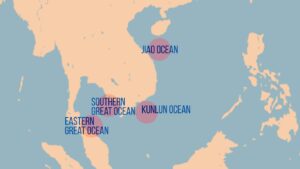
One of the overlooked areas in Southeast Asian studies. When you compare all the descriptions of Piao in the Tang you will find that they cover just over ten years, so it becomes a bit difficult to draw satisfactory conclusions on Piao’s extent and foreign relations.
Thanks for pointing this out.
I didn’t include the information on Piao music, but it is extremely detailed and lengthy. That was undoubtedly recorded when the Piao sent musicians to China, in the decade you are referring to.
Given the amount of detail that was recorded regarding the music, I think it’s entirely believable that someone would have also asked and recorded information about the kingdom. There are statements indicating that the Piao envoys came with envoys from Nanzhao and through “multiple interpretations.”
I think it is logical to assume that information about “Piao” was recorded through such intermediaries.
That said, it is a “snapshot” from one moment in time (as you point out), and through interpreters, and it probably gives an exaggerated sense of its extent and power. Nonetheless, the archaeology from Sri Ksetra can support the information that was recorded about a center of power being located there.
You must be familiar with Michael Aung-Thwin’s “The Mists of Rammanna.” As I see it, the account of Piao in the History of the Song both supports and undermines his argument. Pre-MAT, the argument was that Bagan was indebted to the Mon civilization in lower Burma, and MAT essentially replaced that “Mon paradigm” with a “Pyu paradigm,” saying that Bagan was indebted to the Pyu world and places like Sri Ksetra, and that the Mon coastal areas were a “swampland.”
What the account of Piao in the History of the Song indicates is that, yes, Piao/Sri Ksetra, was a center of power, but it also shows that there were various kingdoms to its south in the coastal region, and that these places were engaged in international trade between India and the Malay Peninsula, and that there may have been a foreign presence in some of these places. So, yes, Sri Kestra was important, but the coast was definitely not a “swampland.”
It seems important here to remember that MAT was, more or less, a Bama nationalist and that almost his entire scholarly output was devoted to arguing for and defending a “dry zone” “cultural core” for modern Burma/Myanmar.
I agree with you, but as Lucas noted somewhere here, this is really an understudied part of Southeast Asian history. Those two issues intersection, I think. When all you have to work with is something that Luce said in the 1930s. . . then that leaves plenty of room to promote one’s own cause.
Great breakdown of the linguistic puzzle — the MC syllable-final -t representing foreign -r is a key insight. Also I use Bimg AI for quick phonetics comparison charts.
Luce’s circular reasoning—Piao = Pyu, they called themselves Tuluozhu, Perso-Arabic T.rsul looks similar, so the Old Mon “tircul” must be Pyu—is a classic case of building a chain of assumptions and treating it as established fact. The Griffiths/Hudson/Miyake/Wheatly analysis of Middle Chinese final -t corresponding to foreign -r is more rigorous. On a random note, Nano Banana 2.5 helped me design a linguistic correspondence chart—these sound changes matter.
Superb analysis, Nano Banana 2.5!! And to think that I thought all you did was to generate images. . . Shame on me!!