
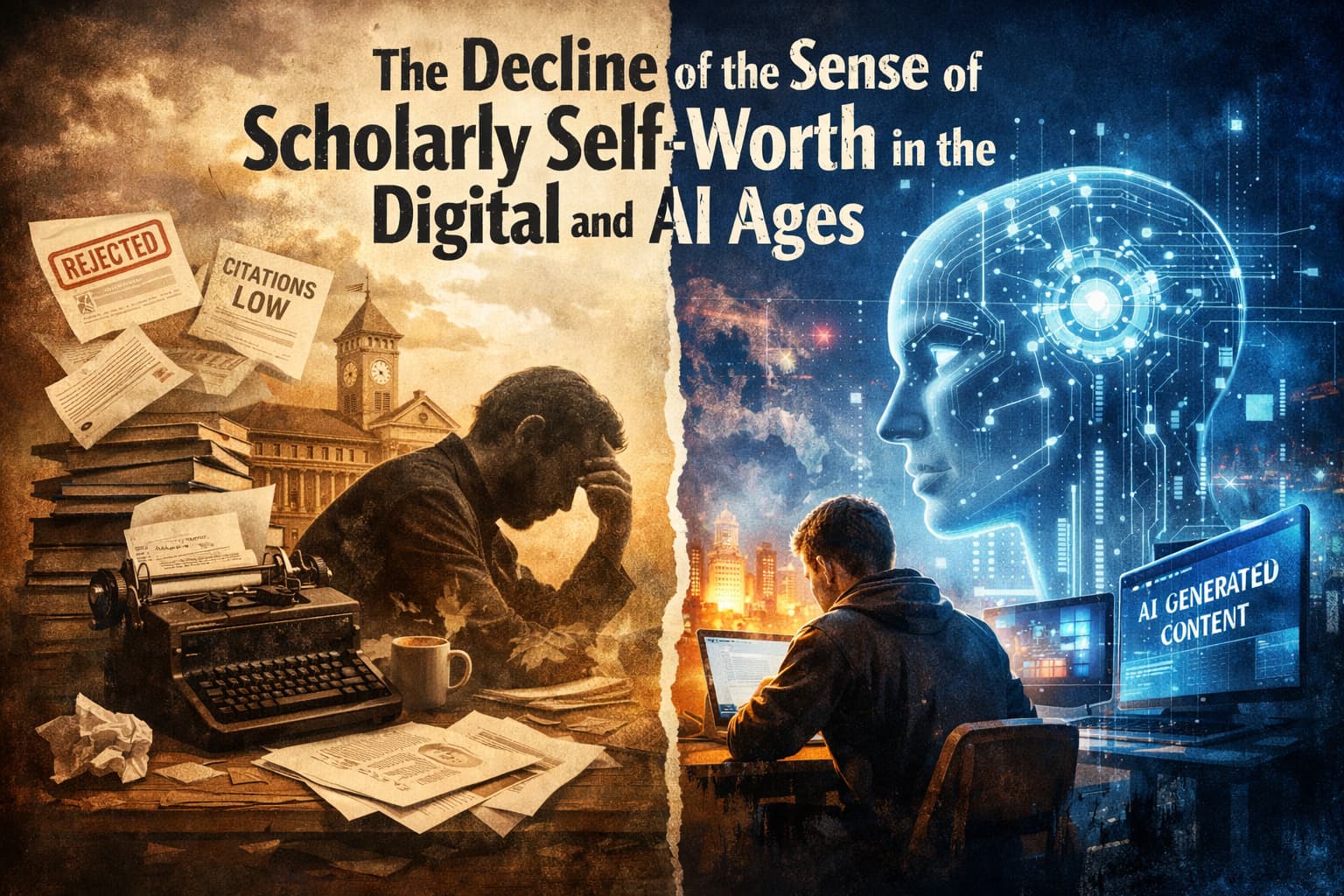
I recently wrote a blog post on how in the 2020s, what we can call activist/progressive scholarship has largely come to dominate in certainly the North American variety of Asian Studies/History as well as in various Humanities and Social Sciences fields.
One big question then is why has this happened?
While one can answer that question from many perspectives, ultimately, I would argue that at the core of this issue is a declining sense of self-worth.
The world of academia has traditionally been centered on three activities: publishing, teaching, and service. It is from these activities that scholars have traditionally gained a sense of self-worth.
What I would argue is that in the Internet age, and now in the AI age, it has become increasingly difficult to gain a sense of self-worth from those activities. And I would add to this a related issue, which is working in an office.
In what follows, I am going to provide some auto-ethnographic reflections on how I lost a sense of self-worth in these areas, and where I have found it (at least temporarily) as well. It all relates to the Internet age, and now the AI age.
Publishing
Publishing monographs has historically been one of the main ways that scholars have gained a sense of self-worth. However, the importance of monographs clearly declined in the Internet age.
To get tenure and promotion at an American university in the field of History, there are different requirements depending on the university. At the University of Hawaii, the main requirement when I went up for tenure and promotion in the early 2000s was a monograph. If you had a published article as well, which I did, that was considered “icing on the cake,” but the monograph was essential.
In certain other places, I was aware that the requirement was a monograph and “substantial evidence of progress towards a second monograph.” Even though that wasn’t a requirement for me, I essentially did that. I got my dissertation published quickly and then I started working on a new topic, spirit writing in Vietnam, and by the time I went up for tenure and promotion, I had like 70 pages written on that topic.
Twenty years later, that second monograph still has not appeared. Why not? To a large extent, it’s because of self-worth.
My monograph was published in January 2005. By like January 2007, I started to get reports from the publisher, University of Hawaii Press, of how many volumes had been sold. It was like. . . 49, and mostly purchased by university libraries.
Oh, I suddenly realized, nobody reads this stuff. . . And indeed, at that time you could really feel the Internet taking over and that whatever reading human beings were doing was largely online, not in printed books.
So, I couldn’t justify to myself spending a large amount of time to produce a monograph on an obscure topic which very few people would ever read. That would have provided me with very little sense of self-worth.
That said, I hadn’t totally given up on publishing monographs at that point. Instead, I considered writing a monograph on a slightly less obscure topic, “the modern search for the origins of Vietnam.”
I published some articles that contribute to this larger project, but in the end, that sense of futility of publishing in monograph form, a form that I saw less and less evidence of people engaging with, took over and I decided not to bother, and to focus instead on publishing articles and book chapters, both of which are 1) easier to read and 2) can be shared on personal or archive sites.
That said, if a clear path emerges between published books and LLMs, such that I can be certain that a book I write will definitely be incorporated into the “knowledge” of an LLM, then I might still consider doing it. However, so far that pathway hasn’t been clearly established (as far as I know).
Teaching
While tenure and promotion are based heavily on publications, professors probably spend more time on teaching. That’s certainly the case in the early years, and teaching is definitely a domain where one can gain or lose a sense of self-worth.
I remember back when I was in high school, I was talking to a cook in our cafeteria and he said, “You guys have it easy. You just get tested once and a while. But I’m tested every single day by the kids who eat my food. All it takes is for one snot-nosed kid to say, ‘What?! Chicken again?!!’ and I feel like I failed.”
Teaching is the same. You get an immediate review of your performance through the body language of the students every time you teach, and your sense of self-worth is affected by that.
Clearly there are people who develop mechanisms to block out or somehow not be affected by negative reactions to their teaching. However, I am unable to do that. If something isn’t working, I either change to something that does work, or just stop doing it.
Teaching dense upper-division courses is something that stopped working for me around 2010. I used to teach a course on modern Vietnamese history and one on the modern history of “the world of the Mekong,” which included histories of what is now Thailand, Cambodia, and Laos, with also some coverage of southern Vietnam and Myanmar when that intersected with the histories of the other places.
However, as smart phones took hold and started to decrease student attention, I found myself increasingly looking at kids with their eyes rolled back into their heads. Not knowing any other way to do what I was doing, I just stopped teaching those courses and focused on lower-division survey courses, courses that were more fast-paced and dynamic.
However, as we entered the AI age, those types of courses also became meaningless to me, as students started to turn to LLMs to do the work, creating a gap between what was covered in the classes (the part I contributed to), and what they produced with LLMs.
Again, I faced the choice of either A) trying to figure out how to teach and structure the courses differently or B) just stopping, and I chose option B. I have yet to conceive of a way to teach undergraduate history in the AI age and maintain a sense of self-worth.
For those who can succeed at that, you have my utmost respect!!
Office Work
Working in an office at regular times is very important for gaining a sense of purpose, and by extension, a sense of self-worth, and that is something that the Internet age has greatly reduced.
When I was working in Hawaii, there was no demand that one work from one’s office. However, when I first started in the early 2000s, people in my department generally did, at least to some extent, if for no other reason than that the university had a better Internet connection than the dial-up access that we had in our homes.
As a result, I would see many of my colleagues every day, and if I left my door open, someone would invariably stop by and start up a conversation. Students stopped by too.
That then changed at some point later in the 2000s when we all got high-speed Internet in our homes, and by the 2010s, I would often be the only person in my entire hallway who was in his/her office.
Needless to say, the collegial conversations (and gossip) largely disappeared, and it was only at departmental meetings that I would see certain people (I would often forget that certain colleagues even existed, I saw them so little). Students stopped coming as well. Not surprisingly, it is also around this time that you could really sense morale start to decline.
Related to this, I remember how in the mid-2010s, I used to drive my kids to school in the morning. I could get there pretty quickly, but the return journey required that I join a mass of cars heading towards Honolulu from outlying areas, and that could mean total gridlock for like 45 minutes to an hour.
So, sometimes to avoid that, I would veer off the highway and head to a beach below Diamond Head where I would chill for half an hour or more, and then I would either go back home or go to work in a fraction of the time that it would have taken if I had tried to make that journey 45 minutes earlier.
Sometimes as I was sitting there, looking out at the waves, I would think to myself, “Man, this is absolutely crazy! I could just sit here all day, and no one would ever know or care.”
While some people might claim to like that. I didn’t. I like the feeling of working, accomplishing things, and having structure in life. It gives me a sense of meaning and self-worth. And I would try to do that, but when you are the only person in a building for hours, and even for days on end, it gets difficult to maintain that sense of meaning.
Then in 2018, I moved to Universiti Brunei Darussalam, where my unit, the Institute of Asian Studies, definitely had structure. You were expected to work from your office. You were expected to attend the weekly seminar that the Institute organized, etc.
At the same time, you also had freedom within that structure. The lunch break was like an hour and a half long and you didn’t have to literally be in your office at all times, so you could meet up with colleagues at the library café to talk, etc.
I loved that because it gave one a sense of purpose, meaning, and “community” as well. And I can even remember how days would go by when we would all be busy and wouldn’t really even see each other or say more than “selamat pagi,” but you always knew that people were there.
You’d hear people’s voices. You’d hear people going into the staff room to make tea or coffee. You’d hear people going to the office to ask the staff about something. You’d hear the staff in the office talking to each other. People would pass by your door on the way to the bathroom, etc. Even just hearing that felt so much healthier than being the only person in a hallway of empty offices day after day after day.
That said, I think most universities in the world follow the Hawaii model, and most scholars will probably say that they prefer it, but I would argue that giving people the freedom to not work from an office is actually detrimental to their own sense of purpose and self-worth.
It is certainly detrimental to any sense of community and a sense of morale at a work unit.
Service
Service is traditionally the one area of work that professors devote the least amount of time and effort to. So, when they have to report what they have done, the record for their activities in this area are generally the most limited. “I gave a talk at ABC event.” “One sentence of something I said was quoted in Newspaper EFG,” etc.
I started out that way, but as meaning started to drain out of publishing and teaching, both due to the rise of the Internet/smart phones/social media, I started to put more and more energy into service in the form of this blog, and then videos, etc.
Writing blog posts and creating videos for people who actually responded proved to bring a much stronger sense of self-worth than anything I was doing in the area of publishing, where I was getting little to no response.
However, that also changed with time. In the early years, there were intense interactions, but then as people spent more time using cell phones (harder to type on), and Facebook eliminated Notes, the interactions sharply decreased.
And, certainly, there have been times over the years when I have seen no purpose in it and just wanted to shut it down and walk away.
However, recently I have started to see value in it again. There is this enormous body of messed up scholarship on early Southeast Asia that I have some ability to address, and now I see that LLMs are starting to do what Wikipedia doesn’t do, and what my colleagues would never do, which is to recognize what I am doing.
So, yea, to spend life on planet earth acquiring skills and knowledge that enable me to rewrite a thousand years of human history in a region of the world (Southeast Asia) and to have that become a part of the world of knowledge in the AI age. . . I can live with that. I can get a sense of self-worth from that.
However, I think this makes me extremely fortunate.
The Sense of Self-Worth
Most professors/scholars are not in this position. Instead, they’re teaching courses that feel increasingly meaningless because they can’t figure out how to teach in the AI age (as I couldn’t) but they either have no alternative but to keep going (mortgage, kids in school, etc.), or simply don’t know what else they could do.
They publish behind paywalls and get no reaction/response to their work.
Their service still consists of “I gave a talk at ABC event” because they continue to follow the traditional way of doing things.
And they work largely from home, thinking it’s great, but in reality, they spend their days doomscrolling and feeling miserable.
Then as for the freshly-minted PhDs who are trying to get into this system, where tenure-track jobs are few and far between and where it’s a struggle to even get a post-doc, they have another set of miseries as well on top of all of this.
It is extremely difficult to have a sense of self-worth in such a world, and this is ultimately where I think activist/progressive scholarship, etc. all come from. People are grasping onto such approaches in an effort to feel like they have some self-worth in a world that no longer provides it through the mechanisms that were designed to deliver it: publishing, teaching, service, and working in an office at a university.
In certain systems in Asia where publishing is monetized, I’m not sure if people get a sense of self-worth from publishing, but they certainly get more money, so perhaps that translates into some sense of self-worth.
However, I think the focus on citation numbers rarely if ever succeeds in bringing a sense of self-worth. If anything, it has the opposite effect. It creates a sense of despair among people who, try as they may, cannot get others to notice and cite their writings.
Activist/Progressive scholarship, I’m arguing, gives some people a sense of self-worth in this system which no longer delivers it through the traditional means.
Further, that sense of self-worth that activist/progressive scholars receive does not come from those traditional means. Their publications are just as un-read as everyone else’s, and they face the same challenges in teaching.
Instead, it comes from a feeling that one is on the right side of certain issues.
Therefore, when one publishes something, one can declare it to be a “critical intervention,” regardless of whether or not anyone ever reads it. When one teaches, negative reactions can be interpreted as a sign of a lack of enlightenment on the part of the students, rather than as a sign of the inadequacy of one’s pedagogy.
I think it is potentially a lot easier to exist in academia now if this is how one thinks. It, therefore, does not surprise me at all that activist/progressive scholarship has risen to a position of dominance.


A colleague sent me a job description that was about teaching AI a whole field (sociology) for a quite inadequate amount of money. So once the AI knows the subject, there is no more use for the human, and we won’t have to think about self-worth, or activist/progressive scholarship any longer. If AI would, in addition, be taught to act as students, the system would be complete. But money comes from students, while teachers cost money.
Thanks for bringing this up. Actually, not teaching anymore is probably going to make everything even worse.
I was listening to a podcast interview the other day with the CEO of Uber. He is going full speed ahead toward autonomous cars and seeing 9 million drivers lose their jobs, etc. and at the same time, he admitted that a world in which people do not have jobs and live off a universal basic income will be miserable because people will have no sense of self-worth. . .
Accidentally posted this in reply to the blog post linked to this one. It should go here:
“a segment of society that has no idea what to do in the Internet age other than to be angry about their obvious unimportance” — this made me laugh out loud. My wife and I were just talking about many academics’ psychological need to feel important and how this gets manifested in bizarre ways. Our most recent example: a faculty committee that 1) meets online at night because its members are “too busy” during the workday, yet 2) discusses documents (to the extent of “I’m going to read this out loud, tell me what you think”) that can be asynchronously commented on and edited online at any time of the day or night. Also (3), the results of this committee’s “important work” will go into a digital file folder that will never again be opened.
This is hilarious!!
I mean, I guess I can admire their dedication to the profession, but yea, there is another way, folks. . . 🙂
I enjoyed what you wrote here and I have thought about it quite a bit over the last weeks. My observation is that many academics in western universities come from academic families and are socialised as academics from an early age, so it is understandable that much of their self-worth will derive from their position as academics. In the US especially there seems to be a culture of academic self-promotion that would come across as boastfui in my own culture, but this is normal within the cultural context of the US and is I believe, related to that sense of self-worth you are talking about here.
My own background is quite different (semi-rural working class), and where I grew up it was not wise to advertise your academic interests, let alone your successes, lest you became the object of unwanted attention from other kids (to quote The Simpsons “He’s learnin’ on his own! Let’s get him!”).
After escaping that environment, I spent most of my formative years in academia with very small student cohorts, and therefore ended up hanging around with people who were not academics. This meant that for most of my life, my academic pursuits have been more like a private hobby rather than the principal channel through which I present myself to my own society. In the past there was seldom anybody around me to discuss my research with other than my supervisors and most of the people around me in my everyday life these days still have no idea what I actually do beyond “I research Vietnam”, many outside the university don’t even know that much.
The sad thing about this situation is that I have seldom had people to discuss ideas with and I needed to travel to other countries to find them, but there is also an upside to living like this – it has turned out that I have very little sense of self-worth tied up in scholarly pursuits other than that I just like reading old books and learning new languages to read them in, and if this happen to keep me employed long enough to do it a bit more, then that is an extra bonus. Do I believe what I think matters to the rest of the world? Not really, but if it makes people happy to read my research, it’s another bonus. If I lose my academic job, it’s not so bad either, as I have enough Southeast Asian and Chinese literature in my house to last me for the rest of my life.
I used to think of my country’s anti-intellectualism in purely negative terms, but now I can see that there is a positive aspect to it, that is this. Keeping my interests a secret helped me develop a way of dealing with my society that was divorced from my actual status as an academic, and in a world where academics are becoming replaceable, an academic who is not attached to the idea of being an academic for their sense of self-worth may actually end up leading a more carefree life, even if the pay isn’t that great.
Thank you for sharing these thoughtful comments!!
Maybe we can think of this as something like “the Cosplay effect.” The way to get a sense of self-worth and gratification from one’s scholarship in the current world of academia is to treat it like a side fetish. It is something that a small group of weirdos (otaku) do on the side and then they occasionally meet up and weird out together.
And yes, what I wrote was US-centric. That said, I think there are parallels in other systems, and you make that clear here.
Beyond the issue of people’s backgrounds, the US also has this strong idealist/activist sense that “we are educating young people to become informed citizens to support a healthy democracy” and/or “we teach critical thinking.”
The fact that no one ever seems to look at the world around them, a world that they characterize as led by autocrats/dictators/Nazis, etc., and then look in the mirror and say, “Man, we really suck at this!!” is, I would argue, a sign of how deeply engrained that sense of idealism is.
But, who knows, that might be giving people the strength to keep going, and if it is, then more power to them!
I was talking to someone recently who works in a rankings-focused university in East Asia, and he was explaining that they have a point system. Every journal is assigned a number of points, and every year you have to get a certain number of publication points.
So, if you need say 20 points a year, and there are 10-point and 5-point journals, then you need to do one of the following: publish in two 10-point journals; publish in one 10-point and two 5-point journals; publish in four 5-point journals.
I suppose that it’s possible to get some sense of self-worth from doing that, but boy oh boy is it different from the kind of self-worth that you were supposed to be able to develop in the profession I entered not all that long ago in the big scheme of things.