

One of the core inscriptions that is cited in the Srivijaya narrative, the Ligor Inscription, as well as some inscriptions from southern India, mention alongside the name “Srivijaya” the name “Sailendra.” This is the name of a dynasty/line of rulers that is also mentioned in an inscription on Java.
For as long as there has been scholarship on Srivijaya, there has been parallel, and intersecting field of research on the Sailendra. Further, this Sailendra scholarship also makes use of the same flawed assumptions about the meanings of key placenames in Chinese sources, such as Shilifoshi, Moluoyu, Heling, and Shepo.
The “standard” view of the meanings of the location of these places was established by scholars in the late nineteenth and early twentieth centuries, was seen to be deeply flawed by scholars like R. C. Majumdar and others in the 1930s-1970s, but then was simply repeated and perpetuated by O. W. Wolters in the 1960s-1980s.
In this “Pelliot/Wolters paradigm,” as I’ll call it, as Paul Pelliot is probably the most frequently cited early scholar, this is what the above places mean:
Shilifoshi = Srivijaya/Palembang
Moluoyu = Jambi
Heling = Java
Shepo = Java
Scholars have been confident that this is what these terms refer to, and yet they have struggled endlessly for more than a century to get the sources to make coherent sense, and in the process, they have created elaborate explanations of moving capitals and conquest, etc.
This confusion is the result of people using the flawed Pelliot/Wolters paradigm to examine the sources.
We will look at recent examples of this below (the early examples are mainly in Dutch-language scholarhip), but let us first look at some of the Chinese sources to see what they record, and where some of the ideas that scholars work with come from.
Chinese Sources
Shilifoshi, Moluoyu, Heling, and Shepo are all names that appear in Tang-era sources, such as in the writings of the monk, Yijing, and in the official Tang dynastic histories. From these texts, we get some sense of the expansion of power of Shilifoshi, and perhaps the movement of a capital in the case of Heling/Shepo.
Let us look first at information that Yijing recorded about the route to and from India, as it is in his writings that the first two terms above get mentioned, and in annotations that he wrote, we get a sense of Shilifoshi extending its power or control.
Route to India:
未隔兩旬果之佛逝。經停六月漸學聲明。王贈支持送往末羅瑜國(今改為室利佛逝也)復停兩月轉向羯 荼。至十二月舉帆還乘王舶漸向東天矣。
Before twenty days had passed, he indeed reached Foshi. He stayed there for six months and gradually studied śabda-vidyā [the science of sounds/phonology]. The king gave him support and sent him on to the country of Moluoyu (now changed to Shilifoshi). He again stayed there for two months, then turned toward Jiecha. When the twelfth month arrived, the sails were raised and, returning to board the king’s ship, he gradually made his way toward Eastern India.
Return Route from India:
從斯兩月汎舶東南到羯茶國,此屬佛逝,舶到之時當正二月,若向師子洲西南進舶,傳有七百驛,停此至冬。汎舶南上一月許到末羅遊洲,今為佛逝多國矣。亦以正二月而達,停至夏半。汎舶北行可一月餘便達廣府. . .
[Tāmralipti] is the place where one boards a ship and enters the sea on the return journey. From here one sails for two months to the southeast until one reaches the polity of Jiecha [Kedah]. This is under the jurisdiction of Foshi 佛逝. When the boat arrives, it is the second lunar month.
To travel to the island of Sri Lanka [師子洲 Shizi zhou], one heads by boat forward into southwest for [the equivalent of] 700 travel stages. One stays here until winter, and then in taking a boat coming up from the south, one reaches Moluoyu in a little over a month. Now this is the Foshiduo 佛逝多 Kingdom. It is also in the second lunar month that you arrive.
One waits until the middle of summer, and then taking a boat to the north, one can reach Guangfu. . .
The key information here is the following:
Moluoyu – now changed to Shilifoshi; Now this is the Foshiduo 佛逝多 Kingdom;
Jiecha [Kedah] – This is under the jurisdiction of Foshi 佛逝.
This information is, of course, not entirely clear. Was the Foshiduo Kingdom the same as Shilifoshi? Was that a typo? We don’t know.
However, at a general level, we can get some sense of a situation where there was a place called (Shili)Foshi, and it somehow came to bring Moluoyu and Jiecha under its control or influence.
Following the Pelliot/Wolters paradigm, scholars have tried to create a history of Srivijaya at Palembang (Shilifoshi) extending its influence or control over Jambi (Moluoyu) and Kedah (Jiecha), etc. However, when one tries to incorporate other historical details from sources like the dynastic histories, then one encounters problems and inconsistencies, and scholars have struggled to get all of the information to make sense.
I can’t go through all of the details again, and I’ve talked about them in earlier posts (see the series on From Pelliot to Wade: Jia Dan’s Itinerary Through Maritime Southeast Asia and From Chavannes to Sen: Yijing’s Journey through Southeast Asia), but essentially, from all of the research I have done, it is blazingly clear to me that Shilifoshi was not “Srivijaya” and it was not at Palembang.
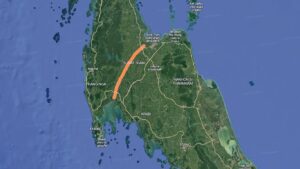
Instead, I would place Shilifoshi somewhere around Surat Thani or Nakhon Si Thammarat, while Moluoyu was somewhere around what is now Phang Nga province (the old Takua Pa), and Jiecha was Kedah.
Besides all of the textual information that can locate these places in these areas, it also makes sense that a place on the east coast of the Malay Peninsula would want to control places on the western side of the Peninsula, and in this case, it looks like Shilifoshi at some point controlled the two most important ports on the western side of the peninsula, as it was from these ports that ships sailed to and from India and Sri Lanka.
Meanwhile, from Yijing’s writings, we can also see that there was another place nearby, Heling, and that many monks traveled there. Further, monks would travel onward from Heling to places like Moluoyu and then to India.
My guess is that Heling was somewhere in the area to the south of Nakhon Si Thammarat (NST). There is archaeological evidence that stretches in a curved line from NST to the southwest, along what was once a trans-peninsular route, and my guess is that Heling might have been in that area. Further, there are also records saying that it was south of Panpan, which also seems to have been in the NST area.
Then, in the New History of the Tang, this Heling kingdom is said to also be called Shepo, a name that would have sounded something like “java/jaba,” and it says that “The king resides in the citadel of Shepo. His ancestor Ji Yan moved east to the citadel of Polujiasi, and the twenty-eight small states nearby all submitted as vassals” (王居闍婆城。其祖吉延東遷於婆露伽斯城,旁小國二十八,莫不臣服。)
That the name “Shepo” here comes from the name of a citadel, is one sign that this is not referring to Java. However, there is textual information about its location that also demonstrates this.
In an earlier post, in looking at a Tang-era itinerary from the southern coast of Burma to this very same Shepo, it ended with the following overland and riverine passage:
十五日行,踰二大山,一曰正迷,一曰射鞮,有國,其王名思利摩訶羅闍,俗與佛代同。經多茸補邏川至闍婆,八日行至婆賄伽盧,國土熱,衢路植椰子、檳榔,仰不見日。
After fifteen days’ travel, crossing two great mountains, one called Zhengmi and the other Shedi, there is a kingdom whose king is named Sili Mohouluozha [Sri Maharaja]; its customs are the same as those of Fodai. Passing through the Duorongbuluo River and proceeding to Shepo, after eight days’ travel one reaches Pohuijialu. The land of that kingdom is hot; coconut and areca palms line the roads so thickly that when one looks up one cannot see the sun.
王居以金為甓,廚覆銀瓦,爨香木,堂飾明珠。有二池,以金為隄,舟檝皆飾金寶。
The king’s residence uses gold for bricks; its kitchens are roofed with silver tiles; fragrant wood is used for fuel; the halls are adorned with bright pearls. There are two ponds with embankments made of gold, and the boats and oars are all decorated with gold and precious stones.
This is NOT an itinerary of a route to island Java. That should be obvious for anyone to see, and as I wrote about in a recent post, O. W. Wolters went through all kinds of intellectual and textual contortions to try to get this passage to indicate a route to Palembang. . . which it is also not.
From passages like this one, as well as the description of Shepo in the 1225 Zhu fan zhi, and other passages, I would argue that Shepo was somewhere in the area of the greater Lake Songkhla region. A journey from southern Burma that eventually goes overland between two mountains and takes a river to a citadel is describing a journey to a place like Sathing Pra or Songkhla.
Further, in some of the names above I think we see evidence of the Austronesian term for island, “pulau.” Polujiasi 婆露伽斯, where the ancestor of the king of Heling residing at Shepo citadel moved to, could be “Pulau Jiasi.”
Meanwhile, Pohuijialu 婆賄伽盧, the place the itinerary leads to, if the second character, hui 賄, was miscopied from the similar-looking character, lu 賂, then we would have “Polujialu,” or “Pulau Jialu.”
In any case, while there are elements of the above information that is not clear, what is clear (go back to the earlier posts in these series for the details) is that these places were all on the Malay Peninsula, in the area between Kedah in the west and Songkhla in the east, and between Phang Nga in the west and Surat Thani in the east.
Working with the Pelliot/Wolters Paradigm
This is what I have come to understand through extensive research. However, the “standard” view of the meanings of the location of these places, as established by scholars in the late nineteenth and early twentieth centuries, and as repeated and perpetuated by O. W. Wolters in the 1960s-1980s, is that Shilifoshi = Srivijaya/Palembang, Moluoyu = Jambi, Heling = Java, and Shepo = Java.
That this is not what these places refer to, and that becomes obvious when one works with the Chinese sources, as it becomes impossible to get the sources to make sense. This is why, for over a century, the writings on Srivijaya have been so confusing and chaotic.
O. W. Wolters wrote voluminously about issues like how the “capital” of Srivijaya supposedly moved from Palembang to Jambi, and yet was never able to produce a clear and convincing argument, such that in 2016, Hermann Kulke wrote that “Jambi’s history also remains an intricate enigma that ultimately even Wolters was unable to solve in his detailed study of Jambi in The Fall of Śrīvijaya in Malay History (1970).”
Hmmm, so Wolters spent a book trying to solve something and couldn’t do it. . . Isn’t that a pretty good sign that something might be a bit wrong? Decades before Wolters wrote on Srivijaya, there were scholars who pointed out that the Chinese sources don’t support the Srivijaya narrative, however, Wolters ignored those points and just continued working with 19th-century ideas. . .
Somehow the idea that maybe he had something wrong never appears to have dawned on Wolters, and it also doesn’t seem to have dawned on scholars who continue to employ the Pelliot/Wolters paradigm.
For instance, in recent years there have been scholars who work on the Sailendras and Srivijaya who have employed the above paradigm in their writings, and unsurprisingly, like Wolters, they have struggled to get the Chinese sources to make sense.
Jordaan
In 2006, Roy E. Jordaan published an article entitled “Why the Śailendras Were Not a Javanese Dynasty.” Jordaan made some use of information in Chinese sources in this study, however, he cannot read Chinese, so he relied on the Pelliot/Wolters paradigm.
Here is part of a paragraph where Jordaan talked about why he thinks the Śailendra were of foreign origin:
For the present purpose, it may suffice to recall W.F. Stutterheims (1929) analysis of the curious alternations in the pattern of tributary missions to China, with embassies from S ´ rı-wijaya being halted in 742 and replaced by missions from Java. However, whereas Stutterheim took this as evidence for a Javanese hegemony over Sumatra, we are inclined to relate this to the overlordship of the Śailendras in the archipelago. One of the indications is that the missions from Java were not dispatched from She-po (which was the old Chinese designation for Java) but from Ho-ling (thought to be a transcription of Walaing, a toponym that is connected with the Ratu Boko plateau, which was the site of a famous Buddhist monastery). In contrast the decline of Śailendra power led to a resumption of missions from She-p’o, while the eviction of the Śailendra from Java and their settlement in the western part of the archipelago was immediately followed by a resumption of tributary missions from Sumatra, at first hailing from Chan-pei (Jambi), in 853 and 871, and thereafter from San-fo-ch’i. We believe that this toponym was the Chinese name for the newly reconstituted Śailendra kingdom, and did not refer to Śrīwijaya of old, as is commonly assumed. Henceforth, Java and Sumatra (the latter being ruled by scions of the Śailendra dynasty) were vying with each other for recognition by the Chinese court as the pre-eminent kingdom in the region. In the Indo-Malay archipelago itself their formerly mutually beneficial political and economic relationship gave way to hostilities and war. (6-7)
The first point I’ll make is that this passage does not site any sources for its information. Apparently, it’s all just “common sense.” That said, the fact that Jordaan was using the Wade-Giles system here to transcribe Chinese names is a good indication of where this information came from: old, outdated works, most likely Wolters.
From those old, outdated works, Jordaan adopted various flawed assumptions, such as the idea that Ho-ling [Heling] and She-p’o [Shepo] were Java.
Heling was also not “Walaing.” That’s a crazy idea that Louis-Charles Damais came up with in the 1960s. In his study, Damais correctly pointed out that Heling was not “Kalinga,” as earlier scholars had argued, but in not knowing Chinese, he still placed Heling on the island of Java, and came up with an argument that it was “Walaing.” However, Heling was not on Java.
The Chan-pei [Zhanbei] that presented tribute during the Song dynasty period was not “Jambi.” Zhanbei is recorded in the History of the Song as the term for the ruler of Sanfoqi, and in the account of Sanfoqi in the History of the Song we find that many different rulers and polities presented tribute under that name, one of which was the Zhanbei kingdom.
I am the only person who has 1) not ignored or come up with a ludicrous idea to dismiss the point that “Zhanbei” was how the king of Sanfoqi was referred to, and who has 2) proposed a term that fits the context. In particular, I have demonstrated that Sanfoqi was Kambuja and that the Zhanbei was probably the Khmer term for a ruler, Samdaech, a term that we also find in inscriptions from that period.
Beyond all of that, however, just look at how chaotic the writing and ideas are in the above passage. In fact, it looks a lot like O. W. Wolters’ chaotic writing and ideas. This is, writing ability aside (as I can’t speak to that), I would argue, an inevitable result of attempting to make sense of the past by using the flawed Pelliot/Wolters paradigm.
One can’t understand anything about Java by looking at what the Chinese wrote about Heling and Shepo, because those places were not Java. As such, when one tries to do so, one will end up with a chaotic mess, and that is precisely what we see in O. W. Wolters’ many writings and in the passage above in Jordaan’s article.
The above article came out before Jordaan published a book on the Sailendras in 2009 together with Brian Colless entitled The Maharajas of the Isles: The Sailendras and the Problem of Srivijaya. I do not have access to that book as it appears to be out of print or otherwise inaccessible. That said, I don’t feel like I am missing much as I can get a sense of Jordaan’s ideas from this article, and I have also read some of Colless’ writings.
Like Jordaan, Colless cannot read Chinese. That said, he is clearly very intelligent, but at the end of the day, intelligence isn’t enough to fully solve the problems regarding how the Chinese sources have been understood by scholars who work on early Southeast Asian history. R. C. Majumdar was also very intelligent and saw the problems with the Chinese sources, but without knowing Chinese, he could not solve them.
Zakharov
Not long after Jordaan and Colless published their book, epigrapher Anton O. Zakharov wrote a piece in 2012 called “The Śailendras Reconsidered,” in which he discussed the ideas of Jordaan and Colless and other scholars and put forth his own ideas. In the process, he also relied on the flawed Pelliot/Wolters paradigm.
Zakharov wrote for instance that,
The transfer of the Javanese capital “to the East” known from the Chinese chronicles is extremely obscure information as it covers both terms which are considered as designations of Java and its polities, i.e. Shepo and Heling: “The king (of Heling) lives in the city of Shepo; but his ancestor named Jiyan transferred (the capital) to the East, to the city of Polujiasi” (Xin Tang‐shu, book 222, notice on Heling) and “during the epoch of Tianbao (742–755 CE) (the capital) of Shepo was moved to the city of Polujiasi” (Ying huan zhe‐liu, chap 2) (Pelliot 1904: 225, n. 2). If Heling was Walaing, as Damais supposed (1964: 93–141), these references have nothing in common with the Śailendras.
The transfer of the Javanese capital “to the East” is indeed very obscure in Chinese chronicles, because IT DOESN’T EXIST. Heling and Shepo were not Java, so that passage, which we cited above, doesn’t tell us anything about Java.
Further, there is no such text as the “Ying huan zhe-liu,” only an Yinghuan zhi lue 瀛寰志略, a nineteenth-century text which Pelliot noted in that footnote, but which is an inappropriate source for understanding a Tang dynasty record as it dates from potentially 1,000 years later. Indeed, the reference to a nineteenth-century work in discussing a much earlier source is one of the many problems with Pelliot’s 1904 study, and is one of the reasons why scholars should have moved beyond Pelliot many decades ago.
This paper was published in 2012 as part the Nalanda-Sriwijaya Centre’s working paper series. The Nalanda-Sriwijaya Centre was under the Institute for Southeast Asian Studies (ISEAS) in Singapore.
Now stop and think about where Zakharov was and what he was citing. . . Citing “Pelliot 1904” at the Nalanda-Sriwijaya Centre in 2012. That speaks volumes. It is a clear sign of how flawed knowledge about the Chinese sources for early Southeast Asia had remained stagnant for over a century by that time. What is more, the situation remains the same today.
In another passage, Zakharov discussed the Chola inscriptions and then stated that:
These data show that the members of the Śailendra dynasty held sway over Kedah at the end of the tenth to the beginning of the eleventh century and also ruled Srivijaya. (11)
(11) It should be emphasized, however, that the locality of Srivijaya in the epoch is debatable (Jordaan & Colless 2009). It may have been located only in Kedah, in Kedah and Sumatra, or in Palembang and Jambi in Sumatra. If the Chinese term Sanfoqi means “three Vijayas”, it may refer to the three polities from the early tenth century onwards bearing this name. (10, fn 11 is on 36)
Again, this idea that Srivijaya was located in different places at different times (or that there might have even been three of them at the same time) is a direct result of scholars, particularly O. W. Wolters, examining the sources (be it inscriptions or texts) from the perspective of the flawed Pelliot/Wolters paradigm.
Nothing makes sense when you try to understand the sources thinking that Shilifoshi = Palembang, Moluoyu = Jambi, Heling = Java, Shepo = Java, etc. As a result, Wolters and others had to come up with elaborate explanations of moving capitals and conquests and tri-partite polities, etc. It’s all completely absurd because Shilifoshi, Moluoyu, Heling, and Shepo are not the places they thought they were.
It’s like using sources about London to write about Paris. As ridiculous as that would be, that is precisely what scholars of early Southeast Asia have been doing for more than a century now.
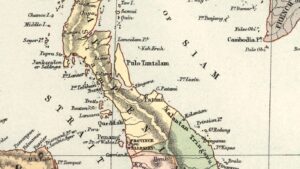

Polujiasi 婆露伽斯, could it be the island of tantalem on which sat a citadel at the time?
The move of the “capital” east can be explained, from Rattaphum to Ranot (Rawa) on the island Jiasi?
The itinerary from Burma sounds like arriving around Satun, then on a path through the mountains, where the modern highway 406 runs to Rattaphum, with pak phayung as its port. Then on to the tantalem or Ko yai.
Pak payung was nestled among the quaternary rock islands of ko mak and ko nang kham before the emergence of a barrier island that would later become Satingpra.
Rattaphum region is known for a long human habitation. M.C. Chand Chirayu Rajani Is of the similar opinion, from here, both Patalung and Singora emerged.
It’s hard to know. The first thing I’ll say is that I forgot that this passage mentions that the king of Heling lives in “Shepo Citadel.” That right there gives us an indication of where the name Shepo/Java/Jaba came from.
On the route it mentions a Duorongbuluo 多茸補邏 River. 1,000 years ago, that might have been pronounced something like “ta rywng phuə la.” I can see Tanjung Pulo there, meaning something like “cape island,” or in the case of this river’s name, the “river at the cape island.”
This passage, however is unclear: The king resides in the citadel of Shepo. His ancestor Ji Yan moved east to the citadel of Polujiasi. Is the citadel of Shepo on the island of Jiasi? Is that what’s that saying?
It’s not clear. I think all we can really get from this is that it’s talking about the Lake Songkhla area, and there was a citadel on an island, or citadels on islands.
As for the route from Burma, I feel like in this early period, it also could have been further north, such as across from Krabi or Trang. The areas to the east of Krabi and Trang have been so developed (by agriculture) that it’s difficult to see/imagine what it was like 1300 years ago. However, I do know that archaeological finds have been made in an arc turning westward from NST towards that break in the mountains heading towards Krabi.
My general sense is that either there was a gradually southward opening up of trans-peninsular routes, or the Chinese gradually became aware of trans-peninsular routes further to the south over time. I feel like when they are talking about Heling, it’s more towards NST, and when they talk about Shepo, it’s more towards Songkhla. A route from Burma might have cut across further north and then gone down to Shepo on the open water.
This is all still mainly speculation though.