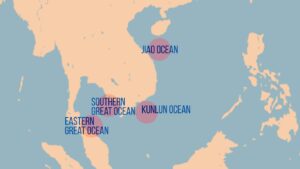
By the late nineteenth century, as I documented in the previous two series of posts, scholars had linked two placenames recorded in Chinese sources, Shilifoshi 室利佛逝 and Sanfoqi 三佛齊, with the area of Palembang on the island of Sumatra.
As I also documented in those posts, those efforts to make that connection were fundamentally flawed.
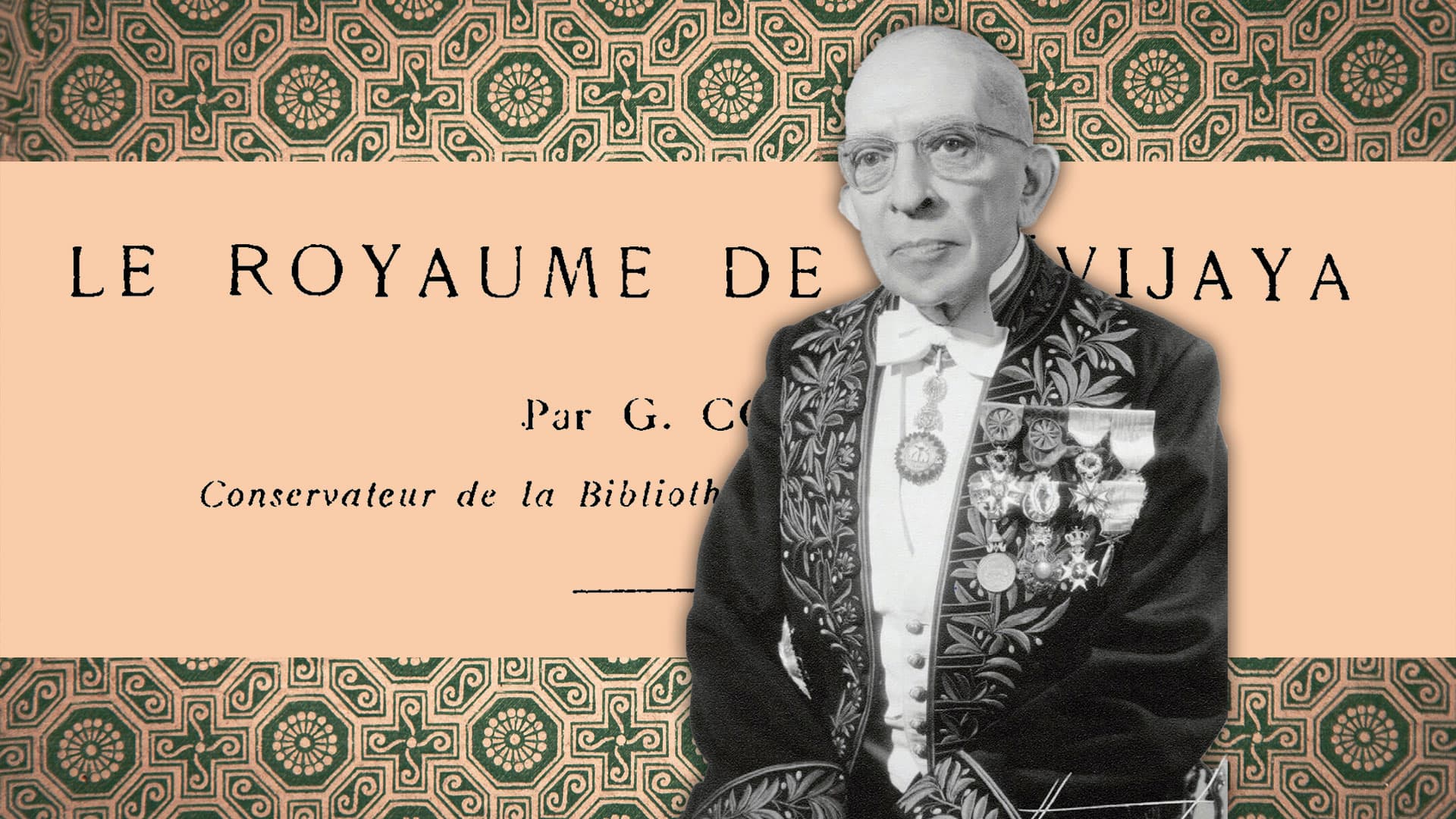
Then in 1918, in an article entitled “Le Royaume de Çrivijaya,” French scholar George Cœdès built on those flawed connections and added yet another flawed connection by attempting to link Shilifoshi and Sanfoqi to a place called “Srivijaya.”
In particular, there were inscriptions that were found at the end of the nineteenth and the beginning of the twentieth centuries that contained the name “Srivijaya.” In his 1918 article, Cœdès argued that this was the name of a kingdom and that it was recorded in Chinese as Shilifoshi and Sanfoqi.
Shilifoshi and Sanfoqi obviously do not look or sound anything like “Srivijaya.” However, in his 1918 article, Cœdès attempted to argue that we can see “Srivijaya” in those names.
As far as I know, no one has ever examined Cœdès’s evidence or arguments for the idea that Shilifoshi and Sanfoqi are Srivijaya. That is what I will do here. And a warning: it gets detailed fast, but that’s just how it is.
Finding Jai in Shi
Cœdès put forth his argument primarily by discussing the name Shilifoshi. He did not have evidence to support the claim that Sanfoqi was also “Srivjaya.” He largely assumed that.
As for the name Shilifoshi, it clearly begins with the Indic “Sri.” That is unquestionable. What Cœdès tried to argue was that the subsequent part, foshi, was “vijaya.”
Is the equivalence of fo-che [foshi], fo-ts’i [foqi] = vijaya more plausible? As regards the second syllable, certainly yes. M. Pelliot had already pointed out that Yijing (in whose writings the name Fo-che [Foshi] first appears) uses che [shi 逝] to transcribe the first syllable of Jeta. Since the publication by M. S. Lévi of the catalogue of the Yakṣas in the Mahāmāyūrī, it is known that the same character is used by Yijing to transcribe ji (Ojjihanā = Ou-che-ho-na [Wa-shi-he-na], v. 54), jai (jaya = che-ye [shi-ye], v. 56, 62), and jaya (Ujjayanī = Ou-che-ni [Wa-shi-ni], v. 16).
In 1915, French Indologist Sylvain Lévi, published a study entitled “Catalogue géographique des yakṣa dans la Mahāmāyūrī” (Journal Asiatique, Vol. 5: 19-138).
The Mahāmāyūrī is a Buddhist dhāraṇī scripture, that is, a text that contains Sanskrit-language formulas (dhāraṇī) that were believed to have protective powers. In this article, Lévi examined one specific section of the Mahāmāyūrī that contains a list of yakṣas, or spirits, tied to particular places in an effort to understand the historical religious geography of Buddhist India.
The Mahāmāyūrī was translated into Chinese multiple times, and is known as the Buddha-Spoken Great Peacock Queen Spell Sutra (Foshuo da kongque zhouwang jing 佛說大孔雀呪王經).
One of the monks who translated this text was Saṃghapāla/Saṃghabhara 僧伽婆羅, a monk from Funan, in Cambodia, who translated texts in China in the early sixth century. Another was Yijing 義淨, the monk whose journey through Southeast Asia to India and back has been repeatedly referenced in writings on early Southeast Asian history. Yijing reportedly completed his translation in 705 AD. And finally, a third was Amoghavajra 不空, also in the eighth century.
In his article, Lévi transcribed the Sanskrit text, and then showed how the above three translations, and a Tibetan one, rendered the Sanskrit.
In referencing this study, what Cœdès tried to argue is that it showed that the character, shi 逝, was used to transcribe the Sanskrit sounds ji, jai, and jaya, and that, therefore, this would mean that the ending of “Foshi” could have been any of those sounds, ji, jai or jaya.
Finding Vi in Fo
Cœdès then went on to attempt to argue for a different reading for fo 佛, the first character in Foshi, and the middle character in Sanfoqi. Here is that passage as well as footnote 3 where he adds additional information.
The equivalence fo = vi is at first sight much less satisfactory. I nevertheless believe it possible. It is known that the character 佛 fo, regularly employed to transcribe the name of the Buddha, had a pronunciation *pwiδ. Now the shift from vi, or more exactly from bi (3), to bu through labialization is a possible phonetic phenomenon; indeed, it is not without parallels, and this is enough to justify the use of fo. In the end, fo-che [foshi] and fo-ts’i [foqi] can represent a form bujai, a spoken corruption of vijaya.
(3) The confusion between v and b, common to so many Indian or Indian-derived alphabets, was probably caused by a phonetic phenomenon. A Sanskrit syllabary, probably attributable to Yi-tsing [Yijing], uses the same character 婆 p’o [po] to represent Sanskrit ba and va (cf. Takakusu, Record, p. lxi). In the languages of Indochina and in Malay, most words of Indian origin beginning with v are written and pronounced with b. Concerning the Bangka inscription, Mr. Blagden notes: “It will be noticed that many of the above words have v which modern Malay has replaced by b” (J. Straits Br. RAS., 1913, no. 64, p. 70). Vijaya became bijai in Khmer and Thai.
This argument is difficult to follow as it depends on several separate steps: v becoming b, then bi becoming bu, then fo 佛 being accepted as a rendering of that rounded labial syllable.
Cœdès did not argue that fo 佛 directly transcribed Sanskrit vi. Rather, he proposed that Vijaya had already developed, in vernacular pronunciation in Southeast Asia, into a form such as Bijaya or Bujai.
According to Cœdès, since the v and b in Sanskrit were often confused in Southeast Asian contexts, and since further labialization could shift bi toward bu, the old pronunciation of fo 佛, reconstructed as a rounded labial syllable, could then serve to represent this altered spoken form.
Thus, according to Cœdès, Foshi 佛逝 and Foqi 佛齊 did not reflect the Sanskrit “vijaya” itself, but a vernacular derivative such as “bujai.”
Yijing
The idea that the character, fo 佛, in Yijing’s day had a sound something like “bu” is fine. Pulleyblank (96), for instance, argues that this term transformed over the course of roughly the first millennium AD from “but” to “fɦjyt/fɦiut” to “fɔ.”
The problem with Cœdès’s argument is the preceding part. He wants us to believe that there was a vernacularized version of “vijaya” in Southeast Asia that was pronounced something like “bujai,” and that it was used in the name of a kingdom that was a center of Buddhist learning, and that Yijing, an expert on translating Sanskrit texts into Chinese, recorded the name of that kingdom as “Shilifoshi” which begins with the Indic “Sri,” but then is supposed to end with a vernacularized term, bujai, that came from “vijaya”. . .
This already takes a major leap of faith or imagination to follow, however, it becomes even more untenable when we take a closer look at Yijing’s translation of the Mahāmāyūrī and get a better sense of his erudition.
Cœdès cited three places in that text where the character, shi 逝, was used to transcribe three different sounds:
1. ji in Ojjihanā = Ou-che-ho-na [Wa-shi-he-na] 嗢逝訶那
2. jai in jaya = che-ye [shi-ye], 逝也
3. jaya (Ujjayanī = Ou-che-ni [Wa-shi-ni], 嗢逝尼
With #2, we can see that Yijing had a way of transcribing “jaya” in two character, shi-ye 逝也. This appears in the name of a yakṣa, Puraṁjaya, which Yijing rendered as Bu-lan-she-ye 晡闌逝也 (Lévi, 45).
Meanwhile, the section of the Mahāmāyūrī that Lévi examined came from the second fascicle. If Cœdès had been able to consult the first fascicle, what he would have seen was the character, shi 逝, used in the name “Jetavana” (Shiduo lin 逝多林), as Pelliot had noted, and in the expression “vijaya vijaya” (pishiye pishiye 毘逝也毘逝也). Hence, Yijing knew how to transcribe the Sanskrit term, “vijaya.”
As such, yes, the character, shi 逝, did at times represent the sound “jai,” but Yijing also knew perfectly well how to transcribe the full terms, “jaya” and “vijaya.”
Let us now look at #3, the example Cœdès pointed to where he thought that Yijing had used the single character, shi 逝, to transcribe the Sanskrit “jaya.”

In the Sanskrit version of this text, there is a placename that is recorded as Ujjayanī. Saṃghapāla transcribed this in four characters as Yu-she-ye-ni 鬱闍耶尼 while Yijing transcribed a three-character version, Wa-she-ni 嗢逝尼.
Following Pulleyblank’s reconstructions, in the Tang period, these two transcriptions could have been pronounced something like “?yt ʂhiaj jia nri” and “?ut ʂhiaj nri,” respectively.
The point that Cœdès sought to make is that this name contains the sound, “jaya,” which Saṃghapāla rendered as ʂhiaj jia 闍耶 but which Yijing appears to have condensed into one character, ʂhiaj 逝, the same character that appears at the end of the name Foshi. Hence, Cœdès argued that this character on its own could be read as indicating “jaya.”
However, the common name for the place that this Sanskrit text referred to as Ujjayanī is Ujjayinī, the capital of the polity of Avanti, and now referred to as Ujjain. Further, in Chinese Buddhist texts, this name was transcribed in many different ways, such as Wu-she-yen-na 烏闍衍那, Wu-she-yen-ni 鬱闍耶尼, You-shan-ye-ni 優禪耶尼, and Yu-she-ni 鬱闍尼, none of which contain characters that can be read as transcribing “jaya.”
Lévi appears to have been aware of this, for while Cœdès claimed that the character, shi 逝, could represent the sounds, “ji, jai, and jaya,” Lévi listed “jayi, ji, and jay” (123.)
So, while Saṃghapāla had rendered the particular Sanskrit form of this placename in this particular text, Yijing may have known the proper name of this place and rendered it more accurately than Saṃghapāla had.
Finally, Saṃghapāla/Sanghabhara was a fascinating and complex figure. As perhaps a speaker of Old Khmer, he studied in China under a monk from central India, and he translated into Chinese at least in part by dictating to Chinese collaborators. Therefore, there are all kinds of variables involved here concerning how Saṃghapāla pronounced the Sanskrit and what dialect(s) his Chinese collaborators spoke. (See South W. Coblin, “Notes on Sanghabhara’s Mahamayuri transcriptions,” Cahiers de Linguistique – Asie Orientale, Vol.19, Noi. 2 (1990): 195-251).
As such, there is absolutely zero evidence to support the claim that the character, shi 逝, could indicate or reproduce the sound, “jaya.” Instead, what I argue we see in the above example is evidence of Yijing’s erudition, and his effort to be as accurate (and perhaps orthodox) as possible.
What’s the Point?
I have gone down this rabbit hole to make a point: Yijing knew Sanskrit, and he knew a “jaya” and a “vijaya” when he saw one.
As such, it is absolutely preposterous to think that a man of his erudition would spend years in a place of Buddhist learning, Shilifoshi, and then produce its name in a hybrid Sanksrit/vernacularized-Sanskrit form.
How are we supposed to understand this? Did Yijing not know that Foshi was “vijaya” and therefore, did not render the name accurately as Shilipishiye 室利毘逝也 as he was fully capable of doing?
Did he spend years hearing people say some incomprehensible term after “Sri” and never ask what it meant?
Was he just trying to be “inclusive” and give voice to diverse ways of knowing and being?
The idea that Foshi is a vernacularized version of “vijaya” that Yijing just either knowingly or unknowingly reproduced is utterly preposterous.
But hold on, folks, because it gets even crazier.
Foshi and Champa
Realizing that his argument was weak, Cœdès claimed to have stronger evidence in a connection between “Foshi” and “Vijaya” in the Cham world. Here is what he wrote:
One therefore cannot invoke the linguistic argument against the identification of Çrīvijaya with Che-li-fo-che [Shilifoshi] and San-fo-ts’i [Sanfoqi]. But one would like to have in its favor something more, and better, than a negative proof. That positive proof is provided by Cham epigraphy.
At the end of the tenth century and in the course of the eleventh, the Chinese and Annamese texts mention, as the capital of Champa, the city of Fo-che. As M. Pelliot has already noted, this name, written 佛誓 by the Annamese and 佛逝 in the Song che [History of the Song], is identical to that of the country of Fo-che [Foshi] or Che-li-fo-che [Shilifoshi] in Sumatra. Now, it is known with certainty from the epigraphy that at that time the Cham capital was in Bình Định and was called Vijaya.
This new example of Fo-che [Foshi] corresponding to Vijaya seems conclusive.
Ok, so let’s take a step back, and think about this. Let’s look at what Cœdès was saying.
In the seventh century, Chinese, and Yijing in particular, recorded the name of a place called Shilifoshi. The “Shili” here is “Sri.” Then according to Cœdès, the “foshi” part came from “bujai,” a vernacularized version of “vijaya.”
Then roughly 300 years later, the Vietnamese and Chinese encountered a place in the Cham world that Cœdès believed from inscriptions was actually called “Vijaya” and the Vietnamese and Chinese rendered that name as “Foshi,” just like the supposed Vijaya-Bujai-Foshi of 300 years earlier.
If what Cœdès said was true, that is, that the original Foshi came from a vernacularized version of Vijaya, then how on earth would Vietnamese and Chinese know that 300 years later?
Vietnamese and Chinese would have had to go through a thought process something like this: “Oh, Vijaya! People in Southeast Asia vernacularized that name a long time ago as “Bujai” and Yijing rendered it as “Foshi,” so we should record this place’s name as Foshi too.”
This is BATSHIT.CRAZY!!!
It’s absolutely insane.
And this is the strongest piece of evidence that Cœdès had in attempting to claim that Shilifoshi was “Srivijaya.”
UNBELIEVABLE.
Further, if we go deeper into the historical sources, we find that there is not much to build on to make the case that Foshi in this context signified an Indic title rather than a local Cham placename.
The History of the Song records that in 1990, “the new king Yang Tuo-pai self-declared the xinzuo Foshi kingdom” 新王楊陁排自稱新坐佛逝國) while the Song huiyao jigao records that (新王楊陀排自稱所生佛逝國) “the new king Yang Tuo-pai self-declared the suosheng Foshi kingdom.”
If we read the two characters before Foshi for meaning, the History of the Song version could be read to mean that the king self-declared the “newly-seated Foshi Kingdom,” but the expression “newly seated” (xinzuo 新坐) in this sense doesn’t exist in Chinese sources beyond this reference here.
Meanwhile, the other version could be read to mean that the king self-declared the “natal Foshi Kingdom,” with the “natal” (suosheng 所生) meaning the place where the king had been born. This makes more sense, and it also means that it could easily be referring to a local Cham placename rather than an Indic title.
Meanwhile, in the Vietnamese Đại Việt sử ký toàn thư, all that is recorded is that in 1044, the Vietnamese attacked a Phật Thệ/Foshi citadel (佛誓城).
Scholarly Discipleship in Place of Verification
No one has ever done what I just did above here.
That is, no one has ever gone through Cœdès’s ideas and logic for arguing that Shilifoshi is a reference to “Srivijaya” and tested them to see if they make sense.
Instead, like disciples following a guru, or a cult leader, for over a century, scholar after scholar has simply believed and followed.
This is absolutely insane because Cœdès’s entire argument that the Chinese placenames Shilifoshi and Sanfoqi are “Srivijaya” and that the information in the Chinese sources about these two places can be used to understand the history of “Srivijaya” hinges on the lone point that Shilifoshi = Srivijaya.
As the above discussion should make blazingly clear, Cœdès did not in any way shape or form provide evidence to make an even remotely plausible argument for such an equivalence.
I am writing this on a Sunday. I’m recovering from a cold. I’ve spent part of the past couple days, half sick, investigating this topic and writing it up. If I can figure this out over a weekend under these conditions, how is it possible that no one has ever written anything about this in the past century?
What on earth have scholars been doing?
That is the topic we will examine next.