
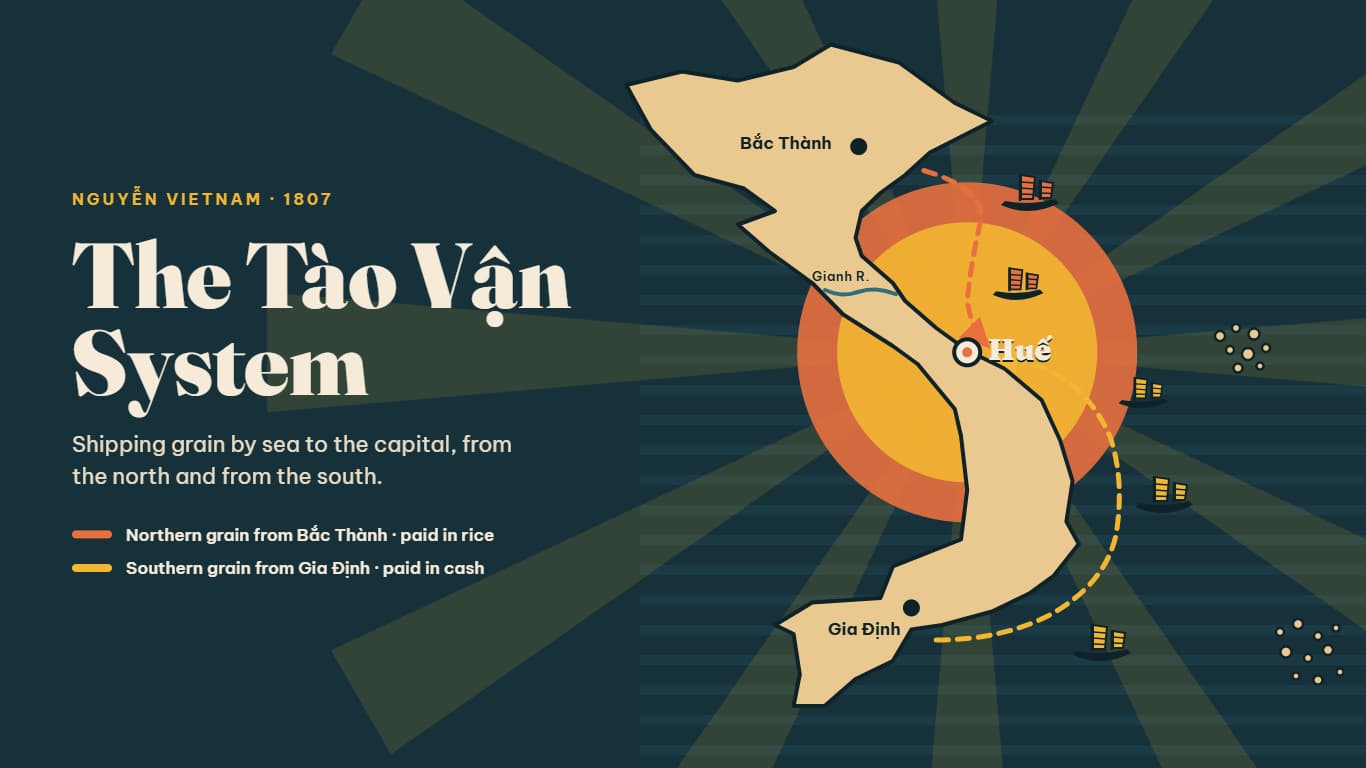
In the 19th century, the Nguyễn dynasty set up a system for shipping grain from the northern and southern halves of the country to the capital at Huế. Historians refer to this as “tào vận” (漕運), a term that refers to the shipment of grain by water, and was historically used in China to refer, for instance, to the shipment of tribute grain along the Grand Canal.
In a chapter on the 19th century in A Maritime Vietnam: From Earliest Times to the Nineteenth Century (2024), Li Tana uses the tào vận system to test the degree to which there was national integration under the Nguyễn. However, her depiction of the tào vận system is wildly inaccurate.
A much more solid account of the tào vận system was produced six years earlier, in 2018, by Taga Yoshihiro in his “Betonamu Genchō no sōun seido ni kansuru kisoteki kōsatsu” ベトナム阮朝の漕運制度に関する基礎的考察 [A foundational study of the grain transport system of Vietnam’s Nguyễn dynasty]. Shigaku zasshi 史学雑誌, 127(8), 1–34. https://doi.org/10.24471/shigaku.127.8_1
The tào vận system is a difficult topic to figure out as its origins are complex and it changed over time. Taga does an extremely admirable job of documenting much of what can be known.
In his article, Taga mentions some regulations that were established for the tào vận system in 1807. Due to the limits of space, Taga does not detail all of the points in those regulations. However, given that those regulations provide some of the clearest information about the early form of the tào vận system under the Nguyễn dynasty, I thought it would be helpful to provide a translation (using Claude) of that passage from the Đại Nam thực lục (Chính biên, Đệ nhất kỷ, 33:7b–10b).
There are some units of measurement that will get repeated below:
Length units: 1 trượng = 10 thước; 1 thước = 10 tấc.
Grain measures: phương (方), thăng (升) and oản (盌). One thùng (桶) = 57 phương 9 thăng.
Money: 1 quan (緡) = 10 mạch (陌).
I have italicized those terms here, but they appear too many times below for me to manually italicize them all in this webpage.
定漕船條例。一曰度法,〈度自船頭遏水板,至船尾遏水板,得幾丈尺爲長,中分之爲中心。再度自中心左邊蓋板内,至右邊蓋板内,得幾尺寸爲横。度自横檔而下,得幾尺寸爲深。〉
[The court] fixed the regulations for grain-transport ships [漕船].
1. Method of measurement [度法]. Measure from the water-stop plank at the bow to the water-stop plank at the stern. The number of trượng and thước obtained is the length. Divide this in half to find the midpoint. Then, at the midpoint, measure from the inside of the deck plank on the left side to the inside of the deck plank on the right side. The number of thước and tấc obtained is the beam [横]. Measure downward from the crossbeam. The number of thước and tấc obtained is the depth.
This explains how ships were measured. The key indicator, as we will see below, was the length of the beam that ran across the center of the ship.
二曰船牌,〈各項船横自五尺以上,各給船牌一張,明著長横深若干尺寸與船户派度姓名,及應載之數。歲十月,諸營鎮各委人來京認領,分給所在船户爲憑。〉
2. Ship plates [船牌]. Every ship of any type with a beam of five thước or more is issued one ship plate. The plate clearly states the ship’s length, beam and depth in thước and tấc, the names of the ship owner and of the person sent to measure the ship, and the amount the ship is to carry. Each year in the tenth month, each dinh [營] and trấn [鎮] sends someone to the capital to collect the plates, which are distributed to the ship owners in their area as proof [of registration].
So, we can see here that ships had to be measured, and that information was apparently reported to the capital. Then people from each dinh [營] and trấn [鎮] had to obtain the above “ship plates” from the capital and deliver them to the respective ship owners.
The terms dinh and trấn, meaning “camp” and “garrison” respectively, originally referred to military units. However, in the Nguyễn dynasty period these names continued to be used even though the units had administrative roles.
三曰載例,〈長舵及公私各項船横自七尺至七尺五寸,例載官糧四百五十方;
七尺六寸至七尺九寸,例載五百五十方;八尺至八尺五寸,例載六百五十方;八尺六寸至八尺九寸,例載七百五十方;九尺至九尺五寸,例載八百五十方;九尺六寸至九尺九寸,例載一千方;十尺至十尺五寸,例載一千二百方;十尺六寸至十尺九寸,例載一千四百方;十一尺至十一尺五寸,例載一千六百方;十一尺六寸至十一尺九寸,例載一千八百方;十二尺至十二尺五寸,例載二千方;十二尺六寸至十二尺九寸,例載二千二百方;十三尺至十三尺五寸,例載二千四百方;十三尺六寸至十三尺九寸,例載二千六百方;十四尺至十四尺五寸,例載二千八百方;十四尺六寸至十四尺九寸,例載三千一百方;十五尺至十五尺五寸,例載三千四百方;十五尺六寸至十五尺九寸,例載三千七百方;十六尺至十六尺五寸,例載四千方;十六尺六寸至十六尺九寸,例載四千三百方;十七尺至十七尺五寸,例載四千六百方;十七尺六寸至十七尺九寸,例載四千九百方;十八尺至十八尺五寸,例載五千二百方;十八尺六寸至十八尺九寸,例載五千五百方;十九尺至十九尺五寸,例載五千八百方;十九尺六寸至二十尺,例載六千一百方。
凡載以載例之數,定爲十分,長舵減十之一,私船減十之三,聽載私糧,以備附耗食用。如船横七尺至七尺五寸,例載官糧四百五十方,長舵減一分,四十五方,寔載四百五方,私船減三分,一百三十五方,寔載三百十五方,餘以此推。〉
3. Loading quotas [載例]. For trường đà [長舵] ships and for public [公] and private [私] ships of all types, the official grain [官糧] each carries by rule is as follows:
beam of 7 thước to 7 thước 5 tấc: 450 phương
7 thước 6 tấc to 7 thước 9 tấc: 550 phương
8 thước to 8 thước 5 tấc: 650 phương
8 thước 6 tấc to 8 thước 9 tấc: 750 phương
9 thước to 9 thước 5 tấc: 850 phương
9 thước 6 tấc to 9 thước 9 tấc: 1,000 phương
10 thước to 10 thước 5 tấc: 1,200 phương
10 thước 6 tấc to 10 thước 9 tấc: 1,400 phương
11 thước to 11 thước 5 tấc: 1,600 phương
11 thước 6 tấc to 11 thước 9 tấc: 1,800 phương
12 thước to 12 thước 5 tấc: 2,000 phương
12 thước 6 tấc to 12 thước 9 tấc: 2,200 phương
13 thước to 13 thước 5 tấc: 2,400 phương
13 thước 6 tấc to 13 thước 9 tấc: 2,600 phương
14 thước to 14 thước 5 tấc: 2,800 phương
14 thước 6 tấc to 14 thước 9 tấc: 3,100 phương
15 thước to 15 thước 5 tấc: 3,400 phương
15 thước 6 tấc to 15 thước 9 tấc: 3,700 phương
16 thước to 16 thước 5 tấc: 4,000 phương
16 thước 6 tấc to 16 thước 9 tấc: 4,300 phương
17 thước to 17 thước 5 tấc: 4,600 phương
17 thước 6 tấc to 17 thước 9 tấc: 4,900 phương
18 thước to 18 thước 5 tấc: 5,200 phương
18 thước 6 tấc to 18 thước 9 tấc: 5,500 phương
19 thước to 19 thước 5 tấc: 5,800 phương
19 thước 6 tấc to 20 thước: 6,100 phương
In all cases, the quota is treated as ten parts. Trường đà ships deduct one-tenth and private ships deduct three-tenths. [In that space] they are allowed to carry private grain [私糧] to cover wastage and [the crew’s] food [耗食]. For example, a ship with a beam of 7 thước to 7 thước 5 tấc has a quota of 450 phương of official grain. A trường đà ship deducts one part, 45 phương, and actually carries 405 phương. A private ship deducts three parts, 135 phương, and actually carries 315 phương. Other cases are worked out the same way.
Here we find an important distinction between different types of ships: trường đà [長舵] ships and public [公] and private [私] ships.
Trường đà ships had been used by the Nguyễn lords prior to the establishment of the Nguyễn dynasty in 1802. While they were under the authority of the government, it doesn’t look like they were actually owned by the government. The evidence suggests that trường đà ships were privately owned, but that their owners were enrolled in a standing transport service organized by the state.
As we will see below, there were ports in the center (just to the south of where the dividing line between the Nguyễn and Lê/Trịnh realms had been prior to the nineteenth century) that had the status of “trường đà ports” and that transported grain for the government every year. Hence, there was a special, and historical, relationship between the Nguyễn and the world of trường đà ships.
Then there were public and private ships. Here, “private” is easy to understand, but “public” is not. Again, I don’t think that these ships belonged to the government. It could be that they belonged collectively to villages, like the communal/public [公] land that each village possessed.
From the information above, it appears that these public ships were probably treated the same as private ships, although the regulation does not say so directly. If so, they could each withhold 30% of the quota of rice “to cover wastage and [the crew’s] food [耗食].”
The trường đà ships, by contrast, could only withhold 10%. It’s not clear to me what accounts for this difference, but it may relate to the long history that the Nguyễn had with the trường đà ships and perhaps a sense that they were more likely to meet a professional standard (and not lose rice) than unfamiliar ships that were contracted to ship grain.
Or perhaps the public and private ships had to be enticed with better conditions to agree to transport rice.
四曰均勞逸,〈凡漕船一年公載,一年行商。如𤅷江以内長舵、公私各項船例載嘉定官糧,長舵定以戊辰應載,己巳行商,公私船以戊辰行商,己巳應載。𤅷江以外,公私船例載北城官糧,亦分爲二,一以戊辰應載,己巳行商,一以戊辰行商,己巳應載,餘以此推。〉
4. Balancing work and rest [均勞逸]. Grain-transport ships carry official cargo [公載] one year and trade [行商] the next. For example, inside [i.e., south of] the Gianh River [𤅷江, in Quảng Bình], the trường đà ships and the public and private ships of all types are assigned to carry official grain [官糧] from Gia Định [Saigon]. The trường đà ships are set to carry [official grain] in mậu thìn [1808] and to trade in kỷ tỵ [1809]. The public and private ships trade in mậu thìn and carry in kỷ tỵ. Outside [i.e., north of] the Gianh River, the public and private ships are assigned to carry official grain from Bắc Thành [the northern region, governed from Hanoi]. They too are divided into two [groups]: one carries in mậu thìn and trades in kỷ tỵ, and the other trades in mậu thìn and carries in kỷ tỵ. Other cases are worked out the same way.
Apart from one exception discussed below, no group of ships carried grain every year. South of the Gianh, trường đà ships alternated with public and private ships from one year to the next. North of it, the public and private ships were split into two groups that took turns.
五曰寬難賠,〈各項船領載官糧,海程遭風有抛棄者,所在官勘寔。如領載在北城者,何艘例受恩頒,每減十二方十五盌,官受十方,船户受二方十五盌,何艘例受雇借,每減八十五升,官受七十五升,船户受十升,其餘以此例折算。如領載在嘉定至廣南者,何艘例載官糧七分者,每減十方,官受其七,船户受其三。何艘例載官糧九分者,每減十方,官受其九,船户受其一。〉
5. Easing compensation for losses [寬難賠]. When a ship of any type that has taken on official grain meets a storm at sea and jettisons [抛棄] [cargo], the local officials investigate and verify it.
For ships that took on their cargo in Bắc Thành: if a ship is entitled to the royal grant [恩頒], then for every 12 phương 15 oản lost, the state bears 10 phương and the ship owner bears 2 phương 15 oản.
If a ship is entitled to the hire [allowance], then for every 85 thăng lost, the state bears 75 thăng and the ship owner bears 10 thăng. Other cases are calculated by this rule.
For ships that took on their cargo between Gia Định and Quảng Nam: if a ship is assigned to carry seven-tenths [of its quota] in official grain, then for every 10 phương lost, the state bears 7 and the ship owner bears 3. If a ship is assigned to carry nine-tenths in official grain, then for every 10 phương lost, the state bears 9 and the ship owner bears 1.
This section has some points that are unclear or confusing. First, I am not sure what a royal grant [恩頒] (literally “a gracious bestowal”) was. However, we can see here that ships that received it followed a similar system of compensation if they lost their cargo.
This section then mentions a hire allowance. This was a payment for transporting rice; however, it came in two forms, rice and cash. In particular, ships that transported rice from the north to the capital received a hire rice [雇借米] allowance while ships that delivered rice from the south to the capital received a hire money [雇借錢] allowance. These two forms of payment are discussed in #6 and #7 below.
As we’ll see below, ships that transported rice from Bắc Thành to the capital received 10 thăng of hire rice for every 75 thăng they carried.
Then in #5 (above) we see that for each 85 thăng lost at sea, the state absorbed 75 thăng and the ship owner 10 thăng. The figure 85 is thus 75 thăng of official grain plus the 10 thăng of hire rice paid on it. This suggests that the hire rice was loaded together with the official grain. So, when cargo was lost, the state wrote off its own grain, and the owner lost his own share of the grain aboard, that is, the payment for carrying it. In effect, he went unpaid for the lost portion but was not made to replace the government’s grain.
The third paragraph above is about ships that delivered rice from the south, and it makes a different point. It references the two percentages of rice that were loaded on ships: one for the government and one to cover wastage and the crew’s food. In essence, it says that the government was responsible for its percentage and the ship for its percentage.
What’s not clear is 1) if the ships from the south got to keep their hire money (presuming that it wasn’t lost in whatever storm was encountered), and 2) how the percentage of grain set aside for wastage and to feed the crew on northern ships was calculated in this system of compensation.
六曰雇借錢,〈以領載糧數多少、海程遠近爲差,每糧五十七方九升爲一桶。如載自嘉定抵京者,給錢三緡,自平順二緡六陌,自平和二緡二陌,自富安一緡八陌,自平定一緡四陌,自廣義一緡,自廣南六陌。如不期有發載在某營鎮抵某營鎮者,其雇借錢以此例推。載二次者,照發如例。〉
6. Hire money [雇借錢]. This varies according to the amount of grain carried and the length of the sea route. Every 57 phương 9 thăng of grain counts as one thùng. For cargo carried from Gia Định to the capital, [each thùng] is paid 3 quan; from Bình Thuận, 2 quan 6 mạch; from Bình Hòa, 2 quan 2 mạch; from Phú Yên, 1 quan 8 mạch; from Bình Định, 1 quan 4 mạch; from Quảng Ngãi, 1 quan; and from Quảng Nam, 6 mạch. If, outside the regular schedule, cargo is dispatched from one dinh or trấn to another, the hire money is worked out from these rates. Ships that carry twice are paid twice by the same rule.
This regulation applied to ships that delivered rice from the south to Huế. They were paid in cash on a scale based on distance from the capital.
七曰雇借米,〈渠河、里和二港及各社全受長舵,常年搬載,不在分番之例。如發載自北城抵京者,每糧七十五升,給雇借糧十升,清平與山南下同,自清華八升,自乂安六升,自廣平四升,自廣治二升。嘉定至肇豐各港不期有領載自廣治以北者,同此雇借例。惟各項船例載在廣南以内,而願載在廣治以外,其自廣治抵京者,每糧一桶,給雇借錢六陌,自廣平一緡,自乂安一緡四陌,自清華一緡八陌,自北城二緡二陌。〉
7. Hire rice [雇借米]. The two ports of Cừ Hà [渠河] and Lý Hòa [里和], and villages that are wholly trường đà, carry cargo every year and are not part of the rotation.
For cargo dispatched from Bắc Thành to the capital, every 75 thăng of grain earns 10 thăng of hire grain [雇借糧]. Thanh Bình and Sơn Nam Hạ are the same. From Thanh Hoa it is 8 thăng; from Nghệ An, 6 thăng; from Quảng Bình, 4 thăng; and from Quảng Trị, 2 thăng.
If ships from the ports between Gia Định and Triệu Phong [肇豐, north of Huế] take on cargo north of Quảng Trị outside their regular assignment [不期有領載自廣治以北者], the same hire rule applies. However, if ships of any type that by rule carry [grain] from Quảng Nam southward wish to carry beyond Quảng Trị [願載在廣治以外], they are paid hire money per thùng of grain: from Quảng Trị to the capital, 6 mạch; from Quảng Bình, 1 quan; from Nghệ An, 1 quan 4 mạch; from Thanh Hoa, 1 quan 8 mạch; and from Bắc Thành, 2 quan 2 mạch.
Here we see that ships that carried rice from the north to Huế were paid in grain/rice rather than in cash. This included ships from the south that were officially assigned to transport northern rice to the capital. However, southern ships could also volunteer to make northern shipments, in which case they were paid in cash on a scale that exactly mirrored the scale based on distance employed in the south.
Meanwhile, Cừ Hà [渠河] and Lý Hòa [里和] were singled out as special places. These were ports in the area of Quảng Bình where there was a long trường đà ship tradition. It appears that the Nguyễn had a close relationship with these places from long before the nineteenth century.
八曰代漕錢,〈各項船例應載者,一年公載,一年出稅錢。行商各照應載官糧九分、七分之數,每糧一桶,納錢二緡,餘倣此。〉
8. Money in lieu of transport [代漕錢]. Ships of any type that by rule are required to carry [grain] carry official cargo [公載] one year and pay tax money the next [出稅錢]. When trading [行商], each pays 2 quan for every thùng of grain, based on its quota of official grain at nine-tenths or seven-tenths. Other cases follow this rule.
In the alternating years when ships were not delivering grain, they had to pay a tax. That tax was based on the amount of grain that was set by the loading quota in #3 above, minus one tenth for trường đà ships or three-tenths for private (and probably public) ships.
However, as we just saw in #7, there were certain “trường đà ports” and “trường đà villages” from which trường đà ships were obliged to deliver rice every year. Hence, they did not have trading years when they needed to pay the above tax.
The final two regulations are pretty straightforward. Here they are:
九曰港稅錢,〈各項船横不滿五尺者,公載稅例竝免。其板船横自五尺至五尺七寸,歲輸稅錢三緡;五尺八寸至六尺三寸,稅錢四緡;六尺四寸至六尺九寸,稅錢五緡。竹船横自五尺至六尺九寸,其稅錢視板船各半;七尺至七尺九寸,稅錢十緡;八尺至八尺九寸,稅錢十四緡;九尺至九尺九寸,稅錢十八緡;十尺至十尺九寸,稅錢二十四緡,自此則止,不得過十尺九寸。魚藝船横自五尺至六尺九寸,其稅錢與板船同;七尺至七尺四寸,稅錢七緡;七尺五寸至七尺九寸,稅錢八緡;八尺至八尺四寸,稅錢九緡;八尺五寸至八尺九寸,稅錢十緡;九尺至九尺四寸,稅錢十一緡;九尺五寸至九尺九寸,稅錢十二緡,至此則止。〉
十曰禁詐冒。〈所在派人度船,差三寸,笞五十,每三寸加一等,罪止杖一百。若受財,以枉法計贓論,追贓入官。船户用情不寔,差自三寸至六寸,罪同;六寸以上,没其船貨,半入官,半賞告者。其或經年修補,而横檔稍廣,即聽單申覆度。船牌頽敝及沈失,亦聽單申懸後。倘有留賣于他,券内須明著其船長横深與應載之數,呈所在官,取具文跡。凡船牌給過現存之數,歲以十月冊開投遞。所存少者,聽其增領備給。敢有僞造船牌,行商及許人借貸,一經告解,僞造與借貸俱坐死,船貨半入官,半賞告解。又船户領載,不得借人代載,有船二三艘,亦各如例。領載不得以一艘而兼領、代領。違者雖遇風濤抛棄,亦據原數責賠,不在赦例。〉
9. Port tax [港稅錢]. Ships of any type with a beam of less than 5 thước are exempt from both official carrying and tax.
Plank ships with a beam of 5 thước to 5 thước 7 tấc pay a yearly tax of 3 quan; 5 thước 8 tấc to 6 thước 3 tấc, 4 quan; and 6 thước 4 tấc to 6 thước 9 tấc, 5 quan.
Bamboo ships with a beam of 5 thước to 6 thước 9 tấc pay half the plank-ship rate; 7 thước to 7 thước 9 tấc, 10 quan; 8 thước to 8 thước 9 tấc, 14 quan; 9 thước to 9 thước 9 tấc, 18 quan; and 10 thước to 10 thước 9 tấc, 24 quan. This is the limit; [bamboo ships] may not exceed 10 thước 9 tấc.
Fishing ships with a beam of 5 thước to 6 thước 9 tấc pay the same as plank ships; 7 thước to 7 thước 4 tấc, 7 quan; 7 thước 5 tấc to 7 thước 9 tấc, 8 quan; 8 thước to 8 thước 4 tấc, 9 quan; 8 thước 5 tấc to 8 thước 9 tấc, 10 quan; 9 thước to 9 thước 4 tấc, 11 quan; and 9 thước 5 tấc to 9 thước 9 tấc, 12 quan. This is the limit.
10. Prohibiting fraud [禁詐冒]. If a person sent locally to measure ships is off by 3 tấc, he receives 50 strokes of the light stick, with one degree added for every further 3 tấc, up to a maximum of 100 strokes of the heavy stick. If he took a bribe, he is sentenced according to the amount of the bribe under [the law on] perverting the law, and the bribe is recovered for the state. If a ship owner, through favoritism or falsehood, causes a discrepancy of 3 to 6 tấc, the punishment is the same. If the discrepancy is more than 6 tấc, his ship and cargo are confiscated, half going to the state and half as a reward to the informant.
If, after years of repairs, the crossbeam has become somewhat wider, [the owner] may submit a petition for remeasurement. If a ship plate is worn out or lost [at sea], he may also submit a petition to have it recorded for [later reissue]. If [a ship] is sold to someone else, the contract must clearly state its length, beam, depth and quota, and must be presented to the local officials to obtain written documentation.
Each year in the tenth month, the number of ship plates issued and still on hand is listed in a register and submitted. Where few remain, [the locality] may apply for more to keep in reserve.
Anyone who dares to forge a ship plate, or to trade with one, or to lend one to others, once denounced and brought to trial, is sentenced to death, both the forger and the borrower or lender. The ship and cargo go half to the state and half as a reward to the person who denounced them.
Further, ship owners who take on cargo may not have others carry it in their place. Owners with two or three ships are treated by the same rule for each ship. A single ship may not take on combined or proxy loads. Violators must compensate for the full original amount, even if they jettison cargo in a storm, and are not covered by amnesties.
As I said at the outset, this system changed over time; however, I think these 1807 regulations serve as a good starting point to understand in general how the system worked (at least at first), and in particular, how complex it was.
