
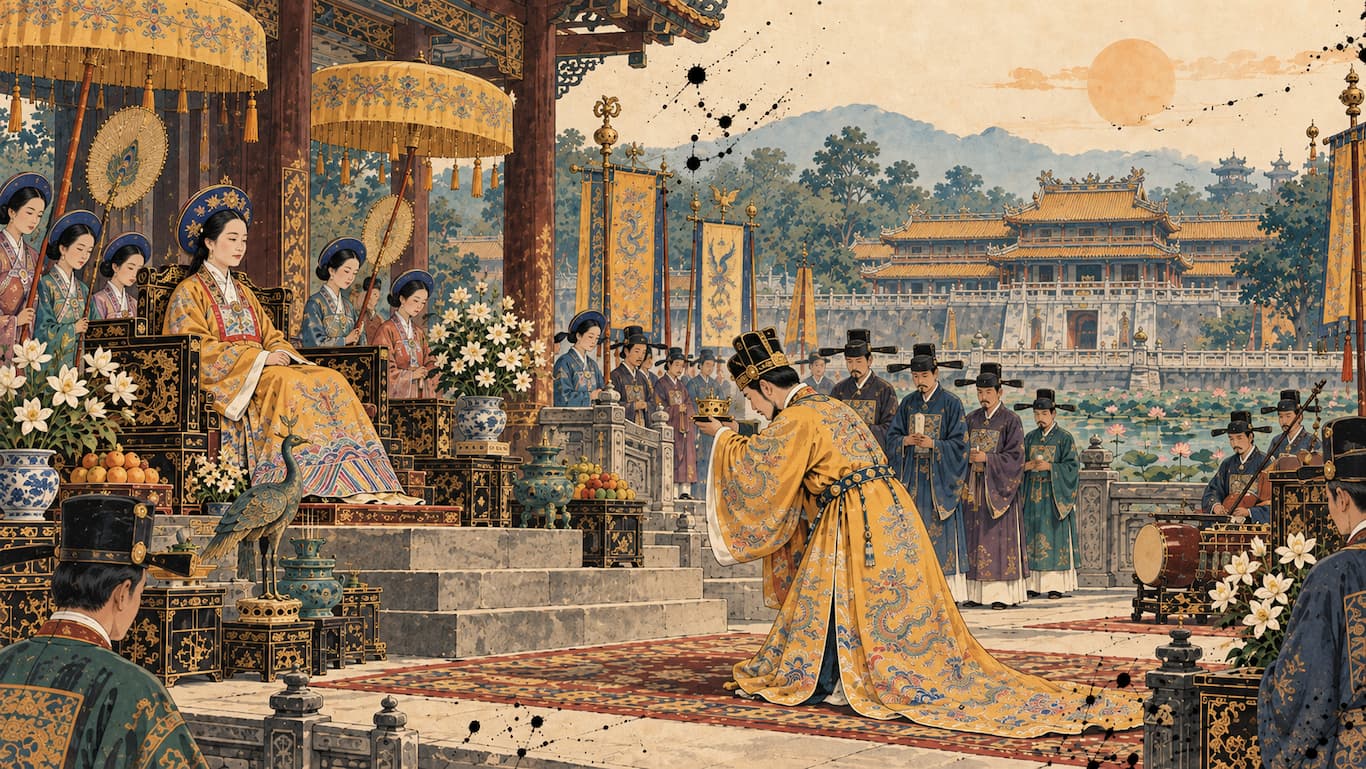
I recently read a really interesting article by historian Taga Yoshihiro on “Economic Aspects of Court Rituals and Ceremonies in Nineteenth Century Hue.”
In the article, Taga examines the economics behind certain Nguyễn dynasty rituals. It’s a fascinating article, and I encourage everyone to read it.
At one point in the article, Taga discusses a ceremony that was held by Emperor Minh Mạng in 1827 for the 60th birthday of the empress dowager. It was clearly an epic event, and so I decided to translate that passage with Claude.
Emperor Minh Mạng issued an edict at the end of this celebration that would still take a lot of work to fully translate, as the language is ornate and the text contains numerous classical allusions. But readers should be able to get a gist from the version below.
Also, the headings below are not in the original text. They are there to break up the information below to hopefully make it more readable.
This is recorded in the Đại Nam thực lục, đệ nhị kỷ, 49/11a-18b.
Preparing for the Celebration
Because this year the Empress Dowager would reach her sixtieth birthday, the emperor first ordered the Ministry of Rites to examine the ritual codes and submit a proposal. The ministers reported: “Our kingdom has received Heaven’s favour and been granted vast blessings. The Empress Dowager is strong and fortunate, and her long years increase. His Majesty reverently serves her joy and has begun this celebration. From now on, let it be held every ten years, so that all within the seas may rejoice together and the annals gain lustre. As for engraving jade and casting gold in order to raise her honorific titles, let this wait for a later occasion, to make her radiant virtue plain.”
The emperor approved the proposal. He ordered the officials concerned to put up decorated sheds to the left and right of the Observing Goodness Chamber [Duyệt Thiện đường 閱善堂]; to build a decorated tower in front of the courtyard inside the Immortal Longevity Gate [Tiên Thọ môn 僊壽門], with decorated sheds to its left and right; and to build decorated sheds in the courtyard of the Hall of Diligent Governance [Cần Chánh điện 勤政殿] and a banquet chamber in front of the Spreading Civility Tower [Phu Văn lâu 敷文樓].
He then fixed the order of the ceremonies. (In ordinary years, at the Festival of Sacred Longevity [Thánh thọ tiết 聖壽節], the emperor presented twenty taels of gold and two hundred taels of silver; now pearls, jade and rare objects of every kind were added. The imperial sons, the dukes, the Imperial Clan Court [Tôn Nhân Phủ 尊人府], and all civil and military officials customarily presented one hundred and twenty taels of silver; now they were to present twenty taels of gold, together with brocade, satin, gauze, pongee, fine silk and cloth of every colour. The citadels and garrisons and the subordinate kingdoms and tributary Man [thuộc quốc cống man 屬國貢蠻; with “Man” literally meaning “savage”] were each to bring local products suited to them, such as kỳ nam aloeswood, ordinary aloeswood, rhinoceros horn, and silks of every colour.)
Musical pieces were composed. Singers from Thanh Hóa, Nghệ An and Bắc Thành, together with performers of the hundred entertainments and other arts, over sixty persons in all, and musicians from Chân Lạp [真臘, Cambodia] and Cam Lộ [甘露, inland Quảng Trị Province area], over twenty, were selected and assembled at the palace gate, ready to sing and play. The prohibitions and the dates for hanging lanterns were proclaimed in the capital and the provinces. (For ten days in all, namely seven days before, the day itself, and two days after, the handling of legal cases was suspended. For five days in all, namely three days before, the day itself, and one day after, slaughter of animals was forbidden. On these five nights, officials, soldiers and commoners were each to hang lanterns at their doors.)
The Days Before the Celebration
On the day bính thìn (ten days before the Great Celebration), and from that day until the day of the ceremony itself, the officials attended court in their ranks, and while working in their offices all wore full dress. Each day the emperor went to the Palace of Maternal Longevity [Từ Thọ cung 慈壽宮] in court dress to watch over the Empress Dowager’s meals, and he knelt to offer the spoon and chopsticks with his own hands.
The Empress Dowager said: “Serving the meal and handing over the chopsticks is the work of the palace attendants and maids. Why should the emperor trouble himself like this?” The emperor replied: “Everyone else in the world is busy running about and cannot look after their parents. Only I can serve and care for mine at her side. Only when I do this is my heart at ease.” The Empress Dowager then asked: “Now that the celebration is being held, are people in the capital and in the provinces content?” The emperor replied: “Officials and commoners alike have received your kindness, and they do not count the running about as hard work. Their offerings of local products are also a way of showing their sincerity. This is what everyone wholeheartedly wishes.”
Actors performed rope-walking and ladder-climbing plays inside the Immortal Longevity Gate. The emperor escorted the Empress Dowager to the decorated tower to watch them.
The Ministry of Rites submitted a register of the congratulatory local products from the various places. The emperor said: “Kỳ nam, rhinoceros horn, gauze and silks are all local products, and they are enough to show the givers’ humble sincerity. But the gold from Bắc Thành must have been bought specially for the purpose.” He sent it back.
Fourteen men from the native districts [thổ ty 土司] of Bắc Thành, Thanh Hóa and Ninh Bình, including the native defence commissioner Quách Công Nguyên, the native prefect [thổ tri 土知] Lưu Trọng Chương and the native sub-prefect Phan Thiên Thạch, offered local products. The emperor said: “You are attached to the provinces and circuits, and you are not like the subordinate kingdoms and tributary Man. The local products of your places include your own share, so why offer something separately? You are excused.” He gave each of them a set of ordinary court dress.
Chân Lạp sent envoys to present congratulatory gifts (cardamom, amomum and purple ant, fifty catties of each; two elephant tusks; two rhinoceros horns; two pairs of deer antler velvet; twenty bolts of coloured silk), together with the annual tribute. The emperor rewarded the chief envoy, Nhâm Lịch Đột 壬瀝突, with the great court dress of the fourth military rank, and the deputy envoys, Phạt Kha Đê 伐柯低 and Na Đốc Ca 篤卡文, with the ordinary court dress of the sixth civil rank. Each also received clothes, trousers, and quilts and bedding against the cold.
The various Man of the Seven Stockades of Cam Lộ [Cam Lộ Thất Sách 甘露七冊] and the Three Upland Settlements of Lạc Phàm [Lạc Phàm Tam Động 樂凡三峝] offered congratulatory gifts. (Seven Stockades of Cam Lộ: twelve elephant tusks, five rhinoceros horns and two pairs of deer antler velvet. Three Upland Settlements of Lạc Phàm: four elephant tusks and one rhinoceros horn each.)
A Nỗ [阿弩, Anou], chief of the kingdom of Vạn Tượng [萬象, Vientiane], sent a memorial saying: “The customary rite of making the journey to court has kindly been waived for my kingdom. I beg instead to offer, as a respectful gift, things left by my ancestors: a pair of gold finger ornaments and twenty-three pieces of jade.” The officials of Nghệ An Province forwarded it, but the emperor declined it and told him: “I have already seen your sincere heart. What a kingdom treasures is worthy men. Even a pearl as bright as the moon, or a jade that lights up a carriage, is not what I value, and still less stones that merely look like jade!”
The emperor rewarded the soldiers and craftsmen who had built the towers and sheds with money, in differing amounts. He then said to the Ministry of Rites: “I have already approved building a decorated shed in the courtyard of the Hall of Diligent Governance as the place for granting banquets. But I think of the banquet rites of earlier emperors, which were mostly held in the hall itself. The hall here is high and open, so why build a shed and burden the workers? From now on, whenever there is a celebration, banquets may be given in the hall.”
Reporting the Great Celebration
On the day ất sửu, the emperor reported the Great Celebration ritual to the Hall of Imperial Benevolence [Hoàng Nhân điện 皇仁殿]. That night he composed with his own hand the poem “Feelings on a Winter Night” [Đông dạ hữu cảm 冬夜有感]. At the morning court he showed it to his officials, and with tears he told them: “My late father, the Generational Ancestor and Grand Emperor [Thế tổ Cao hoàng đế 世祖高皇帝], opened up the territory and unified the realm. His merit was great and his virtue rich, and I cannot describe even a ten-thousandth part of it. His age was nearing sixty, and I meant to wait until the year tân tỵ to ask to hold a celebration. I did not expect that he would ascend to heaven, and now my call cannot reach him. Each time I speak of it my heart grieves, so I wrote this poem to set out what I feel is lacking in me. The filial duty of an emperor lies in continuing his predecessor’s aims and carrying on his work, in setting up norms and laying down the canon for all time, and not only in ceremonies. Even so, a son serving his parent must still have these complete rites, so that no regret is left behind. Now that the Empress Dowager’s sixtieth birthday has come, raising the cup and offering good wishes cannot repay her deep kindness, but through this a son’s heart may be a little comforted.”
The emperor escorted the Empress Dowager to the decorated tower and had the musicians perform the dance of auspicious omens and play the music of the eight Man peoples inside the Immortal Longevity Gate. (It began with Cam Lộ and Chân Lạp and ended with Vạn Tượng.)
He feasted the princes, dukes and civil and military officials in the left and right chambers inside the Immortal Longevity Gate.
The Great Celebration
On the day mậu thìn, the Great Celebration ceremony [Đại khánh lễ 大慶禮] was held. The emperor wore the nine-dragon crown, the yellow robe and the jade belt, and led the princes, dukes and civil and military officials to the Palace of Maternal Longevity. There he presented the golden congratulatory memorial and the gifts.
(The emperor’s gifts were: a “Ten Thousand Years of Longevity” ruyi sceptre of green jade; a “Longevity, Firmness and Purity” diamond as large as a fingertip; ten sticks of top-grade ginseng from Guandong, “for long life”; a set of longevity wine; a pair of long, large rhinoceros horns inlaid with gold; a pair of “Imperial Longevity, Eternal Spring” flowers, with gold-traced porcelain vases and glass covers; a carved gold longevity terrace with clouds and phoenixes, set with pearls; a tall, large aloeswood tree; nine finely carved nine-tiered pagodas of white stone, containing nine incorruptible gold-bodied images of the Buddha of Boundless Life; and a pair of finely made longevity screens of kingfisher feathers set with pearls and decorated with flowers and birds.
The boxes and cases were placed on yellow tables to the left and right. The cases of memorials and gift boxes from the princes, dukes, the Imperial Clan Court, princesses, senior princesses, women of the imperial clan, and civil and military officials, together with the cases of congratulatory memorials and gift boxes from the citadels, provinces and circuits, were placed in the decorated sheds to the left and right of the Observing Goodness Chamber. The cases of congratulatory memorials and gift boxes from the subordinate kingdoms and tributary Man were placed on the red tables in the decorated sheds to the left and right of the decorated tower.)
Three longevity toasts were offered. (For the first, Duke of Kiến An, Đài [建安公旲] and Duke of Điện Bàn, Phổ [奠盤公普]; for the second, Duke of Định Viễn, Bính [定遠公昞] and Duke of An Khánh, Tĩnh [安慶公㫕]; for the third, the eldest prince [皇長子] and Prince Miên Nghi [皇子綿宜], who held the gold wine vessel and the gold cup.) Five pieces of music were played. (When the Empress Dowager took her seat, the Venerating Celebration piece [Sùng Khánh chi chương 崇慶之章] was played, and the musicians and dancers performed with rattle drums, clappers, zithers, moon lutes, pipas, flutes, three-string and two-string instruments. At the first toast, the Assembled Celebration piece [Tập Khánh chi chương 集慶之章] was played, with the dance of the blue flower branch; at the second the Manifest Celebration piece [Chương Khánh chi chương 彰慶之章], with the dance of the red flower branch; at the third, the Preserved Celebration piece [Bảo Khánh chi chương 保慶之章], with the dance of the yellow flower branch. When the rite was complete, the Completed Celebration piece [Thành Khánh chi chương 成慶之章] was played, with the dance of the immortal peach.
The envoys and attendants of the tributary kingdoms and the chiefs of the tributary Man were led by the Ministry of Rites to the courtyard before the decorated tower to present their congratulatory gifts. The elders of the imperial clan, the students of the imperial clan, the duke surname (?) [công tính 公姓] and the Trần clan [Trần tộc 陳族] all paid their respects in the courtyard before the decorated tower. The elders and headmen of the Honoured Village and the Honoured District [Quý hương Quý huyện 貴鄉貴縣], the members of Văn Xá commune [Văn Xá xã 文舍社], the students at the Imperial Academy, the elders of Thừa Thiên, and the people of the Lê and Trịnh clans paid their respects outside the Immortal Longevity Gate. Trung Hầu [Company] fired nine congratulatory cannon salutes. The princesses, senior princesses, palace consorts of the former reign, daughters of the dukes, concubines of the princes and dukes, women of the imperial clan, and the wives of civil and military officials were led in separately by the palace eunuchs to pay their respects.)
Inside the palace, officials great and small all carried out their duties. Outside, the subordinate kingdoms, the tributary Man and the native officials were all joyful and respectful. When the rite was complete, by the Empress Dowager’s decree, the princesses and those below them were feasted in the Observing Goodness Chamber and in the left and right sides of the decorated tower. Then the palace treasury was opened, and rewards were given to the princes of the blood and the relatives, in differing amounts. (Princes of the blood, 4,000 strings of cash; the senior princesses, 5,500 strings; the emperor’s sons and daughters, 10,000 strings; the consorts of the former reign, 1,000 strings; the sons and daughters of the dukes, 1,000 strings; the men and women of the imperial clan, old and young, 5,000 strings; the concubines of the dukes, 500 strings; the wives of civil and military officials, 1,000 taels of silver; the Trần clan, 1,000 strings; Văn Xá commune, 500 strings; the Lê Xuân clan of Ba Nguyệt commune, 300 strings; Ba Nguyệt commune, 200 strings.)
The Great Banquet
On the day kỷ tỵ, there was a great banquet in the Hall of Diligent Governance for the princes, dukes, civil and military officials of the third rank and above, and provincial officials of the rank of tham tri and hiệp trấn. Beforehand, the Ministries of Personnel and of War had drawn up a register. Phan Văn Thúy, commander of the Long Võ Camp, and Trần Văn Cương, right commander of the Palace Guard, served as ministers of the rear escort. Phạm Văn Điển, commander of the Elephant Army, and Nguyễn Văn Trọng, acting left commander of the Palace Guard, served as the guards who poured the wine. The guard commander Vũ Văn Từ, Nguyễn Xuân and others, eight men in all, served as guards leading the way. Phạm Viết Thục, Nguyễn Văn Hòa and others, four men in all, served as guards carrying the leopard-tail spears. The director of the Medical Institute, Nguyễn Trọng Tính, and the deputy guard commander Vũ Văn Giải served as guards who inspected the imperial meal. Thân Văn Quyền, Phan Đình Sĩ and Tôn Thất Gia of the Secretariat served as recorders of the emperor’s daily activity.
On that day the emperor came to the Hall of Diligent Governance. The princes, dukes and civil and military officials who attended the banquet all waited on him in court dress. Prince Miên Định, the imperial relative Duke of Kiến An, Đài, and the senior minister Lê Văn Duyệt, duke of a commandery, offered toasts in turn, and the eight-row dance was performed. When the rite was complete, rewards were given in differing amounts.
(Princes and dukes who carried out duties and offered the toasts each received one roll of crêpe gauze and three bolts of gauze. The civil and military senior ministers who offered the toasts each received one roll of crêpe gauze and two bolts of gauze. The princes and dukes who attended the banquet each received three bolts of satin, three bolts of gauze and one cushion. Civil and military officials of the senior first rank, and the dukes of commanderies, received four bolts of satin and two of gauze. Officials of the senior first rank received two bolts of satin and two of gauze. Those of the junior first rank and the senior second rank each received two bolts of satin and two of gauze. Those of the junior second rank received one bolt of satin and two of gauze. Those of the senior and junior third rank each received one bolt of satin, one bolt of gauze and one small roll of silk.)
Officials of the fourth and fifth ranks, retired officials, the staff of the Secretariat, and the native officials of the provinces and circuits were feasted in the banquet chamber at the Spreading Civility Tower. (Officials of the senior fourth rank received six taels of silver, those of the junior fourth rank five taels, and those of the senior and junior fifth rank four taels each. Retired officials received as follows: senior second rank, thirteen taels; junior second rank, eleven taels; senior third rank, ten taels; junior third rank, eight taels; senior and junior fourth and fifth rank, as above. Staff of the Secretariat of the junior sixth rank and below received one bolt each of southern gauze and southern silk. Native officials received one bolt each of gauze and satin.)
The subordinate kingdoms and the tributary Man were feasted at the Left Grand General’s depot. (The regular rewards and the additional rewards were handed out in the courtyard before the Primal Heaven Hall [Càn Nguyên điện 乾元殿]. The king of the kingdom of Chân Lạp received in addition five rolls of coloured satin, five bolts of red feather silk, two rolls of red crêpe gauze, twenty bolts of coloured gauze and forty bolts of coloured plain silk. The chief envoy and the deputy envoy each received ten taels of silver and three bolts each of coloured gauze and coloured silk. The chiefs of the Seven Man Stockades of Cam Lộ each received five taels of silver, one roll of Song brocade, and three bolts each of gauze and silk. The chief of the Man of Lạc Phàm received two rolls of Song brocade, two bolts of red feather silk, two rolls of jade-blue crêpe gauze, ten bolts of coloured silk and twenty bolts of coloured gauze. The chiefs of the Man of the Three Upland Settlements received two bolts of red feather silk, one roll of jade-blue crêpe gauze and fifteen bolts of coloured gauze.)
The members of the imperial clan, those without posts, the elders, the duke surname, the Trần clan, the Honoured Village and the Honoured District, Văn Xá commune, the Lê Xuân clan and Ba Nguyệt commune were feasted separately, by the Empress Dowager’s decree, in the left and right chambers inside the Immortal Longevity Gate. Civil and military officials of the junior fifth rank and above who could not attend the banquet because of some matter were also given coloured silks and silver according to their rank, in differing amounts.
The Imperial Edict
On the day canh ngọ, the emperor took his seat in the Hall of Supreme Harmony [Thái Hòa điện 太和殿] to receive congratulations and issued an edict to the capital and the provinces. The edict said [what follows is a rough draft, as this edict has ornate language and numerous allusions that need to be investigated]:
“I consider that when the sages set up their teaching, honouring filial piety is how the constant norms are made firm. And when a king takes the throne, gathering blessings is how they are then spread and granted. Great blessings must go to the virtuous, and no duty is greater than honouring one’s parent. I respectfully think of my sage mother, the Empress Dowager, of a distinguished line whose fragrance has spread, and whose dignified bearing shows gentle virtue. When my late father, the Generational Ancestor and Grand Emperor, rose with the divine martial power of clouds and thunder, the hard going of Min in Reng [緡仍; an allusion to Shaokang’s mother, who fled pregnant to Reng] was passed through, and prosperity came twice over. She also heeded the lesson of the hairpin and earrings [zanger 簪珥], the story of Queen Jiang, wife of King Xuan of Zhou, and urged him to diligence. Her fine reputation, like that of Taisi by the rivers Qia and Wei [洽渭], was truly one of harmony. She began by laying the foundation of the king’s civilising influence [vương hóa 王化], and she left rich bequests to shelter her descendants [yến dực 燕翼, from the Odes]. She taught and guided me, and her bright light shone on my early upbringing. The blessings of Zhongsi and Linzhi [two odes, on many grandsons and worthy sons] spread widely, and her radiance shone like the jades Wan and Yan [琬琰]. She recited the Odes and followed the rites, and benevolence and frugality were her model. She was abundant in the purity of jade and the constancy of gold, and her kindness and good fortune extended their shelter. Her breadth and depth match the earth that carries all things, and she receives Heaven’s protection again and again. In the Cassia Hall spring is deep, and the celebrations of her long life, ten thousand years, follow one another. On the Daylily steps the moon is bright, and the sixty-year cycle [hoa giáp 花甲] has just come full circle. Her birthday has come round again, and the good omens of the Jasper Pool [Yaochi 瑤池] gather thickly. The immortal’s tallies pile up, and we rejoice in the lasting spring of the Sea House [Haiwu 海屋]. She has received vast blessings, and the source of this celebration lies deep and far back. Looking up at Heaven, who gives blessing, I see in it the sure protection of the ancestral temple and the altars of the state. I respectfully carry on her shining light, and I stand near to her fine example. In the charts and histories of the Zhou capital, everything was traced to the root of a single filial devotion and so handed down. In the Han palace, the music of Jun and Shao [鈞韶] brought the nine provinces together in joy and service. I am glad to meet this festival, and I now perform the fine ceremonies. On the twenty-fourth day of this month I reported to the Hall of Imperial Benevolence [Hoàng Nhân điện 皇仁殿]. On the twenty-seventh I led my officials in person to present the golden memorial and respectfully perform the rite for her longevity. Honour was complete in every respect, and the ceremony was most grand. The officials in sashes and caps gathered to voice their joy, and throughout the furthest bounds of the land people offered prayers and blessings. Having already held the celebration in early spring, I now extend the reach of filial piety, and to bestow still more blessings I join to it the spreading of grace at the winter solstice [á tuế 亞歲]. To make this great ceremony shine, I now pour out a fresh grace. The favours I grant are seven in number.”
(1. Civil and military officials of the fourth rank and above in the capital and of the third rank and above outside, down to the tham tri and hiệp trấn of the provinces and circuits, are each promoted by one level. Any official, inside or outside, great or small, who has a fault, whatever the public or private offence, and who was demoted but kept in post, is allowed to have one level restored. 2. Officials of the fifth rank and below in the capital and of the fourth rank and below outside who are entitled to a salary receive two months’ salary in cash. Those not entitled to a salary receive one month’s. 3. The parents of civil and military officials of the third rank and above, in the capital and outside, are given honorary titles according to rank, in differing grades. 4. For the citadels, prefectures, provinces and circuits, the unpaid cash, grain, products and taxes of every kind up to and including the fourth year of Minh Mạng are all remitted. 5. In the capital, clerks without rank, soldiers and craftsmen each receive one string of cash. 6. Officials inside and outside the capital who were penalised with a cut in salary for mishaps in public duty are all pardoned. 7. Students at the Imperial Academy, both resident and tribute students, each receive one month’s stipend.)
Alas! May the almanac plant open with good omens, and may long years be reckoned without end. At the banquet of peaches may blessings gather, and may wishes for long life be offered in the cups, rising like the sun and moon. May ten thousand peaceful days bring her joy. I, humble as I am, receive this deep blessing; the grace of the Thái Dịch [太液] pond soaks into you, my officials and people, and you should receive it with respect.”
Bestowing Rewards
Before this, the weather had been fine and clear for a long time. When the Great Celebration ended, thick clouds suddenly gathered on all sides and sweet rain poured down. By the time the edict of grace was proclaimed, the sky had cleared again. People in the capital and in the provinces were all delighted, and they took it as a response to the emperor’s filial virtue. The emperor calmly told his officials: “The celebration was held, and the rain and the sun came at just the right times. This is not something people can bring about. I have received this great gift with even greater awe. This event has brought joy to all above and below, and it also meets what people outside look for from us.”
In the twelfth month, civil officials from the rank of viên ngoại lang and military officials from the rank of deputy guard commander upward were gathered in the Observing Goodness Chamber and given three days of plays to watch. Plays were also staged for three days at the Spreading Civility Tower, mixed with the music of the eight Man peoples and various skits, so that scholars and commoners could all gather to watch.
The emperor gave coloured silks to the officials of the citadels, provinces and circuits. He told them: “In today’s celebration, all who attended in their ranks to offer good wishes have shared in the rewards. I think of the officials of the citadels, provinces and circuits, who serve diligently outside. How could this favour be limited to those here? Let them be given gauze and satin in differing amounts.”
The emperor added to the posthumous honours of Lê Văn Toại, father of Lê Văn Duyệt, giving him the title of đô thống of the senior first rank, and raised Duyệt’s mother, née Nguyễn, to lady of the first rank. Toại had earlier been given the posthumous title of thống chế of the senior second rank, and under the rules he could not share in this grace. But the emperor, thinking of Duyệt’s merit and standing as an old servant, made a special exception for him.
The emperor added the title of hiệp biện đại học sĩ to Nguyễn Đăng Hựu, retired Minister of War. Hựu was over eighty. When he first reached the capital, the emperor received him, gave him a seat, asked after him, and said: “You served in the former reign and held office through two ranks, and you carried yourself without fault. You retired earlier because of age and frailty. Now, at this celebration, you have come in spite of illness to offer congratulations. Your sincerity deserves praise. I give you a poem of my own composition, together with clothes, bedding and one hundred strings of cash.” Now he was given this title as a further reward. Hựu wished to stay for the New Year court congratulations, but the emperor told him: “At your advanced age, staying long in lodgings is not what I intend for an old minister. I also hear that you have a young son at home. Go back and teach him, and I will consider recording his name for employment, to encourage loyalty.” The emperor then ordered soldiers to escort him home and gave him two hundred strings of cash.
The emperor gave the retired chưởng cơ Nguyễn Văn Hưng one hundred strings of cash.
The emperor bestowed the surname Kim 金 on the Chân Lạp chief envoy, Ốc nha Nhâm Lịch Đột. In the previous year, regarding the work for the Vĩnh Tế canal, Nhâm Lịch Đột had been the most useful of the frontier officials, and Lê Văn Duyệt had once praised him to the emperor. Now the emperor received him in the Hall of Diligent Governance. Nhâm Lịch Đột answered clearly and in detail, and the emperor highly praised him, issued a special letter under the imperial seal, and bestowed the surname. When he was about to return, the emperor told him in person: “When you go back, tell your king that you have received my favour today because you worked hard for the court in digging the canal. This also comes from your king’s skill in knowing and using men, so rewarding you is rewarding your king. If you and your colleagues assist your king, so that high and low are in harmony and the affairs of the kingdom are in good order, that is how you show loyalty to the court.” After he returned to his kingdom, he fell ill and died before long. The emperor ordered Gia Định to send one hundred taels of silver.
The emperor rewarded the subordinate kingdoms and tributary Man of Chân Lạp, Cam Lộ, Lạc Phàm and the Three Upland Settlements with silver and silk, and sent them home.
Because the celebration had been completed, the emperor gave the senior officials of the Ministry of Rites, Phan Huy Thực, Đoàn Viết Nguyên, Hồ Hữu Thẩm and Hà Quyền, one entry on their records each, and gave silver in differing amounts to the ministry officials and clerks who had handled the arrangements.
