
I have long been aware that there are a lot of stone inscriptions in Vietnam. Inscriptions are, of course, very important for the study of the past, but for a long time, Vietnamese inscriptions were difficult to access.
Until recently, the main way to study Vietnamese inscriptions was to go to the Viện Hán Nôm in Hanoi, request to see a rubbing of an inscription, and then a librarian would bring out a big piece of fragile folded paper that one would have to unfold, read and take hand notes as it is not allowed to photograph them.
Then in the early 2000s, the Viện nghiên cứu Hán Nôm, the École française d’Extrême-Orient, and the École pratique des hautes études began to publish facsimiles of the rubbings (Tổng tập thác bản văn khắc Hán Nôm / Corpus des inscriptions anciennes du Việt-Nam) as well as a catalog (Thư mục thác bản văn khắc Hán Nôm Việt Nam / Catalogue des inscriptions du Việt-Nam).
At this point, I think 22 volumes of the facsimiles and 11 volumes of the catalog have been published. This makes it easier to research what is written in Vietnamese inscriptions than requesting one inscription at a time at the Viện Hán Nôm. However, these volumes were published over time, and they are enormous (very big and heavy). As such, a researcher would have had to have made multiple trips to Vietnam over a 20-year period and paid an excess baggage fee each time in order to be able to acquire these precious volumes and haul them back to their home.
As such, while helpful, the publication of the volumes of facsimiles, as far as I can tell, only marginally advanced the study of Vietnamese inscriptions.
Now, however, we are in a new era. Thanks to the Vietnamica Project, a major five-year European and Vietnamese academic research initiative (2019–2024) that was led by French scholar Philippe Papin and funded by the European Research Council, thousands of Vietnamese inscriptions have been digitized and are available online as high-quality scans (https://vietnamica.online/).
What is more, the Vietnamica Project has also promoted scholarship on the inscriptions and made that output freely available (in Vietnamese and French) on its website.
Hậu inscriptions (後碑)
I have seen various different statements about the total number of Vietnamese inscriptions and rubbings from the inscriptions. As far as I can tell, a conservative assessment would be that there are at least 25,000 steles, represented by approximately 40,000 rubbings, the majority originating from the Red River Delta.
A majority of these inscriptions record acts of donation (cung tiến). Among such inscriptions are ones that are particular to Vietnam. These types of inscriptions can be collectively called “hậu” inscriptions (bia hậu / hậu bi 後碑). Further, the scholars who have worked on these inscriptions have estimated that hậu inscriptions constitute somewhere between two-thirds and three-quarters of Vietnamese stone inscriptions.
What is a hậu inscription? It is an inscription that records a donation of money, land, or other property to a village temple or Buddhist monastery in exchange for granting the donor or a designated person a certain status or title. That status/title then entitled the person to receive offerings and sacrifices performed by the village community or Buddhist monks on specified occasions, particularly the anniversary of their death after they passed away.
For instance, a villager might donate money or land to a Buddhist temple. In return, the temple would grant the donor the status of “hậu Phật” (後佛, literally, “after Buddha”). After the donor’s death, the monks would perform rituals and make offerings of food and incense each year on the anniversary of the donor’s death.
What did “hậu Phật” mean? The meaning of “hậu” 後 here (also written as 候 and 后) is debated. Some people think that it means that the person was worshipped “behind” or “after” the Buddha, whereas others think it might come from the Vietnamese term “hầu” which means “to serve.”
Meanwhile, there were other kinds of “hậu.” For instance, people who donated to a village or the temple of a spirit could be granted the status of “hậu thần” (後神, literally, “after spirit”).
Finally, and this is a really fascinating element, village officials were often involved in these transactions, even when the transactions involved a Buddhist temple, as they served the role of “guarantors” to ensure that the arrangement between the donor and the Buddhist temple was upheld.
As such, there were different kinds of “hậu” and the process of granting someone this status and establishing the contractual rules concerning the donation and return obligations is collectively referred to as “lập hậu” (立後, “lập” means “to establish”).
Explanations for the Lập Hậu Phenomenon
There have been two approaches to understanding the lập hậu phenomenon. First, there are Taiwanese scholars who have attempted to see this practice as somehow evolving from Chinese religious practices that were shared by the Vietnamese. For instance, in a 2013 article, Lin Shan-wun 林珊妏 examined how the Chinese tradition of establishing shrines to living people (shengci 生祠) intersected with the Vietnamese practice of granting hậu thần status. She characterized this combination as a fusion of Chinese cultural traditions and Vietnamese local religious customs.
More recently, in 2021, Geng Huiling 耿慧玲 and Mao Han-kuang 毛漢光 compared the Vietnamese practice of lập hậu with Chinese ideas of continuing sacrificial offerings to the dead, but noted that in the case of Vietnam, this practice developed into a distinctive form of village social regulation.
The second approach has been put forth by Philippe Papin. Papin has researched hậu inscriptions for at least a couple of decades by now, and in 2022 produced a major monograph in French, a work that has been translated into Vietnamese and is available on the Vietnamica website.
Papin, P. (2022). La chair des stèles : enquête sur les donateurs et les Épigones du Bouddha et des divinités, au Vietnam, des origines à la fin du XVIIe siècle [The flesh of the steles: An investigation into the donors and epigones of the Buddha and the deities in Vietnam, from the origins to the end of the seventeenth century]. Les Belles Lettres.
Papin, P. (2025). Sinh thể văn bia: Khảo cứu lịch sử về cung tiến và bầu Hậu ở Việt Nam từ khởi nguyên đến cuối thế kỷ XVII [The flesh of the steles: A historical study of donations and the conferral of hậu status in Vietnam, from the origins to the end of the seventeenth century] (M. L. Doãn, T. H. Nguyễn, & T. H. G. Dương, Trans.). Nhà xuất bản Khoa học xã hội.
Papin examines inscriptions through the lens of pious donation (cung tiến). He documents and quantifies the inscriptions concerning different forms of donation. Further, rather than looking at donations along ideological lines, such as “Buddhist donation” or “Confucian donation,” Papin distinguishes between different categories of donation, namely, 1) donations made without explicitly stated reciprocal benefits, 2) donations that secured spiritual or ritual benefits, and 3) donations that resulted in the formal conferral of hậu status, which entitled donors to commemorative sacrifices.
By tracing changes in the relative frequency of these different categories of donation, Papin has shown that the practice of lập hậu began in the early seventeenth century and that there was a dramatic increase in hậu inscriptions (particularly hậu Phật inscriptions) during the second half of that century.
Papin’s monograph is a treasure trove of information about the lập hậu tradition, and now that it can be read alongside the actual inscriptions themselves, the door to this topic has been opened wide for everyone to investigate.
Recently I have been doing precisely that, and it has been fascinating to go back and forth between Papin’s monograph and the inscriptions.
In the process, what I have realized is that there is an intellectual dimension to this topic that scholars have overlooked. Indeed, I can see that the lập hậu phenomenon can clearly be placed in the larger currents of East Asian intellectual and social history.
As such, I think that the Taiwanese scholars had the right instinct to look to China for comparison; however, the issues in China that are important for understanding the practice of lập hậu in Vietnam are different from the ones they identified.
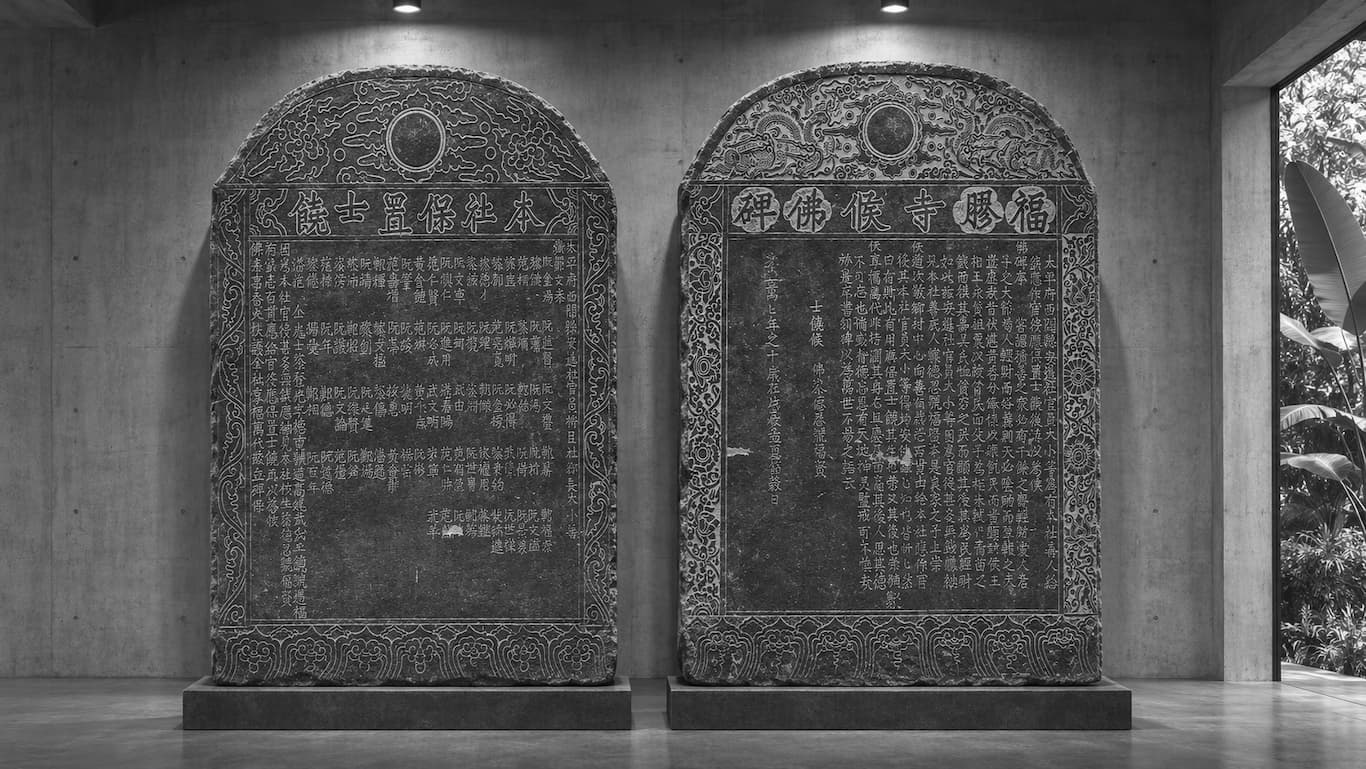
The 1628 Exempted Scholar Inscription
The earliest known mention of the term “hậu Phật” comes from two inscriptions dating from 1628. One has the title “This Village Guarantees the Appointment of the Exempted Scholar” (Bản xã bảo trí Sĩ nhiêu 本社保置士饒), and the other is called the “Phúc Giao Temple Hậu Phật Inscription” (Phúc Giao tự Hậu Phật bi 福膠寺候佛碑). These two inscriptions are from the opposite sides of the same stone stele that was erected at a place called An Tiêm village (安暹社) in the Red River Delta region in what was until recently known as Thái Bình Province, but in 2025 that province was merged into Hưng Yên Province.
Both inscriptions are available on the Vietnamica website (#4349 and #4350), and they were also transcribed (with some minor errors) and translated (although one key passage is summarized rather than translated) in a compilation of seventeenth-century hậu inscriptions that is also available on the Vietnamica website. (Note: at this point, everyone should use AI to check and double-check and triple-check everything.)
I’ll refer to these inscriptions as the “Exempted Scholar Inscription” and the “Phúc Giao Temple Inscription.”
Let us begin by looking at the Exempted Scholar Inscription. It explains that:
因為本社官役甚多,無錢應納,見本社校生黎德忍號福賢有錢壹百貫應給官役,應保置士饒,再以為候佛,奉事香火,扶護全社享福萬代。茲立碑保。
Because our village has many official corvée duties and lacks the money to meet them, we saw that Lê Đức Nhẫn, a hiệu sinh [a student of the school] of our village and styled Phúc Hiền, has one hundred strings of cash to supply for the official duties. [The village] should guarantee the appointment of him as a “sĩ nhiêu” [exempted scholar], and also make him a “hậu Phật,” so that offerings of incense and fire [i.e. the rites of worship] will be made to him. [He will] support and protect the whole village, so that it enjoys blessings for ten thousand generations. We hereby erect this stele to guarantee [this agreement].
What we see here is that An Tiêm could not cover the costs of official corvée duties (官役). Lê Đức Nhẫn then donated money. The village officials then agreed to “guarantee the appointment” (bảo trí 保置) of Lê Đức Nhẫn as a “sĩ nhiêu” 士饒 and “hậu Phật” 候佛.
The term “sĩ nhiêu” is written in Vietnamese word order, and refers to a scholar who has been exempted from certain taxes or duties. As for “hậu Phật,” as stated above, scholars debate what exactly it meant. Further, while here “hậu” is written as 候, in later inscriptions the more common character was 後, and sometimes, 后.
Given that Lê Đức Nhẫn was to receive the honor of “offerings of incense and fire” (奉事香火) and that he would then “support and protect the whole village, so that it enjoys blessings for ten thousand generations,” it would appear that the status of “hậu Phật” is one that he would enjoy after he died, while “exempted scholar” was a status he would enjoy in this lifetime.
What we therefore see in the Exempted Scholar Inscription is that a (young?) scholar gave money to cover local government costs, and the local officials appointed him to two positions, one secular and one religious. In addition to this information, the Exempted Scholar Inscription also contains the names of over 80 local officials. It thus reads like a contract between the village and Lê Đức Nhẫn, one that was witnessed and guaranteed by the officials listed on the stele.
The 1628 Phúc Giao Temple Inscription
The inscription on the other side of this stone stele, Phúc Giao Temple Inscription, is the text of a preface entitled “Preface to the Stele [Recording] the Guaranteeing of Appointment of Exempted Scholar and Hậu Phật [Status] by the Officials of all Ranks of An Tiêm Commune, Tây Quan District, Thái Bình Prefecture to the Good Doer who Contributed Money to Cover Official Corvée Duties” (太平府西關縣安暹社官員大小等,為有本社善人給錢應作官役,應保置士饒,後再以為候佛碑序).
In this title, we see the same basic information that was presented in the Exempted Scholar inscription. Lê Đức Nhẫn is referred to as a “good doer” who gave money to cover the costs of official corvée duties. The officials then agreed to guarantee the appointment of Lê Đức Nhẫn as an exempted scholar and a hậu Phật.
As we will see next, the term I have translated as “good doer” (thiện nhân 善人), is a very important term, as it connects Lê Đức Nhẫn and his actions to a larger East Asian world of ideas and actions.
The Phúc Giao Temple Inscription does not list the names of the village officials. Instead, the preface begins with a passage that legitimates the act of donation. It states:
嘗謂:積善之家,必有千餘之慶。輕財愛人,君子之大節。苟人輕財而好義,則天必陰助而厚報之。夫豈虛哉!
It has been said that a household that accumulates good deeds will surely enjoy a thousand blessings and more. To hold wealth lightly and care for others is a cardinal virtue of the gentleman. If a person holds wealth lightly and cherishes righteousness, Heaven will surely aid him unseen and reward him generously. How could these words be empty?
Morality Books (Thiện Thư 善書)
For anyone familiar with the history of popular religion in China, this opening passage should be immediately recognizable, as it begins with (a slightly altered version of) a well-known statement from the Yijing: “A household that accumulates good deeds will surely have blessings to spare. A household that accumulates wrongdoing will surely suffer misfortunes that linger” (積善之家,必有餘慶;積不善之家,必有餘殃).
This expression is extremely common in the morality book (thiện thư/shanshu 善書, literally, “goodness book”) tradition. Morality books were works that were supposedly revealed by spirits, and they promoted Confucian morality through the (ultimately Buddhist) concept of (karmic) reward/retribution. The key concept was “goodness” (thiện 善). If you accumulated good deeds (tích thiện 積善), you would be rewarded.
While the morality book tradition can be traced back to the Song dynasty period, with the emergence of works like The Most High Lord’s Treatise on Action and Response (Thái Thượng Cảm Ứng Thiên 太上感應篇), it later gained a lot of popularity in the Ming period.
In the early fifteenth century, the Yongle Emperor ordered a book compiled entitled Doing Good and Its Unseen Rewards (Weishan yinzhi / Vi thiện âm chất 為善陰騭) to teach precisely this concept of how good acts would be rewarded, if not in this life, then in the future one’s descendants would reap the rewards of one’s good deeds.
The Đại Việt sử ký toàn thư records that in 1419, that text was distributed to schools in Vietnam together with the Four Books and the Five Classics. And as Cuong T. Mai has pointed out in his “Buddhist Karmic Discourses in Confucian and Daoist Voices in Vietnamese Tales of the Marvelous and Uncanny,” Vũ Quỳnh used the exact phrase “doing good and its unseen rewards” 為善陰騭 in his 1492 preface to the Lĩnh Nam chích quái.
Back to the Phúc Giao Temple Inscription
So, right from the beginning of the Phúc Giao Temple Inscription, we can see that it points to a larger East Asian world of ideas by referencing the statement from the Yijing that was used to justify the ideas promoted by morality books.
The next statement in the inscription makes the same point, but with regards to the act of donation: “To hold wealth lightly and care for others is a great virtue of the gentleman. If a person holds wealth lightly and cherishes righteousness, Heaven will surely aid him unseen and reward him generously” (輕財愛人,君子之大節。苟人輕財而好義,則天必陰助而厚報之).
Thus, the Phúc Giao Temple Inscription begins by stating that people who do good (thiện 善) will be rewarded, and then it says that people who donate money for the good of others will receive “unseen aid” (âm trợ 陰助) from Heaven and will enjoy a “generous reward” (hậu báo 厚報).
Where does this second idea come from? One place we can see it clearly recorded is in the Annotated Examination Policy Essays (Shi ke celüe jianshi 十科策略箋釋), a collection of examination-style essays by the Ming scholar and official Liu Dingzhi 劉定之 (1409–1469). In the first chapter of that work, there is a model examination question and answer. The question asks:
問:輕財而愛人者,君子之大節,此我大[太]宗文皇帝為善陰騭書之作,所以詳載其人焉,願舉以對。
To hold wealth lightly and care for others is a cardinal virtue of the gentleman. That is why, when our Emperor Taizong, the Cultured Emperor, composed Doing Good and Its Unseen Rewards, he recorded in detail the lives of those who exemplified this virtue. Cite examples in your answer.
And in the model answer, we find:
人苟能輕財而好義,則天必陰助而厚報之,夫豈虛哉!
If a person can hold wealth lightly and cherish righteousness, Heaven will surely aid him unseen and reward him generously. How could these words be empty?
Hence, the Phúc Giao Temple Inscription has almost the exact same wording as the Annotated Examination Policy Essays. Further, it continues by discussing historical figures who exemplified this spirit of “holding wealth lightly and cherishing righteousness,” and these historical figures are the exact same ones discussed in the opening passages of the model answer in Liu Dingzhi’s text. Both the texts mention Fu Zhan 伏湛, Huang Xiang 黃香, Wang Xiang 王相, Wang Yong 王永, Zhu Shi 朱軾 and Wu Wu 吳五 (Wu Shi 吳氏 in the inscription). These were all men who used their wealth to help people in need, and as a result, they or their descendants were rewarded, usually in the form of attaining a high office in the government.
The passage in the Phúc Giao Temple Inscription is as follows:
昔伏湛、黃香分俸祿以賑飢民,而貴顯封侯;王相、王永貸租粟以救貧民,而父子為相;朱軾代青苗之錢,而獲其壽;吳氏恤貧窮之民,而顯其後。其為民輕財如此。
In former times, Fu Zhan (伏湛) and Huang Xiang (黃香) shared their official stipends to relieve the starving. They rose to prominence and were enfeoffed as marquises. Wang Xiang (王相) and Wang Yong (王永) lent out grain collected as rent to help the poor, and both father and son became chief ministers. Zhu Shi (朱軾) paid what others owed on their Green Sprouts loans and was rewarded with long life. The Wu family (吳氏) cared for the poor and destitute, and its descendants rose to prominence. Such was the way they held wealth lightly for the sake of the people.
Having thus justified the act of donation, the Phúc Giao Temple Inscription then discusses the particular case of An Tiêm village and Lê Đức Nhẫn’s donation as follows:
茲安暹社官員大小等,因為官役甚多,無錢應納。見本社善底人黎德忍號福賢,本是良家之子,上崇佛道,次敬鄉村,中心向善,有錢壹百貫,出給本社,應作官役。其本社官員大小等,得均安□睡睡如也,皆忻忻然曰:“有財此有用,應保置士饒。”其生也荣,又其後也荣,□〔宜?〕以為候佛,享福萬代。非特潤其身,尤且慶及苗裔。其後人思其德,不可忘也。倘或背德忘恩,有天地神灵監戒,可不慎哉!
於是序書刻碑,以為萬世不易之語云。
We, the officials of An Tiêm village, of all ranks, had many obligations to fulfill for the authorities and no money with which to meet them. There was a man of our commune known for his good deeds, Lê Đức Nhẫn, who went by the name Phúc Hiền. He came from a respectable family, revered the Buddhist Way above all, held his village in esteem, and was devoted at heart to doing good [thiện 善]. He had one hundred strings of cash, which he gave to the commune to meet its obligations to the authorities.
The officials of the commune, of all ranks, could then rest easy [one character unclear] and sleep soundly. They all said with delight, “Here is wealth put to good use. We should grant him the status of ‘exempted scholar.’” He was honored in life, and he would be honored after death. It was [fitting] to designate him a Hậu Phật, so that he might enjoy blessings for ten thousand generations. The blessings would benefit him in his own person and extend to his descendants.
Let those who come after remember his virtue and never forget it. Should anyone disregard his virtue and forget his kindness, the spirits of Heaven and Earth will be watching. How could one fail to take heed?
We therefore wrote this preface and had it engraved on the stele, so that these words would stand unaltered for all generations.
Philippe Papin has studied these two inscriptions and argued that they are “two different versions of the same text” (hai phiên bản khác nhau của cùng một văn bản). One, the Exempted Scholar Inscription, is the “official text” (văn tự chính thức) granting the titles of exempted scholar and hậu Phật, while the other, the Phúc Giao Temple Inscription, is an “ornate version” (phiên bản hoa mỹ), or a “literary version of the same text, embellished with praise for compassion and the sharing of wealth” (phiên bản văn chương của cùng một văn bản, tô điểm bằng lời ca ngợi tấm lòng bác ái và sự sẻ chia của cải) (Papin, 2025, p. 406).
The Phúc Giao Temple Inscription is not simply an ornate version of the Exempted Scholar Inscription. Instead, it is a statement of legitimation, and that statement can only be understood by looking at the wider East Asian context.
The Larger Context of Giving
One very important point to note is that the Ming dynasty period was a time when donation was officially promoted, and became a practice that the literati/gentry participated in.
For instance, in 1440, the Ming court launched a nationwide famine-reserve granary program and commoners who built and stocked granaries under local government supervision were honored as “righteous commoners” (yimin/nghĩa dân 義民). During the Ming period there were also similar honors that were granted to people who helped with famine relief, such as the granting of the status of “righteous official” (yiguan/nghĩa quan 義官).
At the same time, charitable giving became a significant elite practice. This is discussed by Joanna Handlin Smith in her The Art of Doing Good: Charity in Late Ming China (2009).
While giving had long been practiced through families, religious institutions, and the state, Smith argues that from around 1590, members of the local gentry began forming voluntary benevolent societies that could mobilize people across kinship and social boundaries. Smith argues that this development emerged as there was a growing pool of literate men who could keep accounts and administer relief, as well as closer working relationships among gentry, students, physicians, monks, and local officials.
Perhaps more relevant for the case the practice of lập hậu in Vietnam, is Timothy Brook’s Praying for Power: Buddhism and the Formation of Gentry Society in Late-Ming China (1993). In this work, Brook argues that patronage of Buddhist monasteries helped the late-Ming gentry build local influence outside government office. At that time, the number of educated elites grew faster than the number of official posts. By funding monastery construction and restoration, donating land, and writing commemorative inscriptions, gentry families could make their standing publicly visible and build relationships with other local elites. Abbots actively sought this support, and the donations helped revive Buddhist institutions.
My Hypothesis
One point that Brook mentions is that there are cases where members of the gentry would donate to a Buddhist temple on behalf of, or in honor of, their mothers. They did this so that they, as Confucian scholars, would not have to directly associate themselves with a Buddhist institution.
This, I would argue, is close to what we see in the lập hậu phenomenon. In particular, what I see in the Phúc Giao Temple Inscription is a Confucian defense for an act that orthodox Confucianism avoids, namely, interacting with the spirits or otherworldly powers.
The Analects states “Respect ghosts and spirits, but keep them at a distance” (Kính quỷ thần nhi viễn chi 敬鬼神而遠之). That is a fundamental idea in the Confucian tradition, namely, that you keep a distance from otherworldly powers.
However, the persuasiveness of the ideas in the morality book tradition was based on the idea that there was some “unseen/hidden” force out there that responded to human actions. This created a tension: one was supposed to keep the ghosts and spirits at a distance, but the unseen/hidden power that responded to human actions did so in a way that supported the Confucian moral order. Further, in studying the topic of morality books in nineteenth-century Vietnam, I have seen texts that explicitly discuss this tension, and do so by referencing the above line from the Analects, so I am not making this tension up. It was real.
In the end, members of the elite came to see that the ideas in morality books were helpful for teaching common people to follow Confucian moral values and to obey the government. Hence the Yongle emperor’s promotion of Doing Good and Its Unseen Rewards in the early fifteenth century. And closer to the time of the two 1628 inscriptions, you had morality books like Yuan Huang’s 袁黃 (1533–1606) Liaofan’s Four Lessons (Liaofan sixun 了凡四訓) that were very popular. This work and others are discussed in Cynthia Brokaw’s The Ledgers of Merit and Demerit: Social Change and Moral Order in Late Imperial China (1991, Princeton University Press).
So, let’s think about what happened in 1628. The village officials of An Tiêm needed money. Works like the Doing Good and Its Unseen Rewards explained that if you donate money for a good purpose, then you (or more likely your descendants) would enjoy a “generous reward” (hậu báo 厚報).
While that part was straightforward, the problematic part was that the “generous reward” was made possible by “unseen aid” (âm trợ 陰助), and like the “ghosts and spirits,” that was an otherworldly force that scholars needed to “keep at a distance.”
Further, while it was certain that good deeds would be rewarded, it was not certain when that would happen. . . Not, that is, unless you could “guarantee” it. But how could you guarantee it while still keeping your distance from otherworldly powers?
By outsourcing that guarantee to a Buddhist temple. . .
There is virtually nothing Buddhist about the Phúc Giao Temple Inscription. Instead, I would argue that it is a popular Confucian legitimation of the act of giving that argues that if you engage in the good deed of giving you will be rewarded.
The only thing “Buddhist” in the text is the passing remark that Lê Đức Nhẫn “came from a respectable family, revered the Buddhist Way above all, held his village in esteem, and was devoted at heart to doing good” (本是良家之子,上崇佛道,次敬鄉村,中心向善).
While Lê Đức Nhẫn may very well have been attracted to Buddhism or even a devout believer, whoever wrote this inscription was clearly not. In a text devoid of any Buddhist terminology, and surrounded by information that points to Lê Đức Nhẫn’s position as a member of the gentry, the statement that he “revered the Buddhist Way above all” looks like it was added to please the people at Phúc Giao Temple who would be responsible for carrying out the rituals at his death anniversary after he passed.
So, what was the relationship between the officials (88 of them are listed on the Exempted Scholar Inscription), Lê Đức Nhẫn, and the Phúc Giao Temple?
If I read these inscriptions in a cynical manner, then it looks like a scam to me. I can imagine the 88 officials saying to a young Lê Đức Nhẫn, “Yes! If you give us the money, then you and your descendants will all receive blessings. Not only that, we’ll make sure that those blessings will go on forever because we’re going to carve this agreement in stone, and after you die someday, the Phúc Giao Temple will perform rites on your death anniversary forever!! So great is this going to be that not only you, but the entire village will benefit!! You’ll be a hero!!!”
If, however, I put that cynicism aside and try to imagine a world where all of the above ideas from morality books and the goodness of giving were circulating, as well as the ideas about the need for the Confucian elite to keep a distance from otherworldly powers, then I can see a logic to the arrangement.
Ultimately, the reality may have been somewhere in between these two scenarios.
What is certain to me, however, is that the lập hậu phenomenon has a very important intellectual aspect to it that 1) has not been addressed and 2) is closely linked to ideas and practices that were circulating in the larger East Asian world.
I am certain of this not simply because of my reading of the above inscriptions, but because I have seen these kinds of ideas expressed over and over in inscription after inscription. Again, this is not “ornate” language. Instead, it all points to the intellectual foundation of the practice of lập hậu.
Finally, let me conclude by noting that a ton of great work has already been carried out on the topic of hậu inscriptions, particularly by Philippe Papin and the scholars who have contributed to the Vietnamica Project. Further, the digitization of the inscriptions is an immensely important contribution. As such, that I can write over 5,000 words just talking about two sides of a single inscription is only possible because of the wonderful foundation that Papin and others have established through years of hard work.
Indeed, the Vietnamica Project has provided scholars of premodern Vietnam with incredible resources and scholarship to learn from and to examine ourselves. There is still so much that can be explored and discussed, but finally we have the means to do so and a foundation to stand on!! So, thank you so much to Philippe and everyone who has contributed to the project!!!
While I agree with you about the importance of Vietnamica making these inscriptions easily available, pace Keith Taylor in the Journal of Asian Studies, I was not very impressed with the Papin volume on their study. That book is astonishingly ignorant of the scholarship in Chinese and Japanese on temple and other donatory inscriptions, and indeed of almost any literature on comparable and even contemporaneous practices in China. The absence of Joanna Handlin and Cynthia Brokaw from the bibliography is quite remarkable, since these works are decades old now and available in even a mediocre Parisian library (In fact, they are so old I even had to read them in graduate seminars!). Strangely, Papin has written his book as though there has been almost no other scholarship on China, Buddhism, donations, or inscriptions at all. The bibliography is very limited indeed.