Today my wife, Le Ha, told me that there was going to be an opening of an art exhibit at the university library and that she wanted to go to the event.
I looked at the announcement that had been sent to her email. It was all in English, but when I clicked on the link to the website announcement, everything was in Chinese.
“I think this is going to be in Chinese,” I said. “I know,” Le Ha responded, “but I still want to go.”
“Why is the email message you got in English?” I asked. “Oh, because I clicked on ‘translate.’”
So, we went to the event. The infrastructure was great. You entered a nice reception room, which opened up to a single, nicely lit gallery where chairs had been set up for the talk.
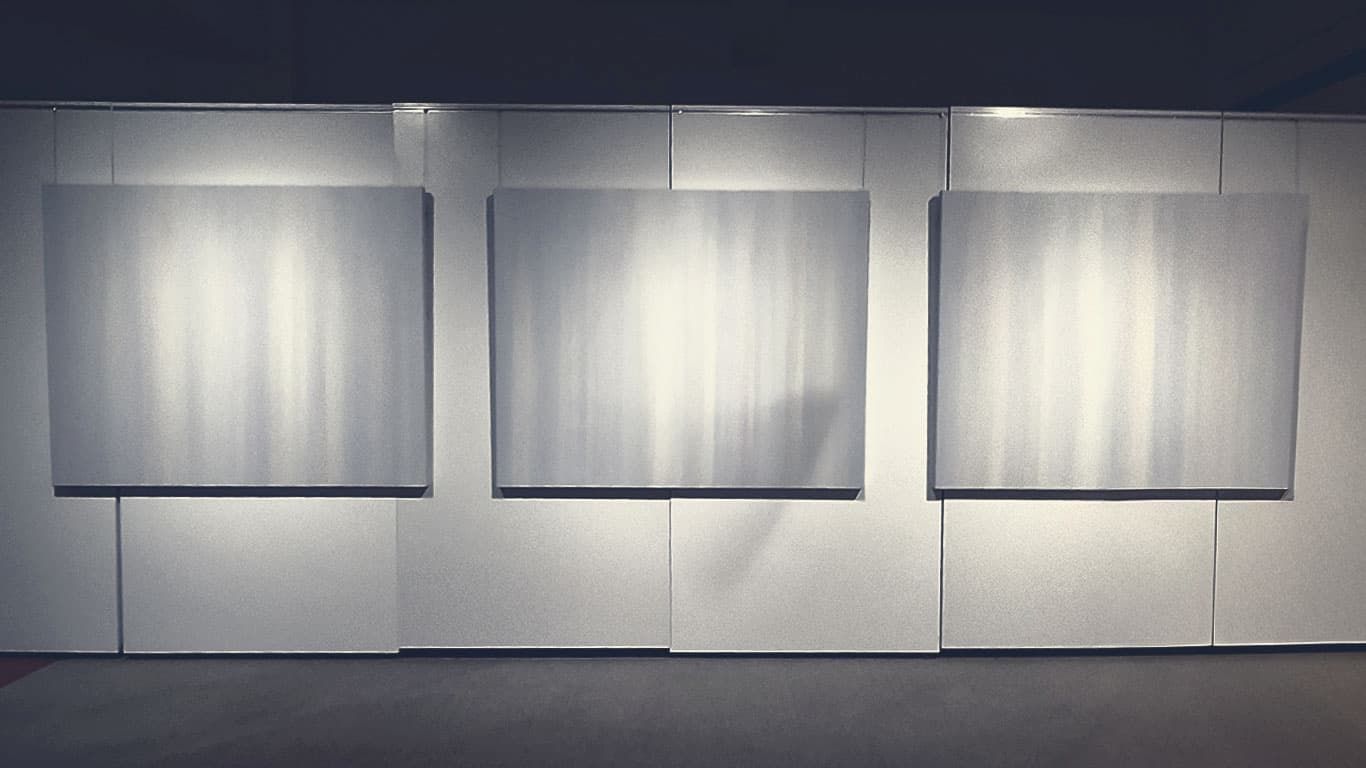
The artist whose work was exhibited is named Li Yixing (李一星), and he is originally from Mainland China. His exhibit is called “White Noise” (Bai zao yin 白噪音).
While we were waiting for the event to begin, I looked at his artwork and read the introduction to the exhibition:
If painting is not regarded as a window that creates the illusion of space, what else can it be?
In the exhibition White Noise, I attempt to suspend both the object and its meaning. By emptying a text of its original content, the number of strokes in each individual character is directly translated into the number of marks made on the canvas. In this way, the text ceases to be something read and instead becomes a set of instructions directing the body to perform a single repetitive task.
Through this process, a form of rule-governed automaticity gradually emerges. As a single action is repeated, the pictorial surface returns to a state without narrative, one that can no longer be read. Through the accumulation of mechanical repetitions, intentions and thoughts are gradually filtered out, eventually giving way to a sense of stillness. Here, the body and the canvas recede into a purely physical “site.” What remains on the painted surface is a density of material that, once the action has ceased, can no longer be read back into meaning.
This exhibition presents these ongoing explorations of ideas through a combination of two-dimensional works and documentary materials.
As I read this, I thought to myself: There is no way on earth that I’m going to be able to understand what people talk about at this event.
In the end, I did have trouble understanding, but it wasn’t because they spoke in the above “art speak.” It was because they were deeply philosophical.
In addition to the artist, there was a host and two professors who spoke at the event. One of the professors was an emeritus professor, I’m guessing in his 70s, while the other was perhaps in his 40s or early 50s.
I’m mentioning their ages because their comments revealed something significant about their generations.
At one point, when the discussion had turned to the issue of what exactly the creative impulse is and how it works, the emeritus professor launched into an extended philosophical discussion. It began with Wang Yangming’s interpretation of the classic phrase, gewu zhizhi (格物致知), and ended with a discussion of relevant concepts in Buddhist philosophy.
The younger professor, meanwhile, was also philosophical, but his explanations were made through analogies with the natural world and everyday life.
As I listened to these two men speak, I realized that I was witnessing the twilight of a mode of thinking. The way that the emeritus professor thinks is not being replicated, and it will pass into obscurity.
Yes, there will still be “philosophy geeks” who will learn about Wang Yangming’s ideas and Buddhist philosophy, but this emeritus professor is not a “philosophy geek.” He is just an intellectual who was educated in an age when becoming familiar with the ideas of Wang Yangming was something that happened more or less by default in the process of becoming educated.
I’ve noticed something similar with philosophy in Vietnam. In the early 2000s, there were always people who would stand up during the Q&A session at a conference and launch into a big philosophical discussion, one that would go from Kant to Heidegger to Marx, etc.
I don’t see that anymore, and haven’t seen it for years.
At the talk this afternoon, there were some young people who attended, but they left early, leaving the middle-aged participants to listen to a philosophical discussion by an elderly intellectual that will likewise probably not be heard much longer.