
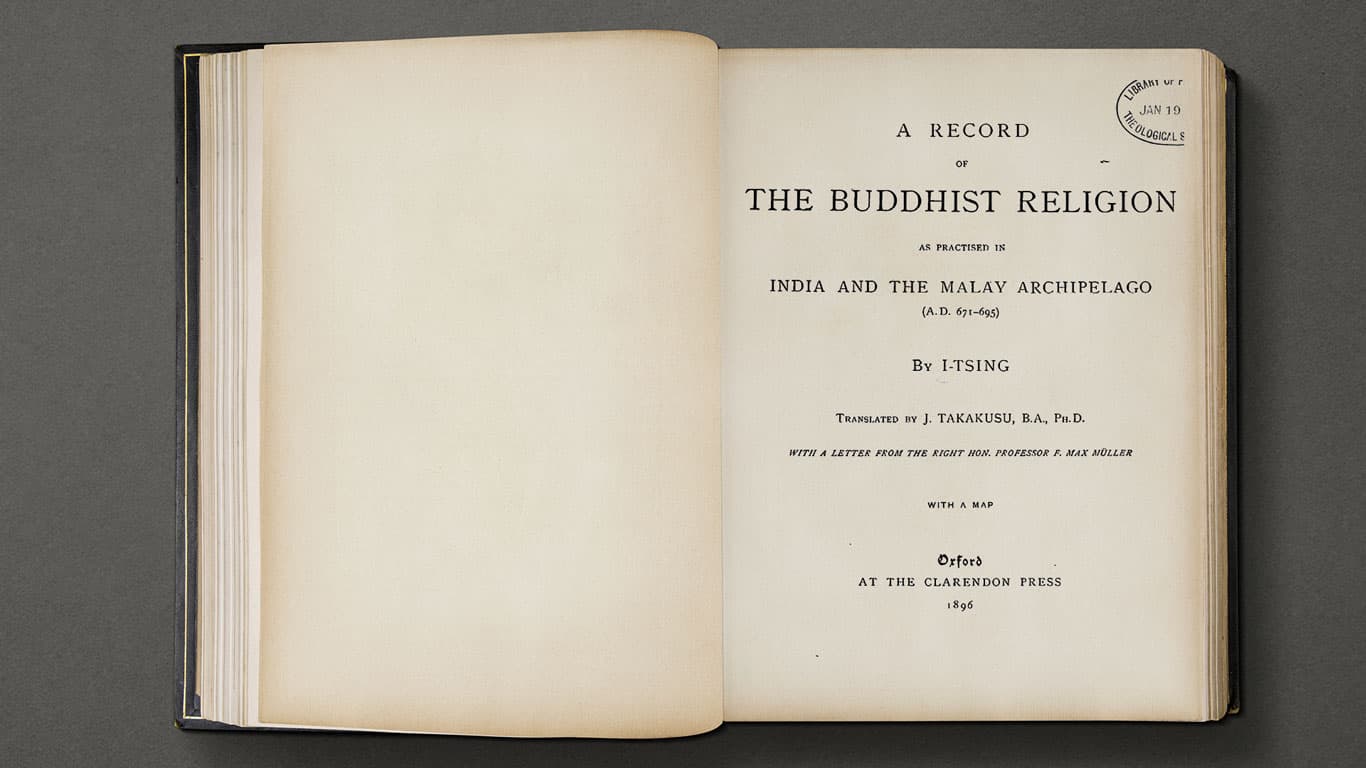
In 1967, historian O. W. Wolters published his Early Indonesian Commerce: A Study of the Origins of Srivijaya. In that work, Wolters mentions Yijing, the seventh-century Chinese monk who traveled through Southeast Asia on his way to India and back, 189 times!!
From that number alone, I think we can gain some sense of how important Yijing and his writings have been for the “Srivijaya is a kingdom at Palembang that was referred to in Chinese sources as (Shili)Foshi and Sanfoqi” narrative.
Indeed, it is in Yijing’s writings that the term “Shilifoshi” first appears in Chinese sources, and in 1918, George Cœdès would claim that this name, together with a later Chinese name, Sanfoqi, both indicated the name “Srivijaya” that was found in some inscriptions in the area of southern Sumatra, as well as on the Malay Peninsula in what is now southern Thailand, and which Cœdès argued had been a kingdom based at Palembang.
Ever since, Cœdès has been praised as some kind of genius for making these connections. In fact, however, by the late nineteenth century, other scholars had already associated Shilifoshi and Sanfoqi with each other and with Palembang.
What Cœdès did was to 1) not investigate how those scholars had come to their conclusions and 2) declare that Shilifoshi and Sanfoqi both indicated “Srivijaya,” a linguistic impossibility.
What I have attempted to demonstrate in this series of posts, is that the nineteenth-century scholars that attempted to link Shilifoshi with Sanfoqi, and both with Palembang, is fundamentally flawed.
To briefly recap, let us look at how Wolters discussed this information in his 1967 work, and I will intersperse my comments with his text.
Julien in 1861, through a study of Chinese transcriptions of Sanskrit words, reconstructed I Tsing’s [Yijing’s] Shih-li-fo-shih [Shilifoshi] as Çrībhodja.
– Note that Julien did not transcribe Shilifoshi as “Srivijaya.”
In 1876 Groeneveldt identified San-fo-ch’i [Sanfoqi] a Sung and Ming toponym, with a port on the Palembang river and suggested that it was the ‘Sarbaza’ mentioned by Arabs in the ninth century.
– And Groeneveldt did this by following late-Ming/early-Qing scholarship that contains flawed (imagined) information about the earlier geography of the Southeast Asian region.
In 1883-1886 Beal, whose interest was Sino-Indian Buddhist relations, was, by extending the equation of toponyms, the first to demonstrate the long span of what was later to be known as ‘Srivijayan’ history. He accepted Yule’s view that Marco Polo’s ‘Malaiur’ was Palembang, observed that I Tsing had said that ‘Mo-lo-yu [Moluoyu] was the same as Shih-li-fo-shih’, and suggested that Shih-li-fo-shih was the same as San-fo-ch’i, ‘Sarbaza’, and Palembang.
– The problem here was that Yule employed a sixteenth-century account by Portuguese admiral Afonso de Albuquerque to determine a placename in Maro Polo’s thirteenth-century writings while Beal used that connection to identify the name “Moluoyu” in Yijing’s seventh-century writings when there were other records, both Chinese and non-Chinese, that 1) one could use and that 2) counter the idea that Moluoyu was at Palembang.
Pelliot reviewed the evidence in 1904 and accepted the conclusions of his predecessors, though he was unable to establish the location of Shih-li-fo-shih in relation to Malayu and Palembang before the beginning of the eighth century. His work remains to this day the basic study of the foreign nomenclature for Śrīvijaya.
– Again, as I documented in the series, “From Pelliot to Wade: Jia Dan’s Itinerary Through Maritime Southeast Asia,” there were enormous problems with Pelliot’s scholarship. And yet, Wolters viewed his work as “the basic study of the foreign nomenclature for Srivijaya”. . . yikes!!
In 1918 Professor Cœdès made the decisive contribution when he examined the Srivijayan inscription of Ligor and established that the T’ang transcription Shih-li-fo-shih was ‘Śrīvijaya’ and not ‘Śrībhoja’. (21-22)
– And as we will see later, Cœdès did not provide convincing evidence to make this point, and indeed, it is simply impossible to get Shilifoshi and Sanfoqi to mean “Srivijaya.”
After presenting this heroic tale of the supposed development of scholarly knowledge, Wolters noted that the field was “bedevilled by I Tsing’s [Yijing’s] mysterious statement that Malayu was ‘now’ Śrīvijaya” (22). This is a reference to certain statements in Yijing’s text that we addressed in the previous two posts. And note here how Wolters uses the terms “Malayu” and “Śrīvijaya” instead of the “Moluoyu” and “Shilifoshi” that are in Yijing’s text. . .
Wolters then adds that,
A few attempts have been made to upset the view that Palembang was the original headquarters and to look for it in the Malay Peninsula, but this form of heterodoxy has never found favour with the veterans, and indeed in 1936 Professor Cœdès felt moved to comment on ‘the strangest vicissitudes of the history of Śrīvijaya in these last few years’ and to call for a halt to the tendency to look for its original seat anywhere except at Palembang. His advice was not immediately heeded, but today there is little inclination to break with traditional thinking on this subject. (22-23)
And finally, in a footnote to this passage, Wolters refers to such “heterodoxy” as “heretic views” (fn. 33, pg. 266).
Oh my!!!
I’ve always suspected that the field of Srivijaya studies was a cult. Now it’s confirmed.
Tansen Sen
Perhaps a good place to get a sense of the “little inclination to break with traditional thinking on this subject,” is in the writings of historian Tansen Sen.
Tansen Sen is a historian of Asia best summarized as a scholar of India–China connections, especially the ways Buddhism, diplomacy, trade, and mobility linked South Asia, China, and maritime Asia across the premodern world.
He was also founding head of the Nalanda-Sriwijaya Centre in Singapore. Therefore, in terms of expertise and institutional status, Professor Sen is a “go-to” person for knowledge about topics like Yijing and his journey through Southeast Asia in the seventh century.
Further, as the founding head of the Nalanda-Sriwijaya Centre, one would assume that he would be familiar with at least some of the scholarship on “Srivijaya.” And as someone who can read Chinese, one would also assume that he would have some sense of the problems in the field of Srivijaya studies.
Let us then take a look at some of what he has written.
In 2006, Professor Sen published a short piece for Columbia University’s “Asia for Educators” program entitled “The Travel Records of Chinese Pilgrims Faxian, Xuanzang, and Yijing Sources for Cross-Cultural Encounters Between Ancient China and Ancient India.”
This, of course, is not meant to be a deeply scholarly article, but I think it is meant to be honest, and it is interesting to see some of the information that Sen provided.
First, he begins by stating that “Compared to the travel records of Faxian and Xuanzang, the works of Yijing have attracted limited attention from students and scholars of Asian and world history” (!!!!).
189 mentions in a one book is limited attention? By the time Sen wrote this, Yijing’s writings had been mentioned countless times over the course of more than a century in the writings of the scholars behind the “Srivijaya is a kingdom at Palembang that was referred to in Chinese sources as (Shili)Foshi and Sanfoqi” narrative. . .
Then after mentioning Yijing’s works, in a footnote, Sen directs the reader to Takakusu’s translation, as well as to Latika Lahiri’s Chinese Monks in India: Biography of Eminent Monks Who Went to the Western World in Search of the Law During the Great T’ang Dynasty (Delhi: Motilal Banarsidass, 1986), which is likewise a flawed work. Lahiri translates Shilifoshi as “Srivijaya,” but equates it with Sumatra, and translate Heling as “Java,” and following Chavannes, places it in the western part of that island, etc.
Again, I know that this was an essay for educators, and therefore, perhaps we can make the case that it is better to teach people what is outdated and wrong than to teach them nothing at all.
Finally, from the maps that Sen includes in this article, we can see that he imagines travel through the Strait of Malacca taking place at an even earlier date than the likes of Wolters did in his 1967 maps that we presented in an earlier post.

In 2014, Sen published an article entitled, “Maritime Southeast Asia Between South Asia and China to the Sixteenth Century.”
In this article, Sen states that “Palembang, possibly the capital of Śrı̄vijaya, attracted Chinese and Indian monks, who are known to have learned Sanskrit and studied Buddhist philosophy from local teachers. The Chinese monk Yijing 義淨 (AD 635–713), for example, studied in Palembang for six months on his way from Tang China to Nālandā.”
He then discusses the various monks that supposedly spent time at “Srivijaya.”
Sen also has a map in this article, one for “Sites associated with Early Buddhism in Southeast Asia, fifth to early seventh centuries.” This map includes “Holing” [Heling] on Java and “Kantoli” off the coast of Sumatra.
We have already discussed the problems with seeing Heling as Java, and we also saw in a previous post that the only information that enables us to locate the seventh-century placename, Gantuoli, as it is transcribed in Pinyin, on or near Sumatra comes from the problematic late-Ming and early-Qing (seventeenth-century) writings that imagined connections between past and present placenames.
Hence, placing on a map “Holing” on Java and “Kantoli” near Sumatra is like Geoff Wade stating in 2013 that there was a consensus that “Heling” was somehow related to the Indian term “Kalinga,” a point we made in a post in the preceding series. All of this shows outdated knowledge and a lack of awareness of the sources.
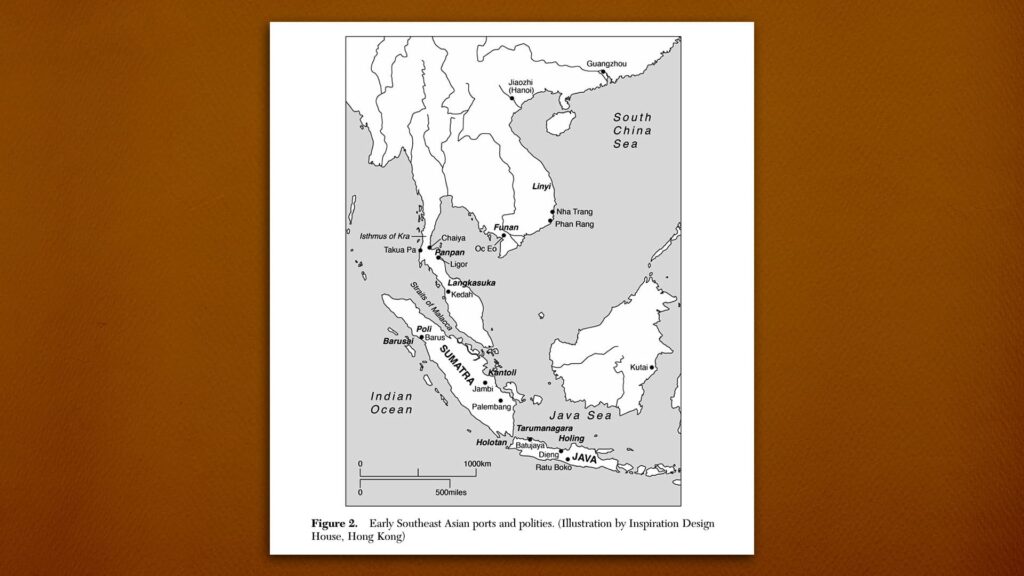
In 2018, Sen published the chapter “Yijing and the Buddhist Cosmopolis of the Seventh Century” in a collection entitled, Texts and Transformations: Essays in Honor of the 75th Birthday of Victor H. Mair.
In this work, Sen summarizes Yijing’s journey to India as follows:
After twenty days they reached Śrīvijaya (Shilifoshi [尸利]佛逝/室利佛逝), most likely the port of Palembang on Sumatra. Yijing seems to have stayed in Palembang for several months and to have become acquainted with the ruler of the region. It was this ruler who supported Yijing’s trip across the Bay of Bengal by finding him accommodation on a “royal ship” (wang bo 王舶). Yijing halted in Kedah (Moluoyu末羅瑜; i.e., Malayu) for two months before reaching Tāmralipti (Tanmoliti 耽摩立底) on the Bengal coast in early 673. (348)
Beyond Shilifoshi unquestioningly becoming “Srivijaya,” for some reason, Sen has made Kedah and Moluoyu the same place. . . And there is a map here too, which has Palembang and Kedah, but no Moluoyu.
For this information, Sen cites a primary source (the Taishō Tripiṭaka version of Yijing’s The Great Tang Biographies of Eminent Monks who Sought the Dharma in the Western Regions), which is great, but if this is what he understands from reading that primary source. . . then that is not so great. . .
Tansen Sen is considered an authoritative figure on the history of India-China relations, and that includes the topic of Yijing, the seventh-century Chinese monk who traveled to India.
However, from the above examples, we see scholarship that unthinkingly repeats problematic information and in some cases is just simply wrong. By the time Professor Sen wrote this article, scholars had been discussing the meaning of those placenames in Yijing’s writings for well over a century, and while I can find errors in their ideas, none of them ever made the mistake of equating Kedah with Moluoyu.
Further, what I am pointing to here are not tiny or irrelevant details. All of the details that I am pointing to are key building blocks of the “Srivijaya is a kingdom at Palembang that was referred to in Chinese sources as (Shili)Foshi and Sanfoqi” narrative.
This includes the idea that Chinese were sailing through the Strait of Malacca from as early as the beginning of the fifth century AD; that “Srivijaya” had roots that went back to a polity called Gantuoli; that Shilifoshi is “Srivijaya”; that Heling is “Java”; and that Yijing’s itinerary contains key information about the early world of “Srivijaya at Palembang,” including its relationship to Moluoyu and Kedah.
Sen repeats many of the outdated ideas from the “Srivijaya tradition,” but in equating Kedah with Moluoyu, he also shows a significant lack of awareness of one of the most discussed topics in that tradition. As such, if the founding head of the Nalanda-Sriwijaya Centre isn’t aware of which information here can be supported by the evidence in the sources and which can’t, and isn’t aware of key discussions in the field of Srivijaya studies. . . . then who on earth can we turn to?
Again, I could go through article after article by scholar after scholar, but if a “leading scholar” clearly doesn’t understand the sources and the various problems in the extant scholarship. . . then there is really no use in doing that.
Yijing’s Itinerary
Instead, I would like to end this series by looking at the information that Yijing recorded about the itinerary through Southeast Asia one more time.
Clearly this is a topic that scholars do not understand, and have never properly understood. What is more, in the case of the information about how one returns from India, that passage has never been translated accurately before. Paul Wheatley translated it again in 1961 in his The Golden Khersonese, but made the same mistakes as Takakusu had in 1896.
There are two important passages in Yijing’s works. One is about the journey to India, and one is about the journey from India back to China. Further, they mention three key places: (Shili)foshi, Moluoyu, and Jiecha [Kedah].
For a long time, scholars debated about where Shilifoshi and Moluoyu were and whether or not they were the same place. That debate is too detailed to document here, however, it reached a point, following the scolding of “heretics” by Cœdès and Wolters, where scholars came to believe that Shilifoshi was “Srivijaya” at Palembang, and Moluoyu was “Malayu” at Jambi.
Again, you can’t get the Chinese sources to indicate that, but this is where that discussion ended up.
Let us now look at the passage of the journey through Southeast Asia to India.
未隔兩旬果之佛逝。經停六月漸學聲明。王贈支持送往末羅瑜國(今改為室利佛逝也)復停兩月轉向羯荼。至十二月舉帆還乘王舶漸向東天矣。
Before twenty days had passed, he indeed reached Foshi. He stayed there for six months and gradually studied śabda-vidyā [the science of sounds/phonology]. The king gave him support and sent him on to the country of Moluoyu (now changed to Shilifoshi). He again stayed there for two months, then turned toward Jiecha. When the twelfth month arrived, the sails were raised and, returning to board the king’s ship, he gradually made his way toward Eastern India.
This passage is about Yijing himself. What we see here is that from China, Yijing went by ship to Foshi. From Foshi the king “sent” Yijing to Moluoyu, from where, two months later, he “turned toward” Jiecha [Kedah], and from there, “returning to board” the king’s ship, he sailed to India.
For all of the scholars who believe that Foshi was at Palembang and Moluoyu was at Jambi, they see this passage as indicating that Yijing sailed all the way from Guangzhou to Palembang in less than 20 days (on what Wolters called the “Major ocean highway”), and that he then went on a royal ship from Palembang, to Jambi, and then to Kedah, and finally to India.
For such people, the phrase that in Moluoyu, Yijing “turned towards” (zhuanxiang 轉向) Kedah has been an unsolvable problem, as sailing from Palembang to Jambi, one would reach Kedah by sailing in the same direction.
From my understanding, that is, my understanding that Foshi was on the eastern side of the Malay Peninsula and Moluoyu on the western side, to the north of Kedah, the directions here all make sense. And it would also make sense that a king of Foshi would support and send a revered monk across the peninsula.
Finally, while part of that journey probably consisted of overland travel, the majority was likely on royal ships or barges.
For me, the one problematic detail in this passage is when Yijing records that in Kedah, “returning to board the king’s ship, gradually made his way toward Eastern India.” This expression “returning to board” (huancheng 還乘) is odd, as it is not a common term. This leads me to wonder if there could be something wrong with that statement.
As it turns out, there is another account in this same text which records this same itinerary. It is in a record about a certain Vinaya Master Zhihong 智弘律師, and this is what it records:
東風汎舶一月到室利佛逝國。國王厚禮特異 常倫。布金華散金粟。四事供養。五體呈心。見從大唐天子處來倍加欽上。後乘王舶經十五日達末羅瑜洲。又十五日到羯荼國。至冬末轉舶西行。
With the east wind, he sailed by ship for one month and arrived in the kingdom of Shilifoshi. The king treated him with exceptional generosity, far beyond ordinary custom. He scattered golden flowers and sprinkled gold dust, made offerings of the four requisites, and expressed his devotion with his whole body in reverence. Seeing that he had come from the Son of Heaven of the Great Tang, he honored him all the more.
Afterward, he traveled on the king’s ship. After fifteen days he reached the island of Moluoyu. After another fifteen days he arrived in the kingdom of Jiecha [Kedah]. At the end of winter, he changed ships and sailed westward.
This passage has also caused difficulties for the scholars who believe that Shilifoshi was at Palembang and Moluoyu at Jambi, as they cannot explain how the sailing distances between Palembang and Jambi, and Jambi and Kedah would each take 15 days.
From my understanding, this is not a problem, as the first distance is from Foshi across the peninsula to Moluoyu, and the second the distance by sailing, or possibly even rowing, down the coast in a small vessel. That is why in order to sail to India, at Kedah, Vinaya Master Zhihong did not continue to take the king’s ship, but instead, changed ships.
My guess is that this is what Yijing did as well, and that the odd expression of “returning to board” the king’s ship is possibly a scribal error.
Then we have Takakusu’s flawed translation (followed by Wheatley’s in 1961) of Yijing’s record of how one could return from India. To quote again, Takakusu rendered this passage as follows:
Sailing from here two months in the south-east direction we come to Ka-cha [Jiecha]. By this time a ship from Bhoga [Foshi] will have arrived there. This is generally in the first or second month of the year. But those who go to the Simhala Island (Ceylon) must sail in the south-west direction. They say that that island is 700 yoganas off. We stay in Ka-cha till winter, then start on board ship for the south, and we come after a month to the country of Malayu [Moluoyu], which has now become Bhoga [Foshi]; there are many states (under it). The time of arrival is generally in the first or second month. We stay there till the middle of summer and we sail to the north; in about a month we reach Kwang-fu (Kwang-tung). The first half of the year will be passed by this time. (xxxiv)
The scholars who believe that Foshi was at Palembang and Moluoyu was at Jambi, generally understand this passage to be a record of Yijing’s own journey. They thus believe that he sailed from India to Jiecha [Kedah]. Then a boat came from Foshi [Palembang]. Then he sailed to the south, and after a month reached Moluoyu [Jambi]. And then finally, he sailed to China.
Again, the distances cause problems for such scholars, as they cannot understand why in this record it took a month to sail from Kedah to Moluoyu, whereas in the account about Vinaya Master Zhihong, that passage only took 15 days.
However, there is another problem, and this is one which anyone who knows Chinese and who reads this passage should have noticed, and that is that there is another odd expression here “nanshang” 南上, meaning “coming up from the south.” Where Takakusu has “then start on board ship for the south,” it actually talks about boarding a ship “coming up from the south.”
More specifically, if one reads this passage in the way that Takakusu mistranslated it, then it means that one traveled from Ka-cha [Kedah] to Moluoyu by taking a ship that was “coming up from the south.” That makes absolutely no sense.
However, it does make sense after we address the mistakes in Takakusu’s translation and produce a more accurate rendering of this passage. In doing so, we find that Yijing did not record anything about a leg of the journey between Kedah and Moluoyu. Instead, he provided information about how one could journey from Sri Lanka to Moluoyu in a ship that was “coming up from the south.”
從斯兩月汎舶東南到羯茶國,此屬佛逝,舶到之時當正二月,若向師子洲西南進舶,傳有七百驛,停此至冬。汎舶南上一月許到末羅遊洲,今為佛逝多國矣。亦以正二月而達,停至夏半。汎舶北行可一月餘便達廣府. . .
[Tāmralipti] is the place where one boards a ship and enters the sea on the return journey. From here one sails for two months to the southeast until one reaches the polity of Jiecha [Kedah]. This is under the jurisdiction of Foshi 佛逝. When the boat arrives, it is the second lunar month.
To travel to the island of Sri Lanka [師子洲 Shizi zhou], one heads by boat forward into southwest for [the equivalent of] 700 travel stages. One stays here until winter, and then in taking a boat coming up from the south, one reaches Moluoyu in a little over a month. Now this is the Foshiduo 佛逝多 Kingdom. It is also in the second lunar month that you arrive.
One waits until the middle of summer, and then taking a boat to the north, one can reach Guangfu. . .
Other than the expression “returning to board,” every detail in what Yijing recorded makes sense in my understanding of the Chinese sources, that is, my understanding that 1) there was no recorded travel through the Strait of Malacca in this period, and that therefore, 2) Chinese recorded nothing about what was at places like Palembang and Jambi, and that instead, 3) they repeatedly recorded information about the trade corridor between the southern end of the Indochinese Peninsula and the area of Surat Thani province and the greater Lake Songkhla region, as well as about the trans-peninsular crossings that extended from those areas.
Even with that one unexplained detail, it could be the case that after a break at Kedah, Yijing “returned to board” a different one of the king of Foshi’s ships, one that could make the crossing to India. Hence, every aspect of my understanding of the sources can be explained and supported.
That is definitely not the case for the scholarship of others over the past 150 years.
In conclusion, Yijing plays a very important role in the “Srivijaya is a kingdom at Palembang that was referred to in Chinese sources as (Shili)Foshi and Sanfoqi” narrative. Indeed, it is in his texts that scholars who follow this narrative, or cult, believe that the name “Srivijaya” was first recorded, in the supposed form of “Shilifoshi.”
However, Yijing’s writings do not make sense when we try to understand them from the perspective of the “Srivijaya narrative” with “Srivijaya” at Palembang and “Malayu” at Jambi.
Instead, like Jia Dan’s itinerary, Yijing’s writings only make sense when we understand that in the first millennium AD, Chinese and other peoples were crossing the Malay Peninsula in the area of what is now Surat Thani province and the greater Lake Songkhla region, and that Kedah and Moluoyu to its north, were the two main ports for ships that crossed between India and Sri Lanka and the western side of the northern half of the Malay Peninsula.


Wolters was lucky that his book came out a year before Coedes’ 1944 book in English translation. He basically “translated” the latter’s work to an English-only reading audience. I vaguely emember a publication edited by Manguin and someone else in the late 1990s that presented decades old French publications in English. One can imagine that if people cannot access the secondary scholarship in the original language, how reluctant they may be to peruse the oroginal textual material.
Good point! And yes, I’ve long felt that Wolters gained a name for himself by introducing (outdated) French scholarship to an English-speaking audience without them realizing what he was doing, in part because they were so in awe that he “knew Chinese.”
And ChatGPT to the rescue. You’re thinking of: Sriwijaya: History, Religion & Language of an Early Malay Polity: Collected Studies by George Cœdès and Louis-Charles Damais edited by Pierre-Yves Manguin and Tan Sri Dato’ Mubin Sheppard published in Kuala Lumpur by MBRAS (Malaysian Branch of the Royal Asiatic Society), 1992. It is Monograph no. 20 in the MBRAS series.
The contents listed by MBRAS are these: Coedès’ “The Kingdom of Sriwijaya,” “The Malay inscriptions of Sriwijaya,” “A new theory about the site of Sriwijaya,” “The Ligor stone: the current state of its interpretation,” and Damais’ “Language B of the Sriwijaya inscriptions.”
I remember coming across a reference to this a long time ago. It’s very difficult to find. When I was in Brunei, I saw it in the library there. However, I’ve almost never seen anyone cite that work. So, while it was a noble idea to translate these works to try to make them accessible to an English-only audience, by not making it easily available, they defeated the purpose.
I see that as something very “French.” I can’t think of how many times I’ve come across some deep study on an arcane topic produced in France that ends up a 10-kilo tome published by the EFEO, which you basically can only get if you actually go there (and purchase extra weight for your return flight).
I’ve said many times that the digitization of Chinese sources makes the task of research so much easier now. The same goes for finding the secondary scholarship. Cornell University Library is the best library for Southeast Asian history in the US, but now we have instant access to pretty much all of the obscure old publications that are there.
So whatever the nineteenth-century scholars up to O. W. Wolters cited, it’s all just a click away. In writing these posts, there is nothing that I haven’t been able to find.
Encouraged by your example I used ai to search for quotations in French works from the 19th century. Not even one of the suggestions was correct, and when I pointed this out, the ai came up with further incorrect results. So, there is still hope for humanity.
I hate to lessen your hope for humanity. . . but my guess would be that you are using a free version of something.
Most LLMs come in different tiers. The free tier is where AI was at a year or more ago. The paid tier is where it was at a few months ago. And the pro tier is where it is at now. I use the paid tier, and what you describe hasn’t happened to me for the past few months now.
Then the other day I Googled something and then went “deeper” by asking the AI snippet at the top of the page questions. From its answers, I thought I was making a major discovery, and then I realized that it was wrong, and when I “confronted” it, it admitted that what it said had not been accurate.
That used to happen with me with the paid version of ChatGPT, but again, that hasn’t been happening for a few months now, since, I think, it’s last update.
I heard someone recently say that using free LLMs to critique AI is like using a flip phone to critique a smart phone.
That said, I still have faith in humanity. . . to make all the wrong decisions and to still somehow keep going. So, I’m not worried. Everything should continue to be very “human.” 🙂