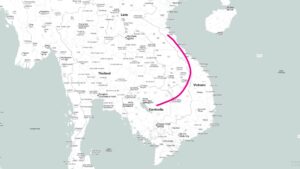

All fields are different, but the field I am most active in now (looking at early Southeast Asia through Chinese sources) is very different today than it was just 10 years ago, and it is different because of the digitization of sources.
This is something which I think people who do not work in this field cannot completely grasp, and so I’m going to try to explain here how the world I work in now is so different from the world of just a decade ago.
The example I will use will relate to a topic I’ve been writing about, a place called “Zhenlifu” 真里富.
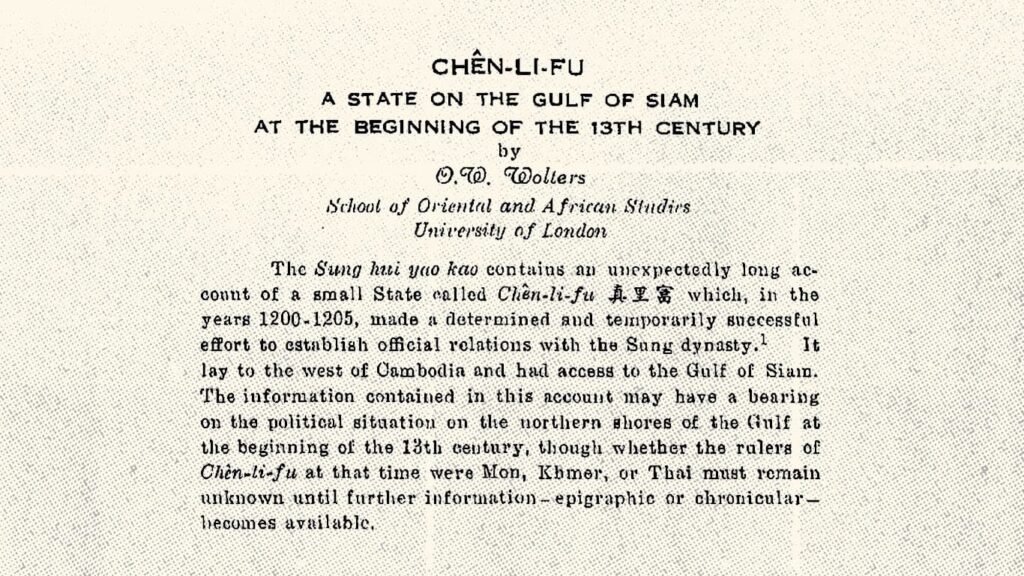
In 1960, historian O. W. Wolters wrote an article about an account of Zhenlifu that appears in a Song dynasty source. Wolters stated at the beginning of that article that Zhenlifu “lay to the west of Cambodia and had access to the Gulf of Siam.”
He came to that conclusion because in some Song-era sources, like the History of the Song, Zhenlifu is referred to as a dependent/vassal center/town (yi 邑) of Zhenla 真臘, a place that Wolters associated with “Cambodia.” That source also records that Zhenlifu was “in a corner in the southwest” (在西南隅).
Based on his understanding of this information, Wolters argued that Zhenlifu “lay to the west of Cambodia and had access to the Gulf of Siam.”
I recently wrote a post, “Zhenlifu (Chen-li-fu) was NOT in Thailand,” where I explained why Wolters’ view is flawed, and I explained how we can see that Zhenlifu was clearly located in the area of what is today Cambodia.
While it is possible to challenge Wolters’ point based on the sources he consulted, one can also challenge his claim by pointing to sources he did not cite. I did both in the blog post, however, the particular piece of information in the source that Wolters did not cite was a piece of information that would have been very difficult to find as recently as about 10 years ago.
Wolters translated a passage on Zhenlifu that appears in a text known as the Song huiyao jigao 宋會要輯稿 (Draft Institutional History of the Song).
That passage contains a section on a temple in Zhenlifu, and states, “Whenever there is a lawsuit that cannot be resolved, the parties go to the Temple of Numinous Efficacy [Lingyan si 靈驗寺] and, facing each other, drink Buddha water. The one who remains at peace is deemed truthful, while the one who falls ill is deemed false.”
I then found a passage about a place that is referred to as “the Kingdom of Zhenla’s
Zhanlipo citadel” (真臘國之占里婆城), with “Zhanlipo” 占里婆 here being a name that is similar to Zhenlifu 真里富. The text that this appears in is the twelfth-century Lingwai daida 嶺外代答 (Representative Answers from Beyond the Passes), and it records information about a temple in Zhanlipo where “Whenever there is a dispute, the parties agree to confront one another before the Holy Buddha; the one in the wrong dares not go.”
These are obviously talking about the same place. And this second piece of information describes Zhanlipo/Zhenlifu as a Zhenla citadel. That should lead us to question the idea that Zhenlifu “lay to the west of Cambodia and had access to the Gulf of Siam,” and that’s what I do in the above post.
However, that piece of information would have been almost impossible to find prior to the digitization of Chinese sources.
While the Lingwai daidai contains a section on Zhenla, and scholars have consulted that section, that is not where this information appears. Instead, it’s way in the back of this text, in the final chapter called the “Records of Anomalies Section” (Zhiyi men 志異門).
Without being able to search for “Zhanlipo,” it would be very difficult to find that passage.
But wait, how did I know to search in this text, and to search for “Zhanlipo” 占里婆 instead of “Zhenlifu” 真里富?
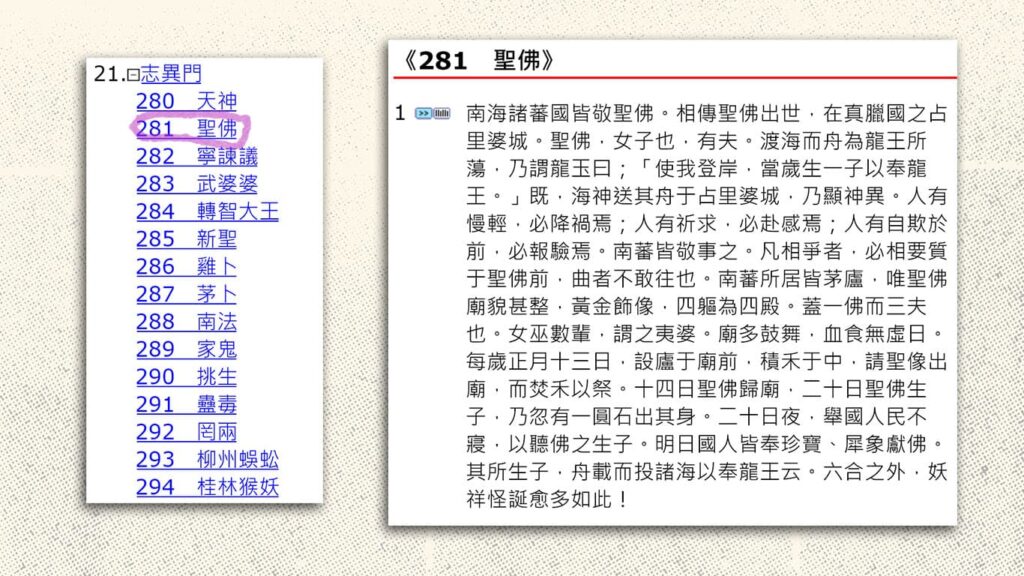
There is a website (world10k.com) that contains a lot of information about historical Chinese place names. So, when I want to know about a place like Zhenlifu 真里富, I search for “真里富 world10k.”
World10k will list the place name, alternative versions of the name, the texts where the name appears, and then it will have explanations of where the compilers of the world10k site believe the name referred to.
I often disagree with their ideas about the places the names refer to (their knowledge resembles the information in works like Wolters’ 1960 article), and I don’t always agree that all of the alternative versions of the name refer to the same place, HOWEVER, I always find the information about which texts the name appears in to be extremely helpful.
So, that is how I found that Zhanlipo could be a possible alternative writing for the name, Zhenlifu, and that Zhanlipo is mentioned in the Lingwai daida.
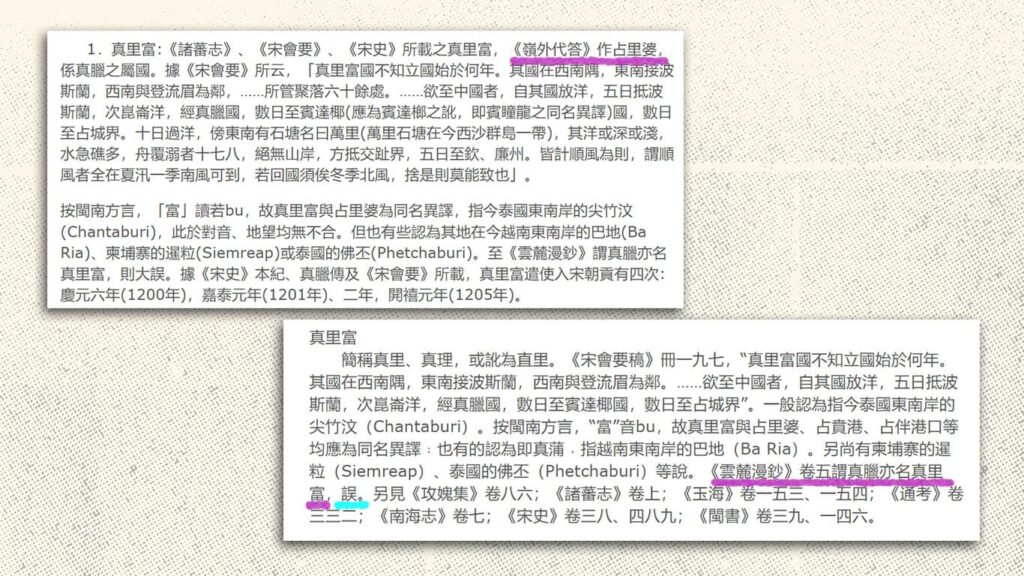
Looking again now at world10k (and as a reader noted in a comment), I see that there is another text that mentions Zhenlifu, and in fact, equates it when Zhenla. In particular, the Song-era Yunlu manchao 雲麓漫鈔 (Random Notes of the Cloud-Covered Foothill) says that “Zhenla is also called ‘Zhenlifu’” (真臘亦名真里富).
Having consulted world10k, I then always follow up with what I see there by checking the texts it references.
In the past 10-15 years (I’d say really only in the past 10 years), pretty much all of the texts that are mentioned in the world10k pages have been digitized and are available on a site known as the Chinese Text Project, or what I call “Ctext.” And Ctext is searchable, so it is very fast and easy to check
So, how does this make scholarship in the digital age different?
First, obviously it makes it possible to find information that previously would have been difficult to locate. That’s really helpful, but the really key point is something else.
Now that we can basically find “everything” (because the number of Chinese texts that contain information on early Southeast Asia is limited), that puts us in a very different position from our predecessors.
Previously, an historian like O. W. Wolters could look at information in a single text, or a small number of texts, and make an argument about that information.
Now that we can see “everything,” it doesn’t make sense anymore to write about what one text, or a small number of texts, says. Instead, the goal, as I see it, is to take what we see in our expanded vision and try to connect the information together and get as much of it as possible to make sense.
When we do this, what we find is that many earlier arguments (like the one by Wolters’ on Zhenlifu) quickly fall apart, because the scholars who made those arguments did not see all the related information (of course, there are also plenty of errors in earlier works too, and methodological issues, etc., but that’s another issue).
At the same time, we can also now come up with new explanations of the past because we have an expanded view of all the related information.
I keep saying this, but I’ll say it again here. WE ARE IN A NEW ERA. The digitization that has occurred in the past 10 years makes working with the Chinese sources on early Southeast Asia a totally different game from what it was just a decade ago.
And that’s just talking about how scholarship is different in an age when the sources have been digitized. Now that we have AI to work with as well. . .
A Nerdy Afternote:
The reader who pointed out that the Song-era Yunlu manchao equates Zhenlifu with Zhenla also referred to the world10k site when he wrote, “Modern Chinese commentators reject the Yunlu manchao suggestion as an error. They rather follow the Zhufanzhi, Wenxian tongkao and Songshi that all regard Zhenlifu as part of Zhenla.”
Yes, in the image above, I have highlighted in blue where it says “error” after the statement “Chapter five of the Yunlu manchao states ‘Zhenla is also called Zhenlifu.’”
The world10k people are interested in deciding which source is “correct” and which source has an “error.”
On the one hand, yes, they are correct that the Yunlu manchao made an “error” when it said that Zhenla was also called Zhenlifu, because in other sources we can see Zhenlifu referred to as a Zhenla citadel or a dependent/vassal center/town of Zhenla. And we have evidence of both Zhenla and Zhenlifu presenting tribute. So, they were obviously not the same place.
However, we can go beyond that and ask ourselves “why” such an error occurred. Why would there be confusion about what the name of Zhenla was?
As I wrote in a reply comment, I find that modern scholars, including the people who have compiled the information on world10k, look at information in Chinese historical sources assuming that 1,000 years ago Chinese had knowledge about “the region of Southeast Asia” in a very similar way to the way we view it today.
So, they knew that “Zhenla” was “Cambodia” which modern scholars assume was accessed from the east; “Zhenlifu” was someplace in the Chao Phraya River plain (which one would have to go a long way from “Zhenla” to reach by ship); “Sanfoqi” was “Srivijaya” down at the southern end of Sumatra; “Shepo” was “Java” on the island of Java etc.
However, it’s clear (and should be common sense) that they did not have that kind of knowledge. For a place like Zhenla, they reached it by going inland along rivers and canals. They didn’t have the concept of a space as large as “Cambodia” today. They just knew the citadel they reached where they engaged in trade. And from that perspective, they also knew of another citadel in the area (and probably very nearby in our modern view of space) that was under Zhenla’s authority, Zhenlifu.
From that very small view of the world, we can understand how it would be possible to equate Zhenlifu with Zhenla. Ships that came from there, or went there, were essentially going to the same place.
This error in the Manlu yunchao equating Zhenla with Zhenlifu comes from a section on the Fujian Maritime Customs Office (福建市舶司). It is impossible to know where the information in that section came from, but we can imagine that it must be related to knowledge of Zhenla/Zhenlifu from ships arriving from, or going to, that area.
While it is an “error,” errors can still tell us something about the past. In this case, I think this error, supports the other information that I discussed in previous posts, that is, information which tells us that Zhenla and Zhenlifu were very close to each other.
I would never try to build an argument on this one error, but I think it adds to all of the other evidence that points to Zhenlifu as a place in what is now central Cambodia.
This nerdy afternote is to further my point: We now have the ability to go far beyond our predecessors. We can see more than they could, and from that expanded view, we can think and conceptualize more than our predecessors were able to.