
For years, I have been telling people that we are living in a new age. With the digitization of historical sources, something that has really only developed significantly in the past ten years in the world of scholarship I am involved in, we can produce scholarship that is much, much more accurate and inciteful than ever before.
I was recently reminded of that as I was looking through Li Tana’s book, A Maritime Vietnam (2024) and was surprised to read the following two sentences:
“Throughout early Southeast Asia, elites monopolised aromatic processing; this seems particularly true for Jiaozhi. A fifth-century Chinese poem depicts the image of ‘the Viet king pounding hun-luk aromatic’.” (70)
Ok, over the past thirty years, I’ve spent plenty of time going through the Chinese sources for early “Vietnam.” However, I had never seen this line from any poem.
Further, the idea that a Chinese poet in the fifth century would mention a “Viet king” and that this would be a reference to a ruler in Jiaozhi, that is, the Red River Plain, makes no sense to me. The Chinese at that time did not see the people in that region as “Viet.” (Also, since we are looking at this from a Chinese perspective, it would make more sense to render it as “Yue,” but that’s a minor point.)
So, naturally, when I come across information like this that does not make sense, I go to the footnote, and then down the rabbit hole.
This is what the footnote says:
Zhu Fazhen, ‘Luofushan shu’ [Commentary on Mount Luofu], in ‘Xiang bu’ [Incense section], Taiping yulan, chapter 982 (www.guoxue123.com/zhibu/0201/03tpyl/0981.htm, accessed 5 April 2014). Hun-luk 薰陸香, an early Chinese word derived from the Arabic word kundur, refers to frankincense (now pronounced xunlu), which originated in Yemen and Somalia. However, since Jiaozhi functioned as the first stop for any exotic import travelling from overseas to enter the Chinese empire, Chinese subjects generally considered the aromatic resin as a product of the province. The Chinese text states: ‘Hunluc is produced in Jiaozhou’ [薰六, 出交州].
The footnote lists a web page that contains the text. Li Tana accessed the webpage in 2014. That’s a long time ago!! Particularly in our digital age when more and more materials get digitized and made available. I have repeatedly found that something that I could not decipher at one point, I was able to decipher a year or two later simply by Googling as something new had become available online that enabled me to understand what I previously couldn’t.
So, I go to that webpage and find that it is in Simplified Chinese. Maybe I’m extreme, but I never read Chinese historical texts in Simplified Chinese. I see the transformation from Traditional to Simplified characters as a form of translation, another layer where something can possibly change. Also, I just want to see the closest form to the “original” as possible. But ok, I’ll except that I’m extreme when it comes to this matter.
Therefore, I look up the Traditional Chinese version of this text on ctext (the Chinese Text Project) [https://ctext.org/taiping-yulan]. Yes, that is also a step away from an “original,” and that is why when I publish something, I might use ctext first, but then I locate a print version of the text to verify and cite, but for this exercise, I’m just going to use ctext. That said, I found a character in ctext that didn’t make sense and was able to see that other online versions of the text have a different character that makes more sense (see below).
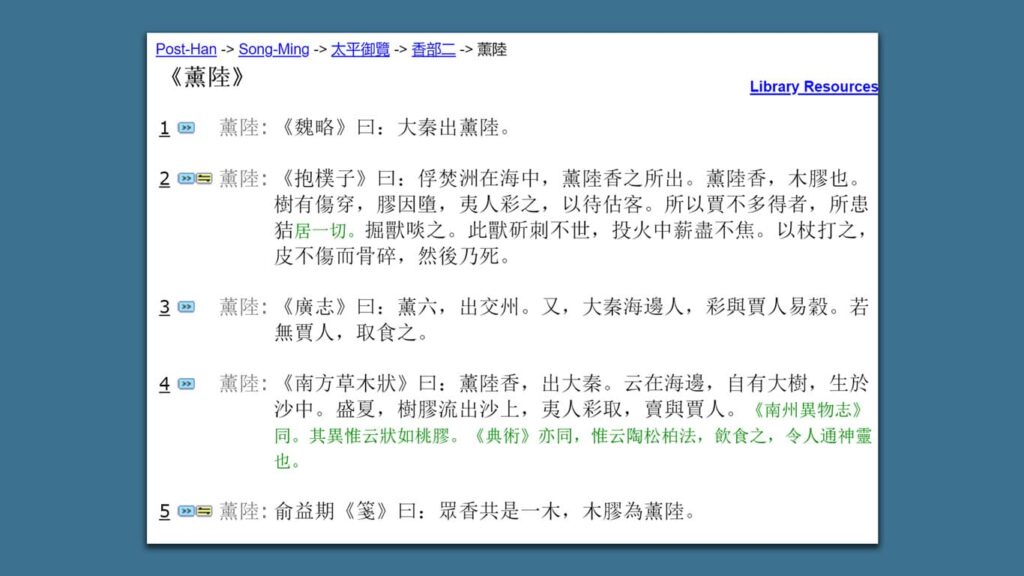
On ctext, I find that Chapter 982 in the Taiping yulan is divided into sections, one of which is on xunlu 薰陸 incense (not sure where Li Tana is getting the Romanization “hun-luk”).
Contrary to Li Tana’s statement that “Chinese subjects generally considered the aromatic resin as a product of the province [of Jiaozhi],” I see that the first entry says “Daqin produces xunlu” (大秦出薰陸).
We can debate about what Daqin refers to. I have never looked closely at the history of this term, but in general, it pointed to someplace quite far to the west of India, such as the Mediterranean region, and that could include, for instance, where Yemen is located. The term was not particularly precise, but it consistently indicated that general area.
Moving on, the next entry says, “Fufen Isle lies in the sea; it is the place from which xunlu incense is produced” (俘焚洲在海中,薰陸香之所出). I’m not sure where Fufen Isle was, but I don’t think it had anything to do with Jiaozhi.
This is followed by the information Li Tana quotes. She refers to the incense/aromatic in this passage as “hunluc” rather than “hun-luk.” While that was probably a typo, in the text, xunlu is written differently, as xunliu 薰六. To quote, it says that “xunliu is produced in Jiaozhou” (薰六,出交州).
That same entry then goes on to say that, “Moreover, the people along the seacoast of Daqin harvest and trade it for grain with merchants. If there are no merchants, they take it and eat it” (又,大秦海邊人,彩 [Wikisource = 採] 與賈人易穀。若無賈人,取食之。).
Finally, there is another entry that states, “xunlu incense comes from Daqin” (薰陸香,出大秦。).
From the above information, it is impossible to come to the conclusion that Li Tana does, that “Chinese subjects generally considered the aromatic resin as a product of the province [of Jiaozhi].” If we base our understanding of this matter on the above section, rather than the one phrase that Li Tana extracted from this section, the logical conclusion would be to say that “Chinese subjects generally considered the aromatic resin as a product of Daqin.”
For historians, it’s always important to read what is around (above, below, left, right) the information that we find potentially significant in a text.
So, while I notice that Daqin is the place associated with xunlu incense, I don’t see any reference to “a fifth-century Chinese poem” depicting “the image of ‘the Viet king pounding hun-luk aromatic’” or the text that is supposedly quoted for that information, “Zhu Fazhen, ‘Luofushan shu’ [Commentary on Mount Luofu].”
Not knowing what the characters for this person’s name or the title of the book are, I go back to the page in Simplified Chinese that Li Tana cited, and search for the one character that I can be sure of, shan 山, meaning “mountain.”
There I find this author and text (竺法真《登罗山疏》) mentioned twice, but the quoted passages do not say anything about a “Viet king.” So, I convert the name and title to Traditional characters (竺法真《登羅山疏》) and search for the title in the Taiping yulan in ctext.
I find the passage in Chapter 981, not the 982 that Li cited. There it has “Zhu Fa[zhen’s Commentary on Mount Luofu states ‘the Viet king pounds the xunlu aromatic” (竺法《登羅山疏》曰:越王搗薰陸香。).
Looking around this passage, I can see that this chapter has general comments taken from various historical records that mention “incense/aromatics,” such as this one:
《林邑記》曰:朱吾以南,有文狼。野人居無室宅,依樹止宿。食生肉,彩香為業,與人交市,若上皇之民矣。
The Record of Linyi states, “South of Zhuwu there is Wenlang. The wild people live without houses or dwellings, lodging by relying on trees. They eat raw meat and harvest aromatics for their livelihood. They trade and interact with others, like the people of the emperors of antiquity.
This is not a literary section. It is not citing poetry.
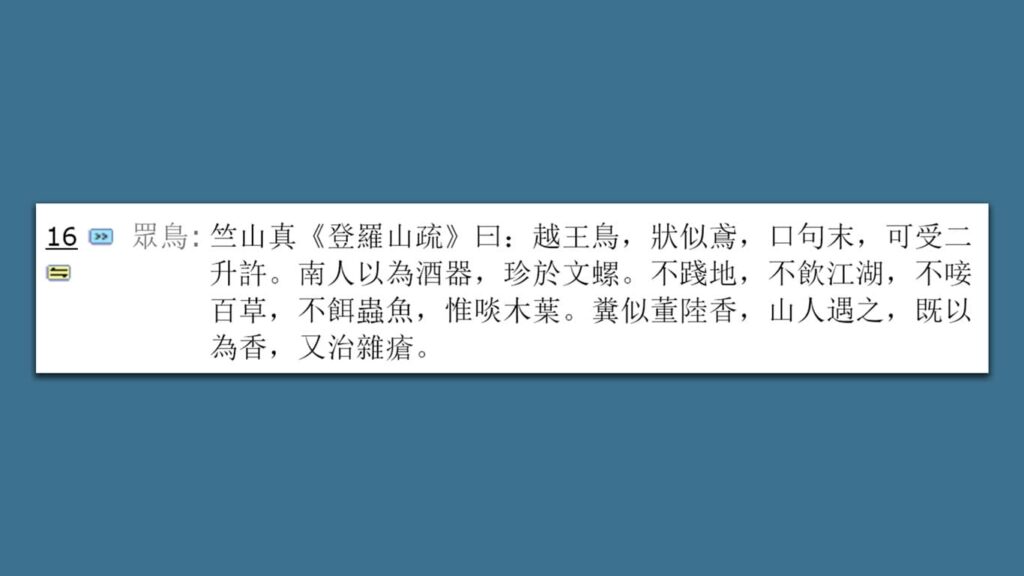
I then look for more references in the Taiping Yulan to this text, and find it cited in a section on birds (Chapter 928) where this same text is quoted as saying:
越王鳥,狀似鳶,口句末,可受二升許。南人以為酒器,珍於文螺。不踐地,不飲江湖,不唼百草,不餌蟲魚,惟啖木葉。糞似董陸香,山人遇之,既以為香,又治雜瘡。
The Yue/Viet King bird 越王鳥 resembles a kite (hawk). Its beak curves inward at the tip and can hold about two sheng. People of the south use it as a wine vessel, and value it more highly than patterned conch shells.
It does not tread on the ground, does not drink from rivers or lakes, does not peck at the hundred grasses, and does not feed on insects or fish; it eats only tree leaves.
Its droppings resemble xunlu 董陸 incense. When mountain folk encounter them, they use them both as incense and to treat various sores.
Ok, so as I suspected, the “Yue/Viet king” was not a person. It was a bird, and that bird’s droppings resembled a kind of incense, a kind of incense that was not generally believed by Chinese to come from Jiaozhi/Jiaozhou, but from Daqin.
Going back to the first statement, that “the Viet king pounds the xunlu aromatic” (越王搗薰陸香), we can see that the character for “pounds” (dao 搗) resembles the character for “bird” (niao 鳥).
It’s obvious to me that the passage in Chapter 981 (again, not 982) was an attempt to condense the information about the Yue/Viet King bird’s droppings that we find in Chapter 928, to say something like “the Yue/Viet king bird’s droppings are like xunlu incense” or “the xunlu aromatic” (越王鳥,糞似董陸香).
The above information has absolutely nothing to do what Li Tana said it was about: “Throughout early Southeast Asia, elites monopolised aromatic processing; this seems particularly true for Jiaozhi.”
Instead, it’s about bird droppings that resembled an aromatic that came from Daqin, somewhere around the Mediterranean.
Further, we still don’t know exactly where these bird droppings were. One would need to dig further to figure out where exactly the Mount Luo in Zhu Fazhen’s text was (I’m guessing somewhere in southern China, like Guangdong).
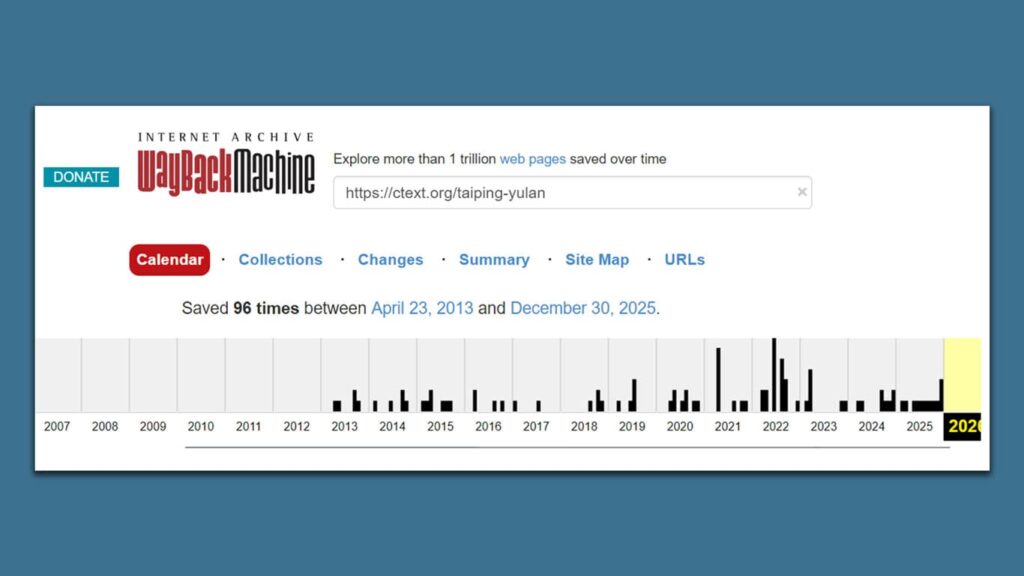
In checking the Wayback Machine, it looks like the ctext version of the Taiping yulan might not have been fully operational in 2014, and the Simplified-text version that Li Tana cited was not searchable.
So, her misunderstanding of this information can partly be explained by that (although there were undoubtedly ways to find this information if Li Tana had tried [it was in the digitized text that she consulted] and double-checking what one wrote a decade ago before publishing it is never a bad idea). However, there are larger problems here: thinking that the Chinese would refer to a “Viet king” in the fifth century Red River Plain, claiming that Chinese saw xunlu incense as coming from Jiaozhi/Jiaozhou when the passage repeatedly mentions Daqin, seeing a poem where there is no poem, not following up and checking details in the sources, etc.
However, to return to the issue of digitized sources, the above discussion is a perfect example of why I keep saying that we now have the ability to produce scholarship that is far superior to the scholarship that was produced in the past, and by “the past,” that can still mean “now” as long as people don’t make the effort to be really precise and accurate in their work.
The answers are literally sitting right there in front of us, just a mouse click or two away, or a line or two above or below.
Finally, while I have written here about one specific example and shown how we can easily correct it with the available digitized sources, the way that this specific example points to numerous problems, from intellectual approach to historical methodology to textual analysis, should be sufficient to make it clear that there is much more that I could write about this book.
Meanwhile, looking online at the snippets of reviews that are freely available, I see comments like “Li Tana’s A Maritime Vietnam: From Earliest Times to the Nineteenth Century is a wonderful foray into a facet of the country’s history that is not often told” (Eric Tagliacozzo), “This book represents a new stage in Vietnamese studies, achieved through Li Tana’s multilingual, multidisciplinary and comprehensive research” (Yuriko Kikuchi), “Tana Li’s book A Maritime Vietnam: From Earliest Times to the Nineteenth Century is a brilliant exploration of how the sea has long mattered in the history of a country too often thought of largely in terms of its terrestrial orientation” (George Dutton), and “This masterful work stands as a summary of a lifetime of scholarly output by Li Tana” (Andrew Chittick).
As I have been saying, when it comes to discussing the work of their colleagues, scholars don’t tell you when it is deeply flawed, and more importantly, they don’t document the deep flaws. While most people probably don’t even realize such issues, the niceties of academic culture do not allow for deep critiques. Instead, it is only acceptable to operate at a generalist, abstract level, and then perhaps throw in a vague comment at the end of a review about certain “limitations.”
This is why scholarship never progresses, and why “the poetic image of the Viet King pounding his hun-luk aromatic” will last for an eternity.
Ah, but maybe that’s all for the better. After all, we should probably leave the Yue King bird in peace. It looks like he has gone relatively unnoticed for some 1,000 years already. I’m sure that he is happier that way.

Thank you for bringing this to the attention of the readers. May I add some more on the same entry in Li Tana’s work:
In the section referred to by Li Tana in Taiping yulan no “Luofushan shu” (no characters provided) is cited (as you mentioned as well). The texts quoted in Li Fang 李昉 et al., Taiping yulan 太平御覽 (Beijing: Zhonghua shuju, 1960), 982.1b-2a (4347), on xunlu are the Weilüe 魏略 (3rd cent.), the Baopu zi 抱樸子 (4th cent.), the Guangzhi 廣志 (Jin dynasty), the Nanfang caomuzhuang 南方草木狀 (3rd-4th cent.), and Yu Yiqi’s 俞益期 (Jiaozhou) jian (交州)牋 (fl. 3rd-4th cent.).
There is no mention of a “Viet king pounding hun-luk”. The start of the Guangzhi statement reads: “Jiliu chu Jiaozhou 寄六出交州.” It is by association with the other texts, that the reading jiliu has to be replaced with xunlu, but not with xunliu. The compilers of the entry must have been certain that jiliu was the same as or similar to xunlu. Li seems to not care about the Chinese transcription either, giving the reader a choice of Hun-luk and Hunluc which are probably Vietnamese transcriptions (hùn lʊk, huân lục) (you would know that better than I).
As for the “reviews”, and to stay in the picture, birds of a feather flock together…
Thanks for the comments!!
Yes, for the sake of simplicity, I just said in the “first entry,” “second entry,” etc. But each “entry” is a citation from a different source, and you provide the sources and their dates here. That’s very helpful!
As for your second paragraph, I can see that the digitized version that Li Tana cited and the ctext version that I cited both have “Xunliu comes from Jiaozhou” (薰六,出交州。), but that there is a Chinese Wikisource version that has “Jiliu comes from Jiaozhou” (寄六,出交州). [https://zh.wikisource.org/wiki/%E5%A4%AA%E5%B9%B3%E5%BE%A1%E8%A6%BD/0982]
This is why it’s always important to eventually consult a print version. This one here is from 1815 (清嘉庆十二年):
https://commons.wikimedia.org/w/index.php?title=File:CADAL01020650_%E5%A4%AA%E5%B9%B3%E5%BE%A1%E8%A6%BD.djvu&page=18#/media/File:CADAL01020650_%E5%A4%AA%E5%B9%B3%E5%BE%A1%E8%A6%BD.djvu/2
It has the 廣志 and the 南方草木狀 both mentioning 薰六!!
That information might be too garbled to really matter, but I’d be curious to look at earlier versions. I was going to see if the “Harvard Chinese Rare Books” page had anything, but it’s blocking me right now [https://curiosity.lib.harvard.edu/chinese-rare-books]. Harvard! What are you doing?!!
As a general wonder (to Prof. Kelly as well), I guess that Li Tana has 2 pieces of info together (the Shu reference with “Viet King” in 981 and the “Xunlu is produced in Jiaozhi” in 982) to reach her conclusion, then only cites Chapter 982.
On the other hand, it is curious that we have the “寄六” mismatch. Even the Chinese Wikisource version has mismatches, anyone please check which the referring text of that version is. In the end, perhaps the only way to solve this is to have physical or scanned copies of Guangzhi and some other books, all of those are not extant afaik.
“I guess that Li Tana has 2 pieces of info together (the Shu reference with “Viet King” in 981 and the “Xunlu is produced in Jiaozhi” in 982) to reach her conclusion, then only cites Chapter 982” – that is correct.
That said, that she doesn’t get her citations correct is much less of a problem for me than that she thinks that the “Viet king” could have been a reference to a person, or that she claims that Chinese generally believed that xunlu incense came from Jiaozhou when the source she cites repeatedly mentions Daqin. Getting a number wrong is a “typo,” but these other issues are knowledge/research related.
As for print versions of texts, I tried to figure out if there is a difference between what Ctext does and what Wikisource does.
There is a collection of books that was created during the Qing dynasty period known as the Siku quanshu 四庫全書, and then there was a publication of books made in the first half of the twentieth century known as the Sibu congkan 四部叢刊. The Sibu congkan can be seen as more valuable as it was a photolithographic reprint of old, including Song dynasty era, texts. The Sibu congkan version of the Taiping yulan is supposed to be of a Song period version.
I could be wrong, but I think what Ctext and Wikisource did was to OCR the Siku quanshu versions and then check them against the Sibu congkan versions. Why do it that way? It could be because the writing is uniform across the Siku quanshu (it was all carved for woodblocks at roughly the same time), whereas there is more variation in the Sibu congkan, because it contains copies of older works.
I’m not entirely sure if that is correct for Wikisource, but I think that’s how Ctext did it, and you can access the originals on that site. You have to sign up/log in, and when you are on the page of a text, then in the upper right of the screen there is a “library/電子圖書館” link and you can select to view either the Sibu congkan or Siku quanshu version.
I just checked the Sibu congkan version, and it has 寄六!!! So, the passage which Li Tana cites to claim that Chinese generally believed that “xunlu” 薰陸 incense came from Jiaozhou, probably originally said that something called “jiliu” came from Jiaozhou. That said, it was placed in a section on “薰陸,” so there must have been some reason for that, but I don’t know what that might have been.
Again, this doesn’t bother me all that much. However, the fact that the same section associates xunlu incense with Daqin three times and yet Li Tana choses to only talk about Jiaozhou, which is only mentioned once, and with an incense with a different name but theoretically the same, and claim that that is the place which Chinese associated this incense with – that is what bothers me because it’s not an honest statement of what is recorded in the source.
I take back what I said. I’ve looked further, 寄六 should be right. That’s what the《四部叢刊三編》本《太平御覽》has, and that text is supposed to be based on a Song-period print.
Thanks for pointing that out!!
Afair, I have a physical copy of the book, and now I am not sure if I should read it normally (other than read and semi-research every details – it would be exhausting).
Also, there are some details in your post that still make my brain “itchy” (I mean it generally, not your fault):
1. The piece of info “5th century poet/poem” is still not satisfactorily decoded. Is Zhu Fazhen the poet? Where is the poem? Is it contained in the Loufa Shu? (Shu is surely not a poetic type of text)
2. In chapter 928, is the bird mentrioned with any reference of any source? If not, it is not even sure that Zhu Fazhen described the bird in details in his Shu.
3. Does Li Tana’s claim “Throughout early Southeast Asia, elites monopolised aromatic processing; this seems particularly true for Jiaozhi.” have any other supporting evidences in the case of Jiaozhi?
Thank you for the comments/questions!!!
1.) There is no poem (or there is no evidence that there is a poem) in Zhu Fazhen’s text where this came from.
2) The source is the same source: the “Deng Luoshan shu” by Zhu Fazhen – the “Commentary on Ascending Mount Luo.” I’ve pasted below all of the references to it in the Taiping Yulan.
3) Further down the page (70), Li Tana says this:
“As a Chinese source from the Song era explains:
“Linyi, Champa, Java and Jiaozhi produce various spectacular perfumes and [they know
how to] blend them. When burned, they smell extraordinarily fine and elegant. [Because
of this,] those people [from Linyi, Champa, Java and Jiaozhi] have commented that
Chinese aromatics of the so-called ‘Three Balances’ (sanyun) or ‘Four Excellences’
(sijue) are nothing but beggars’ aromatics.79
“Resituated into the context described above, it becomes clear that Southeast
Asians were not merely deriding the low quality and inferior fragrance of
Chinese-processed aromatics; they were also talking about the people who
made them. The Chinese craftsmen most certainly came from common social
classes, while aromatics processors in Southeast Asia typically came from
among the highest social classes.”
This also leads down another rabbit hole. I’ve done that, and it requires a lot of explanation, like the case above. I’m too tired right now to do so at the moment, but maybe later. The gist though is that there is no possible way to demonstrate that there were people in Southeast Asia who called Chinese incense “beggars’ aromatic” and that people in China knew this and recorded it in a book.
How did that happen? What language was this conveyed in? Who understood that language? What Chinese incense was sold in Southeast Asia? etc.
That statement should be understood as an elite “insiders joke” in China. But to make that point requires looking closely at the text and analyzing the type of text that it appears in, which is a text from much later, a Ming dynasty era text: http://www.chinaknowledge.de/Literature/Science/xiangsheng.html
As for your statement that “I am not sure if I should read it normally (other than read and semi-research every details – it would be exhausting),” that is EXACTLY my point!! Your distinction between “reading normally” and “semi-researching every detail” is a perfect way of describing the problem!! It can’t be read “normally,” which is what the reviewers do, and that is why reviews are superficial and meaningless. And yes, it’s exhausting to semi-research every detail, but one does discover interesting things when one does that – like birds that defecate incense!! Who would have known. . . But wait! Why hasn’t this been commercialized like Cà phê Chồn? (civet-cat-defecated coffee beans)!! Wow! I could become a millionaire!! I need to find that bird!!!
These are the passages from Zhu Fazhen’s text that are cited in the Taiping yulan [using this online version: https://ctext.org/taiping-yulan?searchu=%E7%99%BB%E7%BE%85%E5%B1%B1%E7%96%8F; and translated by Grok]. There is no poetry anywhere to be found, and it’s about places in what is now Guangdong, which, by the way, Chinese did refer to as Yue/Viet 越/粵, so it makes sense that a bird there would be called the “Yue/Viet king.”
竺法真《登羅山疏》曰:增城縣有石溝,深廣三丈,有兩瀑布皆同注此溝。相傳云是仙人流杯池水。
Zhu Fazhen in “Notes on Ascending Luo Mountain” said: In Zengcheng County, there is a stone ditch, three zhang deep and wide, with two waterfalls both pouring into this ditch. Legend has it that this is the water from the immortals’ floating cup pool.
竺法真《登羅山疏》曰:增成縣南有烈青洲,洲南又有牛潭,漁人見金牛常出水盤石上。義熙中,縣民張安釣此潭,於石上躡得金鎖,大如指,長數十尋,尋之不已。俄有物從死晷引之,力不能禁。以刀斫斷,惟得數尺,遂致大富。后義興周靈分亦好釣,常見此牛寢伏石上,旁有金鎖。往掩之,得二丈許,遂以財雄為南江都尉。
Zhu Fazhen in “Notes on Ascending Luo Mountain” said: South of Zengcheng County there is Lieqing Island, and south of the island there is Ox Pool, where fishermen saw a golden ox often emerging from the water onto the flat rock. During the Yixi era, county resident Zhang An was fishing in this pool; on the rock, he stepped on and obtained a golden chain, as thick as a finger and tens of xun long, and he kept pulling at it without end. Suddenly, something from the bottom of the pool pulled it back, and his strength could not hold it. He cut it off with a knife, obtaining only a few chi, and thus became very rich. Later, Zhou Lingfen from Yixing also enjoyed fishing and often saw this ox lying on the rock with a golden chain beside it. He went to seize it, obtaining about two zhang, and thus became wealthy and prominent, serving as the Duwei of Nanjiang.
竺法真《登羅山疏》曰:山上有神湖,湖中有白鴨。
Zhu Fazhen in “Notes on Ascending Luo Mountain” said: On the mountain there is a divine lake, and in the lake there are white ducks.
竺山真《登羅山疏》曰:越王鳥,狀似鳶,口句末,可受二升許。南人以為酒器,珍於文螺。不踐地,不飲江湖,不唼百草,不餌蟲魚,惟啖木葉。糞似董陸香,山人遇之,既以為香,又治雜瘡。
Zhu Shanzhen (sic.) in “Notes on Ascending Luo Mountain” said: The Yue King Bird resembles a kite in appearance, with a hooked beak that can hold about two sheng. Southern people use it as a wine vessel, valuing it more than patterned conch shells. It does not tread the ground, does not drink from rivers and lakes, does not peck at various grasses, does not eat insects or fish, but only eats tree leaves. Its excrement resembles Donglu incense; when mountain people encounter it, they use it as incense and also to treat various sores.
竺法真《登羅山疏》曰:五距鳥,足有重距,其音「先顧」,或謂之先顧鳥。似孔雀,背連錢文。
Zhu Fazhen in “Notes on Ascending Luo Mountain” said: The five-spur bird has double spurs on its feet, its call is “xian gu,” or it is called the xian gu bird. It resembles a peacock, with connected coin patterns on its back.
竺法真《登羅山疏》曰:嶺南道無筋竹,惟羅山有之,其大尺圍,細者色如黃金,堅貞疏節。
Zhu Fazhen in “Notes on Ascending Luo Mountain” said: In the Lingnan circuit, there is no veinless bamboo; only Luo Mountain has it. The large ones are a chi in circumference, the slender ones are the color of gold, firm and upright with sparse joints.
竺法真《登羅山疏》曰:荔枝冬青,夏至日子始赤,六七日可食,甘酸宜人。其細核者,謂之焦核,荔枝之最珍也。
Zhu Fazhen in “Notes on Ascending Luo Mountain” said: Lychees are evergreen in winter; around the summer solstice, the fruits begin to turn red; after six or seven days, they are edible, sweet and sour, pleasing to people. Those with small pits are called jiao he, the most precious of lychees.
竺法《登羅山疏》曰:越王搗薰陸香。
[Zhu] Fazhen in “Notes on Ascending Luo Mountain” said: The Yue King pounds xunlu incense.
竺法真《登羅山疏》曰:旃檀,出外國。玄嘉末,曾城有人于山見一大樹,員蔭數畝,三丈餘圍,辛芳酷烈。其間枯條數尺,援而刃之,乃白旃檀。
Zhu Fazhen in “Notes on Ascending Luo Mountain” said: Sandalwood comes from foreign countries. At the end of the Xuanjia era, in Zengcheng, someone saw a large tree in the mountain, its round shade covering several mu, more than three zhang in circumference, with an intensely spicy fragrance. Among it, there was a dried branch several chi long; he pulled it and cut it with a blade, and it turned out to be white sandalwood.
竺法真《登羅山疏》曰:沉香,葉似冬青,樹形崇竦。其木枯折,外皮朽爛,內乃香。山雖有此樹,而非香所出。新會高涼土人斫之,經年,肉爛盡心,則為沉香。出北景縣,樹薊贓大,土人伐之累年,須外皮消盡,乃割心得香。
Zhu Fazhen in “Notes on Ascending Luo Mountain” said: Agarwood has leaves resembling holly, with a tree shape that is tall and towering. When its wood withers and breaks, the outer bark decays and rots, and inside is the fragrance. Although the mountain has this tree, it is not the source of the fragrance. Natives of Xinhui and Gaoliang chop it; after years, the flesh rots completely to the core, then it becomes agarwood. From Beijing County, the trees are extremely tangled and large; locals fell them over many years, must wait until the outer bark is completely gone, then cut to obtain the fragrant heartwood.
Thank you for explaining, Prof.! I would add some more things:
1. As for the “5th century poem”, it is clear from your post that this info has no citation or even any reference from your deep dive. That’s why I’m confused how Li Tana states the info self-evidently like that. It makes readers assume Zhu Fazhen is the poet and his Shu is from the 5th century.
Besides, for my curiousity, I check out the three mentioned versions of Taiping yulan (Ctext, Chinese Wikisource, 1815 print from Wikimedia), especially the reference in Chapter 981. Afaik, it seems that (as minor minor points):
2a. Wikisource typos: 竺法《登真羅山疏》. Is this Wikisource’s fault or one of its referring text version?
2b. “Luofu”shan from Li Tana is not a correct interpretation (by who? I’m not sure). Your translation of the text’s name is correct but I can’t help thinking how one comes up with “Luofu”.
Thanks again for the comments! I’m glad you’re interested!!
1. I have no idea why she said that the sentence about the “Viet king pounds the xunlu aromatic” was from a poem.
2a. In the print version I checked, it has the full name 竺法真:
[https://commons.wikimedia.org/w/index.php?title=File:CADAL01020650_%E5%A4%AA%E5%B9%B3%E5%BE%A1%E8%A6%BD.djvu&page=6]
2b. “Luofu” shan. . . Long before I looked at this book, I heard people complaining about the many typos. It’s true. However, it is much more serious than typos and a “copy-editing problem.”
To edit this book, one would have to go through the kind of process I went through above to find information in primary sources that Li Tana does not properly cite. Then in doing so, as happened to me above, one would find that not only does she not cite information correctly, but that she misinterprets information, etc.
Therefore, this book has a much bigger problem than a “copy-editing problem.” It has a major “scholarship problem.”
Re: “scholarship problem”. I agree with your conclusion and cannot understand who was responsible at the publisher’s to give the ok for publication, when the text is riddled with so many factual, philological and scholarly errors.
While it is common to blame publishers, the real problem is with scholars and reviewers. No one should ever submit for publication a chaotic manuscript, and no reviewer should ever accept such a manuscript.
As for publishers, they generally do not have copy-editors any more who do anything more than check that the works cited and the works listed in the bibliography correspond. But in this case, it looks like Cambridge doesn’t even do that. In the example above, for instance, the Taiping Yulan is not listed in the bibliography.
That said, if I was such a copy-editor who only needed to check the citations and sources, I would pull my hair out if this manuscript showed up on my computer. Which again, points back to the reviewers, and to the scholar herself.
Beyond that, it’s also a problem with a field. The other day I reviewed an article and had nothing to say. It was basically perfect as is. I also recently reviewed a book manuscript and had only some minor comments. It was also very solid, from content to footnotes, etc. However, those works did not come from the field of what we could call “Southeast Asian history (using sources in classical Chinese) in Anglo-world universities” where this work is from. While that field is not large, it has never been populated by scholars who can seriously understand the Chinese sources, and as such, for generation after generation, we’ve had mediocre work after mediocre work. And so when a publisher turns to “the experts” in such a field to review a chaotic manuscript. . . of course, this is what we get. How could we expect to get anything else?
So, yes, the publisher has problems, but the real problems lie far beyond the publisher, and go far back in time.