A long-time reader of this blog, “Saigon Buffalo,” shared information and documents that he discovered concerning religious descrimination towards Buddhists during the period of Ngô Đình Diệm’s presidency in South Vietnam.
While the “Buddhist Crisis” in 1963 is well-known, Mr. Saigon Buffalo unearthed evidence of earlier issues. Initially he posted this information in the comment section to a post on this blog, but given how comprehensive that information is, I think it would be best to place it here in a new post.
What follows are the comments that Mr. Saigon Buffalo originally posted with links to the historical documents that he bases his points on.

For years I have been collecting contemporaneous documents that may make possible a well-founded answer to one of the most controversial questions in South Vietnam’s history, the question concerning religious discrimination allegedly endured by the Buddhist community under the presidency of Ngô Đình Diệm. However, it was only since March this year that I could have stayed long enough at home to sort them out, making those documents ready for sharing online.
Their collection can now be consulted through the link below:
https://flickr.com/photos/168630084@N05
It is a collection which, given the precarious nature of the present moment, deserves to be shared as soon as possible, for it includes key pieces of evidence that have eluded the attention of even professional historians examining the discrimination controversy stemming from the Diệm era, Edward Miller being the chief example among them.
Both in the 2013 study on President Diệm you reviewed and in the 2015 article dealing specifically with the revolt Buddhists staged against him in 1963, Miller has concluded that they did indeed suffer from various forms of unequal treatment during his tenure.
The problem with Miller’s conclusion is, as already alluded to, its evidential basis. The primary sources I have managed to gather indicate that Miller could have rested it on a much firmer foundation than he actually did.
He seemed, for instance, to be unaware of the documentary evidence establishing that as early as 1956, President Diệm had ignited a major conflict with Buddhist citizens over Phật Đản or Vesak, their most important religious holiday of the year. In an ordinance promulgated on January 9 that year, Diệm decided to deprive Phật Đản of the status of an annual public holiday bestowed upon it by Chief of State Bảo Đại in a decree enacted on December 26, 1949.

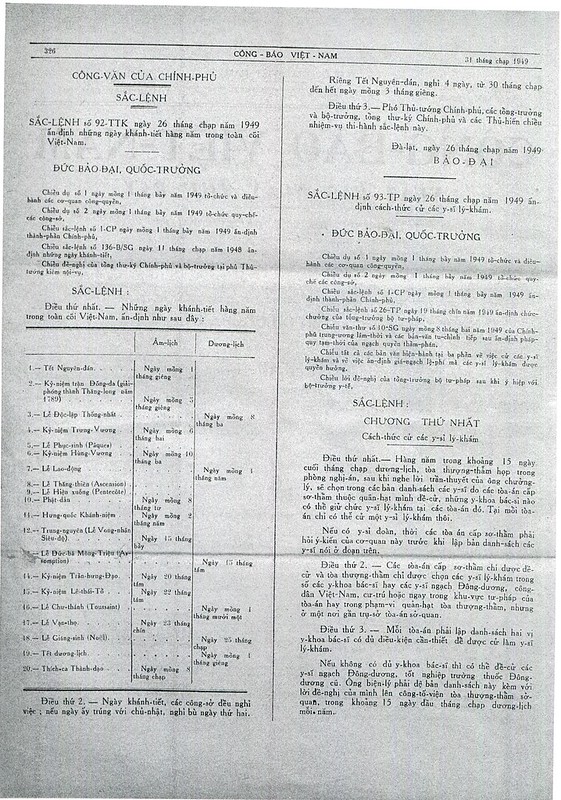
Diệm’s decision, as could be expected, instantly drew ire from Buddhists, who expressed their opposition to it through, among other things, a grand celebration of Phật Đản that, in turn, seemed to fit with their broader discontent towards his regime’s sectarianism at the time. According to a French diplomatic report from Saigon to Paris dated June 9, 1956:
“A l’occasion des fêtes qui se sont déroulées les 16, 17 et 18 Mai pour célébrer le 2.500ème anniversaire de Bouddha, d’impossantes processions ont parcouru les rues des villes, notamment à Saigon, à Hué, à Tourane. Une telle affluence, certes normale en pays bouddhique, est en outre généralement interprétée comme le signe d’une réaction contre les activités catholiques. Certains sermons prononcés dans les jours précédant les cérémonies contenaient des critiques parfois violentes contre la politique personnelle du Président.”

Despite the rancor his Phật Đản decision had sown among Buddhists, Diệm was apparently reluctant to repeal it. Phật Đản would not be restored to the status of a public holiday in South Vietnam until 1958.

In view of the fact that the Buddhist revolt against alleged discrimination was set off in May 1963 by the “flag order” the President’s Office handed down on the eve of annual Phật Đản festivities, Miller would have significantly strengthened his conclusion that Diệm era Buddhists were discriminated, had he also been able to substantiate it with original documents generated by Diệm’s attempt to abolish Phật Đản itself as a public holiday in January 1956.
The documents aforementioned are not the only relevant documents Miller has overlooked. Nor is he the sole historian who has failed to utilize to the full extent the primary sources already introduced into the public domain. Both Sean Fear, in JVS, and Phi Vân Nguyễn, in JAS, have addressed the discrimination controversy after Miller’s studies were published. Yet they too have neglected to make use of first-hand evidence that may have reinforced the basis of their scholarly judgments, and that I have been able to track down thanks to references scattered across various publications on the struggle between President Diệm’s government and South Vietnamese Buddhists.

Dear Mr. Buffalo, first let me express my apology to you as I think you emailed me this information earlier (when the comment section was not working), but I regrettably allowed that email to descend into the inbox void. My bad and my apologies!!
What you have found is very interesting!! On the historiographical issue of you discovering this issue while others haven’t, I would assume that others have consulted this Cong Bao Viet Nam (Cong Hoa), basically the government gazette for the State of Vietnam and the Republic of Vietnam, as it’s a basic source for information about governmental policies and decrees. In looking over the two announcements quickly, I don’t see anything saying that they were canceling Phat Dan. Instead, you simply noticed that it is there in 1949 and not there in 1956. Is that correct? If so, good job!! I could imagine other people looking at that list and not noticing that important detail.
Do you have any idea what the calendar of holidays was prior to 1949? I’m assuming that Tran Hung Dao day was either introduced during the Vichy period or under Tran Trong Kim. How about the Trung Sister day, and the Catholic holidays? Any idea?

PART A
First of all, I have not discovered anything myself. As previously noted, primary sources concerning Phật Ðản 1956 were “already introduced into the public domain.” I have been able to track them down “thanks to references scattered across various publications on the struggle between President Diệm’s government and South Vietnamese Buddhists.”
Adam Roberts, Thích Nhất Hạnh, Đòan Thêm, Dennis Duncanson, Vũ Ngự Chiêu as well as Lê Cung and Phan Văn Hoàng have, through their published works, informed me, in one way or another, (a) that a smoldering conflict over Phật Ðản did occur during the nascent stage of the Diệm presidency, and (b) where I can find the documentary evidence to establish its occurrence in the eyes of skeptics. All credits should go to these scholars, to Lê Cung and Phan Văn Hoàng in particular, whose research has drawn attention to relevant original materials preserved at the Trung Tâm Lưu Trữ Quốc Gia II in Saigon.

Secondly, the earliest public holidays decree of which I posses a photocopy of its official publication is the decree promulgated by the Provisional Central Government of Vietnam on December 11, 1948 and published in the Công Báo Việt Nam on December 18, 1948. Trưng Vương day, Trần Hưng Đạo day as well as various Christian holidays like Christmas, Easter and Ascension were recognized as public holidays by that decree. It also conferred on two Buddhist holidays the status of public holidays, but one of its provisions specified that “Về các lễ Phật, không được để nghỉ hơn một ngày.”


To be continued. . .

PART B
The third point is that by the time Ngô Đình Diệm assumed the Presidency of South Vietnam, Phật Ðản had become a public holiday in the fullest sense of the word for years. In fact, its status as a public holiday was reaffirmed by none other than Prime Minister Ngô Đình Diệm in a decree enacted on March 1, 1955, that is to say, prior to the Battle of Saigon that took place from end April to early May 1955, during which Diệm’s non-Communist adversaries would be vanquished.
https://www.flickr.com/photos/168630084@N05/49765416497/
https://www.flickr.com/photos/168630084@N05/49765094471/
The sudden omission of Phật Ðản from the January 9, 1956 list of public holidays, therefore, had come as a shock to Buddhists. Among other things, it entailed the loss of a day off for civil servants, prompting senior Buddhist clerics like Thích Tịnh Khiết, Thích Tâm Châu and Thích Trí Quang, names that would become familiar in 1963, to request Diệm to reconsider his decision, which the President refused to do.
By presidential fiat Diệm did grant government workers a day off at the occasion of the 1956 Phật Ðản, on the grounds that 1956 marked the 2500th anniversary of the Buddha’s Enlightenment. Phật Ðản itself, however, would not regain its status as a public holiday, when the January 9, 1956 ordinance was modified by another presidential ordinance in October 1956.
President Diệm’s refusal to accede to the wish of Buddhists on this matter meant that they had to continue their campaign to get his Phật Ðản decision reversed. In the spring of 1957, a Buddhist magazine, for instance, published in its editorial comment a thinly veiled attack on that decision.
Also in the spring of 1957, the Minister of Education officially requested Diệm’s permission to reinstate Phật Ðản as a holiday for school pupils, citing in support of his request the letter he received from a senior education official in central Vietnam, who had called for such a holiday to “tránh cảnh tượng các lớp học về ngày lễ Phật-Đản trống không vì đại-đa-số học sinh đều thuộc gia-đình phật-giáo sẽ xin phép nghỉ ngày ấy và cũng vì lý do chính trị nữa.”
Diệm appeared to have remained unmoved by such a call. A July 26, 1957 report by the French Embassy in Saigon indicated that by the summer of that year, Phật Ðản was still denied the status of a public holiday. Government workers, however, would again receive, by presidential fiat, a day off at the occasion of the annual Phật Ðản.
It was not until 1958 that Phật Ðản, according to a Buddhist source, would be restored to its former status as a public holiday, but I have not yet been able to identify by what government decision exactly that restoration was accomplished.
The sequence of events summarized above is based on reproductions of contemporaneous documents you find below. What you, Lê Minh Khải, have assumed in your response to my initial comment, therefore, is incorrect. 😉
Historians like Miller did not miss a virtually imperceptible detail in the volumes of Công Báo Việt Nam (Cộng Hòa). They have overlooked “a giant Suzuki.”
Letter from Thích Tịnh Khiết to Ngô Đình Diệm
https://www.flickr.com/photos/168630084@N05/49762261178/
https://www.flickr.com/photos/168630084@N05/49762786096/
Letter from Thích Tâm Châu to Ngô Đình Diệm
https://www.flickr.com/photos/168630084@N05/49762784466/
Petition by Thích Trí Quang to Ngô Đình Diệm
https://www.flickr.com/photos/168630084@N05/49762502456/
https://www.flickr.com/photos/168630084@N05/49761968873/
To be continued. . .

PART C
Presidential Fiat 1956
https://www.flickr.com/photos/168630084@N05/49762807022/
October 25,1956 ordinance
https://www.flickr.com/photos/168630084@N05/49762144432/
Continuance of the Buddhist Campaign
https://www.flickr.com/photos/168630084@N05/49761264822/
https://www.flickr.com/photos/168630084@N05/49760942411/
https://www.flickr.com/photos/168630084@N05/49760943971/
Editorial Comment Buddhist Magazine 1957
https://www.flickr.com/photos/168630084@N05/49760287333/
https://www.flickr.com/photos/168630084@N05/49760285553/
https://www.flickr.com/photos/168630084@N05/49760817676/
https://www.flickr.com/photos/168630084@N05/49761142792/
Request by the Minister of Education
https://www.flickr.com/photos/168630084@N05/49761284817/
https://www.flickr.com/photos/168630084@N05/49760954506/
https://www.flickr.com/photos/168630084@N05/49760951921/
July 26, 1957 Report from French Embassy
https://www.flickr.com/photos/168630084@N05/49760799831/
https://www.flickr.com/photos/168630084@N05/49761120302/
https://www.flickr.com/photos/168630084@N05/49761118717/
Presidential Fiat 1957
Thanks!
Sorry to take so long!!
This is all fascinating. Thank you both for these posts and for pointing out the earlier evidence of the regime’s antipathy toward Buddhism. Do you know if there is any scholarship on the 2500th anniversary celebrations of Buddhism in Saigon?
To the best of my knowledge, there is still no scholarly account of the 1956 Vesak celebration in Saigon available at the moment. Perhaps a graduate student should be assigned the task of wading through, inter alia, newspaper articles published in that city at the time in order to produce one 🙂
Hi Mr. Kelly! Reading this post and those documents, I wonder what happened from the perspectives of Catholics (the clerics and commoners perhaps differed). After looking up on the Net, I’ve encountered the 2-part book by Father Peter Phan Phát Huồn: Việt Nam Giáo Sử. Have you or any historian fairly reviewed this book? Is it worth reading? Is it up to the academic standards? Knowing that would be helpful, as I don’t want to waste time on sectarianistic materials. Thank you!
Hello! To be honest, I do not claim to be knowledgeable about Vietnamese Catholics. For your questions, you might want to look up Prof. Tuan Hoang at Pepperdine University. He is very knowledgeable about that topic.