Higher education is going to be different when the Covid-19 pandemic ends, and I can see multiple forces at play that will collectively diminish fields like Asian Studies and Asian History.
The first comes from those fields themselves. In the 1990s, in response to globalization, there was a push in Asian Studies/History to be more transnational in focus. Three decades later, this approach is still being promoted through initiatives like the Social Science Research Council’s InterAsia Program, a program that supports transnational scholarship on “connectivities.”
This is a logical and timely scholarly approach, and it has produced insightful scholarship over the past three decades.
This intellectual push for transnational scholarship, however, is now being mirrored by an administrative push that is less benevolent. In particular, some universities have sought to do away with traditional general education courses and to create a curriculum that offers multidisciplinary Humanities, STEM and Social Science subjects so that students can understand the connections between these fields and thereby somehow enhance their “employability.”
Nanyang Technological University in Singapore, for instance, has announced that it is establishing a new core curriculum that will require students to take multidisciplinary courses. I have heard that the National University of Singapore is heading in the same direction. Further, this is an approach that new and innovative universities like NYU’s global campuses, Duke Kunshan and Yale-NUS have already adopted.
Meanwhile this is all taking place in an age when many universities are becoming obsessed with rankings.
Will these developments affect the Humanities, and fields like Asian Studies and Asian History? Definitely.
Because in this new world, universities just need a few Humanities scholars who specialize on connectivities, who can co-teach multidisciplinary courses that enhance student employability, and who can co-publish articles with colleagues in Social Science and STEM fields to boost the university’s rankings.
As for everyone else. . .
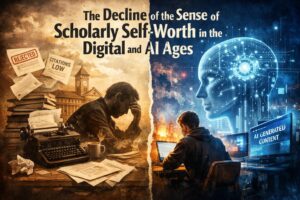
Why pay for a History department when you can pay one person to teach ‘World History’ instead? And why pay one person to teach World History when you can just pay to stream someone at Harvard instead?
What is really grim about all this is that there’s nothing fundamentally ‘new’ about supposedly transformative online technology. It is ‘disruptive’ mostly because it provides a pretext to, say, weaken labour legislation (Uber) rather than provide a better service.
If the universities of the 1920s wanted to cut costs, there was nothing to stop them from buying recorded copies of Freud or Franz Boaz lectures on wax cylinder, and paying something minimum wage to press ‘play’ for a roomful of students – save the common-sense awareness that this was obviously inferior than hiring an expert in the field to teach in person.
The technology hasn’t changed so much as our values have changed. Public universities were established on the understanding that although they would be expensive, they would also provide better outcomes. Now, we make things worse than before, because they’re cheaper.
Thanks for the comment!! Ultimately, I don’t think we can boil everything down to one factor (and I suspect you likely think the same). Technological change is definitely key. Yes, you could have had education by vinyl record. There was education by radio, and tv, and more recently, by MOOCs, but none of those really “took off.” Zoom, however, I think is serving as a technological tipping point. None of those previous technological changes allowed for a live human presence. Zoom does, and that is a game-changer.
In terms of values, I think Zoom allows a lot of values to stay in place. To realize that, we have to accept that the values that drive higher education are not always noble. There are a lot of classes that are lousy. The teachers are boring, the students are bored, and everyone knows this. And yet, classes like that continue year after year (and student evaluations are negative year after year). Although teaching is officially one of the elements that are supposed to be considered in tenure and promotion, there are very few universities that take that seriously (at least at research universities). And for decades profs and administrators have been totally ok with such “values.” In 20 years in higher education, I have never heard anyone demand that we address the problem of professors who continually received bad evaluations from students for their teaching. Instead, I have only come across a response of simply dismissing the negative views of students.
Now we have Zoom. If you are a student, you can log in from your bedroom, keep your video cam off, turn down the volume and “attend” without having to endure being in a boring classroom. When you are the teacher in such a classroom, you can just speak to a computer screen and not have to look at the bored faces of the students. Both sides like it and want it to continue. Have values changed? Not at all.
That’s just one way of looking at the situation. There are many others we could look at, but this is the type of issue that will not get talked about because people in higher education can’t acknowledge and discuss the fact that many people in their midst are simply lousy at what they do and that the entire enterprise suffers as a result, with students being the big losers. By now though this has all become normalized. Students know that a lot of classes suck and that they have to come up with strategies to cope. Zoom is a great coping strategy.
So then a university administration conducts a survey of online learning at the university and discovers that students think online classes are ok. With this “data,” the university unveils a new “vision” to prepare students for the 4.0 economy, etc. This is when the History department is merged into some core curriculum program. Did values change? Not really. The same disinterest in what happens in classrooms is still there, and it’s a disinterest that has been perpetuated by everyone in higher education, profs/students/admin, for decades.
Thanks for the thoughtful response!
It’s interesting to hear you say that, speaking from a country where student evaluations really do matter a great deal. This is because a recent government policy shift has meant that universities are now funded primarily by student tuition fees. Predictably, this leads to several problems: given spiraling teaching demands, faculty have far less time for research (which remains critical to survival, never mind promotion). Student evaluations have also become incredibly powerful – which, faculty research has shown, tends to discriminate against lecturers who are female and/or of minority backgrounds. We are also far more involved in recruiting students than an American school would be. And, there’s a trend toward ‘dumbing down’ the curriculum at some institutions: more film screenings, less-rigorous assignments, no pressure to complete assigned readings and more courses on topics which academics (rightly or wrongly) find less academically interesting, such as battlefield military history. Research on topics which 18 year-olds don’t find appealing has become much more difficult to sustain. Finally, predictably, grade inflation is now a severe problem, on a par with the United States within ten years.
On the other hand, a lack of concern about pedagogical quality and effort is not an issue here – if anything, we have the opposite problem. Student demands are taken very seriously (if at times too seriously) and young or temporary scholars who do not win favour in the classroom do not have their contracts renewed (we don’t really have tenure). Students are customers now, and for better or worse, the customer is always right. Ironically, this will probably spell the end of online teaching here past the pandemic; students HATE it so far, and see it as decidedly inferior to teaching face-to-face (which I, out of self-interest, find a great relief). The idea of reducing a full slate of courses to a single ‘interdisciplinary’ unit would also never fly, given the complaints we field already about poor course selection. And, given that we still charge full tuition fees (on par with out-of-state at a top US public school) AND require students to be on campus even for entirely online learning (because we are literally insolvent without the dorm fees), the students will have the upper hand in these sorts of admin deliberations.
Anyhow, whilst I can appreciate the value and convenience of online learning for students who live at home and work part-time in order to help manage tuition fees, this still seems like a cop-out relative to the experience their parents had, when – at a time when the country was much poorer – tuition was free and students were paid a state stipend for living expenses. Of course politically, those days are gone forever.
Wow!! Thanks for these comments. They are very interesting. But would you mind telling me where you are referring to? I’m guessing UK/Europe.
Some of what you are saying would describe Australia, but I have the sense that Australian universities will push ahead (because of the $$ savings) with online instruction even though they know that students don’t like it. Australia seems particularly ruthless.
Yes, the extremes of everything are bad, but unfortunately, that’s where things tend to end up. You have places that totally disregard student evaluations and places that “over-use” them (where the student has become a customer). The norm should be somewhere in between. . .
I participated in that same “dumbing down” process in the US. The issue where I was, however, was that so many students were having to work 30+ hrs a week, that they simply had no time to do the work that people 10 years earlier (who didn’t have to work so much because tuition was much lower) had been able to do.
This is also why I don’t think there will be an outcry from students at such universities about online courses because so many students are already in “survival mode.” They just want to get through university as fast as they can so that they can stop paying so much money and going deep into debt.