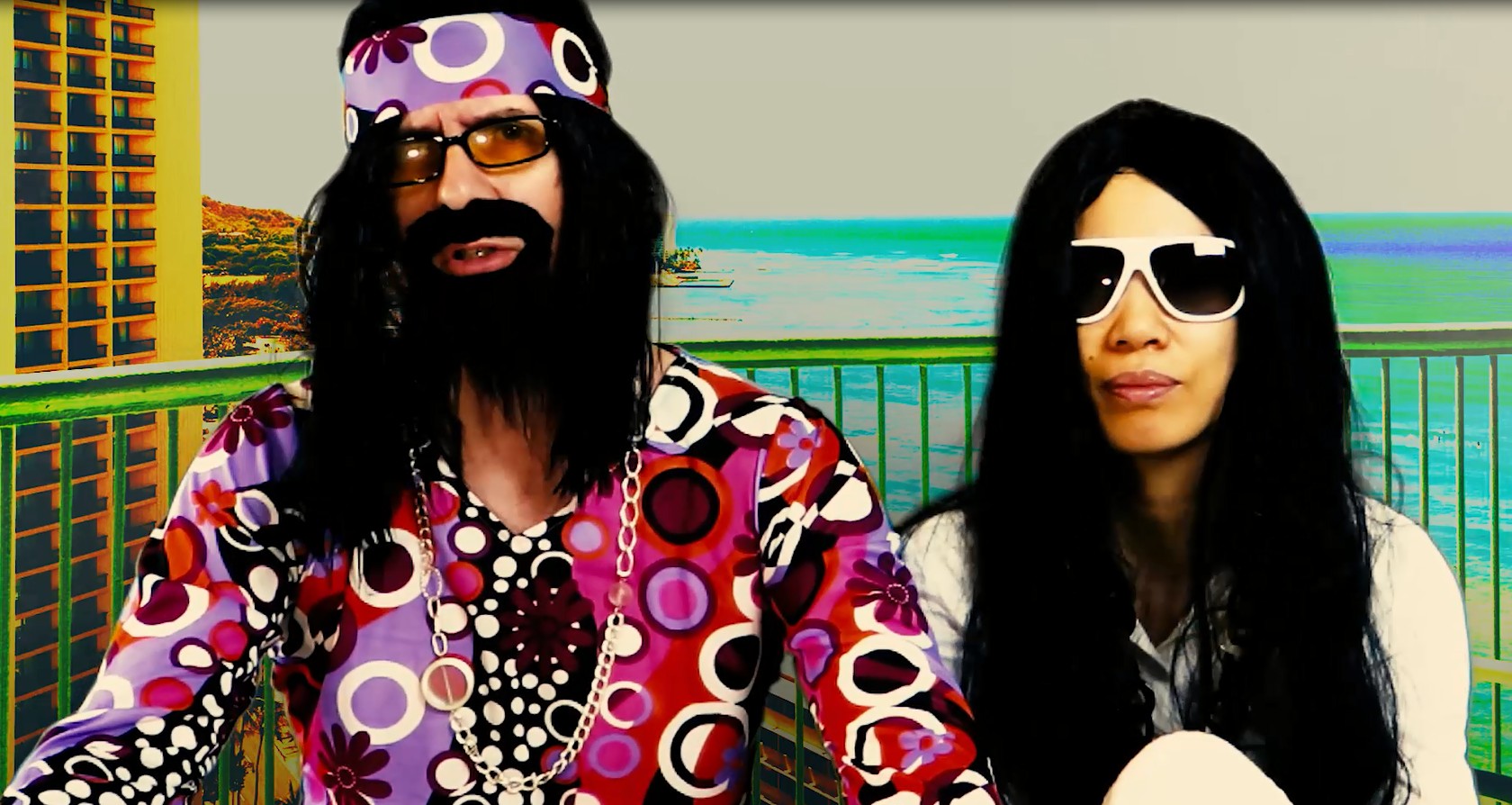
Inspired by the “Bed-In for Peace” that John Lennon and Yoko Ono held in 1969, this is a “Bed-In” review of the book Misalliance: Ngo Dinh Diem, the United States, and the Fate of South Vietnam by Edward Miller.
This bed-in is held by two imaginary people, Ron Lemon and Koko Matcha. The book they discuss, however, is real.
The clips from the actual “Bed-In for Peace” are from the film, “Bed Peace.”
Many thanks to Yoko Ono for making this valuable historical source available on YouTube.
The historical footage of South Vietnamese President Ngô Đình Diệm comes from the British Pathé video archive.
Much of the narration at the beginning is a reading of the description of the book.
The purpose of this video, like the others that will appear in this series, is to cross/transgress/ignore the boundary between the worlds of academic knowledge and popular culture. Doing so, we think, opens up a space for new questions to arise and for people to see academic knowledge in new ways.
Among various reviews of this book, the most insightful seems to me to be the one by a historian from New Zealand who suggests that it can be read in a less America-centric manner: “The most important alliance between 1954 and 1963 may not have been that between Diệm and the United States, but that between Diệm and the people of South Vietnam. The fundamental misalliance was between Diệm and his people.”
https://cross-currents.berkeley.edu/sites/default/files/e-journal/articles/cherry_0.pdf
Thanks for pointing out this review. And yes, I get this point, but doesn’t it also need to be paired with what this reviewer says about the other book that has recently come out on the Diệm years?
“Understanding the conflict between Diệm and his rivals requires a more sophisticated picture of South Vietnamese society than Cauldron of Resistance portrays.”
In other words, when we talk about a misalliance was between Diệm and his people, who exactly are the “people” we are talking about? Did the disgruntled farmer out in the countryside really matter to the officers who assassinated him? Or were they displeased with Diem for other reasons? Reasons more close to them and their personal interests? The phrase “his people,” is perhaps a good way of looking at it, if we see it to mean the people with some power who were the most directly affected by Diệm’s own power. But if we take “his people” to mean “all of the people of South Vietnam” (and I’m not saying that you implied it this way, as I’m sure you didn’t), then I think we will start to head back to a more simplistic view of the period.
How do political scientists understand or gauge concepts or phenomena like “the people” and “popular resistance”? I’m not sure, but this reviewer seems to be saying that we still need to do this.
It appears that the French Ambassador to South Vietnam’s First Republic had anticipated all the pertinent questions you would raise today and had answered them elaborately in a report he sent to Paris in March 1962. A Vietnamese-American historian has summarized this report in a book published in the United States fifteen years ago. His summary indicates that by the spring of that year the misalliance between President Diem and several constituent elements of Southern society had become unescapable fact…
You can throw a look at the cover of that book as well as read the complete summary via the links below.
http://postimg.org/image/nhnrw0g5n/
http://postimg.org/image/ol7w7z0sr/
http://postimg.org/image/6wg5gcp1n/
http://postimg.org/image/cyns6udhn/
E. Miller is from the revisionist school of US historians trying to rehabilitate Diem and the US endeavours as well intentioned and having both a coherent doctrine but star crossed and failing due to some ( mysterious ? ) misunderstandings
For a “bad ” mind , the US support of Diem for “inventing south VN ” (as James Carter said ) recalls the US- British 1945 Greece involvement . They threw their support to the pro-nazi Greek collaborationists to crush the Greek ( mostly communist ) resistance mouvement .
Diem belonged to the VN catholic community whose original sin consists of having been the collaboraters , the support troops of french colonial conquest and 80-year rule of VN .
Cao Huy Thuân : Christianisme et colonialisme au Vietnam (1857-1914)
http://www.persee.fr/web/revues/home/prescript/article/befeo_0336-1519_1972_num_59_1_5137
His father Ngô dinh Kha was no patriot , he participated in the crushing of the VN resistance mouvement Cân vuong and a staunch supporter of the French . As a minister , he spied for them on puppet emperor Thanh Thai
While Diem was province chief of Quang nam , he too was quite brutal with any form of anti french resistance .
The catholic commmunity considered VN as their posssession ; they conquered and ruled it first through the hands of French navy and admirals ( most of navy officers were catholics and royalists ) .They were bent on converting VN to catholic faith as they did in the Philippines
The French anticlerical Republicans after the fall of Napoleon III took over ( stole from the catholics ) the administration and exploitation of VN and hindered the evangelization of the country ; the catholics chafed under their
restrictions for 80 years They hoped their time has come again in 1954 after the fall of French colonial rule
Diem was not anti French nationalist no VN patriot , he was a CATHOLIC VN patriot
After taking over south VN instead of building a pluralistic democracy he tried to transform VN into kingdom of God , as a VN CATHOLIC country See http://arcticbeacon.com/books/Avro_Manhatten_-_Vietnam_Why_Did_We_Go.pdf Chapter 10 and 11 : Catholic totalitarianism
Let me ask a few of questions.
Question 1: Where is the academic study that is based on years of archival research around the globe (Vietnam, France and the US at the very least), relying on archival sources in multiple languages (Vietnamese, French and English at the very least) that passed a blind peer review process and was published by a reputable academic press which argues that Diem “tried to transform VN into a kingdom of God, as a VN CATHOLIC country”?
Answer: There is no such academic study.
Question 2: Where is the academic study that is based on years of archival research around the globe (Vietnam, France and the US at the very least), relying on archival sources in multiple languages (Vietnamese, French and English at the very least) that passed a blind peer review process and was published by a reputable academic press which argues that Diem was a US puppet?
Answer: There is no such academic study.
Question 3: Where is the academic study that is based on years of archival research around the globe (Vietnam, France and the US at the very least), relying on archival sources in multiple languages (Vietnamese, French and English at the very least) that passed a blind peer review process and was published by a reputable academic press which argues that Diem was a very complex figure whom we can’t use simplistic terms like “puppet” or “great leader” or “Catholic patriot” to characterize?
Answer: Ed Miller’s book.
“Revisionists” are people who challenge un-grounded (meaning not based on serious archival research), politicized, biased interpretations of the past (which other people uphold) by employing equally un-grounded, politicized, biased interpretations of the past.
Ed Miller is not a revisionist. He is a professional historian who follows and upholds the highest standards of the history profession in North America (like many other professional historians). He is someone who spends years researching what he eventually writes about. He bases that research on an exhaustive examination of archival materials from around the globe in at least three different languages, and spends years weighing the evidence that he finds in the archives.
That is VERY DIFFERENT from what someone like Avro Manhatten did. Manhatten was openly-anti-Catholic, did not read Vietnamese, and never spent a second in a Vietnamese archive (and probably never looked at anything relating to Vietnam in a French archive, and certainly never did research on Vietnam in the US National Archives or any American presidential libraries where records from presidencies are held).
There is absolutely no comparison between the two, and more importantly, there is no comparison between what they wrote.
“…which argues that Diem was a very complex figure.”
At the risk of stating the obvious: his vanquished rivals can also be said to be very complex figures.
A while ago, I came across this claim by an American historian of modern Vietnam:
“In fact, the Resistance did not win the war by 1954. One can put forth a far different and plausible argument: that the French and the new State of Vietnam, aided in particular by the Cao Đài and the Hòa Hảo, defeated the communist-led Việt Minh in the Mekong delta by 1953, and held on to most of their gains in 1954. In 1954, the Việt Minh made a limited comeback, but could not regain lost ground. For all intents and purposes, the Việt Minh had lost the war. It was precisely because of its weak position in the south that the Democratic Republic of Vietnam was compelled to accept the Geneva Accords that divided the country.”
https://www.wilsoncenter.org/publication/caught-between-propaganda-and-history-history-the-southern-resistance-volume-I
If the quoted claim is tenable and if one is allowed to accept as valid the judgment that [t]he fundamental misalliance was between Diệm and his people,” then one cannot help but wonder which turn South Vietnam’s history would have taken, had Washington chosen to listen to General J. Lawton Collins in the spring of 1955…
Hard to tell. . . but if Bao Dai had been the solution, then at the very least, with Sihanouk ruling in neighboring Cambodia, you would have had two very chic rulers in the region for at least a few more years in the 1950s. . .
It has been many decades since the fall of Diêm and the end of US Vietnam venture. One can be allowed to pass judgment on him and the US .
Just stating the obvious , that Diem was a very complex figure and adding that he has a coherent doctrine ( personalim + low modernism ) won’t redeem his notoriety as a ” Mad Hatter ” a stubborn tyrant , a catholic zealot ; his depredations are too well known The same for the Americans ,saying that they were well- intentioned , they had a project for the Vietnamese ( high modernism democracy ) won’t whitewash their reputation as “mad bombers , mad sprayers , mass murderers”
Maybe , in 1954, the French had the upper hand in Cochinchina and the Vietminh were militarily defeated then It was only a temporary , tactical victory for the French . .Retrospectively , it looked like a case of ” we won the battles but lost the war ” . Phoenix-like , the Vietminh rose again thanks to their undergrround VCI ( VC infrastructure ), thanks to their famed Cu Chi tunnels and their Laos and Cambodian sanctuaries . And thanks to Diêm’s mistakes, retrospectively mindless , mad ones : he hunted and sought to crush the Hoà hao and Cao dai sects , they were pushed towards their former ennemies and became founding members of the NLF
The basic invisible primal forces in Asia durng those terrible years was the resurrection of Asia : after the colonial tsunami , responded the anticolonial tsunami ; and in Vietnam it was the Vietnamese people thirst for independance and for unification . Mindless were those ,the French Diem and the Americans who put themselves athwart those enormous waves .
The Indochina and Vietnam wars were unwinnable , once the chinese and Vns awoke .
“after the colonial tsunami , responded the anticolonial tsunami”
Yes, and the one thing that I can’t understand is why the anticolonial tsunami across Southeast Asia gets increasingly oppressive over time. One would think that the road away from colonial oppression would be toward freedom and democracy, but look at Vietnam, Thailand, Cambodia, Burma, Malaysia and Singapore today. . . Why is it that the anticolonial tsunami has produced governments and societies that are more restrictive and oppressive than those of the mindless people who stood in their way?
It’s a classical case of ” winning the war and losing the peace” .
To be a glorious resistance fighter doen’t mean one is to become an enlightened ruler ; to be a victorious resistance fighter maybe entails being a ruthless scoundrel , ” nice people finish last ”
Mao ‘s actions caused the death of 50 millions Chinese ; how many in VN ? So what ? History can’t be beaten back, one should not judge the past by the results of the present . Back then , the colonialists and japanese ‘s crimes elicited in the Chinese and VN a mad , mindless hatred ;even if they could have known what would befall them after victory , they would have answered : we don’t care what happen afterwards ; all we want is to get rid of the agressors , at whatever price .
So the present ” governments and societies that are more restrictive and oppressive than those of the mindless people who stood in their way?”
East is east and west is west ; to each , a different political system
Maybe , it’s in the Asians ‘ bloodstream to endure oppression because of
an ingrained secular subservience to authority .combined with buddhist teachings of forbearance and patience confronted to suffering
Or maybe it’s their karma . All these countries had glorious pasts ; as the saying goes , ” much glory , many crimes “. These countries ‘ dire straits are payback for their deeds
„…the one thing that I can’t understand is why the anticolonial tsunami across Southeast Asia gets increasingly oppressive over time.”
A: Maybe because some forces in society and from outside usually prefer stable, reliable, subservient autocracies over bumpy open societies?
„One would think that the road away from colonial oppression would be toward freedom and democracy…”
B: Seriously, – why would anybody think so? Admittedly SEA governments are quite oppressive today; so, either the supposition of ever increasing freedom and democracy after liberation from colonialism is faulty, the requirements for a development towards these goals were not there, and/or something happened along the way (see A).