In 1976, Edward Schafer published a book about “the South” in the medieval Chinese imagination called The Vermilion Bird: T’ang Images of the South. Filled with fascinating details about everything from plants to people, Schafer’s book demonstrated how vast and rich the information in Chinese sources is for the region of what is now Guangdong and Guangxi provinces, as well as northern and parts of central Vietnam, in the first millennium CE.
At the same time, however, in focusing on how Chinese “thought” about the south, The Vermilion Bird is not an ideal work to read in order to gain a sense of “what actually happened” in that region during that time period. This is a gap that Keith Taylor’s 1983 work, The Birth of Vietnam, partially filled as it provided a very detailed narrative of the history of the Red River Plain, part of the larger region that is examined in The Vermilion Bird, from the earliest times up through the period of Tang Dynasty rule.
Another important contribution toward establishing a picture of the early history of this region came in 1997 when Charles Holcombe published an article entitled “Early Imperial China’s Deep South: The Viet Regions through Tang Times” (Tang Studies 15-16, [1997-8]: 125-157).
What Holcombe essentially argued in this article was that in the first millennium CE Hanoi and Guangzhou were like two Sinicized islands that were more like each other than the surrounding areas. Holcombe also argued that over the course of this period trade became more centralized at Guangzhou and that this led the Red River Plain to become more peripheral to the Chinese world by the time of the Tang.

As helpful as these three works are for learning about various aspects of the early history of the area that stretches from what is today central Vietnam to Guandong Province in China, to really gain a solid understanding of the history of this region would require a bold work of synthesis that would place Taylor’s detailed study of the Red River Plain in the larger context of an equally detailed understanding of the history of the areas of Guandong and Guangxi provinces at the same time, and that would examine the region between Hanoi and Guangzhou that Holcombe did not discuss, and that would discover how the many products from the natural world that Schafer wrote about tie into the historical developments of the region.
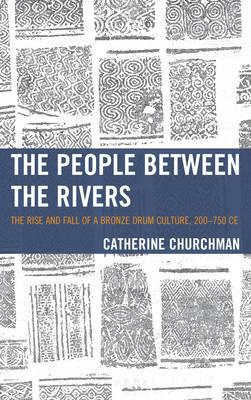
Fortunately for all of us who are interested in the early history of that region, such a synthesis has just been completed. It is Catherine Churchman’s The People between the Rivers: The Rise and Fall of a Bronze Drum Culture, 200–750 CE (Rowman & Littlefield, 2016).

Churchman’s monograph focuses on the mountainous lands between the Red and Pearl River deltas in the period from roughly the end of the Han Dynasty up to the period of Tang Dynasty rule.
The people who lived in this region were known to Chinese authors as “Li” and “Lao” peoples, or more generally as “savages” or “barbarians.” Indeed, they were distinct in some ways from their counterparts in the Yellow River valley, and there is no better sign of this than the (Heger II style) bronze drums that they produced from around the second or third century CE until around the eighth century CE when their separate polities ultimately came to be incorporated into the Tang Dynasty realm.
Churchman documents the history of the rise and fall of Li and Lao polities during this period, and in the process, she also ultimately rewrites the history of the larger region, particularly as it has been represented by modern Vietnamese historians.

So what is this history? To grossly simplify Churchman’s richly documented and detailed study, it is as follows:
The Qin and Han Dynasties expanded their authority southward to the Pearl and Red River Plains. In the process, they largely bypassed the mountainous region in between, and after the Han Dynasty collapsed, there was no dynasty that was strong enough to take direct control of that region until the time of the Tang Dynasty.
This does not mean, however, that the land between the rivers remained isolated. Instead, what Churchman demonstrates is that there were polities in that region that became increasingly powerful over that same time period through their interactions with various Chinese states. In particular, in accepting nominal titles from Chinese dynasties, local rulers gained trade privileges that then provided them with the wealth and resources to expand their domains.
While this region did ultimately end up being incorporated into the Chinese empire, through conquest and gradual political expansion, Churchman’s main focus is to examine a very different development that occurred prior to that – the rise and expansion of Li 俚 and Lao 獠 polities.

While that is the gist of the overarching historical narrative that Churchman presents, there are many other issues that she covers that enrich our understanding of the history of not only the land between the two rivers but also the Pearl and Red River Plains themselves.
First and foremost, she does a wonderful job of explaining how we should understand terms like “Li” and “Lao.” While many scholars have viewed such names as designating ethnic or linguistic groups, Churchman demonstrates that they are more like markers on a continuum of political recognition. (Erica Fox Brindley’s recent book on the Yue similarly problematizes the term “yue” 越.)
To simplify Churchman’s more complex discussion, people who were completely outside of the world of Chinese administration were “Lao,” people who participated fully within the world of Chinese administration were “people” 人 (Chn., ren; Viet., nhân), and local chiefs who accepted titles from Chinese administrators were “Li.”
Again, this is a simplification of Churchman’s discussion of this issue, but the important point is that the divide between “Li” and “ren/ nhân/people” was ambiguous as local peoples who participated in Chinese administrations inhabited an ambiguous space, and as evidence of this Churchman presents several illuminating examples of how the same individual could be referred to in different sources in different ways, from “Li” to “barbarian chief” to “person” to the title that the local Chinese administrator had given him.

Adding to this ambiguity is the fact that the style of rule of Chinese administrators in the south also changed over time. In particular, following the Han Dynasty period many Chinese administrators essentially became hereditary local lords, as many of the various Chinese states between the Han and Tang either did not have the resources or were too short-lived to dispatch officials to the region, and as a result, chose simply to approve of the continued service of the men who were already there.
As such, on one level there was not all that much difference between hereditary Chinese governors in the south and the hereditary Li chiefs who ruled over mountainous regions on their behalf. On another level though, the fact that those Li chiefs continued to produce bronze drums as a sign of their political power and legitimacy was a sign that some differences did indeed exist.
This trend towards the rule of hereditary officials was eventually put to an end in the Pearl River delta as Chinese states, such as the Liang dynasty (502–587), sent their own officials or members of the royal family to take up positions there. However, it continued in the Red River Plain.

While the history of the Red River Plain is not the focus of Churchman’s monograph, she does bring up numerous points about the history of that region, and taken together these points represent a full challenge to the narrative of that region that was produced by Vietnamese historians in the twentieth century and which was presented in English in Keith Taylor’s 1983 work The Birth of Vietnam.
That narrative is that there was a distinct society, culture and language in the Red River Plain before the Qin and Han extended their empires into that region, and that for 1,000 years, the inheritors of that society, culture and language resisted Chinese rule and eventually became “independent” again.
Taylor’s more recent A History of the Vietnamese offers a very different understanding of this period by arguing that the people whom we today refer to as “the Vietnamese” are in countless ways a product of 1,000 years of incorporation in Chinese empires. Churchman doesn’t address this issue of cultural and social change in the Red River Plain, but by discussing that region alongside the Pearl River Delta and the lands between the Red and Pearl rivers she makes it obvious that the Red River Plain did not fit the characterization of a “rebellious” region.

In fact, Churchman demonstrates clearly that the narrative of maintaining cultural distinctness and resisting incorporation into the Chinese empire is a much more appropriate narrative for the lands between the rivers than it is for the Red River Plain.
Whatever cultural and social distinctness existed in the Red River Plain came to a rather abrupt end as Đông Sơn bronze drums ceased to be produced and as that region became comparatively peaceful following Ma Yuan’s crushing of the Trưng Sisters’ rebellion in the first century CE.
By contrast, for the next few centuries a bronze drum cultural world continued to exist in the mountains to the north of the Red River Plain, and the Li and Lao peoples proved to be much more rebellious than their counterparts to the south.
Finally, Churchman makes it clear that by the time of the Tang Dynasty the Red River Plain had become increasingly distant from, and peripheral to, the concerns of Chinese courts. Advances in shipbuilding had made it possible for ships to sail across the open sea directly to Guangzhou instead of following the coast and stopping in the Tonkin Gulf as they had done during the time of the Han Dynasty.
Also, with no serious effort to replace hereditary Chinese officials, unlike what happened in the Pearl River Delta, the “independence” of the region in the tenth century can be more accurately seen as more the result of imperial neglect than of the manifestation of a popular will.

While I find this characterization of the period of Chinese rule of the Red River Plain to be accurate, and while Churchman’s detailed examination of the rise and fall of bronze drum kingdoms in the lands between the rivers is clear and convincing, we are left with one obvious and essential question: what happened to the earlier bronze drum kingdom(s) of the Red River Plain?
The recent book by Nam Kim on the ancient citadel of Cổ Loa (The Origins of Ancient Vietnam, Oxford University Press, 2015) makes it clear that there was a powerful kingdom in the Red River Plain in the first millennium BCE. Churchman shared with me in an email correspondence that she thinks that it may have been easier to control such a large state in a river plain after eliminating or subjugating its rulers than it was to try to conquer numerous mountain polities.
Indeed, this is a central aspect of Churchman’s argument for the bronze drum kingdoms in the lands between the rivers – as kingdoms became larger and more connected to Chinese empires, they ultimately became easier to subjugate and fully incorporate once a Chinese empire had the military resources to do so.

This then reminded me of a famous passage in Li Daoyuan’s sixth-century Annotated Classic of Waterways (水經注, Shuijing zhu) in which he cites an earlier text called the Record of the Outer Territory of Jiao Region (交州外域記, Jiaozhou waiyu ji) for information about the Red River Plain.
This is what the passage says:
交州外域記曰,交趾昔未有郡縣之時,土地有雒田,其田從潮水上下,民墾食其田,名為雒民。設雒王雒侯主諸郡縣。縣多為雒將。雒將銅印青綬。
“The Record of the Outer Territory of Jiao Region states that ‘In the past, before Jiaozhi had commanderies and districts, the land had lạc fields. These fields followed the rising and falling of the floodwaters. The people who opened these fields for cultivation were called lạc people. Lạc princes and lạc marquises were appointed to control the various commanderies and districts. Many of the districts had lạc generals. The lạc generals had bronze seals on green ribbons.’”
I have long struggled to understand this passage because it purports to describe the region before it had “commanderies and districts,” which is shorthand for saying “before it was under ‘Chinese’ rule,” and then it goes on to talk about people controlling districts and having the accoutrements of “Chinese” rule – bronze seals on green ribbons.
If this was really a time before the Qin and Han Dynasties sought to control the region, then shouldn’t the local rulers have had bronze drums?
While Churchman does not discuss this passage in her book, in discussing the bronze drum kingdoms between the two rivers she points out that one of the forms of Chinese indirect rule in the region was to establish what she calls “left-hand districts” (zuoxian 左縣), or what one could probably also call “subsidiary districts.”
These were districts that were under the control of local (Li/Lao) rulers, but were nominally recognized by the Chinese administrator of an officially established district nearby.
And how did that Chinese ruler indicate that he was recognizing a local person as the ruler of a left-hand district? By granting him a bronze seal on a green ribbon (or more generally, a seal and a sash).

In other words, this earliest passage that we have about the Red River Plain looks to be not about a time before that region came under Chinese control, but before it became under “complete” or “direct” Chinese control.
As Churchman explains in her book, during the second half of the Han Dynasty period such efforts were made by Chinese administrators, and the Trưng Sisters’ rebellion, she argues, may have been a reaction to efforts on the part of Chinese administrators to transform indirect rule into direct rule.
That rebellion was of course put down, and from that point onward there is essentially no more evidence of the world of bronze drum kingdoms or chiefs or bronze drum culture in the Red River Plain. Instead, it’s in the lands between the Red and Pearl Rivers that this world continued and evolved, as Churchman so ably demonstrates.
In conclusion, I could write much more about this book as well as about the ideas that it inspires, suffice it to say that our understanding of the early history of the area stretching from what is today central Vietnam to the provinces of Guangxi and Guangdong in China has just taken a massive step forward thanks to the work of Catherine Churchman.
The People between the Rivers: The Rise and Fall of a Bronze Drum Culture, 200–750 CE is a masterpiece of synthesis and insight that provides a lucid overarching framework for several centuries of regional history as well as nuanced discussions of countless ground-level issues, from problematizing the concepts of “Sinicizaton” and “ethnicity” to mapping out trade patterns between the Red River Plain and southern China. It is indeed a masterpiece.
As far as I know, in Thuỷ Kính chú written by Lịch Đạo Nguyên: “Giao Châu ngoại vực kí viết: Giao Chỉ xưa khi chưa có quận huyện, đất đai có ruộng gọi là Lạc điền. Ruộng đó theo nước triều lên xuống. Dân khai khẩn trên ruộng đó lấy lương thực, do đó mà gọi là Lạc dân. Đặt ra Lạc vương, Lạc hầu, làm chủ các quận huyện. Huyện phần nhiều là các Lạc tướng. Lạc tướng mang ấn đồng đai xanh. Sau đó con Thục Vương đem 3 vạn quân đánh Lạc vương, Lạc hầu, thu phục Lạc tướng. Con Thục vương nhân đó mới xưng là An Dương Vương. Sau Nam Việt vương Úy Đà đem quân đánh An Dương Vương. An Dương Vương có thần nhân, tên là Cao Thông là thủ hạ phụ tá, làm cho An Dương Vương một cái nỏ thần, bắn một phát giết 300 người. Nam Việt vương biết không thể đánh thắng. Mới cho quân đóng ở huyện Vũ Ninh. [Theo Tấn Thái Khang kí huyện thuộc Giao Chỉ]. Việt (vương) sai Thái tử tên là Thủy hàng phục An Dương Vương, xưng bề tôi mà thờ. An Dương Vương không biết (Cao) Thông là thần nhân, đối đãi không có đạo lí, (Cao) Thông mới bỏ đi, mà nói với vua rằng: “có thể giữ đuợc nỏ đó thì làm vua thiên hạ, nếu không giữ được nỏ thì mất thiên hạ”. Thông đi, An Dương vương có con gái tên là Mỵ Châu, thấy Thủy là người đoan chính, Châu với Thủy thông giao. Thủy mới hỏi Châu muốn xem nỏ của cha. Thủy thấy nỏ, trộm lấy mà cưa nỏ, rồi trốn về báo với Việt vương. Nam Việt tiến binh đánh, An Dương vương đem nỏ bắn, nỏ gãy, bị thua trận. An Dương Vương xuống thuyền, chạy trốn ra biển. Nay ở hậu vương cung thành huyện Bình Đạo còn thấy nền cũ”.
In conclusion, it showed that Lac King was defeated by King An Duong then King An Duong was defeated by Trieu Da of Nam Viet. So if Lac King was accepted/granted by Han King. So what about King An Duong and Trieu Da?
The big problem is you show only some paragraph and clear all other was written in time order.
I’ve written about this so many times before. Just search through this blog. There are many contradictions in this passage: before there were commanderies and counties the Lac generals in the “counties” (how can there be counties before there were commanderies and counties?) who used seals and sashes (why were they using Chinese administrative symbols before the period of Chinese rule?). . . None of this makes any sense.
So how do we explain what was going on here? It’s clearly someone writing after the fact who is mixing together contemporary terminology with information about earlier periods.
This happens OVER AND OVER AND OVER AND OVER in Chinese sources and in sources like the Dai Viet su ky toan thu. The use of administrative terms in that text is CHAOS. Ngo Si Lien REPEATEDLY uses terms like Giao Chi and Giao Chau for periods when those terms were not used.
1> It’s clearly someone writing after the fact who is mixing together contemporary terminology with information about earlier periods.
ans: It is true but the problem is there is no mixing or ambiguity here. Because Lac King was defeated by King An Duong and Lac generals was surrendered. We all know that Lac King and Lac generals existed before King An Duong. If Lac King, Lac Lord and Lac general existed after An Duong Vuong or Trieu Da, so who was defeated by King An Duong? It is simple logic.
2> who used seals and sashes (why were they using Chinese administrative symbols before the period of Chinese rule?
Ans: actually, you, by yourself, answered this question. This is the mixing contemporary here.
Giao châu ngoại vực ký chép: “Vua nước (Nam) Việt sai hai sứ giả trông coi dân hai quận Giao Chỉ, Cửu Chân, sau nhà Hán sai Phục ba tướng quân là Lộ Bác Đức đánh vua nước Việt, Lộ tướng quân đến quận Hợp Phố, vua nước Việt sai hai sứ giả đem một trăm con bò, một ngàn vò rượu cùng sổ hộ khẩu dân hai quận đến gặp Lộ tướng quân, bèn bái hai sứ giả làm Thái thú của hai quận Giao Chỉ, Cửu Chân, các Lạc tướng vẫn trị dân như cũ”.
Because after King An Duong kill Lac King and Lac Lord, Lac generals who surrendered was still control their land. After Trieu Da and then Lo Bac Duc who help Han King took control over Giao Chi, Lac generals was surrendered and still control their land. Only after Trung rebellion, Lac generals system was destroyed. Lac generals took the seals and ribbons from Han King but only after the Han administrative existed in Giao Chi.
Let me explain it this way: the information in the Shuijing zhu about the Lac kings “describes a society.” The information about An Duong Vuong and Trieu Da, on the other hand, “retells events.” Further, the “society” is described in “Chinese” terms (“kings/marquises (hau), generals, districts, sashes and seals”), but it is supposed to describe the society BEFORE it was under “Chinese” rule. The events, on the other hand, are simply retold as events. There is nothing “Chinese” about them.
It is sort of like this:
“Before North America was taken over by Europeans, the Native Americans lived in reservations where they were protected by police who wore badges. Then Columbus crossed the Atlantic. After that more Europeans came and took over the continent.”
Native American “reservations,” “police” and “badges” all exist in the US today and are part of Native American “society.” They did not exist in North America before Europeans arrived. Did Columbus cross the Atlantic? Yes. Did Europeans then cross the Atlantic and take over control of North America? Yes. Before Europeans crossed the Atlantic were there already people in North America? Yes, but they did not have “police” with “badges” who worked in “reservations.”
The difference is between “describing a society” and “retelling events,” and it is clear that the author of that passage did not actually know what the society of the “Lac kings” was like prior to the time that certain events, like An Duong Vuong’s conquest, took place because it is described in terms that only existed later.
It would therefore make much more sense to see that part as describing what society in the Red River Delta was like at the time that passage was written, or shortly before it was written, just like the example above describes what Native American society is like today rather than prior to the time that Columbus/Europeans arrived.
Again, this passage could have been written after direct Han Dynasty rule was imposed, following a period of indirect rule when the Han Dynasty ruled through Lac kings, Lac marquises, and Lac generals who had [Han Dynasty] seals and sashes, just as the Han and other dynasties did in other places, as Churchman’s book clearly shows.
The difference here is only Lac generals (who was surrendered) took the seals and ribbons from Han administrative, not Lac King and Lac Lord. Lac King cannot exist in Han administrative system.
I guess what you mean now is that Lac is a name for community not a real name for Lac King. Lac King maybe the name for the king of Lac community/ethnic. Is that your idea?
“The term “Lao” was mainly used for people who lived in modern Guizhou and Sichuan before it
was applied to people in the Pearl River drainage area. Its farthest extension was The Li and Lao from the Han to the Sui east into the southern end of modern Fujian and southwest into the mountains west of the Red River Delta. It probably therefore began as a term for “barbarians” who lived in the more mountainous areas to the north before it was applied to the people in the lower hill country south of the Pearl River. The original meaning of “Li”is obscure. As a word, its earliest meaning was “vulgar” or “bumpkin”; as an ethnonym, it seems to have first been recorded in reference to a group of people living outside the Han Empire near Jiuzhen (now the high country of northern central Vietnam), a great distance from the Pearl River drainage area. During the Six Dynasties the ethnonym was never used for people who lived farther east than modern Canton.”
(wirten by the same author with this book I think)
Li peope was appear even in Jiuzhen (Cửu Chân) (Hậu hán thư, juan 86: 9b.)
I, now, think about what happen in Jiuzhen. First, the bronze drums was found the most in region now call Thanh Hoa. It was the place was mention that the The Shrine of the Spirit of the Bronze Drum was placed and the Dai VIet Su Ki Toan Thu mention about Le King was there to do some royal custom related to brone drum.
So, I think that, the first kingdom(s) in Red River Delta and Ma, Ca River Delta was kingdom(s) of people who made bronze drum. When it was defeated by Han people, some of them retreat into high land, not only between two river but also high land in south of Red River Delta like Ninh Binh, Hoa Binh and Ma River like Thanh Hoa.
First kings after 1000 years of Han colonise was Ngo Quyen, Dinh Tien Hoang, Le Hoan was originated from that region, so it maybe the reason why An Nam Do Ho Phu become Dai Co Viet and Dai Viet. It was because the Li/Lao local chiefdom took control the whole country.
When, in the 19th century, French missionaries and scholars tried to figure out where the Giao Chi “race” came from, they came up with an argument similar to what you say here. With the “Chinese” conquest of the region, the truly indigenous people “retreated” into the mountains.
Essentially what we are talking about is cultural/linguistic differences. People can change their culture and languages without going anywhere. These changes come through cultural contact. The Japanese of the late 20th century were radically different from the Japanese of the early 19th century. No one “retreated” anywhere. They simply transformed themselves through contact with other peoples.
I would agree that there is a dichotomy/tension in Vietnamese history between a Sinicized “center” (Hanoi) and a less-Sinicized periphery (Thanh Hoa), but this does not have to be because some original inhabitants “retreated” to the Thanh Hoa or mountainous areas.
What I mean here is that after invaded by Han, some Lac Lords and Lac generals retreat into mountain and rural area. They bring the bronze drum technique as well as culture into some region around and probably mixed with old community existed before. And Ly/Lao community exist not only the region between two river but also the region south of Red River Delta and north central of Vietnam (today, they are Thanh Hoa, Nghe An, Ha Tinh and they was chau Hoan, Ai, Phuc Loc).
This is the reason why the Ly/Lao community used bronze drum longer than Giao community in Hanoi whose culture was transformed into somewhat Sinicized more. During Duong dynasty, they used a lot of local chiefdom of barbarians (Ly/Lao) to control Red River Delta ,the north central of Vietnam and moutain region surround. After the collapsing of Duong dynasty, the local chiefdom mostly has north central origin took control whole country. Therefore, the transformation of language into Vietic branch (belong to Austroasiatic) as well as the disconnected to Chinese system and Chinese community thanks to that.
Are you aware of the book by Li Tana called Tongking Gulf through history. There was an emphasis on the role of Li/Lao and the birth of Vietnam in that book. Li Tana also stressed the difference between Jiao people (supposedly Han and Hanized locals) vs Li/Lao. So there are not many new discoveries regarding the Vietnam side from this book.
http://www.upenn.edu/pennpress/book/14844.html
Yes, I am aware of that book. In fact, my name is on the back cover (offering praise). The information in that book on the Li/Lao was written by the same author as this book here (who wrote in the Tonkin book under the name Michael Churchman). This book, in contrast to the chapter in the Tonkin book, is much more developed and provides many more insights. That chapter, and that book, do not necessarily challenge the basic narrative of Vietnamese history. This book DOES (even though that is not its main purpose).
Therefore before you determine that there is nothing new in this book I would encourage you to make the basic effort to actually READ THE BOOK!!!
Is Catherine Churchman a cousin of Michael Churchman?
Her argument about Li and Lao sounds similar to that of Michael Churchman.
It’s the same person. Different gender now but the same solid scholarship.
I need to look at what Chamberlain wrote more closely, but he was citing Churchman to see “exactly” where these terms were used, and that’s something that Churchman shows in her book is impossible to do because Chinese writers used the terms Li and Lao in fluid ways, and usage changed over time. She devotes an entire chapter to this topic. The gist of it is (and Brindley makes the same argument about the Yue) that the names of peoples in Chinese texts tell us more about what Chinese authors were thinking at that time then they do about the people they were writing about.
Here are some key passages:
“Since the people designated Li and Lao in ancient Chinese texts have left no records of their own aside from a few stelae dating from the seventh century CE, how they actually referred to themselves in earlier periods is a question which cannot be answered with any certainty. That they probably did not use the terms Li and Lao is suggested by the nature of the many references to the Li and Lao, used over many centuries and often inconsistently, for widely scattered and disparate groups of people. These groups almost certainly spoke unrelated languages,6 shared little in the way of material culture, and were never politically unified. The constant refrain that ‘it is their custom to enjoy attacking one other’7 indicate that it was unlikely that they considered themselves to be a single unified group. Although is highly doubtful that they had any meaning for those to whom they were applied, the names Li and Lao did have meaning and significance for those who used them. Rather than answering the question ‘who were the Li and Lao?’ it is better to extend the question, in imitation of F.K Lehman’s query concerning the Kachin of Burma, ‘who were the Li and Lao, and if so, why?’
“The distribution of the use of the terms Lao and Li in pre-T’ang texts can be summarised as follows: Lao was used for people throughout the Two Rivers area, mainly in the hill country or areas more distant from the Chinese administrative centres. It was also used further afield to refer to people of the mountainous country of modern Yunnan, Kweichow, and Szechwan far to the north and north-west of the Two Rivers region. Li was used mainly to the west of Canton, but also in the Red River area in the hills and the plains. Inconsistencies in use abound, however. In some cases the same events are recounted in different works, or even a single work, but different names are used for the same group of ‘barbarians’. In one case in two early texts Wu-hu and Li are interchanged.61 On another occasion the names Li and Lao are confused: in the Ch’ên Shu a military expedition which leads to the capture of a certain Ch’ên Wên-ch’ê 陳文徹 (about whom more later) is recorded as ‘against the Yi and Lao’,62 but the reference to the same expedition in the Liang shu, refers to Ch’ên Wên-ch’ê personally as a ‘Li leader’, and the Nan shih identifies him as a ‘Li leader from west of the river’.63 Aside from these example, the common habit of compounding terms such as ‘Yi and Lao’ and ‘Man and Lao’ also suggests that some writers were more interested in defining ‘barbarians’ with whatever terminology they had at their disposal than they were in distinguishing discrete groups among them. Scholars writing in languages other than Chinese have put forward different theories as to the nature of the people known as Li and Lao. As previously mentioned, Pulleyblank speculated that they have had a connection with the Kadai language family, and this was probably true of the first recorded Lao and Ko-lao, from whose speech the name Lao was most likely borrowed, but the etymology of the name does not necessarily equal its later usage, and the later more widespread use of the term over the south-west China probably had very little to do with Chinese identification of linguistic groups and was based on other factors.
“The general pattern of usage through the Six Dynasties is that Li was increasingly applied to people who lived close to imperially-controlled urban centres and were culturally close to what the writers of Chinese texts considered the norms of civilized behaviour. Those called Lao, on the other hand, tended to live in mountainous areas remote from Chinese centres, suggesting that the term referred to people more geographically distant and culturally divergent from the norms of those who wrote about them. This becomes apparent in the ambiguous status of some individuals termed Li in Chinese texts, particularly those of the period from the sixth to the eighth centuries. Beginning in the sixth century onwards it is not uncommon to find the term Li interchanged with ‘person’ (jên 人). For example, Wang
Chung-hsüan 王仲宣 who lived in the Canton area in the 590s is referred to in four different ways in the
same book, as an Yi of P’an-yü, as a Ling-nan chief (Ling-nan ch’iu chang 嶺南酋長), as a Li commander (li shuai 俚帥) and as a man of P’an-yü (P’an-yü-jên 番禺人).65 Similarly, Li Fo-tzŭ 李佛子
of Chiao-chou who was influential in the local politics of the area in the second half of the sixth century and led an uprising in the fourth year of 602 is called a ‘man of Chiao-chou’ (Chiao-chou jên 交州人) in
one chapter, a ‘Li man of Chiao-chou’ (Chiao-chou li jên交州俚人) in another, and a ‘great leader of Chiao-chou’ (Chiao-chou chü shuai 交州渠帥) in yet another.”