

Chinese historical sources contain valuable information about early Southeast Asia, however, it takes some effort to determine which exact places some of that information refers to.
This task of determining which places in Southeast Asia early Chinese sources refer to is one that the first generations of modern scholars attempted to carry out. In doing so, records of certain itineraries proved to be very important as they gave a sense of the relationship in space between one place and another.
One such itinerary was recorded in the late eighth century by Chinese geographer Jia Dan, and it was examined in 1904 in an article by a young French Sinologist by the name of Paul Pelliot (1878-1945).
Another important itinerary comes in the form of a record of a journey by the Tang dynasty monk, Yijing 義淨, who in the second half of the seventh century, travelled through Southeast Asia to and India and back.
This latter journey was first examined by French Sinologist Émmanuel-Édouard Chavannes (1865-1918) in his 1894 work, Mémoire composé à l’époque de la grande dynastie T’ang sur les religieux éminents qui allèrent chercher la loi dans les pays d’occident par I-Tsing. This was a translation of one of Yijing’s writings.
Over the four preceding blog posts entitled, “From Pelliot to Wade: Jia Dan’s Itinerary Through Maritime Southeast Asia,” I documented flaws in Pelliot’s reading of Jia Dan’s itinerary and then demonstrated how those flawed ideas were unthinkingly repeated for over a century up to the work of historian Geoff Wade in 2013 (but in reality, that unthinking transmission continues to the present).
In labelling this series of posts, “From Chavannes to Sen: Yijing’s Journey through Southeast Asia,” I will likewise demonstrate that the ideas of Chavannes, and other early scholars, about places mentioned in Yijing’s journey through Southeast Asia, are also flawed and that we can see a similar path of unthinking transmission of those ideas up to the writings of historian Tansen Sen in the early twenty-first century, the scholar of our current age who has written the most about Yijing’s journey. Here again though, ultimately those flawed ideas continue to be unthinkingly repeated right up to the present.
So, buckle up! Because here we go again!!
Yijing’s Journey, Texts and the Timing of Annotations
Yijing left China in 671, sailing first to a place called Foshi, and then eventually he made his way to India. He then left India in 685 and spent several years first in a place called Shilifoshi where he worked on translations and other writings before returning to China in 695.
While he was in Shilifoshi, Yijing reportedly completed the following two works by 691:
1) The Great Tang Biographies of Eminent Monks who Sought the Dharma in the Western Regions (Da Tang Xiyu qiufa gaoseng zhuan 大唐西域求法高僧傳)
2) A Record of the Inner Law Sent Home from the South Seas (Nanhai jigui neifa zhuan 南海寄歸內法傳)
Then after returning to China, he completed a translation of the following text in 703.
3) Mulasarvastivada-ekottarakarmasataka 根本說一切有部百一羯磨
Information about places in Southeast Asian can be found in each of the above three works.
Chavannes translated the first text, but in doing so, also consulted the second, which he refers to in footnotes as “Nan-hai…..”
The Great Tang Biographies includes information about various monks who traveled to India during Yijing’s time. However, it also includes information about Yijing himself, and in that section of the text, there is information about the journey that he took through Southeast Asia on his way to India. Here is the text of that passage and a translation:
未隔兩旬果之佛逝。經停六月漸學聲明。王贈支持送往末羅瑜國(今改為室利佛逝也)復停兩月轉向羯 荼。至十二月舉帆還乘王舶漸向東天矣。
Before twenty days had passed, he indeed reached Foshi. He stayed there for six months and gradually studied śabda-vidyā [the science of sounds/phonology]. The king gave him support and sent him on to the country of Moluoyu (now changed to Shilifoshi). He again stayed there for two months, then turned toward Jieda. When the twelfth month arrived, he raised sail and, once more boarding the king’s ship, gradually made his way toward Eastern India.
The statement in the parentheses indicating that Moluoyu was “now changed to Shilifoshi” is an annotation. As far as I have been able to determine, there is no way to confirm who wrote the annotations in this text, or when they were written.
Chavannes believed that he knew, because there are some annotations where Sanskrit terms are explained, and in the version of the text that he consulted, the explanations are preceded by the phrase, “Zhou yun” 周云, meaning “[in the language of] the Zhou is called.”
Chavannes argued that this was a reference to the Later Zhou dynasty (951-960) that had briefly existed after the Tang dynasty period.

As far as I can tell, there are very few other examples of texts that contain the term “Zhou yun,” but one that does appears to date from the time of another short-lived Zhou dynasty, one established in the middle of the Tang dynasty period by Empress Wu Zetian, and also known as the Wu Zhou 武周 dynasty (690-705 AD).
That is the Bukong juansuo xinzhou wang jing [Amoghapāśa Hṛdaya Mantra-rāja Sūtra] 不空羂索心咒王經 (also titled 不空羂索神咒心經 or identified with 不空羂索陀羅尼自在王呪經, Taishō T 1097 or closely related T 1094 variants), a sutra that was translated by the Indian monk Bao Siwei 寶思惟 (Ratnacinta) who arrived in China during that period.
In that work, the Sanskrit term tārā (तारा) is glossed as the pupil of the eye: Duoluo, [in the language of] the Zhou is called pupil (多羅,周云瞳子).
However, 1) I cannot find any version of Yijing’s text that has “Zhou yun” in it. Chavannes stated that he consulted a version of this text from 1611. There is a 1611 version of this text at the Toyo Bunko in Japan, and it has “ci yun” 此云, meaning “this is called.” Meanwhile, the “standard” Taisho version of this text has “Tang yun” 唐云, meaning “[in the language of] the Tang is called.”
2) Even if the version that Chavannes consulted did indeed have “Zhou yun,” that would not prove that the annotations were written at that time (whichever Zhou dynasty that might have been), as it could have simply been the case that a version of the text could have been copied at that time, and the previous “Tang yun” could have been changed to “Zhou yun.”
3) The Zhou 周 in the text Chavannes consulted might have been the result of a scribal error for Tang 唐.
This is important to note because much has been written about the annotations in Yijing’s text and the changes in Southeast Asia that they possibly indicate. However, we really cannot say with precision who wrote those annotations or when they were written. It is probably safest to assume that they were written by Yijing himself when he was in Shilifoshi on his return journey to China.
The Chavannes Translation and His Comments
Here now is the translation of this passage that Chavannes made in 1894. Chavannes translated this passage as if it was written in the first person. There is nothing in the text to suggest such a reading, other than that we know that Yijing compiled this text himself, however, doing so does not affect the meaning of the passage.
Avant que vingt jours se fussent écoulés, nous arrivâmes au pays de Fo-che (Bhôja) [1]; je m’y. arrêtai pendant six mois; j’y étudiai par degrés la science des sons (çabda-vidyâ). Le roi me donna des secours grâce aux quels je parvins au pays de Mo-louo-yu [2]; j’y séjournai derechef pendant deux mois. Je changeai de direction pour aller dans le pays de Kié-tch’a [3]. Lorsque arriva la douzième lune [4], on hissa la voile; je remontai sur un bateau du roi et je me dirigeai petit à petit vers l’Inde orientale. (119-120)
Before twenty days had passed, we arrived in the country of Fo-che (Bhōja) [Foshi] [1]. I stayed there for six months, and there I gradually studied the science of sounds (śabda-vidyā). The king gave me assistance, thanks to which I reached the country of Mo-louo-yu [Moluoyu] [2]. I again stayed there for two months. I then changed direction in order to go to the country of Kié-tch’a [Jiecha] [3]. When the twelfth moon came [4], the sails were hoisted; I went back aboard one of the king’s ships and proceeded little by little toward eastern India.
1. See note 3 on p. 36.
2. 末羅瑜. A Chinese note from the time of the Later Zhou (951–960) says that, at the time of the annotator, the country of Mo-louo-yu had become that of Śrī-Bhōja (室利佛逝 Che-li-fo-che). The same statement is repeated in a note to the Nan-hai… (ch. I, p. 3 verso), but the name Mo-louo-yu is written Mo-louo-yeou, with the last character written 遊. Likewise, the name Śrī-Bhōja is written Che-li-fo-yeou, with the last character again written 遊. — See note 3 on p. 36.
3. See note 2 on p. 105.
4. Since I-tsing departed from Canton during the eleventh lunar month of the year 671, and stayed six months in the country of Śrī-Bhōja and two months in that of Mo-louo-yu, the twelfth lunar month referred to here must be that of the year 672. He tells us, in the Nan-hai…, ch. IV, p. 25 verso, that he arrived in the country of Tāmralipti on the 8th day of the second lunar month of the fourth year of Xianheng (673 CE). In that kingdom, he lived at the Pa-louo-ho temple (跋羅訶 Vārāha?), where he made the acquaintance of Ta-tch’eng-teng (Nan-hai…, ch. II, pp. 5 recto and 7 recto). He set out again for Nālandā Monastery in the fifth lunar month of that same year, 673.
We have already addressed the issue of “a Chinese note from the time of the Later Zhou.” That’s a reference to the annotation, which Chavanne did not include directly in the translation. Further, the point here that he found variant characters in the names for Shilifoshi and Moluoyu in Yijing’s second text is minor, as it is obvious that the same names are implied.
More significant is that the reader is redirected here to another footnote for clarification about the placenames Foshi and Moluoyu: footnote 3 on page 36. Let’s take a look at what it said.
Stanislas Julien’s Sanskrit Transliteration of Shilifoshi
Footnote 3 on page 36 is quite long. We will go through it paragraph by paragraph.
3. The identification of the regions that the Chinese included under the name “islands of the southern seas” presents many difficulties. One can see, indeed, by consulting the Chinese map published and translated by Stanislas Julien at the end of the third volume of the Voyages des pèlerins bouddhiques, that the Chinese of the Tang period had very defective geographical knowledge. They took the Malay Peninsula to be a chain of islands, and they subdivided the islands of Java and Sumatra into several secondary islands. Be that as it may, we shall try to make more precise the information provided to us by Yijing, considering that his testimony must carry great weight, since it is that of an eyewitness.
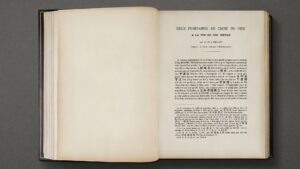
Stanislas Julien (1797-001873) was an early French Sinologist. The full title of the above book is Mémoires sur les contrées occidentales, traduits du sanscrit en chinois, en l’an 648, par Hiouen-thsang, et du chinois en français par M. Stanislas Julien, Tome 2. This work apparently included a reproduction of the Japanese Buddhist world map by Hōtan 鳳潭, first printed in 1710 under the title Nansenbushū bankoku shōka no zu (南瞻部洲萬國掌菓之圖, often rendered “Handy Map of the Myriad Countries of Jambudvīpa”).
This map is not helpful for understanding how Chinese viewed Southeast Asia in the seventh century, as it includes geographic information from much later, but. . . it’s cool as hell!!!

To continue with the footnote:
In the first place, the country of Che-li-fo-che [Shilifoshi] (Śrībhōja, according to St. Julien, Méthode…, p. 103) is also called, by Yijing himself, the country of Fo-che (Bhōja; cf. §46, last sentence and note). The particle śrī therefore does not form part of the name of the country, and is only the honorific term that in Sanskrit is placed before the names of sovereigns, states, temples, and so forth.
Stanislas Julien published a work in 1861 entitled, Méthode pour déchiffrer et transcrire les noms sanscrits qui se rencontrent dans les livres chinois à l’aide de règles, d’exercices et d’un répertoire de onze cents caractères chinois idéographiques, employés alphabétiquement inventée et démontrée. In this work, Julien teaches his readers how Sanskrit terms are rendered into Chinese.
One example comes from the term Shilifoshi, as it appears in Yijing’s second text listed above. He renders it as Śrībhōja. As we will see later, in the twentieth century, various scholars tried to get Shilifoshi to somehow indicate “Srivijaya.”
Julien was a specialist on the Chinese renderings of Sanskrit terms, and he concluded that Shilifoshi was Śrībhōja. Further, Julien was under no pressure to try to get this term to fit with any preconceived views, because he had no preconceived views of what this term indicated. He simply used the knowledge that he had of how Sanskrit terms were rendered into Chinese, and concluded that Shilifoshi was Śrībhōja.
Please remember that.
What Chavannes then noted is that in Yijing’s texts, one can find both the name Foshi and Shilifoshi, and from that he concluded that the “shili” is the honorific term “śrī” and that it was therefore not part of the actual name of the polity.

Then, finally, Chavannes discussed the location of Shilifoshi, or what he called, following Julien and his own understanding that “śrī” was not part of the actual name of the polity, Śrī-Bhōja.
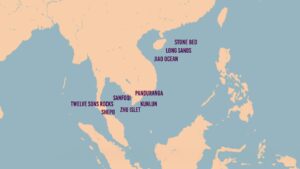
To determine the location of the country of Śrī-Bhōja, I note that in two places (§§46 and 52) Yijing tells us that, when going from China to India, one passes first through the state of Che-li-fo-che [Shilifoshi], then through that of Mo-louo-yu [Moluoyu]. Now the state of Mo-louo-yu seems to me to correspond very exactly to Marco Polo’s Malaiur; this would therefore be modern Palembang. Palembang, according to the commentaries on Albuquerque, was called Malayo by the Javanese (Yule, Marco Polo, 2nd ed., vol. II, p. 263). Thus the country of Śrī-Bhōja would have been situated before Palembang on the route from China to India, that is to say, at the extreme south of the island of Sumatra.
As such, we can see that Chavannes placed Shilifoshi at the southern end of the island of Sumatra, and he did so because in Yijing’s account of his journey, it is somewhere near a place called “Moluoyu,” and Chavannes saw a similarity between that name and the name, “Malaiuir,” which appears in Marco Polo’s writings, and which Scottish Orientalist and geographer Henry Yule (1820-1889) had equated in his 1871 translation of Marco Polo’s account, based on the observations of Portuguese admiral Afonso de Albuquerque (1453-1515), with a place on the island of Sumatra called “Malayo.”
Did you get all that? There was a lot there to connect. Let’s simplify it.
Yijing’s seventh-century Moluoyu = Marco Polo’s thirteenth-century Malaiuir = Albuquerque’s sixteenth-century Malayo.
Here is what Marco Polo wrote about Malaiuir, as translated by Yule in his The Book of Ser Marco Polo, Volume 2.
Of the Island Called Pentam, and the City Malaiur.
When you leave Locac and sail for 500 miles towards the south, you come to an Island called Pentam, a very wild place. All the wood that grows thereon consists of odoriferous trees. There is no more to say about it; so let us sail about sixty miles further between those two Islands. Throughout this distance there is but four paces’ depth of water, so that great ships in passing this channel have to lift their rudders, for they draw nearly as much water as that.
And when you have gone these 60 miles, and again about 30 more, you come to an Island which forms a Kingdom, and is called Mazarur. The people have a King of their own, and a peculiar language. The city is a fine and noble one, and there is great trade carried on there. All kinds of spicery are to be found there, and all other necessaries of life. (223)
And here are some of the points that Yule made in his comments about this passage.
Of the Island Called Pentam, and the City Malaiur.
When you leave Locac and sail for 500 miles towards the south, you come to an Island called Pentam, a very wild place. All the wood that grows thereon consists of odoriferous trees. There is no more to say about it; so let us sail about sixty miles further between those two Islands. Throughout this distance there is but four paces’ depth of water, so that great ships in passing this channel have to lift their rudders, for they draw nearly as much water as that.
And when you have gone these 60 miles, and again about 30 more, you come to an Island which forms a Kingdom, and is called Mazarur. The people have a King of their own, and a peculiar language. The city is a fine and noble one, and there is great trade carried on there. All kinds of spicery are to be found there, and all other necessaries of life. (223)
And here are some of the points that Yule made in his comments about this passage.
There is a good deal of confusion in the text of this chapter. Here we have a passage spoken of between “those two Islands,” when only one island seems to have been mentioned. . .
There is a difficulty here about the indications, carrying us, as they do, first 60 miles through the Strait, and then 30 miles further to the Island Kingdom and city of Malaiur. . .
All this is very perplexed, and it is difficult to trace what may have been the true readings. . .
But there is not information enough to decide what place is meant by Malaiur. Probabilities seem to me to be divided between Palembang, and its colony Singhapura. Palembang, according to the commentaries of Alboquerque, was called by the Javanese MALAYO. The List of Sumatran Kingdoms in De Barros makes TANA MALAYU the next to Palembang. On the whole, I incline to this interpretation. (224)
From all of that uncertainty (and there is even more in Yule’s notes), Chavannes somehow was able to come to the clear conclusion that “Now the state of Mo-louo-yu seems to me to correspond very exactly to Marco Polo’s Malaiur; this would therefore be modern Palembang.”
Voilà! So, there you have it. Yijing referred to Palembang. . .
This process that Chavannes went through of equating names across a millennium and erasing textual uncertainty would have enormous consequences, as little did he know, but he was laying the foundation for the “Srivijaya is a kingdom at Palembang that was referred to in Chinese sources as (Shili)Foshi and Sanfoqi” narrative.
Further, I am also certain that the majority, if not all, of the people who follow the “Srivijaya is a kingdom at Palembang that was referred to in Chinese sources as (Shili)Foshi and Sanfoqi” narrative have no idea about where the supposed connection between Shilifoshi and Palembang comes from, and of how flimsy the evidence for that connection is.
We get some sense of that here. However, we will get a better sense of that in the next post.
A key final point to make here, however, is notice how in coming to his conclusion that Shilifoshi was at Palembang, Chavannes did not make reference to any Chinese sources.
He did not do that, because there is no information in Chinese sources that supports that idea. It is thus an idea that was created externally from the sources.

Takakusu in his treatment of Yijing’s travels identifies the date of production during the early years of emperor Wu (“The date of I-tsing’s work”), so there is no need to dwell on the Later Zhou date at all.
I agree. I was thinking about it. There are probably 2 possibilities.
1) He wrote everything in Shilifoshi, and then when he got back, he or someone copied it and changed his “Tang yun” to “Zhou yun.”
2) He added the annotations when he got back and was copying the text.
Either way, the annotations would be from just a few years apart, and would both reflect information about Southeast Asia from the time of his stay in Shilifoshi on his return journey.