

This post is a continuation of the previous post where we began to look at 1) Paul Pelliot’s 1904 article, “Deux itinéraires chinois de Chine en Inde à la fin du VIIIe siècle,” in which Pelliot examined a trade route from Guangdong through Southeast Asia and ultimately on to India that Tang dynasty scholar-official Jia Dan recorded in the late eighth century, as well as 2) Geoff Wade’s 2013 translation of the same route.
In the previous post, we looked at the leg of that route that one traversed after passing the end of the Indochinese Peninsula. Pelliot believed that the route went directly south to the Strait of Malacca.
Meanwhile, I documented numerous flaws in Pelliot’s reasoning and evidence that make it impossible to support the idea that the route went in that direction. I argued instead that it followed the southern coast of the Indochina Peninsula, and then crossed over the Gulf of Thailand near its western edge to the area around what is now Koh Samui and Surat Thani province in Thailand.
Heling and the Detour to Java
Let us now look at the next leg of this itinerary, and as we did before, we will look at what Pelliot said first.
佛逝國東水行四五日,至訶陵國,南中洲之最大者。
A l’est du royaume de Fo-che [Foshi], en allant par eau pendant quatre ou cinq jours, on arrive au royaume de Ho-ling [Heling]; c’est la plus grande des îles du sud. (373)
To the east of the kingdom of Foshi, traveling by water for four or five days, one reaches the kingdom of Heling; it is the largest of the islands of the south.
Ok, so here we have a new placename, Heling 訶陵. Here is what Pelliot said about that place, and how he located it in relation to the places that were mentioned in the previous leg of this itinerary.
Since Luoyue was on the northern coast of the Strait of Malacca, Jia Dan says that the southern coast was occupied by the country of Foshi 佛逝. This country of Foshi, or Shilifoshi 室利佛逝, is known to us above all through Yijing and the New History of the Tang. Its precise location, and the determination of the true center of its power, give rise to controversies to which I shall return later. For the moment, it is enough to note that, even if Foshi was perhaps not always, or not only, or not entirely Sumatra, Jia Dan’s indications at the end of the eighth century necessarily refer to the eastern coast of that island.
“To the east of the kingdom of Foshi,” Jia Dan adds, “traveling by water for four or five days, one reaches the kingdom of Heling 訶陵; it is the largest of the islands of the south.” Heling, to the east of Sumatra, can only be either Borneo, if one sailed straight east from the Straits, or Java, if the Chinese traveler, following the coast of Sumatra, regarded that coast as running from west to east, although its true direction was from northwest to southeast. For me there is no doubt that Heling is Java, but to establish this we must take up again the question of China’s relations with Java, a question that in recent years has given rise to some very strange misunderstandings. (264-65)
So, after some rationalizing to justify going in a direction that is not east even though the text says that one does go east, what we see here is that Pelliot believed that Heling was Java.
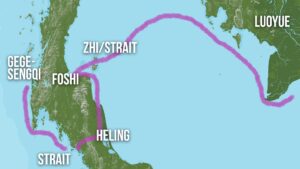
As far as I can tell, Pelliot did not include maps in this article, but if we were to draw a map of the itinerary of the route from Guangdong to India, this is how Pelliot’s understanding of that route would look for the parts we have examined so far:

The maritime routes to South Asia from Southeast Asia crossed over the Indian Ocean from up at the northern end of the Malay Peninsula, and yet, Pelliot has this route going to southeastern Sumatra, and then eastward to the island of Java.
I challenge anyone to find another itinerary in a Chinese historical source where the route turns in the opposite direction of the route to the destination.
As the discussion in the previous post made clear, Pelliot had no evidence to support the idea that this route went down to the Strait of Malacca, but even if we didn’t know anything about that and just looked at the map of what he was proposing. . . it makes absolutely no sense.
Shipping in the eighth century was expensive and dangerous. People didn’t just cruise around to check places out.
However, Pelliot claimed that:
If Javanese civilization was already flourishing enough to attract Chinese travelers on their way from China to India, then naturally it was before passing through the Straits that they would stop at Java. . . Far from being an obstacle to our identification, the fact that one sometimes made a detour to Ho-ling [Heling] when going from China to India, while one could also follow the direct route from Poulo Condore to the Straits, is a new argument in favor of the solution that seems to me beyond doubt: the Ho-ling [Heling] of the Tang, otherwise called Chô-p’o [Shepo], is and can only be Java.
A new argument indeed.
Kalinga
This name, “Heling,” only appears in sources about the Tang dynasty period. Meanwhile, in one of those works, the New History of the Tang, a work that was completed in 1060 during the time of the subsequent Song dynasty, there is a note that says that Heling is also called Shepo 闍婆.
Shepo, meanwhile, is a name that people think referred to “Java,” because at that time, it would have been pronounced in a similar, but perhaps not identical, way.
In explaining what Heling means, Pelliot wrote the following:
The most plausible restoration of the name was proposed long ago by Mayers: the country would have been colonized by emigrants from the eastern coast of India, and would have owed its name Ho-ling [Heling] to the homeland of its civilizers, Kaliṅga. But the New History of the Tang is right to say that this country of Ho-ling was also called Chô-p’o [Shepo]. (286)
“Mayers,” mentioned above as the source for the idea that Ho-ling [Heling] came from Kalinga, is a reference to: Mayers, W. F. “Chinese Explorations of the Indian Ocean during the Fifteenth Century.” The China Review 4 (1875), p. 184 (or the article spanning pp. 173–190.
William S. Frederick Mayers was a British diplomat and Sinologist. In the above work, he mentions “the country of Ho-ling 訶陵, otherwise called She-wa [Shepo] 闍婆, and then says the following:
In the name Ho-ling, or Ko-ling, which is given here as appertaining to Java, one is tempted to recognize the Kalinga of the Coramandel coast, from which the earliest Hindu invaders of the island appear to have proceeded. (Cf. Crawfurd, Hist. Ind. Archipel., II., p. 226).
Here, as we see, Mayers cites Crawfurd, and that is a reference to: Crawfurd, John. History of the Indian Archipelago: Containing an Account of the Manners, Arts, Languages, Religions, Institutions, and Commerce of Its Inhabitants. Vol. II, p. 226. Edinburgh: Archibald Constable & Co., 1820.
John Crawfurd was a Scottish physician and British colonial administrator who took part in the British attack against the Dutch on Java in 1811, where he then became Resident Governor at the Court of Yogyakarta until that territory was returned to the Dutch in 1816.
Here is what he wrote about the name “Kalinga.”
The question of the country of those Hindus who disseminated their religion over the Indian islands, is one of curious interest, but we should refer in vain for a solution of it to any record among the Hindus or oriental islanders. The evidence to be drawn from the examination of language is equally unsatisfactory; notwithstanding this, the fact may be ascertained with a considerable approximation to probability. That country was Telinga, more properly Kalinga, or, as it is universally written and pronounced by all the Indian islanders, Kaling. Kalinga is the only country of India known to the Javanese by its proper name,— the only country familiar to them, — and the only one mentioned in their hooks, with the exception of those current in religious legends. Hence they designate India always by this name, and know it by no other, except, indeed, when, by a vanity for which their ignorance is an apology, they would infer the equality of their island with that great country, and speak of them relatively, as the countries on this or that side of the water. It is to Kalinga that the Javanese universally ascribe the origin of their Hinduism; and the more recent and authentic testimony of the Brahmins of Bali, who made me a similar assurance, as will be seen in another part of the work, is still more satisfactory. (226-227)
Pelliot does cite Crawfurd in his article, but not for this passage. As such, there is no evidence that he read the above quote, only the shorter comment by Mayers. However, I’ve quoted Crawfurd here to provide a sense of the “mindset” that led to the association between the Heling in Chinese sources and the term Kalinga.
I can’t recall when exactly I first encountered this explanation. I’ve been working on this topic of early maritime Southeast Asia for the past six years, but I had occasionally read about this topic in the previous 10-20 years. Whenever it was that I first came across this explanation, I never felt the need to investigate it, as it was so obvious to me that it was the product of a bygone era.
Yet, as flimsy as the argument behind this idea was, it was upheld for over a century, gaining support in the works of Sinologists Édouard Chavannes and Takakusu Junjiro, and scholars George Cœdès, N. J. Krom, and Gustaaf Schlegel.
This is despite the fact that the first character in this name, 訶, is NEVER pronounced, and HAS NEVER BEEN pronounced with a “K.” Meanwhile, there are characters in Chinese that can be read as “ka,” such as 咖, and many that can be read as “ke,” such as 柯、科、棵、顆、苛、珂、軻、蚵、窠、稞、鈳、蝌、瞌、磕、疴、呵、可、渴、岢、坷、軻、克、刻、客、課、恪、氪、緙、溘、騍、剋.

So, contrary to Pelliot’s claim, “the most plausible restoration of the name” Ho-ling/Heling, is definitely not “Kalinga.” Here again, we see evidence of how underwhelming Pelliot’s scholarship was in this article.
Eventually, in 1964, Louis-Charles Damais, a scholar of Java and Javanese epigraphy, published an article that critiqued these views and he specifically called Pelliot to task for not recognizing that the first character in Heling is never pronounced as “ka.”
A few years later, in 1967, historian O. W. Wolters, who generally followed the ideas of early scholars like Pelliot, wrote of Heling in his Early Indonesian Commerce: A Study of the Origins of Srivijaya that, “for many years the word has been uncritically derived from Kalinga, a kingdom in eastern India from which fabulous migrants were believed to have come to Java in early times, but the weaknesses of this identification have recently been exposed” (213).
And in a footnote, he stated further that “After the appearance of M. Damais’ important article. . . Kalinga will disappear from the legends of South East Asia” (fn. 110, 337).
Geoff Wade’s 2013 Translation
On that note, as we did last time, let’s now jump ahead to the twenty-first century to see how historian Geoff Wade translated this passage in his 2013 article, “Maritime Routes Between Indochina and Nusantara to the 18th Century” (Archipel 85: 83-104).
Four or five days voyage to the west of Foshi lies the country of Heling, [25] the largest island in the south.
25. There seems to be a consensus that this term derives from the Sanskrit Kalinga, suggesting a place frequented or populated by persons from the eastern coast of the Indian subcontinent. It appears here to refer to the island of Java or Sumatra. Louis-Charles Damais, however, argues against this identification. See his « Études sino-indonésiennes : III. La transcription chinoise Ho-ling comme désignation de Java », Bulletin de l’École française d’extrême-orient 52 (1964), pp. 93-141.
Alas, Professor Wolters, your prediction did not come to pass. As of 2013, apparently Kalinga remained part of the “consensus” despite the efforts of Monsieur Damais a half century earlier. The legends of South East Asia live on. . .
Beyond that point, for some inexplicable reason, Wade has the route going to the west of Foshi, when in fact, the text indicates that it went to the east.
I guess that’s one way to solve the problem of Pelliot’s illogical detour to the island of Java. . .
But again, if Wade had made even the tiniest of scholarly efforts to examine the information that we discussed in the previous post, he would have never ended up in the Strait of Malacca in the first place. However, as his comment above about Kalinga indicates, he obviously did not make even that tiny effort to think about what he was writing.
I remember one time a few years back a person said to me regarding my argument that the Chinese placename “Sanfoqi” refers to “Kambuja/Kampuchea” rather than “Srivijaya” something like “If what you say is true, then Geoff Wade would have noticed it.”
If that person ever reads this post, let me just say here, “I rest my case.”
Heling and the Java Problem
While the New History of the Tang says that Heling was also called Shepo, a term which many scholars associate with Java, there are other names that appear in Chinese historical sources that scholars likewise think refer to “Java.” Taken together, the appearance of these terms in Chinese sources looks something like this:
- 1) Before the Tang dynasty period, there is mention of names like Zhubo 諸薄, Yepoti 耶婆提, Shepo 闍婆 and Shepoda 闍婆達
- 2) During the Tang period there is a place called Heling 訶陵
- 3) In the Song dynasty period there is a place called Shepo 闍婆, but the New History of the Tang, which was compiled in 1060, during the time of the Song dynasty, says that Heling was also called Shepo (however, the Old History of the Tang that was compiled a century earlier, doesn’t make that claim)
- 4) In the Yuan and early Ming periods you find a Shepo and a Zhuawa 爪哇
- 5) After that point there is only a Zhuawa
Shortly before Pelliot published “Deux itinéraires” in 1904, a Dutch Sinologist by the name of Gustaaf Schlegel had published two related articles in the journal, T’oung pao, one in 1898 entitled “Geographical Notes. III. Ho-ling Kaling” and one in 1899 entitled “Geographical Notes. XII. Shay-po 闍婆 Djavâ.”
Schlegel argued that Shepo 闍婆 and Zhuawa 爪哇 were not the same, and that the “homophony” of these two names had “created the deplorable confusion which has misled all Chinese and European geographers” (XII, 303).
Schlegel also rejected the idea that Heling and Shepo were on the island of Java, and instead, while he said that Heling was Shepo, he also made the case for their locations in different places, with Heling on or near the Malay Peninsula and Shepo on the eastern side of the Malay Peninsula.
Finally, he argued that official Chinese knowledge of the island of Java was non-existent for centuries and only began with the Mongol invasion. To quote one passage where he made this point (I’m changing his transcriptions to Pinyin):
Now it is curious to observe that neither the Mongol Toktagha (脫脫), who wrote the History of the Song-dynasty, and who was therefore well-acquainted with the unsuccessful expedition of Kubilai Khan in 1292 against Java, nor the authors of the Historv of the Mongol-dynasty thenmselves, tell us that Java (爪哇) [Zhuawa] was the old Shay-po (闍婆) [Shepo]. On the contrary, they expressly state that “the customs and products of Java (Java) were not ascertained”. . . (1899, 248)
What Schlegel says here is generally correct. We can see in Chinese sources, starting with some of the information about Shepo in the 1225 Zhufan zhi and continuing to the information about Zhuawa in the History of the Yuan (#s 3 and 4 above), a gradual emergence of an awareness of the island of Java, and of clear signs that this was a new place to Chinese at that time.
Pelliot, however, was strongly opposed to Shlegel’s ideas, and stated the following:
Apart from Heling, which is mentioned only in Tang times, there was more or less agreement in also recognizing Java in the country of Shepo 闍婆, whose first embassy to China dates to 433, and whose name was replaced in the second half of the thirteenth century by that of Zhuawa 爪哇 or Guawa 瓜哇. Schlegel, by contrast, tried to prove that Heling and Shepo should be placed on the Malay Peninsula, that Zhuawa (or Guawa) alone corresponded to Java, and that the ancient Chinese had never gone farther south than Palembang. Thus, although Faxian provides an initial accidental mention of the name Java, one would then have to wait until the first half of the thirteenth century to find in Zhao Rugua information on Java mixed together with other material on the Shepo of the Malay Peninsula. There would have been no official relations between China and Java before Khubilai Khan’s expedition at the end of the thirteenth century; finally, “Java proper never sent any tribute to China before the Ming dynasty (A.D. 1369).”
If that were so, one might ask how the name Java, so familiar to Arab travelers, remained unknown for so long in Chinese commerce. But on the contrary, I believe—and I will try to show—that Schlegel’s theory is false from beginning to end.
To try to show “that Schlegel’s theory is false from beginning to end,” Pelliot discussed names like the ones above and tried to argue that they all refer to the island of Java.
This really doesn’t make sense because, among other reasons (such as the fact that we can locate Heling of the Tang period and a Shepo of the Song period on the Malay Peninsula, as I will demonstrate later), as Schlegel had pointed out, when we get accounts that are unquestionably about island Java in the 1200s-1300s, the writers make it clear that they are recording new information about a place that they did not previously know about.
Although he wrote pages about this in an effort to refute Shlegel’s ideas, Pelliot never put forth solid evidence to support his claim that all of the above terms indicate the island of “Java,” but instead, had to resort to emotional statements such as “So defective on so many grounds, Schlegel’s reasoning is at the same time dangerous because it opens the door to arbitrariness. Every time that, in a notice on Chô-p’o [Shepo], we encounter information that can apply only to Java and not to the Malay Peninsula, nothing would be easier than to say that in those cases, and in those alone, Chô-p’o [Shepo] was improperly used to transcribe the name Java” (305).
In general, modern scholars have followed Pelliot and have seen all of the above names as referring to the same place, the island of Java. So, what this means is that people believe that for over a thousand years, regardless of what the navigational technologies were and regardless of where Chinese mariners sailed (or didn’t sail), all of those different names are supposed to refer to the same place.
I am by no means an expert on European history, and this comparison is not exact, but I think what we should be thinking of is something along the lines of the development of terms from “Anglia” to “England.”
The Angles were one of the Germanic peoples who settled in post-Roman Britain. From their name came the Latin form Anglia, meaning the land of the Angles.
For a long time, there was no single unified kingdom, identity, or name. Instead, there was a patchwork of kingdoms such as: Northumbria, Mercia, East Anglia, Kent, Essex, Sussex, and Wessex. However, one of these places, East Anglia, preserved that earlier name of Anglia. Then when a more unified kingdom emerged, its name took the Old English form of Englaland, meaning “land of the Angles,” and this became England.
I don’t think this comparison is exact, but the information that is recorded in Chinese sources from #1 to #5 above reflects something like this.
Chinese were not in regular contact with places as far south as the island of Java until relatively late, like the 1200s-1300s. Prior to the Tang period, there was some vague conception of some place with a “java/jaba” sounding name. However, it is not clear where exactly that was, or whether this was an endonym or an exonym.
Then during the Tang period, there was a specific place that Chinese visited, called Heling.
In the Song dynasty period, a “java/jaba” sounding name came back into usage and was linked (in one note in one text) to Heling, which was no longer used. Why did that happen?
As I will show later, Heling and a Shepo that we find in some Song dynasty sources were located on the Malay Peninsula in the area of the trans-peninsular crossing from Kedah to Lake Songkhla. Kedah is where ships from the Middle East congregated, and we can see from Arabic accounts that they repeatedly referred to that area as being under the authority of “Zabag.”
I think that this is the same “java/jaba” sounding term that the Chinese used prior to the Tang, and as trade took off in that trans-peninsular crossing area during the late Tang and early Song dynasty periods, that same name again entered Chinese usage. Further, I highly suspect that at that point that it was an exonym.
Still later, in the 1200s and 1300s, we see Chinese expanding their navigational knowledge into the island world of Java and beyond, and in doing so, they encountered a place where the term “java” was used as an endonym by the local people themselves, rather than merely as an exonym by the foreigners who traded there.
This is then when we clearly see the emergence of island Java in Chinese sources and the term Zhuawa.
Schlegel and Pelliot
In writing about Pelliot’s “Deux itinéraires,” I’m returning to that article for the first time in years. I have consulted it before, but in general I simply don’t like reading these old writings because they contain so many flawed ideas that I find it much more productive to just read the primary sources and build my knowledge from there.
As the previous post should have already made clear, there is simply no benefit that one gains from reading the likes of Pelliot. Doing so is an utter waste of time.
That said, there have been times when I’ve read the works of other early scholars like Gerini or Madjumdar and found certain places where their ideas did make sense, but those places were always surrounded by so many flawed ideas that I always saw those instances as simply examples of “even a blind chicken finds corn.”
Now that I am reading Pelliot’s “Deux itinéraires” again, I realized that I only vaguely recall ever reading Gustaaf Schlegel’s work before. In reading it now, I can see that Schlegel’s writings are like a stream-of-conscious presentation of information in the Chinese sources, which I find just as annoying as Pelliot’s uncontrolled-diarrhea presentation of information in the Chinese sources, where information flows out randomly at different points in the text of his article and in the footnotes.
So, I think I vaguely recall looking at Schlegel’s writings before, seeing their confusion, and then going back to the primary sources, but I also think that my relationship with these works is not the same as that of many other people, so, given that Schlegel made some valid points, why haven’t other people considered what he wrote?
Pelliot is held in extremely high regard in the field of early Southeast Asian history as well as in the field of Southeast Asian archaeology. I don’t think I have ever heard anyone criticize him.
Instead, you are much more likely to see people praise him, and to note his critique of Schlegel, such as in Firth and Rockhill’s 1911 translation of the Zhufan zhi (Chau Ju-Kua: his work on the Chinese and Arab trade in the twelfth and thirteenth centuries) where they state about Schlegel’s understanding of Shepo that Pelliot “has conclusively shown, it would seem, that Schlegel’s suggestions on this point are quite untenable.” (79)
Jumping forward to 1967, Wolters wrote in his Early Indonesian Commerce, and I’ve changed his Wade-Giles transcriptions to Pinyin, “That Heling was in Java is shown by the statement in the Xin Tangshu that it was also called Shepo [=] ‘Java’, and it was Pelliot who argued most forcibly in favour of its being a Javanese toponym” (213-214). The Xin Tangshu is the New History of the Tang, and Wolters was referencing that one line in this 1060 text that equates Heling with Shepo.
However, as we saw in the previous post, Pelliot’s rejection of Schlegel’s claim that Luoyue could have been Longvek was “forcible,” but also astoundingly “untenable.” And as I was reading it, I kept having this sense that something personal was behind that critique.
There were multiple pieces of evidence that Pelliot discussed that demonstrated that Luoyue was in Cambodia, but each time, he dismissed them and insisted that Luoyue must be near Johor.
Pelliot obviously hated Schlegel. I don’t know if that was a French-Dutch rivalry thing, or if it was a younger generation-older generation rivalry thing, as Schlegel was of an earlier generation and had died the year before Pelliot’s “Deux itinéraires” was published.
Paul Pelliot was just 26 years-old when he published “Deux itinéraires.” Gustaaf Schlegel, by contrast, died the year before at the much more mature age of 63.
In the writings on Southeast Asian geography that he produced shortly before he passed, one gets the sense that Schlegel was in a rush to get all of the knowledge that he had about the sources into print. His writings lack focus, but they show breadth in his awareness of the sources (or perhaps he always wrote like that?).
Pelliot’s “Deux itinéraires,” on the other hand, is intellectually immature and emotionally petulant. We can see Pelliot desperately attempting to discredit Schegel by any means possible.
This makes me wonder: Could it be the case that the trajectory that twentieth-century scholarship on early Southeast Asia took is because some cocky little French kid wanted to make a name for himself by trashing the work of a freshly-dead Dutch Sinologist before a legacy could be formed?
Looking at their work today, I find them both filled with flaws, but I can see that Pelliot’s flaws would go on to serve as the foundation for the “Srivijaya is a kingdom at Palembang that was referred to in Chinese sources as (Shili)Foshi and Sanfoqi” narrative, whereas amidst the many flaws in Shlegel’s writings, are some valid points that make that narrative untenable, and which, following Pelliot’s critiques, scholars have ignored.
My conclusion: There is plenty to disagree with and discredit in Schlegel’s writings, but modern scholars have wasted a ton of time in believing and following the young Pelliot’s petulant critiques.


One important article that confirmed the status quo established by Pelliot is Wang Gungwu’s “The Nanhai Trade: A Study of the History of Early Chinese Trade in the South China Sea” (1958). It appears that in every decade since the 1950s there is a major publication reaffirming what scholars had agreed upon as the correct history (Wolters 1967/1970, Manguin 1979, Manguin 1985 (English translation of the former), The Camb Hist of Southeast Asia (1992), Southeast Asia from Prehistory to History (2004), and I am missing some). That is how students of Southeast Asian and Chinese maritime trade history are introduced to these areas, and naturally they are reproducing what they have been taught as “correct”. I do not think that there is a chance to convince any of these students now turned scholars of diverging views (see, for instance, Li Tana, whom you mentioned already). For this reason, too, the idea of direct Arab trade from the Gulf from the 7th to 12th centuries is still very popular among writers even though the evidence for it is rather limited and is usually fabricated from propositions formulated towards the end of the nineteenth century.
Oh! This is a fantastic comment!! Thank you for this.
It didn’t dawn on me to place Wang Gungwu in this genealogy. I read that piece back in the 1990s and totally forgot about it. But yes, checking it now, I see, for instance, that he mentions “Lo-yüeh (possibly Johore)” on page 95 and then has a footnote that says, “In Chia Tan’s route, Lo-yüeh was described as being the coast north of the ‘straits which the barbarians call che (selat?)’. If the straits mentioned was the Straits of Malacca (P. Pelliot, op cit., p.217 and 231), Lo-yüeh could have been the west coast of Johore; if it was the Straits of Singapore (G. E. Gerini, in Hirth and Rockhill, op. cit., p. 11, n. 4), then Lo-yüeh might have been up the Johore river. In any case, Johore seems to be the place meant. For a detailed study of Lo-yüeh, see Pelliot, op. cit., p.231-9.”
So, yes, this was a confirmation of Pelliot.
That said, bringing Wang Gungwu into the picture adds a level of complexity to this story for me. I believe that article was his MA thesis at the University of Malaya.
Back in the day when I was at the University of Hawaii at Manoa, I remember going through these old microfilms of BA and MA theses from the University of Malaya at that time (and wang Gungwu’s thesis was probably there). In viewing what was produced at that time, it was obvious that it was a really dynamic and exciting time when these young people were engaging with what had not that long ago been a world reserved for scholars from the colonial ruling elite.
So, I think we probably need to see the work of that young Wang Gungwu in that context. It would have been pretty unimaginable for him to go directly to the sources and rethink them.
As for O. W. Wolters, I just think that guy was a fraudster who deceived people with what Edward Schafer referred to as his “opaque, colorless, academic prose.”
Manguin can’t read Chinese, so there was no hope for any insights from him.
Then by the time that we get to the Cambridge History of Southeast Asia, we’re dealing with the “Golden Generation” that was (inadequately) trained in the 1960s-70s. . . so, still no possibility for any insights there.
Then in the 21st century, Geoff Wade was the one who brought expertise to the field and did make significant contributions, but as I’ve been documenting here, he maintained the status quo.
Yes, so I agree. There are these periodic reconfirmations of the status quo, and Li Tana’s work is the latest in that genealogy.
As to youthful sins: Times Press republished Wang’ s text in 1998 without any updates. He merely wrote a new foreword.
Maybe I’m biased, but I would tend to give Wang Gungwu a pass on this. 1) For much of the 60s to 90s he was nation building and institution building and wasn’t spending much time producing scholarship, and if I recall correctly, what he did produce did not go deeply into the topic of early Southeast Asian history.
2) My sense is that when a publisher approaches a prof to request to republish an earlier work, they rarely say “Oh, no, I need to update it.” Instead, they say, “Oh, really? Well, ok, if you think it’s helpful. . .”
3) What that 1998 publication probably says more about is the scholarly environment in Singapore. I can’t think of anything that has challenged the status quo or has been innovative that has ever come out of Singapore. It seems to be a place that worships the (Western) establishment, and seeks to replicate its norms.
So, that in 1998, a publisher in Singapore republished a work from the 1950s by a local scholar that affirmed the views of the Western establishment. . . That strikes me as reflecting the academic norms of Singapore more than anything else.