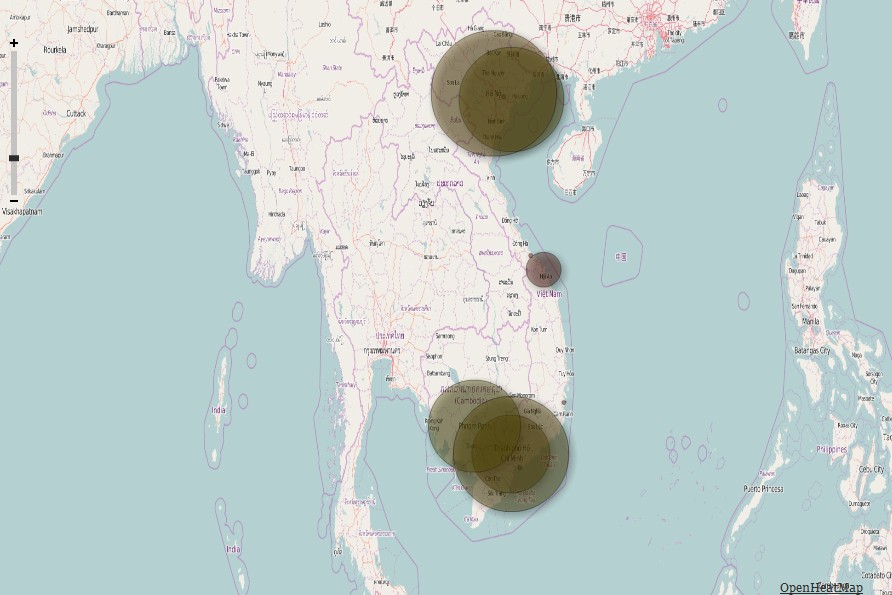
I came across a document that contains a list of movie theaters in French Indochina in 1951.
The distribution of theaters is predicatable: 14 in Hà Nội, 12 in Sài Gòn, 10 in Hải Phòng, 8 in Phnom Penh, 6 in Chợ Lớn, 3 in Đà Lạt, 2 in Đà Nẵng, and 1 each in Huế, Nha Trang, Vũng Tàu, and Hải Dương.

Meanwhile, the number of seats in these theaters was as follows: 7,500 in Sài Gòn, 6615 in Hà Nội, 5350 in Phnom Penh, 4450 in Chợ Lớn, 4370 in Hải Phòng, 1320 in Đà Lạt, 900 in Đà Nẵng, 500 in Huế, 350 in Nha Trang, 350 in Vũng Tàu, and 250 in Hải Dương.

While there is not much that is surprising from these numbers, there are a few things that seem obvious. The high number of movie theaters in cities was not just due to the fact that there were more people there, but also to the fact that there were more Chinese there as well.
There was, for instance, a “Trung Quốc” (“China”) theater in Chợ, Lớn, Hải Phòng, Hà Nội and Phnom Penh. Some of the other theaters must have focused on Chinese films as well.

It is interesting to see that there was only one theater in Huế. I wonder if this was merely due to its smaller population, or if the culture of the old imperial capital somehow discouraged the development of the movie theater industry there.

It is also interesting to see how large the movie theater industry in Phnom Penh was, as well as the fact that there appears to have been a total absence of movie theaters in Laos.

What is the source for this very good information? We must keep in mind that in 1951, many places in Vietnam were either under Việt Minh control, or else they were too precarious to have a nightlife. I’m sure that Vinh had a theatre in the 1930s / 1940s. Nam Định would have to have at least one. I would be surprised if many other towns had them.
If you search for “Indochina” on this page you can see where it is from:
http://cisupa.proquest.com/ws_display.asp?filter=UPA_guides
Yes, you make a good point. This was from some report by someone who was trying to map out the prospects for marketing US films in Indochina. At the time there were already as many American films showing as French ones, but they were trying to see what further potential there was.
It’s pretty interesting. I’ll try to upload the pages soon.
I just checked my notes and there were movie theatres in Lạng Sơn, Tuyên Quang, Bắc Ninh. There were two theatres in Nam Định and Vinh. In the south there were theatres in Rạch Giá, Long Xuyên, Vĩnh Long, Sóc Trang, Cần Thơ, Mỹ Tho and Trà Vinh. These locations were either under Việt Minh control or not secure enough to engaging in the activities they wanted.
Thanks a lot for this!!
So let’s say that the disparity here is indeed because this person was just talking about places that were clearly under French/State of Vietnam control. What this shows us is that all of the major cities were under French/State of Vietnam control in 1951.
We can use this information about movie theaters to then think of larger issues, as those places were still under French/State of Vietnam control in 1954 when the Battle of Dien Bien Phu took place.
The “orthodox” narrative (and a concept that I believed for many years) was that the French were “defeated” at Dien Bien Phu. What I now realize (thanks to the scholarship of people like Christopher Goscha, Pierre Asselin, etc.) is that, yes, the French lost a major battle at Dien Bien Phu, but they still controlled all of the major cities where all of those movie theaters were. The Viet Minh had not “captured” those places, and they never did. The French were therefore not really “defeated.”
Instead, after Dien Bien Phu the French decided to “give up” trying to hold on to their colony, and they “gave” the Viet Minh the places that they still controlled, which was all of the major cities, i.e., the economic heart of the nation, and where all of those movie theaters were.
But then that also makes me wonder – what did people watch in those movie theaters that were in areas under Viet Minh control in the early 1950s?
When the Việt Minh came back to Hà Nội in 1954 they had no problem finding Russian, Chinese, and other Eastern bloc films to project on the silver screen. It did take several months for them to push Hollywood and French movies out of the way. Many of those theatres could have been knocked down during the war – the Việt Minh strategy of tiêu thổ kháng chiến destroyed a large number of structures. More typical were mobile projectors with generators that screened films in the maquis.
A drawing is worth a thousand words :
_ http://www.histoire-et-philatelie.fr/pages/008_indo/547_la_periode_navarre_2.html : the map shows in 1954 the whole of Vietnam was either Vietminh-held or contested , the French held only the towns and the roads linking them
_ http://images.google.fr/imgres?imgurl=https%3A%2F%2Fc1.staticflickr.com%2F5%2F4027%2F4376819922_9922cac4e0.jpg&imgrefurl=https%3A%2F%2Fwww.flickr.com%2Fphotos%2F27681737%40N04%2F&h=500&w=495&tbnid=CEA-Oyd1edxp0M%3A&docid=iLY_X2wk2q4AYM&ei=GjsEV6SlIIGlaYHIuOAC&tbm=isch&iact=rc&uact=3&dur=891&page=2&start=34&ndsp=32&ved=0ahUKEwikmub2xPjLAhWBUhoKHQEkDiwQMwiSASg5MDk : very impressive , it shows the ” pockmarked ” face of Tonkin ; the Vietminh infiltrated nearly all the villages
Overall , the Vietminh controlled 95% of the peasants ,i.e; 90 % of the people .
End 1950 , the French suffered a momentous strategic defeat ,the battle of the frontiers or RC 4 ; they lost 6000 men . The Chinese and VN from then on linked up , chinese help could flow unhindered
Panic set in ; start 1951 ,they were saved by a generous infusion of US materiel ( among which , napalm ) and de Lattre brilliant generalship .But it was just a reprieve ; from then onto Dien bien phu , they lived under the threat of an asian Dunkirk , of being suddenly overwhelmed by a direct or flanking attack .
Maps are not direct representations of reality. Someone had to create that map based on some kind of information, and that is a process that can be filled with flaws, at both the human and technical levels.
Yes, I have used that map for years in my class, but in recent years I’ve come across so much new scholarship which calls into question the “message” that this map conveys.
In the South, if the Viet Minh really “controlled” the territory indicated on that map, such “control” didn’t last very long after 1954, which suggests that it was very weak control. Given that the Cao Dai, Hoa Hao, Binh Xuyen, and some Catholic communities were anti-communist, and given that Bao Dai and Diem had to struggle to try to “control” those areas themselves, I highly doubt that this map is accurate.
The other problem with this map is that if this was reality, then it makes it very hard to believe that the Viet Minh would agree to a division at the 17th parallel. Scholars who have actually worked in Vietnamese/French/American/Soviet, etc. archives, however, now argue that the Viet Minh were increasingly nervous by the end of the war that the Americans would intervene, and if that happened, they might lose, especially given that their forces were exhausted after Dien Bien Phu, soldiers were deserting, etc. It was therefore a better option to accept a division at the 17th parallel than to keep fighting for the cities and to face the possibility of American intervention.
So now that we know all this, rather than thinking that a picture is worth 1,000 words, I would much prefer to see someone do some research about where that map came from. Who made it? What information was it based on? What was the cartographer’s political orientation? Did that person have an agenda, or did s/he try to be as accurate as possible? And if it’s the latter, we would also need to know about the information it was based on. How accurate was that information?
All of this would be fascinating to know, because as time goes by, we find out that so much of what we thought we knew really isn’t true, so we have to keep re-learning about the past.
_ the Tonkin ” pockmark ” ( vérole ) map was quite well known ; B. Fall talked of it , he himself had a similar map of his own research , based on tax collection and targeted assassinations acted by the Vietminh .The vérole map was drawn by the French general staff , it is mentioned in paragraph 84 http://books.openedition.org/igpde/3327?lang=fr
_ looking at the Indochina 1954 map , one can see that in Cochinchina Vietminh territorial and population hold was not as deep as in Tonkin
Half the country was actually contested between several factions : french , Vietminh , religious sects, bandits , ..
_ the Vietminh demanded at Geneva , the line of separation should be at the 13th parallel but the 17th was forced upon them by the great powers ; a meeting between Chou enLai and Mendes France was well publicized
_ before Dien bien phu , French colonial army fought rearguard action , battered by the steady , rising Vietminh tide , their backs to the sea
_ after Dien bien phu , French expeditionary forces were utterly demoralized , their VN underlings deserted en masse , the Geneva accords saved colonial army from humiliation and disintegration , as befell south VN army in 1975 .
Might not be the same period but when my mum was growing up in pre-1975 Buon Me Thuot, there used to be a cinema that showed exclusively Bollywood films.
Wow!! That’s really interesting! Thanks for sharing that.
Yea. It would be interesting to look at the appeal of Indian cinema in post-colonial Southeast Asia and how they fared there compared to their Chinese counterparts.
In the fall of 1962, I enjoyed watching “Seven Samurai” at the cinema in My Tho (I vaguely recall it was dubbed in Vietnamese) and returned back several times for Hong Kong movies. Upton 1975 I continued to watch sword flicks in Saigon at the Casino Saigon, Eden, or Majestic (once a week or so) or western movies at the Rex or Eden. Subtitles took much of the screen — usually Chinese, then English, and then Vietnamese but sometimes a fourth unknown language (Indonesian??) also appeared.
I don’t recall Bollywood films at that time — the local cinemas usually showed Hong Kong/Taiwan or Vietnamese productions and rarely a western film (except the Rex/Eden). Western movies would not draw large crowds to the cinema.
My favorite were the Shaw Bros productions — David Chiang in the One Armed Swordsman is still vivid in my memories (he moved over to Hong Kong TV soaps — I saw him a couple of years ago on Vietnamese TV channels).