
In the 1950s, students in America were taught that Thomas Jefferson was a great man because he wrote in the Declaration of Independence that “all men are created equal.”
Then in the 1960s, African-Americans fought for equal rights, there was a feminist movement, and an intellectual/academic movement known as post-modernism emerged.
Historians responded by looking for African-Americans and women in the American past, and by questioning written sources, rather than simply accepting as “truth” what was written in the past.
Today students in America are taught that Thomas Jefferson wrote in the Declaration of Independence that “all men are created equal,” but they are also taught that Jefferson owned slaves from Africa, and that women were not allowed to vote in America at that time. In other words, students are now taught to not accept what was written in the past as “the truth,” but instead are encouraged to understand the past in all of its complexity.
This does not mean that the statement “all men are created equal” is no longer important. It is. It is just that people are taught to not see that statement in simplistic terms, and by extension, they are taught to not see their society, country and the world in simplistic terms.

In looking into the early-fifteenth-century Ming occupation of Đại Việt over the past few days, and thinking about what I have read about this period in Vietnamese, it is obvious to me that historical scholarship in Vietnam today, and the general knowledge of the past of the Vietnamese public, is similar to what existed in America in the 1950s.
As someone who has benefited from all of the intellectual transformations that took place in America in the 1960s – 1990s (a period that Vietnamese scholars did not participate in), I have tried to show in the previous posts how this period can be examined in ways that bring out the complexity of the past.
This is what is missing from Vietnamese writings on this period. Vietnamese historians begin their examination of the past with certain ideas already set in their minds. 1) The conflict in the early fifteenth century was between “the Vietnamese” and “the Chinese,” and 2) “the Vietnamese” had a clear sense of their national identity, and this can be seen clearly in the “Bình Ngô đại cáo.”
I have a very different view of this period. I see the early fifteenth century in Đại Việt as an utterly horrible period in which all of the worst human traits – greed for power, deceit, betrayal, treachery, disregard for common people, etc. – all came to the fore. What is more, these negative human traits were not displayed by the Chinese alone, but by Vietnamese as well.

Lê Lợi was a power-hungry general who had massive amounts of innocent blood on his hands when he gained control of Đại Việt. He betrayed the Trần and thought nothing of killing innocent civilians who happened to be in Ming-controlled citadels.
The Ming officers who were stationed in Đại Việt were also definitely not angels. They forced common people to work for them, and those common people ended up dying when Lê Lợi’s forces captured their citadels.
At the same time, it is also obvious that this was not a clear-cut conflict between Lê Lợi and the Ming as there were many Vietnamese who collaborated with the Ming, and some Chinese who collaborated with Lê Lợi.
What is more, all of these people lied to each other and betrayed each other.

It is in this context that the “Great Pronouncement” (đại cáo) was issued.
Yes, Nguyễn Trãi declared in that document that Đại Việt was a domain of civility, but its new leader had come to power in a very uncivil manner, by killing innocent civilians and soldiers who had surrendered.
Yes, Nguyễn Trãi declared that the territories of the South and the North were different, but he had earlier used this point, unsuccessfully, to try to convince a Vietnamese collaborator to stop supporting the Ming effort to make Đại Việt a province of the Ming empire.
And yes, Nguyễn Trãi declared that the customs in the South were different from those in the North, but like Huineng’s interaction with the Fifth Patriarch, that was more like an acceptance of the “Chinese” view that the people in An Nam were “barbarians” than of a proud sense of difference.

Does all of this mean that Nguyễn Trãi’s “Great Pronouncement” was not important? No, it was very, very important.
When viewed from the perspective of East Asian political history, it is a masterpiece. Just as the Zhou Dynasty “Great Pronouncement” was an innovative document that used the (at that time new) idea of the mandate of Heaven to justify the rule of a new dynasty, so did Nguyễn Trãi’s (at that time new) claim of the South’s rightful existence as a separate kingdom justify Lê Lợi’s rule (and perhaps his elimination of Trần Cảo), as Lê Lợi was the only one who sought to maintain the South’s separate existence, or so the “Bình Ngô đại cáo” claimed.
I realize that people will say that this idea of the South’s separate existence was already present from an earlier time (Nam quốc sơn hà), but I find that hard to believe. If it did exist, it obviously didn’t prevent educated Vietnamese from collaborating with the Ming.
Instead, what I’ve come to see over the past week is that rather than it being the case that there was “a sense of Vietnamese national identity” that existed PRIOR to the Ming occupation that Nguyễn Trãi appealed to in the “Bình Ngô đại cáo,” I would now argue that a sense of identity started to be created DURING the Ming occupation as Nguyễn Trãi struggled with Ming officials and Vietnamese collaborators to gain recognition for the existence of a separate kingdom in the South.
Ultimately that makes perfect sense, as identities are created through interaction.

I’m going to stop this series here. There are some issues that I didn’t get to, but I’ve already spent a week of my life on this series so it’s time to move on. (I think the Ngô in the Dư địa chí refers to Ming soldiers who stayed behind, and the later reference in the Đại Việt sử ký toàn thư about people with Ngô fathers likewise refers to people whose fathers were Ming soldiers who stayed behind. However the positive comments about the Ming in the Dư địa chí by Lý Tử Tấn support my idea that the term “Ngô” was something more specific than “the Ming” or “the Chinese.” Again, I think Nguyễn Trãi used that term to refer to Ming Dynasty policy at a certain time as “false” [ngụy], but then perhaps the troops that stayed in the Red River delta continued to be called by that term. However, Lý Tử Tấn obviously didn’t see the Ming in that way.)
Again, I really want to thank the readers who pushed me to take a closer look at this time period. There is much, much more than can be done here, but I think the posts that I have made point in a much more accurate and productive direction than the dominant narrative of a conflict between “the Vietnamese” and “the Chinese” and of “a sense of Vietnamese national identity” that has existed since time immemorial.
Finally, I have to admit that I think the dominant Vietnamese narrative does a great disservice to the past. By painting the past in black and white, of course it eliminates anything “bad” about the Vietnamese (which helps make people feel good about themselves), but it also fails to acknowledge how totally brilliant and innovative Nguyễn Trãi was.
In the end, I can’t find much to like about Lê Lợi, but Nguyễn Trãi was a genius.
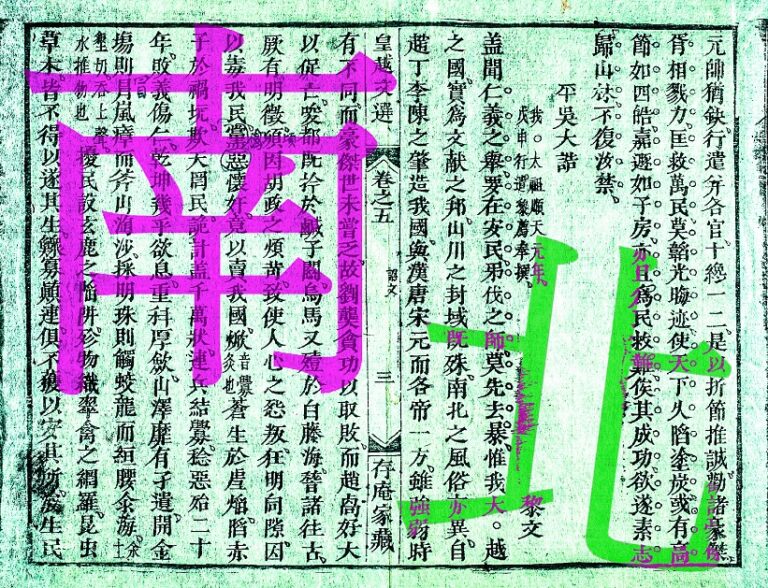
Now that you conclude your series, let’s go through the argument:
1. The North Vietnamese historians call Bình Ngô Đại Cáo a “declaration of independence”. (I used the term “North Vietnamse because the South Vietnamse historians never did).
As you put it: “Vietnamese historians begin their examination of the past with certain ideas already set in their minds. 1) The conflict in the early fifteenth century was between “the Vietnamese” and “the Chinese,” and 2) “the Vietnamese” had a clear sense of their national identity, and this can be seen clearly in the “Bình Ngô đại cáo.”
2. You have been trying to prove them wrong throughout this blog. One of the most, if not the most important point that you have been making, is that the term “Ngô” in BÌnh Ngô Đại Cáo does not mean “Chinese” but rather a smaller group of Chinese who lived in then Dai Viet. For this, you cited John Whitmore’s speculation that “Ngô” means a coastal community of Chinese living in Vietnam. You also brought up a passage by Nguyễn Trãi and a commentary by Lý Tử Tấn in Dư Địa Chí which we discussed in another post. Before this, you argued that the term Ngô did not appear anywhere else in Viet literature up to that point in your post “Historicizing the Ngô”.
3. It was this post about the Ngô in Dư ĐịaChí which started this long discussion. However, the point should not be lost. Does that term “Ngố in “Bình Ngô Đại Cáo” means “China” or “Chinnese” in a broad sense as most Vietnamese would understand, or as you say, a sub-group of Chinese living in then Dai Viet
4. My opinion is that while it might not be clear what constituted a “Viet” back then, it was very clear who or what was a “Ngô” to the indigenous people in Dai Viet, and that means Chinese or China in general. I brought up a few instances where the term was used in a letter written to Vương Thông (WangTung).
I will now look at this term in more detail and provide more evidence that “Ngố means “Chinese” or “China”, a very broad generic term used by people in then Dai Viet throughout the years.
a) Before Bình Ngô Đại Cáo, during the Ming occupation of Dai Viet, they were actively seeking talented people to serve. However, the talented people would rather not collaborate. There was then a saying: “if you want to live, go to the jungle, if you want to die, work with the Ngô’s court.”
Here is what was said in Đại Việt Sử Ký Toàn Thư, Bản Kỷ, quyển IX, p. 312:
“Bấy giờ có câu ngạn ngữ: “Muốn sống vào ẩn núi rừng, muốn chết làm quan triều Ngô” (Dục hoạt nhập ẩn sơn lâm, nhập tử Ngồ triều tố quan).
Toàn thư then sai it was true because later Lê Lợi killed all those who collaborated with the Ming.
b) Before writing Bình Ngô DC, Nguyễn Trãi wrote “Bình Ngô Sách” detailing his plan how to defeat the Ming and submitted to Lê Lợi when they first met.in 1423. Khâm Định Việt Sử Thông Giám cương Mục Chính Biên, quyển 14.
c) In letters to Vương Thông and other during the war, Nguyễn Trãi used “Ngô” repeatedly to mean either the country, the court, or the people, which I cited before:
“Kim Ngô chi cường bất cập Tần, nhi hà khốc đãi thậm”
…….
“Thiên mệnh dữ chi, nhân tâm qui di chi, phi Ngô quốc sở năng đọat dã …”
d) After the war, in Lam Sơn Thực Lục, volume 3, this is what was said by the Lê court officials in addressing Lê Lợi as to why he was successful in defeating the Ngô:
“Trong khi muôn việc có rỗi, Nhà-vua thường cùng các quan bàn-luận về duyên-cớ thịnh suy, được, mất từ xưa đến nay. Cùng là giặc Ngô sở dĩ thua, Nhà-vua sở dĩ thắng là vì cớ làm sao?
Các quan đều nói rằng:
– Người Ngô hình-phạt tàn-ác, chính-lệnh ngổ-ngược, mất hết cả lòng dân. Nhà-vua làm trái lại đạo của chúng, lấy nhân mà thay bạo, lấy trị mà thay loạn, vì thế cho nên thành công được mau-chóng là thế!”
e) In Dư Địa Chí, this is what Nguyễn Trãi said about the customs and costumes:
” Người trong nước không được bắt chước ngôn ngữ và y phục của các nước Ngô (1), Chiêm, Lào, Xiêm, Chân-lạp để làm loạn phong tục trong nước.” [People in the (our) country should not copy the languages and costumes of the countries of Ngô, Champa, Laos, Siam, Chenla (because) that will create chaos in the customs of the (our) countrỵ] (the parentheses are mine to clarify the meaning).
“Người Ngô bị chìm đắm đã lâu ở trong phong tục người Nguyên, bện tóc, răng trắng, áo ngắn có tay dài, mũ, xiêm rực rỡ như từng lớp lá. Người Minh tuy khôi phục lại lối ăn mặc cũ của thời Hán, thời Đường, nhưng phong tục vẫn chưa biến đổi.” [The Ngô people have long fallen into following Yuan [meaning the Mongol Yuan Dynasty] customs. They let their hair down, have white teeth, wear short shirts with long sleeves, and caps and robes of variegated colors like layers of leaves. Although the Ming people have returned to wearing the caps and robes of the Han and Tang, their [meaning the Ngô] customs have still not changed]
f) About more than 100 years after the war, this is what Alexandre the Rhodes, a missionary writing in Quốc Ngữ wrote about the “Ngô” in “Phép Giảng Tám Ngày”:
i. “vì sao trong sách ông Khổng, nước Ngô gọi là thánh, rằng “Nữ Oa phụ thạch bổ thiên, đàn bà gọi là Oa đội đá vá trời.”
ii. “vì chưng trong chữ Ngô có chữ thiên là trời, giải thì có hai chữ, một là chữ nhất, hai là chữ đại, nghĩa là một cả”
iii. “vì chưng Thích Ca làm cội rễ bụt Ngô, mà sinh ra đã có trời trước ba nghìn năm”
5. So, there are many instances before, during and after Bình Ngô Đại Cáo that this term Ngô was used to mean literally anything that was Chinese or China itself. And it was not just Nguyễn Trãi or the elite but more likely the mass would use this term.
In contrast, is there anything which says that the Ngô is anything else but Chinese or China (i.e.)?
And perhaps it should be very obvious that in Bình Ngô Đại cáo itself, the entire document was about beating the Ming. The only reference to another enemy is “ngụy”, meaning the collaborators. If Nguyễn Trãi was such a great writer as we all know, would he be so incompetent as to write about something and then name the document something else?
(to be continued)
Thanks for the comment. I generally agree with what you say, but there are some things that I should point out.
I don’t think the term “Ngo” is the most important point about disproving the idea that this was a “declaration of independence” and that the elite at that time had a clear sense of a “national identity.” Please read what I wrote. I provided tons of evidence about other points that addressed those issues. The term “Ngo,” is not important for making those points.
Related to that, I no longer think that Whitmore’s idea that “Ngo” could refer to the coastal (Chinese) community is correct. That said, I don’t know if in the period immediately after the war that “all Chinese” in Dai Viet were called “Ngo,” or if the soldiers who stayed behind were called “Ngo.” One reader pointed out the quote from the 1470s about people with Ngo fathers and Viet mothers. I can’t remember who wrote about this, but there were soldiers who stayed behind and who formed a separate division in the army. What happened to those people? Did their kids (assuming that these guys did the obvious and found wives and had kids) continue to serve in the military? I need to know more about the context of that episode, but clearly those people were not liked at that time (1470s), and that could be a continuation of a long-held contempt for the soldiers who stayed behind.
Did people feel the same way about “Chinese” traders on the coast? Where they also called “Ngo” at that time? I haven’t seen any evidence of that.
As for the Du dia chi quote, that needs to be understood, I would argue, in terms of Nguyen Trai’s “dual outlook.” On the one hand, he totally respected everything about the Middle Kingdom’s cultural/intellectual/moral/ritual tradition. On the other hand, he absolutely hated the people who tried to take over control of Dai Viet. “Ngo” was clearly a derogatory term (read my post where I clearly went through the letters to Wang Tong). In that passage in the Du Dia Chi, Nguyen Trai uses both “Ngo” and “Minh.” These terms are NOT synonyms. It’s like saying “the Democrats/Republicans” (take your pick) and “the bastard Democrats/Republicans.” Those are NOT synonyms. And “the bastard Democrats/Republicans” is NOT a general term for “the Democrats/Republicans.” And yet in that passage Nguyen Trai talks about both the Ngo and the Minh. Why? Again, think of his 1) total respect for the cultural/intellectual/ritual world of the Middle Kingdom, which the Ming (despite all of the problems they created for Dai Viet), did restore, and 2) his hatred for the people who tried to control Dai Viet.
My guess would be that he’s talking about soldiers who stayed behind, as they were part of the “group of bastards” who tried to take over the kingdom. That passage is clearly about foreign people in Dai Viet. Obviously common soldiers would not have had the same level of culture as the ruling elite. But I think he particularly disliked these people because of what they had done (the same goes for the Lao, as they had also fought against Le Loi). So my sense is that his comment about their customs is an exaggeration to some extent (being influenced by the Yuan, having white teeth – of course they had white teeth), because he really disliked those guys (and they were nothing like Nguyen Trai who must have worn either Song or Ming robes, even though they were from the land of that cultural tradition). The Ming, however, he can’t totally dislike as they were upholding the cultural/intellectual/ritual tradition of the Central Kingdom. Meanwhile, Ly Tu Tan who replaced Nguyen Trai and added comments to his Du Dia chi quite clearly ABSOLUTELY LOVED the Ming.
So what I would say now is that the term “Ngo” was originally a curse word. Let’s think of it like “bastard.” Who were the “bastards”? Obviously the Chinese who came down to Dai Viet were Ngo. But in something like “Binh Ngo,” was it just the Chinese?
Take a look at a line like this in the Đại Việt sử ký toàn:
“More than 10,000 of the people who surrendered at Ming citadels plotted to rebel and were executed.”
[明各城降人萬餘謀反,誅之。Hơn 1 vạn quân Minh đầu hàng trong các thành âm mưu làm phản bị giết.]
The Vietnamese translation indicates that these were “Ming troops” (quân Minh), but the Han text doesn’t say that, it says that “the people who surrendered at Ming citadels.” Well there were Viet “nguy quan” at those citadels. Were they killed? Or were people separated and only “the Chinese” were killed?
My point here, and throughout the 12 posts I just wrote, is that things at that time were much more complex than “the Vietnamese” and “the Chinese.” And so when you had Chinese and Viet defending a citadel together and someone yelled “Let’s go kill the Ngo,” and after they captured the citadel they killed everyone, then who in the minds of Le Loi’s troops were “the Ngo”? Was it just the Chinese? Was it the Chinese and the Viet nguy quan? Was it everyone in the citadel?
At the time of the fighting, it is difficult to see clear distinctions between people. But it’s clear that Ngo had a bad meaning.
After the fighting, it certainly seems like the term Ngo could be used more specifically for perhaps Ngo soldiers who were left behind. But with people like Ly Tu Tan replacing Nguyen Trai, obviously he wasn’t going to use a derogatory term like that in referring to the Ming.
And at some point it seems to have become a more common term. But then again we have to ask ourselves, how did new terms get transmitted at that time and to where? Did “everyone” know that term? Given how much linguistic diversity existed at that time, I doubt it. The reason why we have to think about this is because we need to explain why the term appears so rarely in premodern sources. If it was a “synonym” for “Chinese,” then why was this synonym almost never used? That needs to be explained.
Again, I think at least part of the answer is that it wasn’t a synonym, but a curse word.
Finally, one more point – the document, as far as I can tell, was not “called” the “Binh Ngo dai cao.” That name was attached to it later when it was placed in Nguyen Trai’s collected works. The earliest reference to the document comes from the DVSKTT where it says, “after defeating the Ngo, the emperor issued a Dai Cao to All Under Heaven.”
So yes, I don’t think Whitmore’s guess that the Ngo had something to do with the coastal/Chinese community is correct. I can’t say, however, that the term “Ngo” in the Du dia chi is referring to “all Chinese.” As far as I know, there were not Siamese all over Dai Viet. Instead, the DVSKTT mentions them trading at Van Don, I think. There were communities of Cham prisoners of war in areas around Hanoi, etc. That is what that document is referring to. We don’t have any evidence of people from Dai Viet going to places like Siam and Zhenla and then coming back with different customs. Instead, we know that there were small communities of foreigners in Dai Viet, and it must be through interactions with these people that some Viet were changing their customs. So did “Ngo” here refer to all of the Chinese in Dai Viet, from traders on the coast to Ming soldiers who stayed behind? Or to just to one of those groups (soldiers)? I don’t know, but the quote from the 1470s makes it clear that at the very least Chinese soldiers were labelled with that derogatory term.
Thanks for the reply. Let’s discuss further some details that you brought up:
1. Here is the quote in DVSKTT, p. 66a, which was introduced to us by Mr. Nguyen Bac in the Dư Địa Chí post
“Tháng 9, ra sắc chỉ rằng:
Những người nguyên nô tỳ của nhà nước, những quan lại ngụy, thổ quan chống đối mà ra thành đầu hàng, những kẻ cha là người Ngô mẹ là người Việt, bọn gian ác phản nghịch, và người Ai Lao, Cẩu Hiểm, Chiêm Thành hết thảy là nô tỳ của nhà nước, đã bổ đi làm các loại công việc mà phải tội, con cái còn bé thay đổi họ tên làm dân thường và lấy vợ lấy chồng ở các huyện xã khác, thì con trai, con gái, cháu ruột, cháu gọi bằng chú bác của bọn ấy, họ tên là gì, chính bản thân phải tới Châu Lâm viện để duyệt tuyển.”
This is during Lê Thánh Tông’s reign, after the Champa expedition and in the 1790s. Although this is a rather confusing statement, we can see that there was some racial and political profiling/discrimination 40+ years after the war.
Not only the “ngụy”, “thổ quan” that surrendered, but the Laos, Chams, and even those who were offsprings of the Chinese fathers were asked to register. For what reasons we don’t know, but surely because of their backgrounds they were monitored.
2. What happened to those Ming soldiers who stayed behind?
There are two instances that give us some ideas – which also happened during Le Thánh Tông’s reign:
a) ” Nhâm Ngọ, [Quang Thuận] năm thứ 3 [1462], (Minh Thiên Thuận năm thứ 6). ….
Ngày 11, nhà Minh sai chánh sứ là Hành nhân ty hành nhân Lưu Trật sang tế Nhân Tông.
Ra lệnh chỉ cho các quan văn võ biết: Các nhà quân, dân ở các lộ, huyện, phủ Trung Đô, nhà nào có nô tỳ là người Ngô, không được cho ra ngoài thông đồng với sứ nhà Minh.” DVSKTT, Vol.7, p. 9a
(Those households which have Ngô servants are not allowed to have contacts with the Ming envoy).
So here is what probably happened: the Chinese who stayed behind after the war for whatever reasons were perhaps enslaved or more accurately became servants for the elite. However, they were not to be trusted, especially when the Ming envoy came over and even on a more or less diplomatic mission.
b) “Tha tội cho Thủy quân vệ chỉ huy sứ Đào Bảo. Vua bảo triều thần rằng: Đào Bảo nguyên trước là người Ngô, sau khi thành bị hạ, làm gia nô cho Lê Sát, đến khi nhà Lê Sát bị tịch thu, cho làm nô ở phủ Bình Nguyên . Nay hắn làm trái sắc chỉ, cố ý vi phạm quân [54a] lệnh, tội đáng phải chết. Song Đào Bảo đã từng làm tôi tớ cho ta ở phiên để, nên đặc cách tha cho tội chết, đồ làm binh cày ruộng.” DVSKTT, pp. 53b-54a
So here is a very clear case of what happened to the Chinese that surrendered. This person, Đào Bảo apparently was one of the Ngô in the “Ming citadels” that you mentioned in the previous post. After the citadel fell to Lê Lợi, he became a house servant fot one of Lê Lợi’s most powerful lieutenant, Lê Sát. After Lê Sát was sacked, he went to serve for Lê Thánh Tông, at that time still a prince (Bình Nguyên). He was then promoted to the rank of a general (or rather admiral). Now that he violated some law, he was to get the death penalty but because he was the King’s servant, the sentence was more lenient, to become a farming soldier.
(to be continued)
FANTASTIC!!! This is REALLY helpful!!
I’ll be curious to see how you continue, but already I can start to picture an historical process.
1) Ngo gets created during the Ming occupation as a curse word for “the enemy.” And yea, that enemy is mainly understood as “the Chinese/Ming,” but the usage at time is still a little bit strange and the conditions at that time are confusing.
2) The people who stay behind continue to be called by that name, and that name continues to have a stigma attached to it.
3) Eventually, somehow, that name becomes a more basic word for common people (or perhaps among the elite when they speak) for “Chinese/China,” and that’s what we see in Alexandre de Rhodes’ dictionary.
4) That said, even though the term became more “normal,” it still somehow has a negative connotation that can be brought out at times. Perhaps that’s how the elite used it. When things were good they talked about Trung Quoc, but when things were not good they talked about Ngo. Because in Phan Boi Chau’s early-twentieth-century novel, “Ngo” isn’t neutral, it’s meant to make people angry. (So perhaps it became like “Tau.” That term can be neutral, but when people get angry and start talking like “bon Tau” then it is no longer neutral.)
Again, thanks for sharing that information!! It really helps clarify things!!!
That is exactly what I was going to do! Thanks for the quick analysis. Hopefully one day we will be able to find out when the term “Tàu” replaced the term “Ngô”.
There are other things that may be inferred from the above quotes:
1. The Chinese/Minh/Ngô who stayed behind became “nô tỳ” (servants) for the victors, most likely those of high ranks such as Lê Sát. It could be that because of their expertise in some fields, they were retained to serve in the new administration/military. They might be called servants, but they had connection to the high power and therefore could rise fast through the ranks like Đào Bảo. There must be good reasons for them to stay because Lê Lợi did let Vương Thông take his troops back to China after the war.
Thái Phúc (Cai Fu), however, seemed to be a puzzling case! He was a known brave soldier for the Ming against the Hồ and was promoted really fast through the rank. Yet he surrendered to Lê Lợi and helped Lê Lợi attacking the citadels with Ming technology. For that reason, Nguyễn Trãi asked him to stay, but he apparently turned down the offer and went back to China, only to be executed later!
2. The Lê kings, although using the Minh/Ngô as servants, never let them forget that they were still …. “Ngô”, even long after the war. The war ended in 1428, but in 1462, when talking about Đào Bảo, it had to be mentioned that he was/is a Ngô.
As for the other Ngô servants, they were not to have any contact with the Ming diplomatic envoy in 1460, and their offsprings even with Viet were asked to register with the court in 1470.
So for a good 40+ years after the war, the Viet or at leas the Viet kings were still suspicious of the Chinese/Ngô, even after they were living among them and marrying the locals and working for them.
How did they feel about the Chinese/Ngô when they were still in power as colonial masters and exploited them during their occupation?
I think it was best summed up by Nguyễn Trãi in Bình Ngô Đại Cáo:
決東海之波不足以濯其污 Quyết Đông Hải chi ba bất túc dĩ trạc kỳ ô
罄南山之竹不足以書其惡 Khánh Nam Sơn chi trúc bất túc dĩ thư kỳ ác
Was it the kind of unifying nationalistic feeling that the North Vietnamese historians would have us believe? No, but there was definitely a distinction and a hatred there between colonial masters and servants.
“Tàu” replacing “Ngô”. . . yes, I was wondering about that too. I haven’t looked at a lot of sources in Nom, but I seem to recall seeing the term “Tàu” used in a Nom source from the late nineteenth century.
I’m wondering if “Ngô” is a term that Vietnamese “rediscovered” in the 20th century as people started to use the Binh Ngo dai cao as a source to promote nationalism. . .
Just “profane en matière” (not well initiated in the field) and pragmatic, I would like to outline my understanding the term “ngô” in Binh Ngô Đại Cáo. The main purpose of the great proclamation is to get back the sovereignty, liberate the country from the yoke of the expeditionary legion sent by The Celestial Court Thiên Triều (sic). Lê Lợi and others wanted to “bình” them, not to “bình” the whole China up to Tân Cương, to Mongolia. In mid 1940 decade, “đánh Pháp” means get rid of the French Foreign Legion; “Đánh Pháp” didn’t imply the intention of erasing the country France, or marching with “đôi dép lốp” over Paris. BNĐC didn’t aim either at civilian Chinese colonies living along the South Sea Coast, though they could be a kind of “fifth column”., let them alone sofar, we will tackle later.
This limitation doesn’t hurt the genius Nguyễn Trãi who should have known all significations of the term.
A recollection reaches me about the “ngô”. Around my high school years, a teacher of mine mentioned this idiome: nói như ngô ăn kẹo. Talk loudly, disorderly like Chinese people with the habit of talking and eating candy at the same time, mainly when they helped themselves in sweet stores. He told us that he often witnessed the happening in Chợ Lớn, South VN. I hope you know who my professor saw in the word “ngô”.
Pending moderation, I consult Việt Từ Điển Trích Dẫn. I got lost, really I did.
First meaning of ngô is this:
吳 ngô
吴 wú
◼ (Động) Nói to, nói ồn ào, rầm rĩ.
Then I had:
◼ Nước Ngô 吳 và nước Việt 越 đánh nhau, oán thù thâm sâu, vì thế Ngô Việt 吳越 dùng nói ví là cừu địch. ◇Tây sương kí chư cung điệu 西廂記諸宮調: Đương sơ chỉ vọng tố phu thê, thùy tri biến thành Ngô Việt 當初指望做夫妻, 誰知變成吳越 (Quyển tứ) Ban đầu chỉ mong làm vợ chồng, ai ngờ nay biến thành cừu địch.
Do you think NT used this historical allusion?
Thanks for the comments. Yes, theories like that have been put forth, but there is no way of proving any of them (so far) as the term is just used in some sources, and it’s never explained. So people have guessed that it might be an allusion to this, or to the fact that the Ming founder had the title of “King of Wu” at one point. There are also theories that tie it to Ho Quy Ly. But again, these are all guesses in the absence of evidence.
When people try to identify “Chinese-ness” they usually talk about things like filial piety, valuing education, etc. However, I’ve always felt that there is another level at which “Chinese-ness” can be identified, and “nói như ngô ăn kẹo” captures that quite well. . . 🙂 However, that is something which it is difficult for academics to write about, because it will seem racist/discriminatory/derogatory. . . but things like the volume at which people speak and whether or not they close their mouths when they eat or whether or not they talk with food in their mouths, or whether or not they spit in public – those are all cultural habits that people learn through their contact with other people who act that way, and I’ve always felt that it would be possible to identify a group of such “everyday cultural habits” that remain quite constant among Chinese communities. It would then be interesting to see how and why those everyday cultural habits change, as there is also evidence for that (and places like Malaysia would be interesting for studying about that).
The debate is somewhat confusing because , I think , of the phenomenon of retro fitting , backwards reading the premodern past with the modern ideas and conceptions .
When one talks of independance in the BNDC times , it’s the independance of a king ( Nam dê’ ) and his land ( Nam quôc ) in relation with a northern emperor and empire ( like i.e. Austria against Prussia or southern Nguyen vs northern Trinh ) , not of VN against Chinese . So , NO ! , BNDC was not the birth of a VN national spirit , the people in huge majority peasants have no education and no political consciousness ; the mandarins and the literati followed and bowed to the holder of the heavenly mandate .
If Ngô was a local slang term in Dai Viet used by the Kinh people and possibly used in Giao Chi (not withstanding the lack of documents– thanks to Yongle) then when was 京 first used? Is this a phonetic rendering of a local term or a pejorative term used first by the Chinese? When was 京 first seen in Documents inside China connected to Dai Viet or Giao Chi?
As Nguyễn Trãi was a great genius (and not a follower), perhaps he used Ngô to allude to southern Chinese. As the Minh armies that entered Dai Viet/Dai Ngu in the 15th century were primarily recruited from the provinces bordering Dai Viet (except perhaps key leaders). Only in late 1427 did a relatively few common soldiers from other provinces come down and they were slaughtered before any enduring contact with locals.
Thanks for the comments and sorry for the slow response!
“Kinh” means capital, so the Kinh are the “people of the capital.”
I’m not sure where it comes from. If I remember correctly, I think the first appearance of it in a text has to do with some Viet who were living in Cham territory. However, I can’t remember when that dates from.
As for Ngo referring to southern Chinese, I think the problem we get into with explanations like that is that we don’t have any evidence that anyone in Vietnam at that time made distinctions about different kinds of Chinese from different regions/provices. To put it another way, we have to be careful to not use our geographic/demographic knowledge to interpret what was in the heads of people who lived 600 years ago.