

One point that I keep bringing up, but I donu2019t find it getting recognized, is the fact that the capabilities that we now have when we conduct research in the Digital Age enable us to easily significantly revise, if not outright refute, the scholarship that was produced in the Analog Age.
Iu2019ve spent a lot of time challenging/refuting scholarship that was produced in the Analog Age, so letu2019s look here at how earlier scholarship can be revised.
In the 1990s, at the end of the Analog Age, Cuong Tu Nguyen translated and annotated a fourteenth-century text called the Collection of Outstanding Figures of the Zen Garden (Thiu1ec1n uyu1ec3n tu1eadp anh u79aau82d1u96c6u82f1). He then published that annotated translation along with a scholarly introduction as Zen in Medieval Vietnam: A Study and Translation of the Thiu1ec1n Uyu1ec3n Tu1eadp Anh (Kuroda Institute and University of Hawaii Press, 1997).
The Collection of Outstanding Figures of the Zen Garden consists of biographies of Vietnamese Buddhist monks from the ninth to thirteenth centuries, and those biographies are linked together in lineages.
When it came out, Cuong Tu Nguyenu2019s study and translation of this text was arguably the best piece of scholarship in English on a topic in premodern Vietnamese history that had ever been published (at least thatu2019s how I saw it). Sure, there are small issues that we can find here and there, but in general Cuong Tu Nguyen did a really good job of translating and annotating this text.
Cuong Tu Nguyen also did a great job of contextualizing this work. At the time, there were scholars in the field of Chinese religion who were revealing the ways in which Zen monks in China had more or less invented/manufactured idealized histories about Zen lineages, and Cuong Tu Nguyen argued that the Collection of Outstanding Figures of the Zen Garden essentially did the same thing.
The scholarship in this book was basically as good as scholarship could be in the Analog Age.

Now, however, we are in the Digital Age, and we can figure out certain things in seconds which Cuong Tu Nguyen probably never would have been able to figure out in the Analog Age (I certainly never would have been able to figure them out).
Letu2019s look at an example of what Iu2019m talking about.
In the Collection of Outstanding Figures of the Zen Garden, there is a biography of a monk by the name of Viu00ean Thu00f4ng (1080-1151) which contains the following information:
In the third year of the u0110u1ea1i Thuu1eadn era (1130), Emperor Lu00fd Thu1ea7n Tu00f4ng summoned [Viu00ean Thu00f4ng] to Su00f9ng Khai Palace to enquire about the principles of political order and upheaval, or prosperity and decline in the world. Viu00ean Thu00f4ng said:
u201cThe world is like an instrument. Put it in a safe place, it is safe; put it in a perilous place, it is in peril. It all depends on how the leader of the people behaves himself. If his benevolence is in harmony with the hearts and minds of the people, then they will love him as a parent and look up to him like the sun and moon. This is putting people in a safe place.u201d [201]
When I read this, I thought to myself, u201cWow! This is strange! This does not sound Buddhist at all. Itu2019s totally Confucian.u201d
Fortunately, Cuong Tu Nguyen included the original classical Chinese text as an appendix in his book, so I checked that passage, transcribed some of it, put it into Google, and. . .
. . . I found that it consists of lines taken from various Confucian texts.
I have highlighted below the passages that come from other texts, and have indicated which text each passage comes from.
u5929u4e0bu7336u5668u4e5fuff0cu7f6eu8af8u5b89u5247u5b89uff0cu7f6eu8af8u5371u5247u5371uff0cu9858u5728u4ebau4e3bu6240u884cu548cu5982u8033uff0cu597du751fu4e4bu5fb7u5408u4e8eu6c11u5fc3uff0cu6545u6c11u611bu81f3u5982u7236u6bcduff0cu4ef0u4e4bu5982u65e5u6708uff0cu662fu7f6eu5929u4e0bu5f97u4e4bu5b89u8005u4e5fu3002
u201cThe world is like an instrument. Put it in a safe place, it is safe; put it in a perilous place, it is in peril [History of the Han, Biography of Jia Yi]. It all depends on how the leader of the people behaves himself. If his benevolence is in harmony with the hearts and minds of the people [Shangshu (Venerated Documents), Da Yu mo], then they will love him as a parent and look up to him like the sun and moon [Zuozhuan (Zuo Commentary), Xianggong 14]. This is putting people in a safe place.u201d [201]
However, it didnu2019t stop there, because Viu00ean Thu00f4ng u201csaidu201d more:
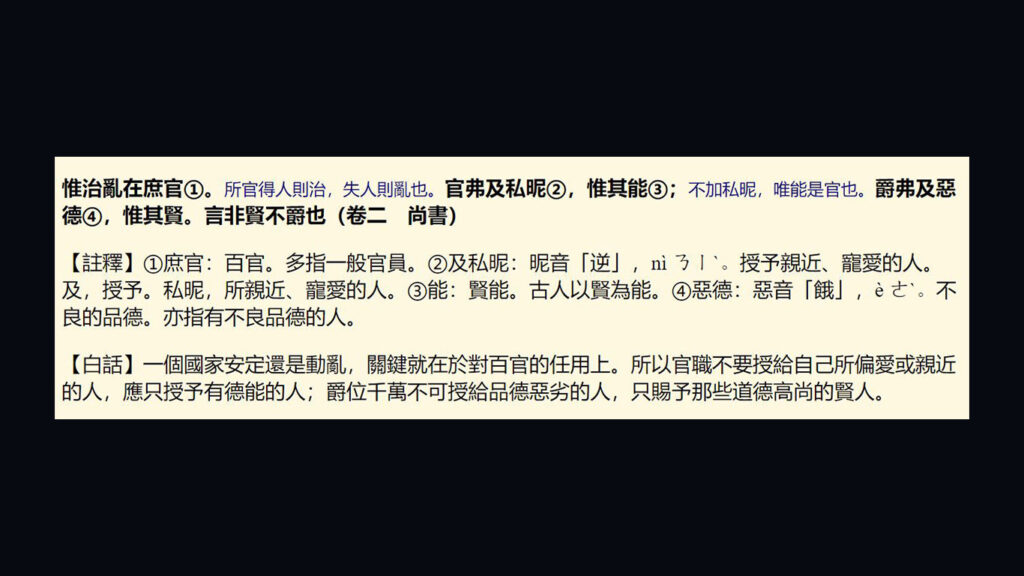
u53c8u4e91u6cbbu4e82u5728u5eb6u5b98uff0cu5f97u4ebau5247u6cbbuff0cu5931u4ebau5247u4e82uff0cu81e3u6b77u89c0u524du4e16u5e1du738bu672au5617u4e0du4ee5u7528u541bu5b50u800cu8208uff0cu4ee5u7528u5c0fu4ebau800cu4ea1u8005u4e5fu3002u539fu5176u81f4u6b64uff0cu975eu4e00u671du4e00u5915u4e4bu6545uff0cu6240u7531u4f86u8005u6f38u77e3uff0cu5929u5730u4e0du80fdu9813u70bau5bd2u6691uff0cu5fc5u6f38u65bcu6625u79cbuff0cu4ebau541bu9813u70bau8208u4ea1uff0cu5fc5u6f38u65bcu5584u60e1u3002u53e4u4e4bu8056u738bu77e5u5176u82e5u6b64uff0cu6545u5247u5929u4e0du606fu5176u5fb7u4ee5u4feeu5df2uff0cu6cd5u5730u4e0du606fu5176u5fb7u4ee5u4feeu5b89u4ebau3002u4feeu5df2u8005uff0cu614eu65bcu4e2du4e5fu3002 u3002 u3002
He also said: u201cOrder or chaos depends on [the behavior of the] officials. If they can win the people over, then there is political order; if they lose the peopleu2019s support, then there is upheaval.
I have observed [the activities of] emperors of previous generations. No one succeeded without employing true gentlemen, or failed unless he employed petty men.
When we trace how these things come about, it does not happen overnight, but develops gradually. Just as heaven and earth cannot abruptly produce cold and hot weather, but must change gradually through the seasons like spring and autumn, etc., kings cannot suddenly bring about prosperity or decline, but rather it is a gradual process depending on their good or bad activities. The sage kings of old knew this principle, and so they modeled themselves on Heaven and never ceased to rely on virtue to cultivate themselves; they modeled themselves on Earth and never ceased to rely on virtue to pacify the people. . .
The final passage above comes from an essay by Tang dynasty scholar-official Bai Juyi u767du5c45u6613 (772-846) called u201cForest of Policiesu201d (Celin u7b56u6797). Itu2019s almost entirely word-for-word the same.
I didnu2019t find evidence that the second passage had come from anywhere, however, that passage is also very generic.
As for the first passage, it starts with a line from the Confucian classic, the Venerated Documents (u201cOrder or chaos depends on [the behavior of the] officialsu201d). The next line is actually an annotation for that line which appears in (I believe) Kong Yingdau2019s Corrected Meanings of the Venerated Documents (Shangshu Zhengyi u5c1au66f8u6b63u7fa9).
What it means in that context is u201cif you obtain the right people (meaning morally upright officials), there will be order, if you lose them, there will be chaos.u201d
In any case, the fact that this text contains a line from the Venerated Documents as well as an annotation for that line and presents all of this as if it was spoken by Viu00ean Thu00f4ng to Emperor Lu00fd Thu1ea7n Tu00f4ng is a good example of how problematic this text is.
To be fair, Cuong Tu Nguyen was well aware that this text is problematic. However, issues like the ones above were difficult to discover in the Analog Age.
In the Digital Age, these issues are now incredibly easy to discover.
That being the case, if we can discover all of this in a matter of seconds in relation to good scholarship, like Cuong Tu Nguyenu2019s Zen in Medieval Vietnam, think of what we can discover if we re-examine topics addressed by scholarship that is not as strong as the work of Cuong Tu Nguyen.
Indeed, in my opinion, this should be the mission of this generation. We should be going over the established Analog Age scholarship with our Digital Age capabilities.
There should be no sacred cows. Anything produced in the Analog Age should be re-examined in the Digital Age, because that is the great opportunity that the Digital Age has granted us.
It has enabled us to enter the Revision Age.



Mr Liam C Kelly
Please share your thoughts on the theory that Chu state was actually a Vietnamese polity and that Vietnamese origins lies with Chu colonisers. Vietnamese being of Chu descent validates the history written by Ngo Si Lien who has been unfairly maligned.
Quora link – https://qr.ae/pYuggj
Thank you for the comment and the link.
The post you linked to doesn’t provide any documentation of where it’s information is coming from. What are the studies that it is based on?
There are a lot of recent studies on genetics, historical linguistics, etc. Without seeing where this person is getting his/her ideas, I can’t really comment.
Sorry it’s a lot of links that’s why haha
An “ABC” Exercise in Old Sinitic Lexical Statistics
https://sino-platonic.org/complete/spp202_old_sinitic_roots.pdf
A Preliminary Investigation into *Southwestern Middle Chinese
https://hilario.bambooradical.com/downloadables/Phan-de-Sousa-2016-03-11-Rutgers-Southwester-Middle-Chinese.pptx.pdf
ABC Etymological Dictionary of Old Chinese
https://starlingdb.org/Texts/Students/Schuessler,%20Axel/ABC%20Etymological%20Dictionary%20of%20Old%20Chinese%20(2007).pdf
Wasn’t mentioned in the Quora post but it’s interesting that the animal names were adopted during the Han dynasty
The sexagesimal cycle, from China to Southeast Asia
https://shs.hal.science/halshs-00922842/file/Ferlus2013_SexagesimalCycle_EnglishVersion.pdf
楚语可能是一种南亚语的亲属语
https://baike.baidu.com/tashuo/browse/content?id=69510a16e4f2391b69c4ec58
This is a proper academic version of the previous link but you might have to use a vpn
上古楚语中的南亚语成分
http://rdbk1.ynlib.cn:6251/qw/Paper/569599#anchorList
Ancient genomes document multiple waves of migration in Southeast Asian prehistory
https://www.biorxiv.org/content/10.1101/279646v1.full
South Chinese = North Chinese + Vietnamese/Dai
https://www.unz.com/gnxp/south-chinese-north-chinese-vietnamesedai/#comments
Ancient DNA Evidence Reveals that the Y Chromosome Haplogroup Q1a1 Admixed into the Han Chinese 3,000 Years Ago
https://dacemirror.sci-hub.se/journal-article/616825ad5dbde18c41d82e6cf0714013/zhao2014.pdf
Ancient East Asian Y-DNA maps
https://forwhattheywereweare.blogspot.com/2013/12/ancient-east-asian-y-dna-maps.html
昆 楚 荆 Etymology
https://en.wiktionary.org/wiki/%E6%98%86#Etymology_1
https://en.wiktionary.org/wiki/%E6%A5%9A#Etymology
https://en.wiktionary.org/wiki/%E8%8D%8A#Etymology
Oh, ok, thanks. Give me a little bit of time here. . . 🙂 I’ll respond soon though.
Oh yeah take whatever time you need, patiently waiting for your esteemed opinion.
Also maybe add this link too
The Origin and Dispersal of Austroasiatic Languages from the Perspectives of Linguistics, Archeology and Genetics
https://digitalcommons.wayne.edu/cgi/viewcontent.cgi?article=1210&context=humbiol_preprints