
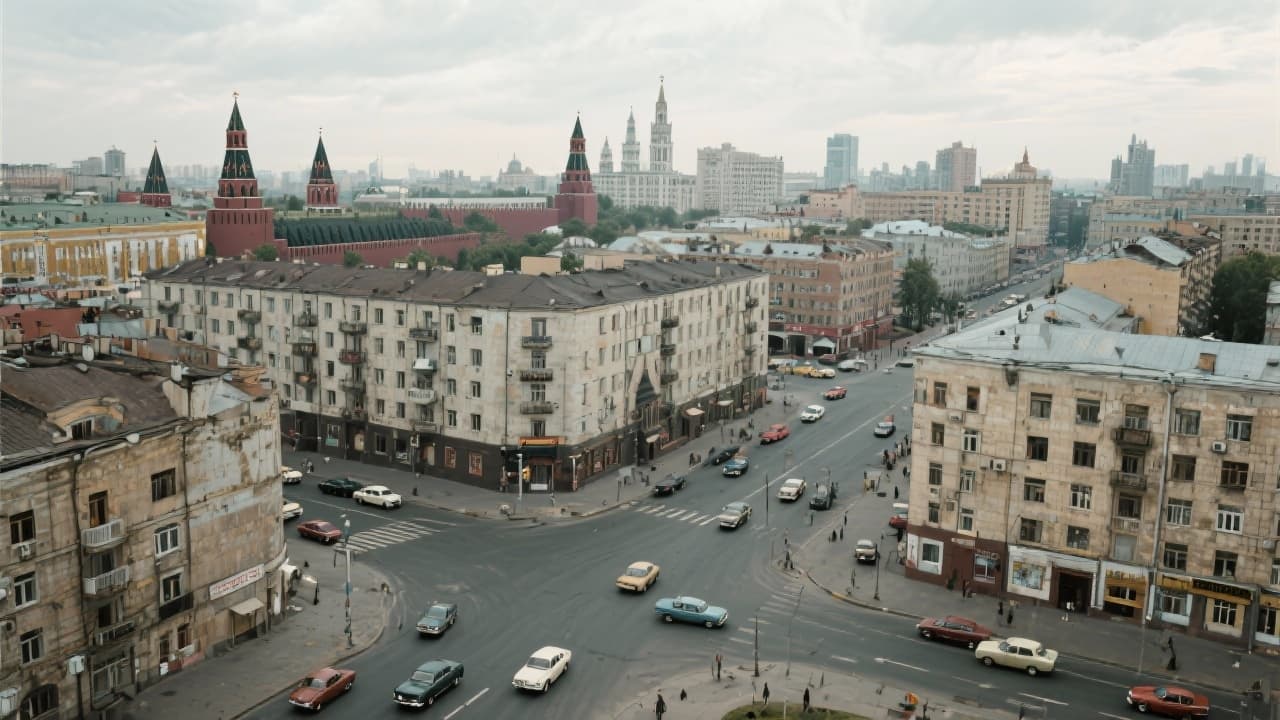
I grew up in Vermont near a small liberal arts college, Middlebury College. Every summer the campus would transform, as the college would hold its “language schools” where students would study a foreign language and pledge to only speak that language for the duration of the program.
The town would transform as well, as in the afternoons and weekends you could encounter people speaking, Russian, French, German, Arabic, Chinese, Spanish, etc. I would go with my brother to play tennis at the college and would hear all of these languages as people walked by or played tennis in the other courts.
So, from an early age, I was aware of foreign languages, but I myself was a very mediocre student, getting a D in Latin and barely scraping by in French with Cs.
However, I remember something changing in my senior year of high school. We read Aleksandr Solzhenitsyn’s One Day in the Life of Ivan Denisovich. By that point, Solzhenitsyn was living in exile in Vermont, and somehow my teacher knew, or made contact with, a gentleman who was assisting Solzhenitsyn, who didn’t speak English, or preferred not to, with his correspondences.
This gentleman spoke to our class, and I remember being blown away realizing that a human being can learn a foreign language to a level where s/he can do things like communicate with the likes of a Solzhenitsyn.
Long story short, I decided to major in Russian when I went to college. I also spent two summers studying Russian at Middlebury (extremely rigorous and rewarding!). Alongside the language, I also studied Russian literature, history, culture, etc., all of the key elements of what is known as “area studies.”
What supposedly makes area studies so valuable is that it enables people to gain a deeper understanding of foreign societies, and in traveling to the then Soviet Union, I found so much confirmation of that claim.
Having become “addicted” to obtaining the kind of access to foreign worlds that area studies knowledge enabled, after college I went to Taiwan, where I taught English and engaged in the same learning process with Chinese that I had previously undertaken with Russian.
I then went to the University of Hawaii to pursue further studies, and there, much to my surprise, I found people talking about how area studies is “bad.”
I began graduate school right as area studies was coming under rather intense “attack” for such issues as the following (this list was created by ChatGPT):
Cold War origins & funding capture — fields and “areas” shaped by U.S. security agendas and foundation priorities.
Policy instrumentalism — research steered toward state/intelligence needs rather than open inquiry.
Orientalism/representation — regions constructed as “Others,” reproducing stereotypes and power asymmetries.
Eurocentrism & coloniality — Western categories and timelines treated as universal; local epistemologies sidelined.
Reification of bounded “areas” — treats regions as sealed containers instead of porous, connected spaces.
Methodological parochialism — weak engagement with general theory; “thick” description without comparability.
Exceptionalism — claims that a region is sui generis, blocking cross-regional learning.
Nation-state naturalization — maps research units to current borders, anachronizing pasts and cross-border worlds.
Language–theory divide — language expertise valued over analytical innovation (or vice versa), creating silos.
Token interdisciplinarity — formal “inter-” labels without real methodological integration.
Gatekeeping & hierarchy — Anglo-American/European institutions dominate funding, publishing, and agendas.
Epistemic extraction — local scholars/communities provide data but are under-credited or excluded.
Archival/access inequities — visas, archives, and field access differentially available; shapes what gets studied.
Culturalism over political economy — overemphasis on “culture” at expense of capital, class, labor, ecology.
Static regional imaginaries — “Southeast Asia,” “Middle East,” etc., treated as timeless, homogeneous units.
Under-theorized global linkages — trade, migration, media flows, and diasporas cut across “areas” but get fragmented.
Discipline dominance — political science, history, anthro, etc., impose their own orthodoxies onto regions.
Neoliberal audit pressures — shifts to metrics and “impact” narrow agendas and favor short-cycle, fundable topics.
Anglophone knowledge economy — English-language publication regimes marginalize non-English scholarship.
Curricular precariousness — area centers treated as expendable under STEM/“global” pivots; leads to defensive scholarship.
Technocratic “region-making” — think-tank categories and policy maps seep into academic framing.
Insufficient reflexivity about power — who defines the “area,” who benefits, and who is legible remain underexamined.
Insular canons — narrow reading lists reproduce the same voices; weak engagement with adjacent literatures.
Thin collaboration with local institutions — partnerships are often extractive or symbolic rather than co-designed.
Insufficient attention to race — racialization within area frameworks (e.g., “Sinophone,” “Arab world”) often untheorized.
Overlooking sub-regional/vernacular worlds — uplands, borderlands, island networks get flattened by capital-city lenses.
Event-driven agenda setting — wars/elections/crises in a region distort long-term research priorities.
In the 30+ years since I first entered graduate school, I have heard these critiques repeated over and over and over and over, and not just by people outside of the field. Instead, many/most of the critiques come from inside the field itself.
By contrast, I have heard very few defenses made of area studies. In general, it is only when cuts are threatened/made do people start to say that area studies is essential and that the US will become “parochial” if it doesn’t support foreign language instruction and the study of foreign countries.
Then after the cuts pass, people go back to repeating that long list of critiques like a mantra.
Cuts are coming again to area studies in the US, and this time they appear to be the most severe to date. At the same time, Middlebury College has also announced that it is closing its Monterey campus, an extension of the college where (new versions of) area studies programs are held.
Once again, as has been the pattern in the past, I’m seeing people start to criticize this turn towards “parochialism.”
But seriously, what defense is left for a field that scholars, from inside the field itself, have criticized repeatedly for 30+ years? When you dig your own grave, you shouldn’t be surprised to find yourself getting buried in it.
I think it’s very sad. I am a diehard supporter of area studies and have never joined the chorus of critiques. That lightbulb that turned on in my brain my senior year in high school has never been switched off.
However, those of us who believe in area studies have been far outnumbered by its critics.
I wrote about that here:
https://www.academia.edu/43792719/The_Decline_of_Asian_Studies_in_the_West_and_the_Rise_of_Knowledge_Production_in_Asia_An_Autoethnographic_Reflection_on_Mobility_Knowledge_Production_and_Academic_Discourses
And more recently talked about the importance of area studies training in the introduction to this edited volume:
https://link.springer.com/book/10.1007/978-981-97-3611-9
Western academia is plagued by a fixation on being critical for the sake of being critical. All scholarship has to question, deconstruct, problematize, destabilize, intervene, trouble, disturb, overturn, contest, challenge, disrupt, decolonize, de-imperialize, undermine, etc.
Obviously, for scholarship to advance, it should question and overturn extant ideas that are not based on solid evidence. That’s not what I’m talking about. I’m talking about the endless studies that critique for the sake of critiquing.
So many of the critiques of area studies are made towards imagined wrongdoers. Critics never point out who exactly these “bad guys” are who are stuck in some imperial/racist mindset and are essentializing and Orientalizing “the Other.”
Who are these people? Name names. And show us exactly what they are doing and where. Name specific books. Name specific articles. Indicate clearly what is in these works that is so reprehensible.
But that never happens. We never find out who the exact evil area studies people are, because people don’t do what the critics say they do. That’s why the critiques are always made at a general level with no names ever named. They are critiques for the sake of critiquing, because that’s the cool thing to do in Western academia.
But as I said, do that long enough, and what are you left to rely on or defend?
I agree with you 100 percent, Liam! I too was an “area studies” undergraduate major. I originally went to Singapore to study physics and mathematics, discovered that I was in “Southeast Asia,” and that I wanted to study this place, so different from the Aotearoa that I had come from. I chose to study Vietnam for 3 reasons: 1) I was told that Vietnam Studies was the future of the “field” (which has basically shaken out to be true); 2) because I was told Indonesian was easy and Thai looked too hard (tones and an Indic script!) (all the wisdom of an 18 year old); and 3) I was taught by the late Thien Di, author of “Vietnamese Supernaturalism”, who made us read Girard, and Bataille, and Foucault, and about Thaipusam, and the Mother Goddess, and Guyanyin, and Nats in Myanmar, and phi in Siam, and every class with him (and almost every class I took at NUS) was just full of rich, fascinating, amazing things that I wanted to find out everything I could about. The cahier de doléances put together by ChatGPT has never seemed very persuasive to me (though I agree that this is a good list of the standard criticisms). If “Area Studies” is a Cold War construct, just wait till you hear about the history of sociology or political science or anthropology (against which almost all of the same criticisms could be made) … For myself, I am content to add another brick to the wall, however long it takes to mix my adobe. Figuring shit out is *hard*. And Mỹ Sơn wasn’t built in a day.
I was an area studies major. The critiques are not directed at the notion of learning foreign languages and cultures, but about the structure of the field. Southeast Asia is a great example, where the more or less arbitrary delineation of the region necessarily imposes structural constraints to understanding the region itself. SE Asia without Bengal and without Guangdong makes no sense, but these places are in other “areas,” making it difficult to study. This is not simply because academics arbitrarily exclude these places from their coverage, but because graduate students have difficulty getting funding and support for projects that don’t fit within the proscribed region. It is similar to how periodization affects the study of history, by pushing students to research topics that are firmly within periods, rather than the events which were apparently so important as to justify this periodization. New subfields like “borderlands” don’t really address the issue, because they simply create new “areas” that only exist in the minds of scholars. The critiques listed are all extremely valid and anyone who doesn’t take them seriously is going to be pretty bad at their field. The idea that we can’t name names in how Area Studies creates real problems for people in these areas is disingenuous. Jeremy Suri is just one of many examples. When the US decides to bomb, invade, destabilize, or starve some country, it does so on the advice of an army of bureaucrats with Area Studies degrees, as well as the works of public intellectuals.
The critiques listed at least call for serious changes, if not outright abandonment. However, it is ironic that you resort (again) to ChatGpt, since it is so-called artificial “intelligence” that is primarily responsible for the demise of foreign language education. Despite being nowhere near up to the task, policymakers, university administrators, and many students think LLMs can translate and even “understand” foreign languages better than humans. You have been consistently promoting this idea on your blog, including using little known indigenous languages which you don’t understand (and thus cannot validate their LLM output) to suggest that AI is coming for us. It’s not reasonable to now blame justified critiques of Area Studies, none of which has ever suggested we shouldn’t learn about the rest of the world. Surely you are not suggesting that the people responsible for gutting humanities did so after reading Edward Said.
Thank you for the comments!!
“The critiques are not directed at the notion of learning foreign languages and cultures, but about the structure of the field.”
I agree, but I still argue that these critiques of the structure of the field have been 1) disingenuous, 2) have dominated the discourse about area studies, such that the value of language study/knowledge is rarely discussed or promoted, and I think this has 3) opened up a space for scholarship that is heavily based on English-language sources to become increasingly acceptable.
Regarding the disingenuousness of the critiques, and relating to your comment that “Southeast Asia is a great example, where the more or less arbitrary delineation of the region necessarily imposes structural constraints to understanding the region itself,” as I have written in both of the articles (linked above) in which I address this issue, I think the ideas of these “structural constraints” only applied to the generation of scholars who went to graduate school in the 60s-70s, and who then came to dominate Asian Studies fields and promote/repeat many of these critiques.
Speaking very generally, in those days, you started studying an Asian language in graduate school, got your Fulbright Fellowship for a year (or maybe served in the Peace Corps for 2 years before going to graduate school), and that was it. By the 1990s, I was studying with people who had all spent years overseas on their own before going to graduate school (because there was a clear discourse about the importance of learning foreign languages that was conveyed in universities and in the public at large), where they had already learned languages to at least say a university 400-level. They did this by spending years teaching English (and simultaneously studying a language) or working as Mormon missionaries (where learning a language is an integral part of the process), etc. In graduate school, they were then easily able to pursue a second language. Further, a lot of us did “border crossing” scholarship before the term even became used because we were influenced by comparative scholarship as was being promoted by the field of world history.
It is in that context that I distinctly remember a senior Southeast Asianist talking about all of these critiques of area studies. I thought to myself, “Have you ever looked at what current graduate students are doing?”
What were the structural constraints? To be fair, there was not a category of “support for dual language study.” And I still don’t think such a category exists today in most universities (maybe the Comparative Asian Studies program at NUS allows for this?), but there were easy ways around this (studying one language with a FLAS, and then another language in other years while holding a TAship, etc.). But more importantly, my colleagues and I went to graduate school with considerable language knowledge under our belts because we all understood the importance of knowing a foreign language, because it was definitely promoted prior to the 1990s (think of the “We MUST learn Japanese to be able to compete with the Japanese” discourse in the 1980s, for instance).
By the 2000s, that stopped happening. By that point, we’d get applicants saying “Yea, so, I went to China for 2 weeks as part of a course, and now I want to get a PhD in Chinese history.” That’s actually true, albeit an extreme example, but in general we no longer got the type of students who had years of experience living and studying abroad as we did in the 1990s. As for why that’s the case, I explain my take in the two articles linked above.
Meanwhile, did we see a collective effort to really promote language study and make the case for its importance in this century? No, I would say the opposite has happened. A few years back, in an effort to inject life into Asian Studies, AAS promoted “Global Asias” scholarship, a field that is supposed to bring together Asian Studies, American Studies and Diaspora Studies. Take a look at the scholarship produced in that field, it is based almost entirely on English-language sources. And that’s what gets promoted by AAS?? Yes, because it ticks the boxes next to that fashionable list of critiques above.
Also, in the late 1990s and early 2000s you had people like Anthony Reid saying that the future of Southeast Asian Studies was with “heritage students” and people in Southeast Asia, that is, with people who theoretically gain language proficiency “naturally” through their upbringing rather than through the programs that are now being cut.
So when you say “The critiques listed are all extremely valid and anyone who doesn’t take them seriously is going to be pretty bad at their field,” 1990s-graduate-student-me and my fellow graduate students would have all said, “Yea, no kidding. All of this is common sense. We’re on it. Move on to things that are more important, like producing scholarship that digs deep into foreign language sources.” However, that is not what has happened. Look at virtually every article on the state of area studies from say 1995 to the present and you are going to see these same critiques repeated again and again, which begs the question: Why can’t people in these fields apparently overcome the “structural contraints” after 30 years? It’s because the critiques are disingenuous.
As for naming names, I see no evidence of Jeremi Suri using foreign languages (well, I saw one German source). Where is his deep engagement with a foreign language? How does this guy who produces scholarship based on English-language sources an example of area studies?
Let’s look at people at the core of Southeast Asian area studies, like this group here:
Keith Taylor; David G. Marr; Christopher Goscha; George E. Dutton; Shawn McHale; Nola Cooke; Wynn Wilcox; Patricia Pelley; Bruce M. Lockhart; Li Tana; Sun Laichen; Andrew Hardy; Philippe Papin; Emmanuel Poisson; Pierre Brocheux; Nguyễn Thế Anh; Phan Huy Lê; Trần Quốc Vượng; Tạ Chí Đại Trường; Haydon Cherry, Charles Wheeler; Tuong Vu; Nhung Tuyet Tran; Hue-Tam Ho Tai; Peter Zinoman; Shawn W. McHale; Kim N. B. Ninh; Patricia M. Pelley; Christoph Giebel; Edward Miller; Sophie Quinn-Judge; François Guillemot; Stan B-H Tan; Erica J. Peters; Alec Holcombe; Martina Thucnhi Nguyen; Nu-Anh Tran; Olga Dror; C. Michele Thompson; Wynn Gadkar-Wilcox. David P. Chandler; Michael Vickery; Penny Edwards; Ashley Thompson; Ian Harris; Trudy Jacobsen; Judy Ledgerwood; Martin Stuart-Fox; Grant Evans; Søren Ivarsson; Volker Grabowsky; Vatthana Pholsena; Oliver Tappe; Thongchai Winichakul; Craig J. Reynolds; Barend Jan Terwiel; Dhiravat na Pombejra; Patrick Jory; Tamara Loos; Chris Baker; Nidhi Eoseewong; Sarasin Viraphol; David K. Wyatt; Maurizio Peleggi; Pasuk Phongpaichit; Charles F. Keyes; Victor Lieberman; Anthony Reid; Pierre-Yves Manguin; Leonard Y. Andaya; Barbara Watson Andaya; Wang Gungwu; Roderich Ptak; James C. Scott; Willem van Schendel; Craig A. Lockard; Eric Tagliacozzo; Anthony Milner; Heather Sutherland; Henk Schulte Nordholt; Leonard Blussé; Michael Laffan; Chiara Formichi; Robert H. Taylor; Alexander Woodside; Michael Aung-Thwin; Maitrii Aung-Thwin; Michael W. Charney; Sanjay Subrahmanyam; Wang Gungwu; Anthony Milner; Timothy P. Barnard; Carl A. Trocki; Syed Muhd Khairudin Aljunied; Farish A. Noor; Derek Heng; Abu Talib Ahmad; Abu Talib Ahmad; Peter Carey; Henk Schulte Nordholt; Heather Sutherland; Benedict Anderson; Taufik Abdullah; Sartono Kartodirdjo; Rudolf Mrázek; Merle Ricklefs; James R. Rush; Anthony Day; Chiara Formichi; Michael Laffan; Nancy Florida; Ann Stoler; Jean Gelman Taylor; Reynaldo C. Ileto; Vicente L. Rafael; Alfred W. McCoy; Glenn Anthony May, etc., etc.
Who are the “guilty” ones? Which of the critiques apply to these people? And where is the evidence?
Maybe the fact that no one has ever “named names” and called out these people for all of their supposed flaws is why the same critiques have been repeated for 30+ years? Is it that these people are simply unaware of what they are doing wrong? If that is the case, then we definitely need to name names and make people aware of their failings!!! Or is it that the critiques are not serious critiques? And, again, where has that strong support for language study been communicated while these critiques have been recycled over and over?
Finally, as for using generative AI on this blog, let’s remember: This is a blog. It is not a peer-reviewed publication, nor is it a manuscript that is going to be submitted for peer-review and possible publication. The entire logic of “academic blogs” is to put ideas “out there” that are “in process.” I think virtually every time I have used generative AI to translate something, I say something like “To really be serious about this, one would need to go in and look closely at the source/translation.”
I see no contradiction between (or irony in) my use of generative AI on an academic blog and my belief in the importance of understanding languages. Over the course of my life, I have formally studied Latin, French, Russian, German, Mandarin, Taiwanese, classical Chinese, Vietnamese, Japanese, Thai, Khmer and Sanskrit. I have used generative AI here to quickly translate classical Chinese passages (which I do have the ability to go back and check more closely). I’ve used it to translate Khmer, my knowledge of which is rusty, but I then went through the text word by word and line by line to verify that it is reasonably accurate (And how wonderful it is to be able to speed up the process of remembering/relearning things one once knew!!). And if I have used it to try to find something in a text of a language that I don’t know (I think I did that for something in Malay), I have said something like “To really be serious about this, one would need to go in and look closely at the source/translation,” meaning that either I would have to learn more before confirming what I found, or someone else with that knowledge should verify it.
In conclusion, ultimately, I would say that the idea that knowing a foreign language is important that I was exposed to was a Cold War-era concept that died when the Cold War ended. In the post-Cold War era, and with the rise of global English, we needed new ways of making the case for foreign languages, but people generally did not do that. Instead, it became fashionable to repeat the above list of critiques and to rely ever more heavily on English-language scholarship.
I still think that knowing foreign languages is important. In fact, I think that foreign language knowledge today arguably needs to be at a higher level than was generally needed during the Cold War (to be able to see beyond the high-level of English competence of so many interlocutors around the globe). That means more commitment to language study, or more reliance on native speakers, however I haven’t seen people making a case for the former. I’m sure that the National Resource Centers do that when they apply for grants, but I’m talking about a larger discourse in the field, and one that people in the public become aware of, like people of my generation did growing up in the Cold War. Instead of that, I just keep seeing the critiques about area studies get recycled again and again.
Meanwhile, if we want to follow the idea that those critiques are true, then it is clear by now that the field can’t improve, and therefore, after 30+ years of going in circles, surely, it’s time to let area studies rest in peace. That’s the only humane course of action for a field that has endured the same critiques for so long with no apparent improvement such that the same critiques have to be repeated again and again.
And one more comment. This point doesn’t strike me as accurate anymore: “When the US decides to bomb, invade, destabilize, or starve some country, it does so on the advice of an army of bureaucrats with Area Studies degrees, as well as the works of public intellectuals.”
I just read this essay the other day on “The Decline and Fall of Area Studies” (https://www.foreignexchanges.news/p/the-decline-and-fall-of-area-studies) by Alex Thurston, and he states that that:
“My own limited experience in interacting with policymakers suggests that area studies has little impact on policies and decisions. During the Obama administration in particular, I was invited fairly frequently to conferences and briefings. At the time, my theory of change (which now seems so quaint and dubious to me) was that I could introduce some “nuance” into policy discussions and in this way contribute to reducing militarism and Islamophobia—but how exactly that “nuance” was supposed to move from the low-level bureaucrats and analysts at these events (assuming they even cared what I had to say) to senior-level decision-makers was a question I could not have answered. In 2013-2014, an International Affairs Fellowship from the Council on Foreign Relations allowed me to serve in government, as a Desk Officer for Nigeria in the State Department’s Bureau of African Affairs, but even in the meeting rooms of Foggy Bottom, I had effectively no influence. Fresh off of my doctoral fieldwork in Nigeria, I was sure that policymakers would be eager to hear my views. But no senior official displayed even the slightest interest in listening to me during twelve months in government. Inside the State Department, hierarchy was all. So of what good were all these investments in area studies scholars?
“Ultimately, there is a tension between the world-remaking aspirations of imperial policymakers and the nuances, cautions, and subtleties that deep area studies concentrations generate—especially in an era of rapid communications and mass-casualty weapons. Whereas earlier empires required local administrators with considerable knowledge of their surroundings, the American empire has primarily featured generalists in Washington attempting to impose projects on the periphery; it is an empire of Donald Rumsfelds, Jake Sullivans, and Jared Kushners, and less an empire of Lawrences or Lugards.”
I was a Southeast Asian Studies major as an undergraduate and the “Southeast Asia” we learned in the 90s was a “mere contingent device” the could include Yunnan or Guangdong or Sri Lanka or the Nicobar and Andoman Islands and even Madagascar, depending on the kinds of questions we were asking. After reading Don Emmerson’s famous essays in the first week of Southeast Asian Studies 110, we were immediately aware of the contingencies of the field, how “East” and “South” Asia were no less contingent, how the Sogdians from now Uzbekistan had spread Buddhism in now northern Vietnam, for example, and how what mattered was developing the linguistic and other competencies necessary to answer questions, not “stuff” that could be crammed into an area-shaped “bucket.” I don’t recognise at all the caricature of “area studies” generated by this AI list as a general bill of indictment, even if some parts of it are sometimes correct around the edges. Jeremi Suri is not a scholar, he’s a flunky and a publicity hound.
Exactly!! I think that list of critiques has essentially become an academic form of “virtue signaling.” They are “admonitions” that you have to recite in your writing to show that you are a member of the cult and uphold its moral code. It doesn’t matter that they are common sense and have long been practiced and understood, because they are not about scholarship. They are about maintaining the moral code of the cult and policing its membership.
It’s all very religious/Christian to me. Scholars: “Forgive us Lord for we have sinned!! We have Orientalized, imperialized, racialized, instrumentalized, colonized, exceptionalized, essentialized, nation-state-ized, etc. etc.”
Me: “Um, actually, no, I don’t see any of this in your scholarship. I think you’ve done a good job. So, what exactly are you referring to? An original area studies sin that we have to collectively and eternally atone for?”
A few random comments:
1. If foreign language study is an indicator of area studies interest among U.S. undergraduates, then interest has declined significantly. From the Modern Language Association’s “Enrollments in Languages Other Than English in US Institutions of Higher Education, Fall 2021” (2023):
“Following the historic peak in enrollments in 2009, language enrollments have been in a sustained decline, with three consecutive censuses showing significant losses. The total percentage drop between 2009 and 2021 is 29.3%.”
I’m going to guess that the decline has continued since 2021.
2. Given Alex Thurston’s experience, and the generally well-documented pattern of U.S. policymakers ignoring the expertise of area studies specialists, the “Policy instrumentalism” critique looks bogus to me. One example of this that comes to mind is David D. Kirkpatrick’s “Into the Hands of the Soldiers: Freedom and Chaos in Egypt and the Middle East” — the US’s foreign policy apparatus from the embassy to the White House could have easily tapped into people with relevant expertise, but didn’t.
3. Peter Hessler and Leslie T. Chang, who have each written books on China and Egypt, have noted their surprise at Middle East specialists who don’t think that anyone who is not a Middle East specialist can have anything worthwhile to say about the region. So maybe some parts of area studies suffer from people trying to protect what they see as their own turf.
4. The ChatGPT list as a whole sounds like the typical academic behavior of “I have to find something to criticize to bolster my self-esteem and justify my status within the professoriate.” Someone who does fantastic and incredibly difficult field research for years in some remote upland village gets criticized for “racializing” a topic in a book review that’s written by someone who never leaves the conference hotel.
^ comment above by me. Forgot to include my name.
For a dismal example of the English-only “area studies” scholarship, one might look at Daniel Immerwahr’s widely read “How to Hide an Empire,” on extra-continental US territorial possessions. It is written as though there is nothing important in Spanish or Tagalog or Visyana or Japanese or Okinawan or Native Hawaiian or any other language in territories the US came to occupy. It is an essay by a clever undergraduate with a good library, not a scholar with command over diverse and difficult languages, literatures, and scholarships. Just recently, the same profoundly unserious Immerwahr published a very silly article in “The Atlantic” about how the Iranian Revolution “almost never happened,” as though this isn’t true of all revolutions. Immerwahr can’t read a word of Farsi or Arabic or Turkish and so his “bourgeois infotainment” (what else is “The New Yorker” or “The Atlantic” these days?) is parasitic on the work of scholars like the late, great Roy Mattahedeh. It is sad when the ignorant and monoglot are now so widely lionized (as Immerwahr certainly is).
E.M. Pitsu, I’m going to disagree from the specific standpoint of “Why has area studies [and other fields] declined?” I have not read “How to Hide an Empire,” so I can’t comment knowledgeably on its scholarly worth. But Immerwahr has a solid academic pedigree: PhD in history at UC-Berkeley and tenured professor at Northwestern. Exactly the kind of academic who typically produces terribly written scholarship read only by a handful of people in a very narrow specialty. Yet he also has written New Yorker articles and a best-selling book. Maybe if more area studies experts communicated as successfully with the public as he does, there would be more interest in area studies. In other words, many academic fields, area studies being one, shot themselves in the collective foot by making themselves irrelevant in the public mind.
On this last note, historically the people who probably did the most in this respect were not academics, but foreign correspondents. Some of the books that got me the most interested in devoting my life to studying foreign societies were the books that foreign correspondents wrote after their 5-year stint at the Moscow/Beirut etc. bureau.
Indeed, when I was in my early 20s, I debated between going the foreign correspondent route or the academic route. For the foreign correspondent route, the “official” way was to start at the obituary desk in Des Moines, Iowa and then gradually work your way up through the system until, two decades later, you got stationed overseas, while the “unofficial” way was to go to some place of interest (like a war zone or some other “hotspot”) and work as a stringer until someone hired you.
I didn’t want to spend all that time going the official way, and as for unofficial route, in the early 1990s in Asia, the options were to go to Cambodia and possibly get blown up by a land mine, which Nate Thayer had covered in all respects, or to go to the then industrial hellscape of developing China, where Mike Chinoy was setting the standard. I was in Taipei where it was very polluted at that time, so I was interested in seeing what breathing clean air might be like, and I was too chicken to do what Nate Thayer did, so I chose academia. However, the work of a foreign correspondent excited me more at the time.
I was thinking that the number of such books has declined, but when I compiled the list below of works about Southeast Asian countries written by reporters, that doesn’t necessarily seem to be the case.
I agree that area studies experts and academics more generally “shot themselves in the collective foot by making themselves irrelevant in the public mind,” but I would argue that it has a lot to do with making little effort to actually communicate in the digital age in spaces where people consume information. Yes, New Yorker articles can be great, but they’re behind a paywall, and my guess is that most of the people who pay for the New Yorker are the same people who still read books.
As for other people, they need it to be freely available and accessible. When I started this blog around 2010, I thought many academics would do the same. That didn’t happen. Then Medium emerged and there was some buzz around it, but that seems to have long died out. In recent years, Substack has emerged as a space where serious ideas get shared (or shared with limits for non-paying viewers) and journalists and academics are making use of it. That’s great!! But it comes 10-15 years into “the decline.” So, if I see something there now that gets me excited about pursuing a career that requires area studies knowledge, well there’s a good chance that the U of Chicago (check the news), etc. already closed that program down. . .
That said, going forward, it looks like Substack will continue to be a good space for discussing and documenting the decline. 🙂
Here is a list of Southeast Asian country studies written by reporters:
Vietnam
Robert Templer, Shadows and Wind: A View of Modern Vietnam (1999).
Bill Hayton, Vietnam: Rising Dragon (2010; rev. ed. 2020).
David Lamb, Vietnam, Now: A Reporter Returns (2002).
Thailand
Andrew MacGregor Marshall, A Kingdom in Crisis (2014).
Cambodia
Henry Kamm, Cambodia: Report from a Stricken Land (1998).
Joel Brinkley, Cambodia’s Curse (2011).
Not quite the same thing, but Nic Dunlop’s “The Last Executioner” (2005), on finding Duch, is in a similar category.
Myanmar (Burma)
Clare Hammond, On the Shadow Tracks (2024/25).
Peter Popham, The Lady and the Generals (2016).
Indonesia
Elizabeth Pisani, Indonesia, Etc. (2014).
Tim Hannigan, A Brief History of Indonesia (2015).
Philippines
Patricia Evangelista, Some People Need Killing (2023).
Philip Bowring, The Making of the Modern Philippines (2022).
Malaysia
Clare Rewcastle Brown, The Sarawak Report (2018).
Timor-Leste
John Martinkus, A Dirty Little War (2001).
The only reason Immerwahr can communicate as he does is because he does not do any research in original languages. He doesn’t do any of the hard stuff. I know that he stopped taking Hindi in graduate school because it was too difficult. His first book, “Thinking Small,” which is actually very good, and uses archival materials, is nonetheless based on zero vernacular-language sources, while covering India, the Philippines, and elsewhere. “How to Hide an Empire” is all based on secondary sources, exclusively in English, with only the very occasional archival document. I would never write an essay for a publication like the New Yorker on the Iranian revolution without a knowledge of Farsi, Arabic, and Turkish. And yet Immerwahr spins his infotainment and his readers are none the wiser to his basic ignorance and his parasitism on those who do know the languages and have done the work. Also “How to Hide an Empire’ is written at a sixth grade reading level. I am faulting his scholarship and attitude, not his readability or infotainment value. He’s plainly a competent and interesting writer. But he cannot be trusted as a “historian of the US and the world” when he knows nothing about the rest of the world that he hasn’t read in English.
” PhD in history at UC-Berkeley and tenured professor at Northwestern. Exactly the kind of academic who typically produces terribly written scholarship read only by a handful of people in a very narrow specialty.”
This is especially arrogant, ignorant twaddle. If you look at the Northwestern history factory, people like Gerry Cadava, Kathleen Bellew, Amy Stanley, Kate Masur, Deborah Cohen, and Ken Alder among others all have PhDs, tenure, and publish with presses like FSG, Norton, Basic Books, Penguin, and other trade presses. The department is extremely public facing. Amy Stanley’s book on “Stranger in the Shogun’s City,” as “area studies” a book as you can get, was a finalist for the Pulitzer Prize in history. Deboarah Cohen’s book “Last Call at the Empire Hotel” won every prize in journalism you could care to name. Alder is one of the most popular and best regarded historians of science and technology, particularly in France, in the world. He wrote a prize-winning book on the determination of the metric metre and the circumference of the globe. Your general position on Area Studies, and your particular position on Immerwahr and Northwestern, is not serious nor credible.
I agree on the foreign correspondents. While an undergrad, my living group had a subscription to the Sunday edition of The New York Times. I remember hitting the international news section every week. Fantastic reporting by people who had developed significant expertise. Same for the Far Eastern Economic Review, which published Nate Thayer’s accounts.
Some of them produced excellent books on contemporary political history — Martin Smith and Bertil Lintner on Burma, Chris Baker and his (academic) wife Pasuk Phongpaichit on Thailand, etc.
Besides the occasional academic who writes well enough to connect with a popular audience, and the journalists who “go native,” I’d say there’s an-between category of people with substantial in-country experience who might have started as occasional op-ed writers (because they happened to be one of the few English-speakers in a place that became interesting to people back home) but later wrote good books. Peter Hessler on China, for example.
As for the medium that will replace or already is replacing books, I would not be surprised if Substack gets sold to someone Jeff Bezos in two years and then goes through the same enshittification process as everything else on the internet.
Personal note: after writing my master’s thesis on Cambodian refugee camps on the Thai border, I took a job with the federal government as a means of living/working in Southeast Asia. It was only after getting hired that I figured out that I’d have to get at least a decade of experience before being competitive for an overseas posting, and I didn’t want to wait that long. So I quit and entered a doctoral program. The next summer I was in Vietnam.
^ Darn it. Did the same thing again. It’s me.
No I think the cut on area studies should have more thing to do with free speech and academic crackdowns under Trump-Epstein dictatorship, especially after the wake of the assassination of far-right race hustler Charlie Kirk as sorts of grifting and suppression of education. I believe Trump’s white house would use ChatGPT to learn and deal with foreign affairs, otherwise they’re bunch of morons tbw (hints Trump claimed he resolved a war between Armenia and Cambodia then blamed antifa for sabotaging UN escalator and tylenol for causing autism)
I was reading an article the other day on government cuts to area studies that I thought was about the present, but then I suddenly realized half-way into the article that it was an article from ~2014-16 about budget cuts under Obama. . .
E.M. Pitsu: you’re pointing out exceptions that prove the rule. See the words “typically” and “Yet” in my comment. For every Deborah Cohen, how many people with PhDs in area studies-related fields are there who never publish anything outside of an article or two in obscure journals read by a handful of people? In case you’re thinking I’m singling out area studies, the problem is not limited to that segment of the academy.