

In these posts I have been demonstrating that a Chinese name (Sanfoqi) that scholars think refers to a kingdom on the island of Sumatra (Srivijaya) actually referred to “Kambuja,” that is, Cambodia, or more specifically, to the kingdom of Angkor.
All of the evidence that I have presented supports this argument, but there is one issue that I have struggled to explain, and that is that while all of the information prior to the mid-fifteenth century places Sanfoqi in Cambodia, after that point you then start to get brief references that seemingly place Sanfoqi on the island of Sumatra.
These references are made in connection with a place called “Old Harbor” (Jiugang 舊綱), and in various sources starting around the mid fifteenth century, it is recorded that Old Harbor used to be called Sanfoqi, and that it is also called (or that the locals call it) Bolinbang 浡淋邦 or Folinbang 佛林邦 (or other variants of this name). Further, one of the titles of a Sanfoqi king mentioned in the 1370s in the Ming shilu contains the characters Baolinbang 寶林邦 as well.
Scholars have argued that this term, Bolinbang/Folinbang/Baolinbang, is a reference to “Palembang.” However, I have now come across information that demonstrates that this is not what that term referred to.
Thanks to a tip from a colleague (Thank you Matt Reeder!!!), I have now found that there is information in a Ryukyuan source, the Rekidai Hoan 歴代宝案, that connects all of these terms with Cambodia.

This source is a collection of diplomatic documents and it contains some letters that were exchanged between the kingdom of Ryukyu and the rulers of the two places mentioned above, Old Harbor and Baolinbang, or what is also referred to at one point in these documents as Bao’anbang 寶安邦. These letters date from the period between 1428 and 1440.
In general, there is little historical information in these documents, as their main purpose was for one official/ruler to express thanks to the other official/ruler for allowing trade to take place. Nonetheless, such basic information about whom the letters were addressed to can help us resolve the issue of what exactly these place names referred to.
From these letters, it is clear that Baolinbang/Bao’anbang was under the authority of Sanfoqi, and that Old Harbor was under the authority of Baolinbang/Bao’anbang.
Further, these letters indicate that Baolinbang/Bao’anbang was ruled by a woman, while Old Harbor was supervised by a Javanese (Sang Arya Wu 僧亞刺吳).
Finally, these letters also mention Siam/Ayutthaya. In the 1420s, apparently some people from Old Harbor were stranded in Kyushu. These people were delivered to Ryukyu to be sent back. However, the Ryukyuan ship returned these people to Siam, rather than Old Harbor, and requested that the Siamese transfer them to Old Port.
In a 1430 letter to the female ruler of Bao’anbang, the Ryukyuans explained this matter. The expression they used, 缺無火長, can be understood to mean that they lacked the navigation expertise/knowledge to sail to Old Harbor at that time, and instead, traveled to a place they were familiar with.
Eventually, however, the Ryukyuans did learn where Old Port was, as there is a letter from the Ryukyuans to the superintendent of Old Port dating from 1428.

The most important document in the Rekidai Hoan for our purposes, however, is one that dates from October 1431. In this document, the Ryukyuans note that a ship that had been sent to Siam had recently returned. That ship had also visited Old Port, and there a Siamese shipped had arrived and reported that the king of Siam had replaced the ruler of Sanfoqi.
Ok, let’s process this. Do we know of any kings that were overthrown by the Siamese in 1431?
Yes. We do. We know that in 1431, the Siamese captured Angkor and replaced its ruler.
Is there any evidence that Angkor was referred to as “Sanfoqi” in Chinese sources?
Yes. There is. I’ve provided plenty of that in the previous posts.
Ok, so the information in the Rekidai Hoan provides further support for the argument that Sanfoqi was Angkor.
It also indicates that Baolinbang/Bao’anbang was under Sanfoqi’s/Angkor’s authority and that Old Harbor was controlled by Baolinbang/Bao’anbang.
So, where were these places?

Scholars have long argued that these places were on the island of Sumatra, however, in reading the Rekidai Hoan, that makes little sense. Instead, from what is recorded in the Rekidai Hoan, as well as in other sources, Old Harbor and Baolinbang/Bao’anbang should have been somewhere near Sanfoqi, and we can see from the Rekidai Hoan and other sources that Sanfoqi was Angkor.
So, for example, when Zheng He set off on his first voyage in 1405, he learned that a Chinese pirate was active in Sanfoqi. Then on his return voyage, he captured that man in Old Harbor.
While there may very well have been an Old Harbor off the coast of Sumatra, and while it is possible that Zheng He may have captured this pirate there, nonetheless there appears to have been other Old Harbors in the region.
For example, there is a 1536 source, the Haiyu 海語, that mentions “Champa’s Old Harbor” (Zhancheng Jiugang 占城舊港).

Besides the historical evidence that we are putting together here, one problem with seeing Bolinbang/Folinbang/Baolinbang/Bao’anbang as “Palembang” is that all of these terms end with the character, bang 邦, which literally means “polity.”
When Chinese transliterated foreign names, they usually did so by using characters that did not have meanings. That would make the use of “bang” here to transliterate “Palembang” strange, as most readers would assume that the name of the polity was just Bolin/Fulin/Baolin/Bao’an and that the “bang” at the end literally mean “polity.”
Indeed, in some sources, the “bang” is dropped, and it is recorded that Old Harbor is also known as “Bolin,” for instance.
Terms like “Folin” and “Bolin” could easily be meant to transliterate a term like the Khmer word for mountain, “phnom.” As such, this term could be indicating something like the “Phnom polity,” and could be an abbreviation for something like “Phnom Penh.”

I am still not sure where these places were, but I am convinced that they were not on the island of Sumatra. Instead, it makes much more sense to locate them in the lower Mekong region, or possibly even on the coast of the Southeast Asian mainland.
Further, that a Javanese was in charge of Old Harbor fits perfectly with what we have seen in previous posts about a Javanese presence in the lower Mekong region during this time period.
Meanwhile, it is now 1,000,000% clear to me that Sanfoqi was not “Srivijaya” or “Palembang.”
Sanfoqi was “Kambuja,” and in the early fifteenth century when these documents from the Rekidai Hoan were written, that meant Angkor, and the letter from 1431 makes that perfectly clear.

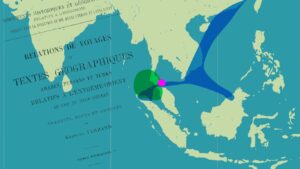
Research on history is no different than science. You need to regress the empirical data against each other. San-fo-qi is the three Wijaya or Seri Wijaya that first recorded in the Tang Shilu which is actually earlier that happened during Tuyuhun era. When Funan stopped submitting to Tuyuhun, they submit from Chaiya as Pan-pan then as San-fo-qi (Seri Wijaya) at Dharmathateh (Nagara Seri Dharmaraja). The 3 Wijaya are actually thr confederation of Chaiya, Dharmathateh (Nagara Seri Dharmaraja) and Langkasuka. After 680, then only Palembang was conquered and the submission from San-fo-qi is from there.