

A reader left a comment recently on a blog post that I wrote 14 years ago about what I thought was evidence of some Tai-language speaking people in the area of the Red River delta in the ninth century.
This was during that time that a multi-ethnic state that the Chinese referred to as Nanzhao was expanding from its center in what is now Yunnan Province and causing a lot of turmoil in the region.
The reason the reader commented was because the post I wrote suggested that there were Tai-language speakers in/under Nanzhao, and that is a point that has long been denied.
I don’t have the time here to go into the historiography of Nanzhao in detail, however, in the first half of the twentieth century there were Thai nationalists who saw Nanzhao as the homeland of the Tai/Thai peoples, and this bothered the Chinese, because Nanzhao was in the area of what is now China. . .
That’s one issue. Then beginning in like the 1960s, you had Westerners start writing about this topic. I think the first might have been Frederick Mote, who spent some time in Thailand in the 1960s and wrote an article on early history where he argued that Nanzhao was not Tai/Thai.
I’ve read that article before, but I no longer have access to it. However, I remember not being convinced by Mote’s evidence. Then there was another guy, Charles Backus (love that name! It sounds like the name of a hipster jazz musician), who wrote a book in 1982 and also said Nanzhao was not Tai (if I remember correctly), and more recently the late anthropologist Grant Evans did the same.
In all of these cases, I have found the evidence and arguments of these scholars to be weak, and forced. It’s like they are ideologically driven to make sure that there are no Tai in Nanzhao, and for the life of me, I can’t figure out where that motivation comes from.
In any case, the recent comment led me to check if anything had been written recently, and I came across a 2021 article by historian Christian Daniels called “Nanzhao as a Southeast Asian Kingdom, c. 738-902.”
In this article, Daniels has a section called “Governance of northern Mon-Khmer speakers” where, once again, we find a scholar rejecting the possibility that the sources could be talking about Tai-speaking peoples.
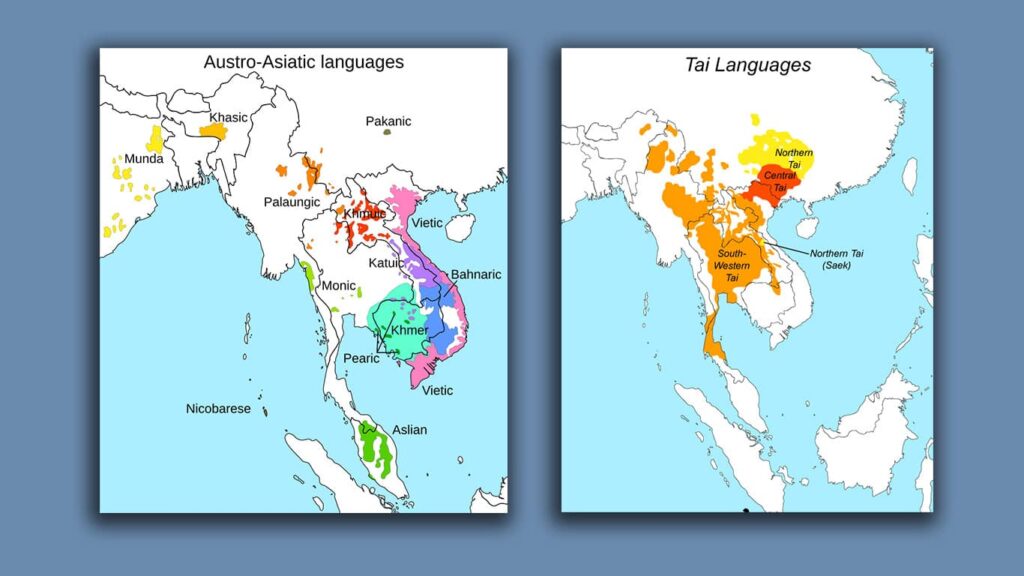
I think everyone agrees that Nanzhao was a muti-ethnic state. In the section on “Governance of northern Mon-Khmer speakers,” Daniels looks at two groups of people who were under Nanzhao rule, and who inhabited the southern parts of that polity: the Pu/Puzi Man/Puman and the Heichi, Jinchi and Mang Man.
In the blog post I wrote many years ago, I wrote about the Mang Man 茫蠻, a term I translated as “Mang Savages,” and I argued that the term “mang” here could be a representation of the common Tai term for a polity, “muang.”
In his article, however, Daniels argues that the Mang Man were Mon-Khmer language speakers. Before he does that, he talks first about the Pu/Puzi Man/Puman.
Today the Wa, Ta’aang (Ch: De’ang 德昂; B: Palaung), and Plang (Ch: Bulang 布朗) are the predominant northern Mon-Khmer speakers inhabiting the area west of the Salween to the east of the Mekong. The Pu Man, ancestors of these three groups, governed five polities west of the Mekong between the fourteenth and sixteenth centuries. The largest polity, known in Sinitic script as Qingdian 慶甸, reputedly submitted neither to the Nanzhao nor to the Dali Kingdoms. It ‘acquiesced to soothing and instructions for the first time’ during the Taiding reign period (1324-1327) of the Mongol-Yuan88 and therefore remained outside the orbit of Sinitic control before the fourteenth century. Next, I discuss Mon-Khmer polities during the eighth and ninth centuries.
The Puzi Man were widely distributed over the jurisdictions of Kainan, Yinsheng, Yongchang and Xunchuan with tribes (buluo 部落) northwest of Tieqiao89 along the upper reaches of the Mekong. Fang Guoyu traces their ancestry back to the Pu or Pu Yue, one predominant ethnic group in the Ailao Kingdom.
The Pu/Puzi Man/Puman refers to a group of Mon-Khmer speakers distinct from the Heichi, Jinchi and Mang Man. The Puzi Man lived at higher latitudes (from 27° to 28°), and forged closer and more intricate associations with the Nanzhao state than the Heichi/Jinchi/Mang Man to their south. Though we have no details of their polities, Puzi Man referred to their tribal leaders as ‘superior chieftains’ (qiu wei shang 酋為上) in the ninth century, possibly indicating a continuum of small-scale Mon-Khmer polities from the Ailao Kingdom period.
Ok, let’s look at the argumentation/methodology here:
- 1) Talks about the current Northern Mon-Khmer speakers
- 2) Says their ancestors were the Pu Man, a group that lived in the region in the 14th to 16th centuries
- 3) Talks about the Puzi Man in the eighth-ninth centuries
- 4) Cites Fang Guoyu who talks about the ancient Ailao Kingdom
In other words, Daniels traces the existence of the Puzi Man/Pu Man in two directions, forward and backward in time, and implies that this population existed across millennia from ancient times to the present.
Daniels then goes on to talk about the Heichi/Jinchi/Mang Man. To quote:
Situated at the southernmost margins of Nanzhao’s administration, the geographic distribution of the Heichi/Jinchi/Mang Man during the eighth/ninth century overlapped with that of the Jinchi/Baiyi in the thirteenth/fourteenth century.
Fang Guoyu cited this concurrence as evidence for his hypothesis that the Heichi/Jinchi/Mang Man were all of Tai ethno-linguistic stock already organised into basin-style polities. Fang classified the Heichi/Jinchi in Yongchang and the Upper Ayeyarwady as Tai2 Nä1 (Tai Neua), which literally translate as ‘upper Tai’, and the Mang Man in the upper Mekong as Tai Lue (Tay2 Lü6).
This equivalence superimposes thirteenth/fourteenth century settlement patterns on eighth/ninth century data. It presupposes the arrival of the Tai in the Upper Mekong by the eighth century and assumes a historical continuum in their distribution from this time onwards. Below I examine the Mang Man designation to argue that these three groups were northern Mon-Khmer speakers.
Hmmm. . .
So, Daniels had no problem citing Fang Guoyu to imagine an historical continuum for the Pu/Puzi Man/Puman from the ancient Ai Lao kingdom to the current Northern Mon-Khmer speaking groups in the region, but when Fang Guoyu does the same for Tai-speaking peoples, Daniels criticizes Fang because he supposedly “superimposes thirteenth/fourteenth century settlement patterns on eighth/ninth century data” and “presupposes the arrival of the Tai in the Upper Mekong by the eighth century and assumes a historical continuum in their distribution from this time onwards.”
Ummm. . . Isn’t that exactly what Daniels did in his discussion of the Pu/Puzi Man/Puman?
This is really odd because earlier in the paper, Daniels states that, “Chinese historians endeavour to link the genesis of the Bai nationality 白族 with the Bai Man of the Nanzhao and Dali kingdoms. This resembles Southeast Asian historians projecting the national identity of the Khmers back to Angkor, the Burmans to Pagan, and the Vietnamese to Dai Viet.” (194)
Aren’t Daniels and Fang Guoyu doing the exact same thing? Why is Fang wrong and Daniels right? Is it because Fang was talking about Tai peoples?
In any case, Daniels goes on to say that Fang Guoyu and I (yay! I got cited!!) both misunderstood “mang” as indicating the Tai term for a polity, “muang.” To quote:
Citing the Yunnan zhi, Fang Guoyu and Liam Kelley took ‘mang as the title for their ruler (jun 君)’ but construed it as a Sinitic variation of the Tai word mäng (moeng). The Yunnan zhi referred to Mang Man rulers as Mangzhao 茫詔, so Fang interpreted this designation as Tai lexicon mäng caw which would mean mäng with rulers. However, no evidence exists to verify the arrival of Tai ethno-linguistic stock in the Upper Mekong as early as the eighth or ninth centuries [emphasis mine].
I don’t think I was wrong, but that’s minor. However, please remember that final sentence as we will return to it later.
Daniels goes on to say that:
A more plausible explanation is to understand mang as a prefix of Mon origin signifying kings or a kingdom (#97) and zhao as the Sinitic transliteration of the Nanzhao term for principalities/kingdoms. In this reading, Mangzhao can be translated as ‘king of the realm’ and Mang Man as ‘barbarians with a king/kingdom’.
This interpretation is further corroborated by Nanzhao’s governance of the Mang Man through an administrative unit known as the Mangnai Dao 茫乃道 lit., ‘Circuit of kings and nobles’. Mangnai contains another Mon word naai, a title for male nobles of ruling families and community elites.
The Mangnai Circuit comprised ‘ten tribes of the Heichi [Black Teeth] and other stock’, all subordinate to the three walled-cities of Weiyuan, Fengyi and Lirun under the jurisdiction of Kainan. Heichi salt production probably attracted Nanzhao to the Upper Mekong.
Fang Guoyu positioned the Mangnai Circuit in today’s Sipsong Panna area. If Fang’s identifications are correct, the Mangnai Circuit straddled the west and the east banks of the Mekong.
Ok, so Daniels claims that “mang” was “a prefix of Mon origin signifying kings or a kingdom.” How does he know that? In footnote #97 he states that “According to Hans Penth, ‘On the history of Chiangrai’, Journal of the Siam Society 77, 1 (1989): 11, mang was a prefix of Mon origin meaning king or kingdom.”
I have problems with this claim. First, if you want to document that “mang” was “a prefix of Mon origin signifying kings or a kingdom,” then don’t cite a statement by a modern historian, check a Mon dictionary and an historical reference like H. L. Shorto’s A Dictionary of the Mon Inscriptions from the Sixth to the Sixteenth Centuries.
I did, and while nothing like “mang” meaning “king” is there (http://sealang.net/mon/dictionary.htm), I did find “hmoiŋ” meaning “king” in Mon. However, from Shorto’s work I learned that this is a term in modern spoken Mon. The term that was used in inscriptions was “smin.”
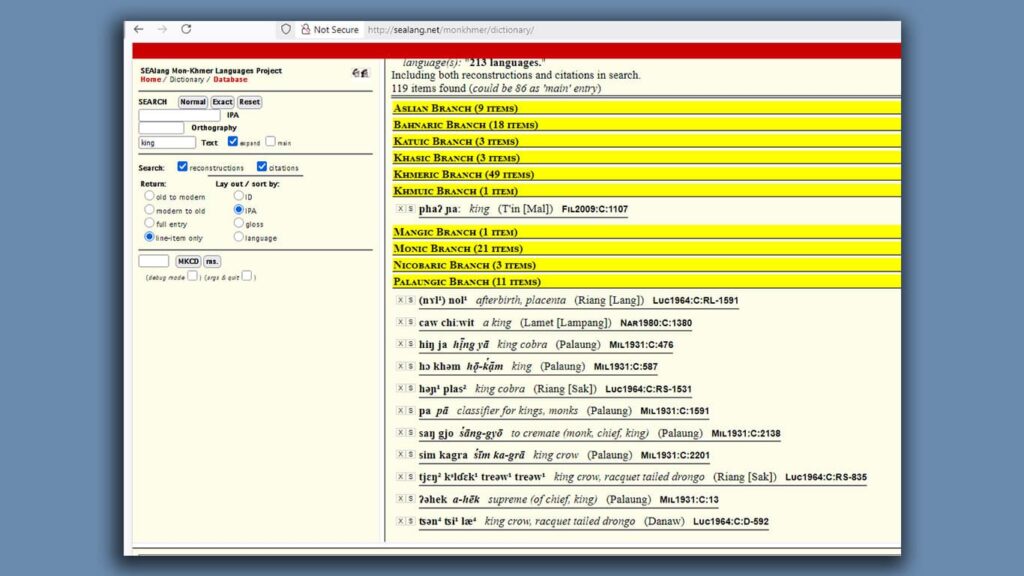
Second, in the area that Daniels is talking about, we really shouldn’t expect to find evidence of “Mon.” Instead, the “Mon-Khmer” (i.e., Austroasiatic) languages that are spoken that far north are Northern Mon-Khmer languages like Palaungic or Khmuic languages. So, it would make more sense to see if this term “mang” exists in such languages.
I also checked that, and I couldn’t find anything like it (http://sealang.net/monkhmer/dictionary/).
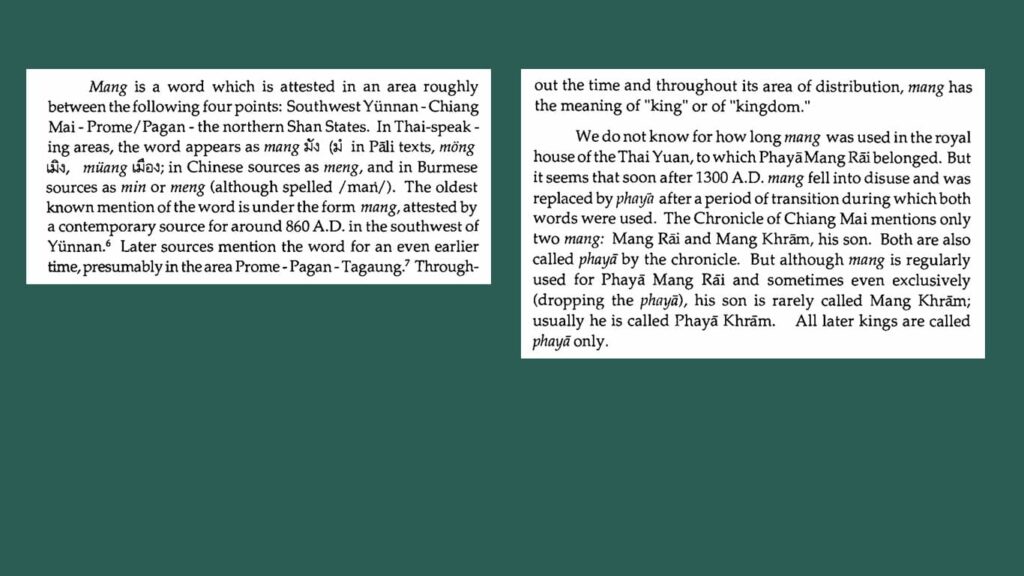
However, that all makes sense, because if you read what Hans Penth actually wrote, you will see that, contrary to Daniels’ statement, he never made the claim that “mang was a prefix of Mon origin meaning king or kingdom.”
Penth’s article is about the founding of Chiang Rai in 1262 or 1263. The first ruler was called Phaya Mang Rai. Penth explains that “phaya” is “a title of possibly Mon or Khmer origin meaning ‘king.’” As for “mang,” he says that it “is a word which is attested in an area roughly between the following four points: Southwest Yunnan-Chiang Mai-Prome/Pagan-the northern Shan States” and he says that it “has the meaning of ‘king’ or ‘kingdom.’”
Importantly for our discussion here, Penth doesn’t attribute mang to any language. Let me repeat that. Contrary to what Daniels wrote, Penth doesn’t attribute mang to any language. He simply says that it appears in Tai, Pali, Chinese and Burmese texts.
In other words, Penth did not say that “mang” was “a prefix of Mon origin signifying kings or a kingdom.” And that makes sense because there doesn’t seem to be any evidence to support that point.
Daniels goes on to say that “This interpretation is further corroborated by Nanzhao’s governance of the Mang Man through an administrative unit known as the Mangnai Dao 茫乃道 lit., ‘Circuit of kings and nobles’. Mangnai contains another Mon word naai, a title for male nobles of ruling families and community elites.”
Naai (nài) is indeed a Mon term, but again, I don’t think we have evidence of Mon usage this far north, and I could not find evidence of this term in the Northern Mon-Khmer languages. As far as I know, the Chiang Mai area is supposed to be a kind of “Mon outpost,” meaning that was the farthest north that the Mon language reached.
Also, as for the evidence of circuits in Nanzhao, there is one passage in the Manshu 蠻書, one of the main sources for information about Nanzhao which states as follows:
南詔特於摩零山上築城,置腹心,理尋傳、長傍、摩零、金、彌城等五道事云。凡管金齒、漆齒、繡腳、繡面、雕題、僧耆等十餘部落。
Nanzhao specifically built a citadel atop Mount Moling and placed a trusted core administrative center there to govern the five circuits of Xunchuan, Changbang, Moling, Jin, and Mi Cities. In total, it governs over ten tribal groups, including the Jinchi (“Gold Teeth”), Qichi (“Lacquer Teeth”), Xiujiao (“Embroidered Feet”), Xiumian (“Embroidered Faces”), Diaoti (“Carved Foreheads”), and Sengqi.
I would really like to know what Xunchuan, Changbang, Moling, Jin, and Mi meant. Did they refer to “kings and nobles” in other languages? If so, what languages?
In the absence of such information, and given that Penth never said that “mang” was Mon-Khmer, and it doesn’t appear to be, and that it is highly unlikely that a Mon term like naai made it this far north, then I see no reason why this Mangnai Dao 茫乃道 couldn’t be Muang Nai Circuit, meaning the circuit of the Tai-speaking polity, “muang,” called “Nai,” in other words, a circuit that contained the name of an existing polity.
My sense is that it was pretty normal to create administrative names based on existing place or administrative names (or to slightly modify them), and there is certainly plenty of evidence from the history of this part of the world to support that idea (think Jiao/Jiaozhi/Jiaozhou, etc.).
Daniels goes on to say the following:
This evidence verifies the differences in distribution of the two Mon-Khmer groups. The first group, the Puren/Puzi Man, were situated nearest to Nanzhao’s epicentre at Lake Erhai and were incorporated earliest. Positioned south of the first group, the second group, comprising the Heizui/Heichi/Jinchi/Mang Man, extended west–east in a band from the Salween to the Upper Mekong.
The Tai group known as the Baiyi were settled in the upper Red and Black River regions of north Vietnam in the mid-ninth century, and possibly in northern Laos and Isan in Thailand as early as the eighth century, (107) but there is no evidence for them residing in Yunnan during this period.
Do you still remember that sentence I asked you to remember?
A few paragraphs earlier, Daniels justification for denying the possibility that the Mang Man could have been Tai speakers (and therefore must have been speakers of a Mon-Khmer language) was that “no evidence exists to verify the arrival of Tai ethno-linguistic stock in the Upper Mekong as early as the eighth or ninth centuries.”
Now he says here that “the Tai group known as the Baiyi” were “possibly in northern Laos and Isan in Thailand as early as the eighth century.” (!!!)
Daniels also says here that the Baiyi were “settled in the upper Red and Black River regions of north Vietnam in the mid-ninth century” but that “there is no evidence for them residing in Yunnan during this period.”
Before that final statement, Daniels has a citation (#107). I always find it odd when scholars put citations in the middle of sentences. The statement that comes after the citation, “but there is no evidence for them residing in Yunnan during this period,” is very important, so where does the evidence for that come from? Is it in #107? Or does it come from someplace else, given that #107 is placed before this important claim? If so, where exactly does that information come from?
Let’s look at footnote #107. Here Daniels notes that Tatsuo Hoshino put forth the argument in 2002 that “Tai ethno-linguistic stock already inhabited Isan and the upper reaches of the Chao-Phraya Basin by the eighth century on the basis of toponyms.” Wow! That’s even further south than what Daniels wrote in the passage above (“northern Laos and Isan”).
Again, Daniels has this information here in a footnote but claimed earlier in the text that Tai-speakers were not even in the Upper Mekong region yet, when making his claim that the Mang Man were Mon-Khmer speakers.
In footnote #107, Daniels also cites an article by Ken Kirigaya, “The Early Syām and Rise of Mäng Mao: Western Mainland Southeast Asia in the ‘Tai Century.’” In this article, Kirigaya discusses the early history of the Shan (Syām), a Tai-speaking group that eventually settled in what is now Myanmar, and a polity called Mäng Mao.
Daniel’s cites page 242, where Kirigaya has a section on “The early Syām in China’s historiography.” This is what Kirigaya wrote:
Ancestors of the various Tai-speaking groups are called Baiyi in the Chinese literature. The term, written “White Clothes,” first appears in the Xin Tangshu, in which the “Baiyi Death-devoted Army” constituted the main force in the Nanchao campaign to the Annam Protectorate located in the modern Hanoi area in the mid-9th century.
Two texts dating to the Song dynasty, Zhufan Zhi and Lingwai Daida, also refer to the Baiyi who inhabited to the west of Annam, i.e., the upper Red and Black River region of northwestern Vietnam, southeastern Yunnan and northern Laos.
Meanwhile, in southwestern Yunnan, according to the later Yuan account, in the time of the Dali Kingdom under the Duan Clan that had replaced Nanchao in the mid-10th century, the Baiyi and other barbarians eventually regained their former lands, and thereafter “slowly began to flourish.”
This indicates that the ancestral group of the Syam had for centuries established their power base in the southwestern corner of Yunnan, the gateway to Upper Burma along the river valleys. [my emphasis throughout]
Hold on! So, in his article, Daniels does not indicate any way that any Tai-speaking peoples had anything to do with Nanzhao. Instead, we are told at the beginning that “Nanzhao was not a Tai polity and had no association with the origin of Tai ethno-linguistic stock” (189). Then we find out here, from Kirigaya, that Nanzhao had a Tai army!!!
Where did that come from?! Isn’t that kind of important to address?
Further, Kirigaya doesn’t have Tai settled in only the northwest of Vietnam, but also in parts of Yunnan, precisely where Daniels says they were not settled.
My god! Daniels isn’t even remotely trying to be serious here. You don’t cite a source but only take the information in that source that fits your argument. That is classic “cherry-picking.”
Now I think I understand why footnote #107 was placed before the phrase “but there is no evidence for them residing in Yunnan during this period.” What Kirigaya wrote definitely does not support that statement. And as far as I can tell, there is no support for that statement.
Daniels commits basically every flaw an historian can commit here: he follows a methodology when it fits his argument but criticizes it when it doesn’t (Fang Guoyu), he cherry-picks information (the Baiyi only in Vietnam), he misrepresents the work of others (Penth), he ignores information that contradicts his argument (Hoshino, Kirigaya), etc.
Mind you, there is nothing wrong with disagreeing with the work of other scholars if you are convinced that they are wrong. However, you have to provide evidence to show that those scholars were wrong, either by directly addressing their studies or by building an argument from evidence that clearly makes the positions of other scholars untenable.
This, however, is not what Daniels does. Indeed, he has counter evidence to his argument that he doesn’t address right in the footnotes of his paper.
What is going on here? I think what is going on here is that Daniels is trying very hard to achieve a specific goal, and that is to deny the existence of Tai-language speakers in the multi-ethnic state of Nanzhao.
What I completely do not understand, however, is why that goal is so important. Why is it so important to show that Tai-speaking peoples could not possibly have been part of the multi-ethnic state of Nanzhao that an historian would be willing to commit every bad practice in the book to try to make that point?
I truly don’t get it. Please, somebody! Explain this to me!!
However, this is precisely what I have seen in the writings that reject the possibility that Tai-speaking peoples were part of Nanzhao. It is at its most extreme here in this article, but I can detect that same impulse in earlier works as well.
And these are writings by white dudes. If it was Chinese scholars doing this, I might be able to come up with a logic (they want to eliminate “the Thai” from “Chinese” history, etc.). But it’s white dudes. So, what is their issue? I just don’t get it. Are they on somebody’s payroll? Is this just what the cool people are supposed to do and that’s why it’s so alien to uncool me?
1) Tai speaking peoples could easily have been in parts of the area governed/claimed by Nanzhao. 2) They expanded into mainland Southeast Asia at the same time that Nanzhao was active (See Pittayawat Pittayaporn’s 2014 “Layers of Chinese Loanwords in Protosouthwestern Tai as Evidence for the Dating of the Spread of Southwestern Tai,” a work Daniels doesn’t cite, even though Pittayawat is the leading scholar on this topic and the article is freely available online). 3) There are terms in the sources for Nanzhao that look like the Tai terms “muang” (polity) and “caw” (lord). Why is any of this a problem?!! Why doesn’t it make sense for an historian to at least check to see if any of these pieces might possibly connect?
In the end, people have been writing about this topic of the Tai and Nanzhao off and on for over a century by now, but as the above discussion should make clear, we still don’t have a decent study about this.
Sorry, I don’t want to make trouble here Mr Liam C Kelly but how come Tai people don’t record anything yet connections based on how words sound and circumstantial evidence are valid but when it comes to Vietnamese who actually wrote things down the same basis for connection are all dismissed as fake and ‘inspired’ by Chinese writings? Maybe it would have been better if Vietnamese never recorded anything?
Good question! You’re not starting trouble. 🙂
In the case of Tai-languages, according to what historical linguists say, you have a pretty clear record of the movement of peoples from the area of what is now Guangxi to the Red River Delta, Laos, upper Burma, and Thailand, and linguists can document this process by comparing the various languages and seeing how they changed.
While there is some linguistic evidence of Tai-language speakers in the Red River delta in the early centuries AD, the main movement of Tai-speaking peoples happened much later, like starting in the 700s or 800s. In other words, for the Tai, we are talking about history from say the past 1000 years or so.
In the case of Austroasiatic languages, which is the language family that Vietic languages belong to, many linguists think that they also migrated into mainland Southeast Asia from southern China, however, they did so much, much earlier.
Further, there is no longer any significant Austroasiatic speaking communities in southern China (comparable to the Tai-speaking communities) that linguists can compare the Austroasiatic languages in mainland Southeast Asia too.
As a result, linguists look to archaeology and genetic science, both of which indicate that there was movement of agriculturalists from southern China into mainland Southeast Asian in the period from like 4,000-2,000 BC, and they assume/guess that these were Austroasiatic-language speakers.
As for the Austroasiatic languages that exist in mainland Southeast Asia, linguists see evidence of a movement away from the area of what is now southern Laos in different directions, such as northward (the Palaungic languages), and at one point there were linguists who thought that this was the “homeland” of such language speakers, but now, as far as I know, more and more linguists are concluding that Austroasiatic languages probably first emerged in the area of what is now southern China, however, I don’t think linguists have a clear idea of (or have agreed) where exactly that would have been.
In terms of why we can talk about Tai words but not the Viet ones you are thinking of: In the Tai case, we are comparing words that are documented in “China” in the 860s in an area that corresponds to the area which linguists see as the “homeland” of Tai languages, with words that are very common, and are found across perhaps all of the Tai languages, including the one that we can still find in what is today China.
In the case of trying to connect the term Hùng with the kingdom of Chu, that is different. First, the time period between these two cases is much longer. Second, we have no idea what kind of language the Chu language was, and there are no longer any Chu language speakers in China, and there haven’t been for a long time. Third, Hùng isn’t a common term for “king” in Austroasiatic languages, whereas “caw” is a common term for ruler in many (or all?) Tai languages. Fourth, you have all of the “literary problems” that I’ve talked about with the Hùng kings, and you don’t have any of those issues with the Tai words “muang” (polity) and “caw” (ruler).
Finally, while the Tai-language speaking people who migrated into mainland Southeast Asia starting around 800 AD spoke languages relatively similar to the Tai languages spoken in the region today, whatever the Austroasiatic speakers who lived in China spoke before migrating into the region around 4000-2000 BC was probably radically different from the Austroasiatic languages in the region today, such as the Vietic languages. As such, even if there was still an Austroasiatic community in China that we could compare with, its language would probably be much more different from the languages spoken in Southeast Asia today than the Tai languages are from the “proto-Tai” of ~800 AD given how much earlier the Austroasiatic migrations into mainland Southeast Asia appear to have been.
As such, these are very different cases.
Finally, I should add that the earliest (?) Tai history was the Camadevivamsa, and it was recorded in the 15th century, the same century that the Dai Viet su ky toan thu was compiled. Just as the DVSKTT was compiled in a foreign language (classical Chinese), so was the Camadevivamsa (Pali). Just as the DVSKTT begins with stories that many historians believe are “medieval creations,” so does the Camadevivamsa start that way as well.
So, I understand your reaction, but these are very different cases. The migration histories of the Tai speakers and the Austroasiatic speakers are very different (one is relatively recent and one is very ancient), as is the linguistic evidence that we have to work with (one we have, one we don’t).
That’s a relief haha, thank you for your patience
So if the general consensus now is that AAs originated in South China isn’t it possible to have multiple waves of dispersal? It can’t be that every single AA migrated to SEA and beyond in that one 2000 year period, if some stayed behind why can’t they be the ancestor of Vietnamese?
—–
I mentioned Tai people were considered barbarians by both Vietnamese and Chinese so they were outsiders on the edge, wouldn’t that ostracism explain why they still exist today whereas AA don’t? If we look at Manchus their language is as good as extinct the cause being thorough assimilation, wouldn’t that also be the case be with AAs considering Chu though regarded as barbarian ethnically sat inside the Sinitic cultural world.
—–
Many AA words were also documented in China all corresponding to the region of AAs
Ye X.F. (2014) analyzed some characteristic words in the ancient Chu language, such as “观” (son), “邛”(mountain), “危”(sit), “淈”(stir), “篁”(bamboo grove), “党”(know), and “凭”(full). He found that these characteristic words in the ancient Chu language have no relationship with the TB, HM, and TK languages; instead, they have some correspondences in sound and meaning to AA languages.
—–
I feel if anything Hung being uncommon gives the best evidence Hung is indeed Xiong. AA are not all the same people so it existing only among some tells us that it could be that AA migrated in different waves and Hung was only an adoption among some at certain point, it could be that it did exist among all but for some reason it fell out of favour with some but neither Chu nor Vietnamese were those some. Also because it exists in languages other than Vietnamese it can’t be dismissed as inspiration from Chinese texts
—–
Isn’t it just a result of time, Chinese wouldn’t understand vernacular Old Chinese either neither do they measure up culturally as ‘Chinese’. If we take a liberal interpretation according to Confucius to be Chinese people had to follow all these strict norms and standards, not cutting their hair etc, if you transported a modern Chinese back in time to meet Confucius he would be horrified and regard them as beastly uncivilised savages but that doesn’t stop the Chinese claiming they are one and the same people and neither is there any debate about it from scholars so why can’t Vietnamese claim Chu?
——
Oh ok, I didn’t know that lol so my apologies
Let’s say Ngo Si Lien indeed took inspiration from Chinese why does modern research seem to substantiate his words? Vietnamese ultimate ancestor is Shennong, leaving aside whether he was real or not, Shennong was supposedly from Hubei so the heartland of Chu and middle Yangtze, he was the God of Agriculture, it’s thought that AAs are the first domesticators of rice and early rice domestication sites are around the middle Yangtze, NSL could have chosen anyone to be the first ancestor and he lucked out on Shennong?
—–
We have relatively precise dates and locations to work with
Chiang is of relatively late origin. It did not occur in the oracle bones. 31 The bronze inscriptions contain one occurrence of this word, and the Book of Odes, nine occurrences, in five poems. When the word chiang acquired the general meaning of ‘river,’ its use as names of rivers was limited to south of the Yangtze.
Moreover, according to several authorities, the term 江南(literally ‘south of the River’) as used during the Han dynasty refers to Ch’ang-sha 長沙 and Yü-chang 豫章, in present Hunan and Kiangsi. 33 The implication is that chiang in chiang nan refers to the middle section of the Yangtze and not the entire river
The notion that the Chinese met the AA’s in the Middle Yangtze region of course does not exclude their presence elsewhere; it just gives a precise indication of one of their habitats. It is perhaps pertinent to mention that the Vietnamese believed that their homeland once included the region around the Tung-t’ing Lake 洞庭湖 which is in that general area
Textual and epigraphic evidence indicates that the word chiang came into the Chinese language between 500 and 1000 B.C.
—–
chuethnic, you have various comments, but to respond in general, here are two points:
1)
The paper that you cited by David McCraw:
https://sino-platonic.org/complete/spp202_old_sinitic_roots.pdf
is a “first attempt” to think about some of the information in the ABC Etymological Dictionary of Old Chinese (2007). That dictionary, meanwhile, is a “first attempt” to create an etymological dictionary of Chinese.
Knowledge about the earliest forms of language families like Sino-Tibetan and Austro-Asiatic continue to develop. So whatever is in that dictionary, needs to be cross-checked with more updated linguistic information, if it has been produced, like this: https://evols.library.manoa.hawaii.edu/server/api/core/bitstreams/e0444bbd-db08-48ba-9d94-99f56d6f5d51/content
So, my point is that linguistic knowledge is constantly changing, so that is something we have to always be aware of.
2)
As for that ABC Etymological Dictionary of Old Chinese, you can download it from libgen or Anna’s Archive, and you will find that on page 3 it says the following:
“1.2.4 Tai-Kadai, Kam-Tai
Kam-Tai languages (KT) are not related to Chinese and ST (Dai Qingxia 1991). Massive
lexical exchanges in both directions between Chinese and Tai, from [Old Chinese] to more recent dialects,
have led some investigators to conclude otherwise. In the distant past, people speaking
these languages likely lived in areas as far north as the Yangtze River basin. For example, the
ruling family of the ancient state of Chu had the clan name xiong 熊 ‘bear’, but in the Chu
language the name was Mi 芈 which is the KT word for ‘bear’. Today, though, KT people live
farther to the south in GUangXI, Guizh6u, and southern Hunan (Pulleyblank 1983: 429ft).”
Then if you look up xiong 熊, this dictionary says that it’s Sino-Tibetan (pg. 542).
As such, I’m not a linguistic, but it looks like you have a long battle ahead of you if you want to convince linguists that the Chu were Austroasiatic speakers and that xiong is Austroasiatic.
I didn’t want to bring it up because in modern phonetics it’s different so it’s just easier to discuss ‘Xiong’ lol but Xiong is a textual recording by the Huaxia, in inscriptions from Chu the word is represented as 酓 and they were homophones at the time. ‘Mi’ was also recorded as 嬭 by Chu. The differences are due to the Huaxia were viciously racist to Chu people reducing them to animals Xiong as bear and Mi as sheep so ‘Xiong’ is not related to Mi or bear or Tai people. At the end of the day it’s just approximations in a foreign script the important point is the context. 嬭 is also the word for mother in Chu and there’s AA correspondence
—–
‘ “Zuo Zhuan·Zhao Gong 13th Year” says that after King Ping of Chu ascended the throne, “his name was Xiong Ju” , that is, King Ping of Chu changed his name from Qi Ji to Xiong Ju. If “Xiong” was the surname of the Chu royal family, then King Ping of Chu did not need to emphasize it at all when changing his name, but only because it was an organic part of the name.
From the above, we can see that the word “Xiong” can only be used by the princes or kings of Chu in successive dynasties. In other words, it is a special title for the leader of the Chu clan, not the surname of the Chu royal family’
—–
I don’t get how it can correlate so well but you won’t even slightly entertain that Hung is Xiong yet you will push back with Xiong being bear to connect it to Tais without hesitation. Not that I question your academic integrity Mr Liam C Kelly but have the commies in Vietnam put any undue pressure on you to suppress the truth about Vietnamese origin? Or is it the Thais since your blog has always been super pro Tai
How do you know that Xiong and 酓 were homophones in the first two millennia BC? Which linguist says this?
To be honest, I sincerely couldn’t care less if Chu was inhabited by Proto-Austroasiatic speakers, or Proto-Tai-Kadai speakers or Proto-anything speakers. All I care about is that we don’t pick and choose information that we like, and explain it in ways that we like, while ignoring all the counter evidence, so that we can make a pre-determined point that we want to make.
If Daniels had presented clear evidence that Tai had nothing to do with anything that we see in the records of Nanzhao, then I would be totally happy to accept that. The problem is that he didn’t do that. Instead, he ignored counter evidence (sitting right in his footnotes) and made up information (about what Penth had stated). THAT is what I am opposed to.
Saying that “Xiong and 酓 were homophones” likewise appears to me to be a case of making up information. Show me the linguist who has written about this or the historical linguistic resource/database where we can see that these two characters were homophones in the first and second millennia BC. If you can do that, then I’ll consider your point. If you can’t do that, then obviously I’m going to disagree with you. It’s not because I want the past to be one way or another. It’s because we can’t make up information and ignore counter evidence (the counter evidence here would be that there is no linguistic evidence to support the idea that these two characters could have ever been homophones).
Let me put this another way. Let me explain how I would test to see if we can make the argument that you want to make.
1) I would look for Proto-Austroasiatic reconstructions for “king,” “ruler,” “leader,” “chief,” etc. in places like this: (https://evols.library.manoa.hawaii.edu/server/api/core/bitstreams/e0444bbd-db08-48ba-9d94-99f56d6f5d51/content). There could be more updated word lists of Proto-Austroasiatic reconstructions, so I would also need to look around and consult linguists to find out what the latest understanding is.
2) I would then look up historical reconstructions of Chinese to see if any of the terms like xiong, mi, etc. are similar to the Proto-Austroasiatic reconstructions.
If I could find a “match” between a Proto-Austroasiatic reconstruction of a term for king/ruler/leader/chief and the historical linguistic reconstruction of any of those Chinese terms, then I would have a starting point for investigating this issue further.
However, before doing that, I would check to see if there was a match with any Pro-Tai-Kadai terms or Proto-Sino-Tibetan terms, to see if the term was borrowed between language families. If so, then there would be no way to know from this single “match” which language family it belonged to, and therefore, the research would have to be expanded to try to see if there were other matches between Proto-Austroasiatic (or Proto-Tai-Kadai or Proto-Sino-Tibetan) terms and the Chinese reconstructions of certain other Chu terms.
3) Assuming that the match I discovered is only with a Proto-Austroasiatic term, I would then do research with a resource like this Mon-Khmer comparative dictionary (http://sealang.net/monkhmer/dictionary/) to see if we can find evidence of this same term in current Austroasiatic languages, and to try to determine a possible history of its spread across space.
In looking at #1, it looks like scholars have not identified a Proto-Austroasiatic term for king/ruler/leader/chief. If that’s the case, then I myself would give up trying to make a point about those characters, because that would mean that it is impossible to have any idea what I’m even looking for. Again, maybe there is an updated wordlist somewhere, or maybe one of the small number of linguists who actively works on this might have ideas that s/he hasn’t published yet, but from what I can see, it looks like no such term has been identified.
If that is indeed the case, then I guess one could then go and try to determine on one’s own what a Proto-Austroasiatic term for king/ruler might have been. However, if, like me, you are not a trained linguist, then I would not advise doing this, but the way this generally works is that linguists look at all of the languages in a language family, and try to identify a term that is shared by several of them, as that could indicate a term that entered these languages when they were in an original “homeland.” Then based on their knowledge of how sounds in languages change over time (knowledge which non-linguists like me do not possess), and their specific knowledge about Austroasiatic languages, they try to create a plausible “proto” version of that term.
So, you could use a resource like (http://sealang.net/monkhmer/dictionary/) to try to do this. However, after doing so, I would DEFINITELY contact the leading linguists on the history of Austroasiatic languages and ask for their opinions. ONLY if they confirmed what I came up with would I continue.
I do that every time I have some point I try to make using historical linguistic information. It is rare that the linguist will say “yes, you are exactly right” (actually, that has probably never happened with me). Sometimes they will say “no, you are completely wrong.” However, in many cases, the linguist will simply point to counter evidence that makes whatever argument I was trying to make too weak, and so I will change whatever it was that I thought I could say, and instead, just say whatever I have evidence to support, and that might significantly change my original argument/point.
“Hùng” is not Proto-Austroasiatic. Its first documented appearance comes thousands of years later. We have no evidence that it is even Austroasitic (it doesn’t appear in any Austroasiatic language). Its earliest appearance is in a Chinese text where it was clearly chosen for its Sinitic meaning rather than its sound. So, starting with “hùng” to make the argument that there is a link between “xiong” in the ancient kingdom of Chu and the “hung” that appears in much later Chinese texts about the Red River delta region to argue that the Chu leaders were speakers of a (proto) Austroasiatic language is linguistically impossible.
In other words, we can’t declare that hùng is an Austroasiatic term when it doesn’t exist in Austroasiatic languages and then project it (unchanging) back in time thousands of years. Instead, we have to try to determine, based on historical linguistics, what Proto-Austroasiatic terms for ruler/king, etc. were and then to see if there is any connection with later terms (and taking into account how pronunciation changed over time).
That you have “xiong” in the ancient kingdom of Chu and “hung” appear centuries later in a revised Chinese text that changed words that only made sense as sounds to words that have meaning, strongly points to a random coincidence. The word for “die” in Thai is “daai” It sounds exactly the same as the English word. This is not because Thai and English are related, it is because of a random coincidence, and every linguist in the world will tell us that languages are filled with such random coincidences (and that is one of the main reasons why I have had to change my ideas/arguments after talking to linguists, because they show me that the evidence to support my ideas is not strong enough to rule out the possibility of a random coincidence).
To prove the connection between xiong and hung is not a random coincidence, anyone would have to go through the steps that I outlined above. At this point in time, I would say that it is impossible to do that, and it may very well remain impossible forever. Ultimately, I think it’s up to linguists. If they can expand our knowledge of the proto language families in that part of the world (and maybe there is something in the power of AI that will enable this?), then we might be able to make some breakthroughs, and I’ll be more than happy to accept whatever they can prove, but until that happens. . .
Oh yes definitely but we can only go on what the two scholars’ first pass findings are until they or others release papers that challenge those findings. As it stands Chu can only be assumed to be AA by the myriad of evidence
Chu – Also known as Jing (荊) and Jingchu (荊楚)
楚 – Schuessler (2007) proposes an Austroasiatic origin; compare Proto-Austroasiatic *ɟrla(ː)ʔ (“thorn”).
荊 – Cognate with Khmer ជ្រាំង (crĕəng, “to bristle”), Khmer ប្រែង (praeng, “bristle”) (Schuessler, 2007)
观 – ancient Chu dialect (OC *koːn, “child; offspring”) (Ye, 2014)
And the information that you present here does not demonstrate that the Kingdom of Chu was inhabited by Proto-Austroasiatic speakers. The terms you point to, Chu and Jing, have primary meanings as plants. They have secondary meanings as references to a region or a kingdom.
1) The term 楚 has multiple meanings. It is not only used as a reference to an ancient kingdom. Instead, it was mainly used to refer to a thorny plant and things related to that. Schuessler was referring that meaning as a plant, not to the name of the kingdom. There is no way to know where the name of the kingdom came from and what it signified. Like “Luo/Lạc” it could be the transcription of the sound of a word that we have no way of knowing the meaning of. This is a ChatGPT translation of part of the definitions in the Kangxi dictionary:
Definitions and Classical Usage
A cluster of shrubs (叢木).
Also refers to the Vitex or jing (荆).
【說文】(Shuowen Jiezi): “叢木也。一曰荆。” — A cluster of trees; also called jing.
Visual description of thorny plants:
【詩·小雅】”楚楚者茨,言抽其棘。”
(From the Book of Songs, Xiaoya: “The thorny plants are楚楚” — referring to the drawing out of thorns.)
【註】”楚楚” describes the appearance of thornbushes.
A type of firewood plant:
【詩·召南】”翹翹錯薪,言刈其楚。”
(From the Book of Songs, Shaonan: “Tall and tangled firewood, speaking of cutting the楚.”)
【疏】楚 is a type of jing shrub. Among all tall firewood, the 楚 is especially prominent.
Disciplinary rod:
【禮·學記】”夏楚二物,收其威也。”
(From the Liji, Xueji: “Summer and楚, two things that embody authority.”)
【註】楚 = 荆 = a rod used to beat violators of ritual norms.
Plant name: 萇楚 (cháng chǔ) — refers to sheep peach (羊桃), a type of shrub or herb.
【詩·檜風】”隰有萇楚,猗儺其枝。”
(From the Book of Songs, Guai Feng: “In the marshes there is changchu, its branches are graceful.”)
Bright or neat appearance (鮮明貌):
【詩·檜風】”蜉蝣之羽,衣裳楚楚。”
(From the Book of Songs, Guai Feng: “The wings of the mayfly, its garments楚楚”) — i.e., crisp, neat, or delicate.
Bitterness or pain:
辛楚 = suffering, often written 憷 in later texts.
【陸機·與弟士衡詩】”慷慨含辛楚。”
(Lu Ji, poem to his brother Lu Yun: “With passionate resolve I endure bitterness and楚.”)
State name: The state of Chu (楚國):
【書·禹貢】”荆州之域,周熊繹始封。”
(In the Yu Gong of the Book of Documents: the region of Jingzhou, where King Xiong Yi was first enfeoffed.)
This refers to the founding of the Chu state.
2) 荊 is the same. It’s primary meaning is as a thorny plant.
I don’t know which scholar, just many articles I saw from Chinese articles reference them being homophonic but this one I guess
—–
Professor Chen Guangzhong of Anhui University – From the comparison of the ancient and middle Chinese pronunciations of “熊” and “酓”, we can see that: ① The ancient pronunciations of the two characters have 5 similarities: similar initials (匣, 影), similar rhyme parts (谈, 勤), similar rhyme nuclei (a, ə), the same medial (ǐ), and the same rhyme coda (m). Therefore, they have the conditions for complete phonetic homophony
Ok, so now I see Professor Chen Guangzhong’s argument. His argument is based on the 说文 and 广韵. I think a trained linguist could bring additional knowledge to this topic, but let’s work with Prof Chen’s argument.
You have a bronze tripod that contains the character yan 酓 as the surname of a king, and in written texts it is xiong 熊. His argument is that both of these terms would have been pronounced something like “ɣǐɛm.” He also thinks that “xiong” is the original form (可能“熊”字是本字,“酓”是借字).
1) As an historian, I would say that it’s much more logical to make the opposite conclusion about which is the original term. The information on the tripod has obviously not changed over time because it is carved in bronze. By contrast, whatever textual information that we have could have easily been changed later because we don’t have physical texts that are as old as the bronze tripod (unless someone has found texts in a Chu tomb that have xiong on them? It doesn’t look like that).
2) Also, based on Chen Guangzhong’s findings, the sound we should be looking for is “ɣǐɛm.” That is what the Proto-Austroasiatic term for king/leader/chief, etc. should resemble.
3) I would want to see a trained linguist provide me with strong evidence to show how ɣǐɛm became “hùng,” because I don’t see a connection there. There are a lot of changes that would have to take place for that to happen, and if the experts on Austroasiatic languages can show me that, then ok, but if they can’t. . .
Here is the passage below, and a translation by Grok, for readers to see.
1933年寿县朱家集李三孤堆楚王墓出土楚王熊前釶(yí)鼎,考古学界认为是楚幽王墓。“釶鼎”的边沿镌刻12字铭文,释文一作:“楚王酓前作铸釶鼎,台(以)共岁棠(尝)。”
这里奇怪的是,楚国王族,不写姓“熊”,却写作姓“酓(yăn)”。元,又写作“前”。按:酓,《说文系传》:“酒味苦也。从酉,今声。”即酒中有苦味。它的读音,《广韵·琰韵》上声:“酒味苦也。于琰切。”又,《广韵·㮇韵》去声:“酓,于念切。”据此,中古音拟音为[ǐɛm]。可以推知,“酓”字上古音归于影纽、侵部[ǐəm]。
熊,《说文》:“兽,似豕,山居,冬蛰。从能,炎省声。”炎,《广韵·盐韵》下平声:“炎,热也。《说文》曰:‘火光上也。’于廉切。”据此,中古音拟音为[ɣǐam]。“炎”字上古音归于匣纽、谈部[ɣǐɛm]。可以知道,上古音酓、熊二字,韵部(侵、谈)相近,声纽(影、匣)相近,属于音近通假。
《楚世家》中写道:“周文王之时,季连之苗裔曰鬻熊。熊驿当周文王之时,姓芈氏,居丹阳。”司马迁采作“熊”字,“釶鼎”用作“酓”字。可能“熊”字是本字,“酓”是借字。
In 1933, a Chu royal tomb, identified by archaeologists as the tomb of King You of Chu, was excavated at the Li Sangu Mound in Zhujiaji, Shou County. Among the artifacts was a Chu royal bronze yí tripod (釶鼎). The rim of the tripod bears a 12-character inscription, interpreted as: “Chu King Yănqián made and cast this yí tripod, to be used for annual offerings.”
What is peculiar here is that the Chu royal family, typically surnamed “Xiong” (熊), is written as “Yăn” (酓) in this inscription. Additionally, the character “Qián” (前) is used. According to the Shuowen Xizhuan, the character Yăn (酓) means “bitter taste of wine” and is derived from the radical for wine (yǒu, 酉) with jīn (今) as the phonetic component. Its pronunciation, as recorded in the Guangyun under the Yăn rhyme (upper tone), is described as “bitter taste of wine, pronounced yǔyăn [ǐɛm].” Additionally, in the Guangyun under the Niàn rhyme (departing tone), it is listed as yǔniàn [ǐɛm]. Based on this, the Middle Chinese pronunciation is reconstructed as [ǐɛm]. It can be inferred that the Old Chinese pronunciation of Yăn (酓) falls under the yǐng initial and qīn rhyme [ǐəm].
For Xiong (熊), the Shuowen states: “A beast resembling a pig, living in the mountains, hibernating in winter. Derived from néng (能), with yán (炎) as the phonetic component.” The character yán (炎), meaning “heat” or “firelight rising” in the Shuowen, is recorded in the Guangyun under the Yán rhyme (lower level tone) as yǔlián [ɣǐam]. Its Old Chinese pronunciation is reconstructed under the xiá initial and tán rhyme [ɣǐɛm]. Thus, in Old Chinese, the characters Yăn (酓) and Xiong (熊) have similar rhyme categories (qīn and tán) and initial consonants (yǐng and xiá), indicating they are phonetically close and likely used interchangeably due to their phonetic similarity.
The Chu Shijia (Records of the House of Chu) in the Shiji states: “During the time of King Wen of Zhou, a descendant of Jilian named Yuxiong. Yuxiong lived during the time of King Wen of Zhou, with the surname Mi, residing in Danyang.” Sima Qian uses the character “Xiong” (熊), while the yí tripod inscription uses “Yăn” (酓). It is possible that “Xiong” is the original character, and “Yăn” is a borrowed form.
But it’s not necessary to the argument if ‘Hung’ was AA or so we don’t need to look into that stuff. It only matters that Xiong existed in Chu in the same context as it did with the Hung Kings. I only referenced it existing among other AA populations as evidence it wasn’t a literary ‘theft’ as you always accuse imperial Vietnamese of doing.
Now you are contradicting yourself. You’ve spent so much time trying to convince me that the Chu people were AA speakers and that Xiong is AA, and now when I provide you with the counter evidence and show you how to make a solid argument (which can’t be made because the evidence doesn’t exist) you say that it’s not important. . .
What I said is totally important, because without linguistic evidence, you have no way of proving that what you are talking about is anything more than a linguistic coincidence, like “die” and “daai.”
I think it’s time for you to go try to convince someone else. I have probably done more than any other person to try to show you what is wrong with your argument and what you need to do to make a convincing argument, but if you refuse to listen, then please, there is no need to continue this conversation.
Again Mr Liam C Kelly, how come AA words appear and you conjure up all reasons under the sun to dismiss them but a royal clan using terms associating them with animals doesn’t elicit the same response? What about the word for child? Why would Chu people have this word that’s cognate with Vietnamese con?
—–
Chu is called Chu because it was full of thorny bushes and shrubs, Jing likewise heavily forrested, the Chu people even paid tribute with thorny arrows
There’s the direct passage from Records of the Grand Historian
昔我先王熊绎辟在荆山,荜露蓝蒌以处草莽,跋涉山林以事天子,唯是桃弧棘矢以共王事
—–
Mr Liam C Kelly you would be well aware that 阳 can mean south face/side of a mountain and we just saw a reference to 荆山, isn’t that reminiscent of a certain Kinh Duong Vuong in Vietnamese historical records?
I am not “conjuring up all reasons under the sun to dismiss” anything. I am checking the evidence and counter evidence. The best argument, and therefore, the most convincing argument, is the one that either doesn’t have counter evidence or which can defend itself against the most counter evidence by showing that the counter evidence is not valid or is wrong, etc.
You used information in David McCraw’s article about the Etymological dictionary, so I looked at that dictionary and saw that is says that the “Mi,” meaning “bear” that we find in the names of some Chu rulers is “Proto-Tai-Kadai.” I also looked that up here and saw that it makes sense (https://en.wiktionary.org/wiki/Appendix:Proto-Tai_reconstructions).
That’s counter evidence to what you are trying to say. So, for your argument that the Chu were AA speakers, you have to be able to prove that such ideas are wrong (but I would also check to see if this scholar is right. Can we find other evidence of Proto-Tai-Kadai words related to Chu?). If you can’t, then you have a weak argument that is not going to convince anyone.
That is not “conjuring up all reasons under the sun to dismiss.” That is doing the very basic job of every historian: checking the evidence. And pretty much for every piece of evidence that you provide, I can easily see that there is strong counter evidence. Again, that means that your arguments are weak, and that you are not going to be able to convince a serious historian or linguist.
As for the article you cite (Ye 2014), here is the abstract: “Abstract: This paper presents a preliminary discussion on the relationship between a certain number of lexical terms in Old Chu and their counterparts in the Austroasiatic languages, and proposes that some feature words in Old Chu have been borrowed from the Austroasiatic languages.”
The author argues that “con” was borrowed into Chu from an Austroasiatic language. He does this by discussing one passage in the Shijing in a poem related to Chu where the character 觀 appears, a passage which people have interpreted in other ways as well. He doesn’t say that the Chu people spoke an Austroasiatic language. His argument is that Chu conquered the Pu people, that the Pu were AA speakers, and that “con” was borrowed into the Chu language.
You have been trying to convince me that the Chu were AA speakers, that xiong is AA, etc. This author, whom you cite for evidence, does not say that. By saying that “con” was “borrowed into” Chu from and AA language, he is implying that Chu was not an AA language. So, do you accept this author’s position? His position contradicts what you have been trying to convince me. If you don’t agree with him, then it looks like you are “cherry-picking” information, that is, taking the parts that you like and ignoring the parts that you don’t like.
https://web.archive.org/web/20181206235249/http://acad.cssn.cn/zt/zt_xkzt/zt_wxzt/bw7/nyxs/201507/W020150728818382888024.pdf
As for 昔我先王熊绎辟在荆山,荜露蓝蒌以处草莽,跋涉山林以事天子,唯是桃弧棘矢以共王事, this is filled with humble language to try to indicate the difficulties that the early Chu ruler faced: “In ancient times, our former king Xiong Yi settled in the Jing Mountains. He used bamboo mats and bluegourd vines as shelter in the wilderness, and traversed mountains and forests in service of the Son of Heaven. He relied solely on a peachwood bow and thornwood arrows to carry out royal duties.”
This line provides no evidence to support the idea that “Chu is called Chu because it was full of thorny bushes and shrubs.” Who named it that? Where do you find that information? The leaders of Chu? They called their kingdom “thorny bushes”? How do we know that? What other kingdoms at that time were named in this way?
Look at the Kangxi dictionary entry. No connection is made between thorny bushes and Chu. Why not? If this was true, then why didn’t anyone ever say anything about that? And if no one ever said anything about that, then how can we know that this is true?
In cases like this where there is no evidence, you can use comparative evidence to suggest that this might be the case. So, for instance, if there is evidence of other kingdoms at that time using vegetation/plants as the name of their kingdom (by evidence, I mean something recorded, like a text that says something like “the Big Tree kingdom was called that way because there were a lot of big trees”), then you can point to that and say “maybe this is where Chu got its name.”
Do we have evidence of other early kingdoms named after plants? That is, do we have clear textual evidence that the name was chosen for that reason? If that kind of evidence doesn’t exist, and if you don’t have textual evidence that the term “Chu” was adopted for the name of the kingdom because of the plants there, then there is no evidence to support the point you are trying to make.
We can think of all kinds of explanations for the past, but if we can’t support those ideas with evidence, then we can’t convince anyone.
But I already look into these things before posting so I wouldn’t bother bringing it up in the first place if I didn’t think it was plausible. For example Proto Tai is estimated to be no older than 2500 years at best so the bear argument doesn’t make sense in a first pass stress test let alone that within Chu itself the word was recorded as Yan not Xiong. The only reason Tai would make sense is if the royal clan in Chu was somehow replaced by Tais so Xiong replaced Yan and they also for some reason wanted to be associated with animals.
—–
What I’m saying is that it’s not important to the discussion if Hung is AA or not so we don’t need to deep dive it. Let’s say Hung wasn’t AA why does it matter? It existed in Chu exatly as it did with the Hung Kings as dual usage of ruling titles
—–
But why should an intimate basic word like child be borrowed by Chu people if they conquered some Pu savages? Groups with higher prestige will borrow peripheral words like river or something but child is out of the question, it has to be a substrate word which would make the base of Chu language AA.
—–
Chu people ruled China since Liu Bang was ethnically a Chu person and the Chinese these days call themselves ‘Han’ people so of course they won’t admit Chu was non Sinitic neither do we need them to. It’s actually better for them to believe Chu was Sinitic because that way Chinese scholars only self incriminate by releasing their research which they otherwise might keep hidden.
1) Proto-Tai – Look at Schuessler pg. 3, he says Mi is from Kam-Tai. Kam-Tai is older. I’m not the expert. Schuessler is. Argue with him.
2) “it’s not important to the discussion if Hung is AA or not. . . It existed in Chu exactly as it did with the Hung Kings as dual usage of ruling titles”
What you are showing can easily be explained as a coincidence. You have to prove that it is not a coincidence. The only way to do that is with LINGUISTIC EVIDENCE.
Again, to use the example I gave before, English “die” and Thai “daai” SOUND EXACTLY THE SAME and have THE EXACT SAME MEANING and are used in THE EXACT SAME WAY.
However, those similarities do not prove that “die” and “daai” are the same word. Instead, you need LINGUISTIC EVIDENCE to prove that, and in this case, there is no linguistic evidence that links “die” and “daai.” It’s just a COINCIDENCE that they sound the same, mean the same, and are used in the same way.
Similarly, you need LINGUISTIC EVIDENCE to show that whatever similarities you think there are between xiong and hung are not a COINCIDENCE.
The problem for your argument is that you do not have the linguistic evidence to prove it. You do not have the linguistic evidence to show that whatever similarity you think there is between xiong and hung is not just a coincidence.
What you are doing is the equivalent of pointing to “die” and “daai” and saying “look! It’s the same word. We don’t need to know what languages these words come from. They’re obviously the same because they are used in the same way. That’s good enough.”
It’s not good enough. You need LINGUISTIC EVIDENCE.
3) “But why should an intimate basic word like child be borrowed by Chu people if they conquered some Pu savages?”
EXACTLY!! So why did you cite this source for your evidence? You are the one who cited Ye 2014. It doesn’t support your argument!!
This is exactly what I’m telling you. You don’t seem to pay attention to the sources of your information. The sources you cite have obvious counter evidence to your argument. So how can you expect anyone to believe you?
All I have done is to check the sources you cite, point to the counter evidence there, which for some reason you choose to ignore, and then you accuse me of being biased or a bad historian. . .
But what other royal clans used terms associating themselves with animals? Just like it doesn’t matter to you that Xiong is related to bear and Mi is related to sheep why does it matter if other states were named after the habitat?
—–
Mr Liam C Kelly are you serious? Why are you pretending that historical chronicles are a personal diary recording every little detail down to scientific precision not that Sima Qian was even alive during that time. It’s your profession, reading tidbits from historical records and extrapolating for the layman now you’re hitting back and saying um no man it literally doesn’t say word for word what you said. But anyway even Chinese scholars/history enthusiasts acknowledge Chu was full of thorny bushes/densely forrested because it’s implied from the records. It’s also implied from the character itself because it’s a pictogram depicting forrests. I don’t see how the Kangxi dictionary compilers fit in here
Ok, then by your logic, I can say all of this, and it is all 100% legitimate:
1) Lu 魯 means “dumb” or “foolish” (愚拙,蠢笨). The kingdom was called that because the people were all dumb/foolish. And the character is made up of a fish 魚 and the sun 日, meaning that the people were as dumb/foolish as fish that lie in the sun.
2) Cai 蔡 means “wild grass” (野草). The kingdom might have been called this because there was a lot of wild grass there. However, “cai” also means “a large turtle for divination” (占卜用的大龜), so the kingdom might have been called this because it was where people got large turtles for divination. Or it might be a combination of both. The character includes the grass radical 艹 and a part that means to perform a sacrifice 祭. So, the kingdom could have been named “cai” because the people made sacrifices in fields of wild grass with large turtles for divination.
3) Yan 燕 means “swallow” (鸟类的一科,候鸟,常在人家屋内或屋檐下用泥做巢居住,捕食昆虫,对农作物有益). It was called this because there were a lot of swallows there.
4) Wei 衛 means “protect” (保護). The kingdom was called this because the people there were good at protecting themselves and others.
I see. This is great! I can just make things up!! No need for any evidence. Oh, this is going to make my life so much easier. Thank you!!!
And I’m sure that peer-reviewers will also fully support this approach. . .
Woah woah time out Mr Liam C Kelly, I never accused nor do I think you are a bad historian, far from it I learned a lot from your work but sorry yes, I feel like you are definitely a humongous Tai sympathiser but many scholars probably everyone in the various fields of academics have agendas of some sort, it’s kind of the whole point of academics so you are not alone in that and it’s not a big deal, there’s nothing wrong with your biased toward Tais
—–
1. Anyway back on topic proto Tai as in proto Tai Kadai the entire family, there’s also no o1a samples anywhere around the middle Yangtze so Chu being Tai just doesn’t seem plausible
—–
2. Well yes it is a coincidence but why are there all these coincidences occurring with Vietnamese and Chu when according to you NSL was a liar? It’s literally impossible for everything from linguistics, genetics, historical records to line up like this and there be no relation. It’s not like these coincidences occur in isolation like the Thai and English example but also more than that in the case of Hung it’s based on an incredibly niche situation, false cognates occur all the time because words like die exist in every language but dual ruling titles is too narrow scope for coincidence that’s why I keep stressing the context
—–
I already showed you the evidence, I can’t be expected to do any more than this
According to a recent Vietnamese study, the name Hung derives from an Austroasiatic title of chieftainship that has persisted up to the present time in the languages of Mon-Khmer-speaking peoples living in the mountains of Southeast Asia, as well as in Muong, the upland sister language of Vietnamese; the title is also found among the Munda of northeast India, who speak the most western of the surviving Austroasiatic languages
First, I don’t get what you mean by exactly, my question is how did ‘con/guan’ end up in Chu language, it doesn’t matter if they came into contact with Baipu because this word should not exist in Chu language if Chu was Sinitic just like whatever the word for child was in Native American languages was never adopted into English by American aristocracy or any American
—–
Second, can you show me the paper or paste the relevant part here because the Mr Ye paper I’m talking about ‘guan’ is taken from the Chu section of the Guoyu in a conversation between King Zhuang and a royal tutor where the tutor brings up Qi’s five sons 启有五观
—–
Third Mr Ye says ‘The Chu State became powerful after it occupied the territory of the Pu people’, this could explain how guan was adopted but that would imply the majority demographic of Chu became AA and the only reason Chu became powerful is because of AAs so it literally proves I have been right all along that Chu was AA
—–
The Chu State became powerful after it occupied the territory of the Pu people. (The Records of the Grand Historian: The Family of Chu: “(King Wu of Chu) then began to open up the Pu land and possess it.”) In the Spring and Autumn Period, the Pu people’s activity areas included the current Henan, Hubei, Hunan, Sichuan, Guizhou, and Yunnan (Lü Simian 2008: 213), and when the Chu State was at its peak, its territory spanned Henan, Hubei, Hunan, Sichuan, Shaanxi, Anhui, Jiangsu, Zhejiang, Shandong and other provinces (Gu Derong and Zhu Shunlong 2001: 267). It can be seen that the activity areas of the Pu people and the territory of the Chu State overlapped.
This is what I mean by not giving the theory any consideration, you’re working on the assumption I can’t possibly be right so your default reaction is always to look for evidence or reasoning to the contrary, like why does every state need to have the exact same rationale behind their name? Anyway is Mr William H Baxter’s logic also nonsensical like mine supposedly is keeping in mind that Baxter-Sagart Old Chinese reconstructions are co-named after him
—–
William H. Baxter (apud Matisoff, 1995) suggests a semantic connection between the toponym 魯 Lǔ and its homophone 鹵 lǔ “salty, rock salt” (< OC *C-rāʔ) since that region was a salt marsh in ancient times
I am not working on the assumption that you cannot possibly be right. I personally have no idea what language(s) was(were) spoken in Chu, and I really don’t care. If someone can make a strong argument for one language or another, yes, that will be interesting, but I couldn’t care less which language it is.
I am simply pointing out flaws in your current argument, because your evidence is too weak to convince me of anything (and you came to this website trying to convince me). And I have tried to show you how to make a convincing argument.
For example, you cited Ye 2014 to argue that the Chu used the AA term “con” for child. Based on the textual information in the Guoyu (sorry, I think I said Shijing before!) that Ye mentions, yes, that might be true. However, Ye does not make a convincing case – He says that it was adopted into Chu from an AA group that Chu conquered, but why would a conquering people adopt the word for “child” from the conquered people?
What I am pointing out is that you are not actually looking at what people say. You are just grabbing information that you like. That is not how you make a convincing argument. “Guan” might be “con.” It’s possible, but Ye does not succeed in convincing me, and all you have done is point to Ye (and when I started to talk about what he actually wrote, you seem to have thought that those were my ideas – No, I’m just telling you what Ye wrote).
https://web.archive.org/web/20181206235249/http://acad.cssn.cn/zt/zt_xkzt/zt_wxzt/bw7/nyxs/201507/W020150728818382888024.pdf
Similarly here, as I keep telling you, check your sources. This appears in a footnote in Matisoff’s 1995 article, where he indicates that this was a “personal communication” (p.c.) from Baxter. So, did Baxter ever write this down? It’s not in his 2014 work with Sagart. If he never wrote this down, can we be certain that he continued to believe this?
I have a lot of information on this blog that I thought was correct when I wrote it, but which I later changed my mind about as I learned more, and linguists definitely change their ideas too, that’s why I said that it’s important to get their latest views. Generally, scholars only publish what they are really certain about. So, if Baxter never published this. . . then we have no way of knowing if he continued to believe this or not.
It could be true (just like “guan” might be “con”), but I wouldn’t base my argument on a personal communication mentioned in a footnote to a work on linguistics from 30 years ago. At best, it is as Matisoff stated, a “suggestion.” And that means that there are other possible “suggestions.” So, at the very least, if you want to be taken seriously, you have to consider and acknowledge what those other possibilities might be. Then, you have to justify why you chose one suggestion over another (or others), and finally, as you look at the issue further, you have to continue to be willing to change your ideas if you find evidence that supports one explanation over another.
That is how you build a convincing argument.
Oh I see the misunderstanding, I don’t accept Mr Ye’s reasoning either, all I care about is that Mr Ye found the cognate of guan = child because Chinese have this rigid one tract frame of mind that Chu can only be Sinitic so their reasonings are not always reliable when it can relate to the ethnic of Chu people. Their rigidness is how you get Mr Ye saying guan was borrowed from the Pu based on his assumption that Chu rulers were Sinitic and it can only have appeared in Chu language by being borrowed.
—–
I’m saying guan was always a native Chu word and had always existed in Chu language because such words as child are extremely unlikely to be borrowed so how else could it appear in Chu language. If guan was then a native Chu word that would mean the Chu rulers’ native tongue was AA making them AA/proto Vietnamese people which fits perfectly with the hatred and racism they faced from the vicious Huaxia people
—–
And before you say it could just be a coincidental false cognate because child exist in every language I will respond like before it’s not a one off coincidence like the Thai and English
“I’m saying guan was always a native Chu word and had always existed in Chu language” – Ok, but you can’t do that based on the Guoyu passage alone. You need more evidence to support that. That’s why Ye talked about Chu conquering Pu, but that’s not strong evidence.
How do you do that? If you can find several Chu words that you can link to Proto-AA, then that will make the case more believable. Again though, you have to look at what the most updated views of linguists are.
For instance, Schussler (2008) has “jiang” coming from AA. But then I asked Grok about this, and it told me that “Sagart (2008, 2011) and others, such as Bellwood (2013), propose that the linguistic substrate in southern China, particularly in Fujian, may be Austronesian rather than Austroasiatic. . . In this framework, 江 (jiāng) might not be Austroasiatic but could instead reflect early Sinitic vocabulary or a borrowing from another non-Austroasiatic source.”
And that “Paul Sidwell (2022) and others have shifted the proposed Proto-Austroasiatic homeland to the Red River Delta (c. 2500–2000 BCE) or southern China, based on genetic and linguistic evidence. While this keeps open the possibility of Austroasiatic influence in southern China, it does not specifically support the borrowing of 江 from Austroasiatic, as the term’s attestation in Chinese predates clear evidence of Austroasiatic dominance in the Yangtze region.”
Just like we have to check any source we come across, so do we need to check AI. So, I would follow up on all of this, but what this suggests, is that there is more recent scholarship than Schussler 2008, and I would want to see what people like Sagart and Sidwell have said.
——
On the issue of kingdom names – Who named Lu “salt marsh” and Chu “thorny bushes”? The leaders of those places? If so, that seems incredibly unbelievable to me. Why would anyone name their own kingdom “salt marsh” or “thorny bushes”? Just like you can’t believe that a conquering people would adopt the term “child” from the conquered people, so do I find it unbelievable that the rulers of a kingdom would name their kingdom “salt marsh” or “thorny bushes.”
Both of these cases involve hierarchy. The members of an elite are unlikely to adopt basic words from a conquered people, and they are also unlikely to name their kingdoms with such basic, or even negative, terms.
In what is now Laos, there was once a kingdom called Lan Xang, meaning “a million elephants,” a name that showed the kingdom’s power (elephants were used in war). But in ancient China supposedly powerful kingdoms called themselves “salt marsh” and “thorny bushes”!! Really???
Again, I would want to see evidence to prove that. However, I can’t think of any kingdom anywhere in the world using names like that for their own kingdom.
If that is indeed where those names come from, then it would make much more sense that they were names that Chinese gave their zhuhou 諸侯. As such, they could be indicating parts of the Chinese empire. Or, they could be transcriptions of local words which had positive meaning to the local people, but for which the Chinese chose characters that were not positive.
This is why Baxter’s explanation was referred to as a “suggestion,” because there are other ways that the origin of kingdom names can be explained. And if you chose one way over another, you have to justify doing that in a way that will convince people. I’m not convinced that the leaders of a kingdom would name their own kingdom “salt marsh” or “thorny bushes.”
—–
On another issue, you said somewhere that “According to a recent Vietnamese study, the name Hung derives from an Austroasiatic title of chieftainship. . .”
As I have said so many times now, CHECK YOUR SOURCES. That line comes from Keith Taylor’s 1983 (That’s not recent!!) The Birth of Vietnam where he was talking about scholarship from the late 1960s and early 1970s from North Vietnam.
Check Keith Taylor’s more recent A History of the Vietnamese (2013) and see if he still says this. He doesn’t. I think I said this in a comment to a different post, Taylor ignores the topic of the Hung kings in this later work, because he now realizes that the “evidence” that he earlier thought supported what he wrote in 1983, doesn’t in fact do that.
Why not? This gets to another important point, one that we haven’t talked about. We also have to be aware of the context in which knowledge is produced. In this case, there were a few conferences held in North Vietnam in the late 1960s and early 1970s (published as Hùng Vương dựng nước – 4 volumes) where scholars were basically given the task of trying to prove the ancient origins of Vietnam. This was all part of the war effort, as the North Vietnamese government wanted to make people proud of their country so that they would be more willing to fight to defend it.
In that situation, there was scholarship that was produced that was not solid, such as the claim that “the name Hung derives from an Austroasiatic title of chieftainship.” That idea is in an article from like 1968/9, if I remember correctly. And that is definitely not “recent.”
Taylor first wrote about this in the late 1970s when he was writing his PhD dissertation. At that time, he had a very pro-Vietnam view, something he developed while serving in the war, and he was very sympathetic to the nationalistic ideas of North Vietnamese scholars. Much later, in the 1990s, he came to the realization that his ideas at that earlier time were not accurate. That’s well known in the English-speaking world of Vietnamese history, although I don’t know if Taylor ever clearly wrote that anywhere. But that is why he doesn’t repeat this in his 2013 book.
Nor do linguists today make that argument. People like Paul Sidwell and Mark Alves are leading scholars in the field of Austroasiatic linguistics. I do not think that either of them claim that “the name Hung derives from an Austroasiatic title of chieftainship.” They were both involved in a project to create a comparative dictionary of Mon-Khmer languages in 2009-2011, and I don’t see “hung” in there: http://sealang.net/monkhmer/dictionary/
As for Vietnam, the field of linguistics is very inacative these days. There are extremely few professionally-trained linguists who are still active, so there isn’t much “recent scholarship.”
But even if it’s only a suggestion there was at least a point in time that Mr William H Baxter thought it in the realm of possibility that Lu is derived from the habitat which you promptly dismissed such a logic as nonsensical when I suggested it. Maybe he wasn’t confident enough to publish his personal thoughts lacking the evidence who knows what happened there but with Chu the evidence is too strong
—–
I asked Google why Chu is called Chu using Chinese input and got the AI response, it’s translating weird so I just put the direct reply
1. “楚”字在古代有荆条的意思,用荆条包裹妣厉的尸体,是楚人对她的纪念方式,后将国家命名为“楚”
2. 由于“楚”与“荆”同指荆条,所以楚国也被称为“荆”或“荆楚
3. 楚国在发展过程中,融合了中原文化和当地的苗蛮文化,形成了独特的楚文化
4. 楚国位于长江中游,其文化也深受当地环境的影响,形成了“荆楚文化”
adding to this what I already discussed
5. Chu is a literal pictogram with forrest and foot in it suggesting trudging among the forrest or something
6. Implied from historical records
7. Chu paid tribute of thorny arrows
—–
Not sure if 2 is related to 6 but all possibilities besides 3 and 4 which are vague answers that don’t really address the question relate somehow to thorns/thorn bushes/forrest, how much more convincing does it need to be that Chu has the exact same meaning as the AA root does
I keep saying “check your sources.” With AI, we have to first “find the sources” for its information, and then we need to check those sources.
So, find where Google AI is getting this information (that’s usually not difficult as it’s all scraped from the Internet), and then check that information carefully.
But I gave more evidence, chu, jing, xiong, “邛”(mountain), “危”(sit), “淈”(stir), “篁”(bamboo grove), “党”(know), and “凭”(full), 24% AA in Old Chinese it’s not specified that Chu people are the source but I don’t see who else or where else makes sense
—–
Ok well the coast was populated by Austronesians/Tai so such substrates existing in Chinese is expected but for ‘jiang’ there is zero chance it came from A/T, it’s either Sinitic or AA. Jiang originally only referred to the middle not the entire river so it can’t be borrowed from A/T when it specifically excludes their domain.
—–
Idk what Mr Paul Sidwell means because jiang is estimated to appear in Chinese between 2500 – 3000 years ago, who else was in the middle Yangtze such that they ‘predate clear evidence of AA’, this is the exact timeline of Chu’s emergence, you could say Miao but they are estimated at 0.6% of Old Chinese, if they were the Chu how could they dominate the middle Yangtze but either their language had zero relevance to the Chinese or once did but then somehow lost all relevance?
Viking dudes called their country Iceland, I don’t see how Iceland is any better than salt marsh or thorny bushes and also by the same token I could say ‘salt marsh’ at least has a better meaning than ‘foolish’.
—–
It could be related to Chinese element theory where wood/vegetation = green and green overpowers yellow, yellow is centre which is the Huaxia people so that’s why they had no problem being thorny bushes because Chu was a double meaning signifying their aspirations to conquer the Huaxia/China, there are theories saying Qing is called Qing because water beats fire so you can’t say my suggestion is nonsensical
But idk why you keep saying check sources, it’s not necessary either because I already did so before posting here or it’s not necessary in the first place. Like Mr Keith W Taylor, I never made any reference to his opinions like I didn’t with Mr Ye, I’m purely citing a study contained within his book so whether he no longer supports such a study is not important to my argument. Also have you considered that maybe his change of mind was influenced by none other than yourself Mr Liam C Kelly? You have always insisted that the Hung Kings were a work of fiction concocted by NSL so if you are indeed the catalyst then I’m already talking to you why do I need to fact check him?
—–
The fact is Mr Liam C Kelly a study exists that says various groups of AA use ‘Hung’ for chief or something to that nature if Messrs Sidwell and Alves want to come out with a study that says otherwise then great but until then I go by the evidence that exist at hand because no such contrary evidence exists and omissions do not count as contrary evidence because tbh it’s too late, the world is too modern now. Idk when or how the words for the AA database you linked were collected but if the Vietnamese study is 60 years old, idk if it is but if it is then it only works in my favour because presumably Hung would still only be in use among tribal communities which are not many compared to 60 years ago
“Like Mr Keith W Taylor, I never made any reference to his opinions. . .”
You said this in a comment above:
“According to a recent Vietnamese study, the name Hung derives from an Austroasiatic title of chieftainship that has persisted up to the present time in the languages of Mon-Khmer-speaking peoples living in the mountains of Southeast Asia, as well as in Muong, the upland sister language of Vietnamese; the title is also found among the Munda of northeast India, who speak the most western of the surviving Austroasiatic languages.”
Page 1 of Keith Tayor’s 1983 “The Birth of Vietnam” says this:
“According to a recent Vietnamese study, the name Hung derives from an Austroasiatic title of chieftainship that has persisted up to the present time in the languages of Mon-Khmer-speaking peoples living in the mountains of Southeast Asia, as well as in Muong, the upland sister language of Vietnamese; the title is also found among the Munda of northeast India, who speak the most western of the surviving Austroasiatic languages.”
So, yes, you DID make reference to his opinion. However, the fact that you don’t realize this, is exactly what I have been telling you over and over and over.
You don’t understand much of the information you use. It’s very clear that you just grab whatever information you like off the Internet, without thinking about where it comes from, what other information is in that source, whether the information is up-to-date or outdated, whether the person who wrote it is a specialist or not, etc.
This is why no one will believe what you say. It’s not just me. No one will believe you, because you show time and again that you don’t have an understanding of the information that you present to people.
Just because information exists doesn’t mean that it’s right. The historical profession has techniques/standards for evaluating information and determining its accuracy, as well as techniques/standards for putting together a convincing argument. This is what I have been repeatedly trying to show/tell you, but you either just don’t get it, or simply refuse to try.
I’ve enjoyed this conversation, but I’m done. I have other things to do. Good luck convincing other people of your ideas. I hope that someday some of the things that I’ve said sink in, because you’re obviously very passionate about history, and that’s great to see!!
Well yes I know where the passage comes from because I copy and pasted it directly from the book. I didn’t reference Mr Keith W Taylor’s opinion because I don’t read history books/papers to know what the author’s opinion is. I read them to gather primary evidence sources that authors cite to support their narratives for my own agendas.
—–
Mr Keith W Taylor cited a study to support his opinion whatever it was, if Mr Keith W Taylor no longer believes in that opinion it doesn’t mean the study disappears or becomes invalid so why did I need to fact check him? Some people don’t believe in vaccines, I don’t for corona and that is an opinion but that opinion doesn’t mean studies showing they work become invalid so why would I need to fact check an antivaxer that thinks vaccines suck? I would fact check the studies but no such study exist that says AAs never used Hung
We should fact check EVERYONE. That is the only way historical scholarship can progress.
What did I do in this blog post above? I fact-checked Daniels. That’s the whole point of the above blog post – fact checking. What did I find?
1) I found that he cited evidence from articles that fit his argument but ignored the evidence that countered his argument (cherry-picking).
2) I found that he said that Penth made a certain point, when in fact, he never made that point, etc.
It is dangerous/foolish to just take information from something someone wrote without fact checking. How do you fact check? You go to the person’s sources and read and examine them.
Here’s the source that Taylor cites. It’s at the bottom of this blog post that I wrote many years ago. If you don’t read Vietnamese, AI can probably translate it good enough for you. See if it supports your argument.
https://leminhkhai.wordpress.com/2011/02/28/tr%e1%ba%a7n-qu%e1%bb%91c-v%c6%b0%e1%bb%a3ngs-khun-argument-why-vietnamese-scholarship-doesnt-progress/
In the article, the author, Tran Quoc Vuong (who was not a trained linguist), tries to argue that the Tai term “khun” is the same as “hung” (which, btw, is different from what Taylor claimed the article was about) and that there is a term in an AA language in India that is the same as “hung.” In the blog post, I argue that this is not true.
Contrary to your belief about me, you will see that I do not make a “pro-Tai” argument in my blog post. To the contrary, I say that the Tai “khun” has nothing to do with “hung.”
You will also see that Tran Quoc Vuong was aware of the Chu term xiong and saw it as something similar to hung, but he doesn’t make the argument that hung and xiong are the same term. Instead, he argues that “hung” is an “ancient Viet” term that is related to both Tai and AA. He doesn’t say what xiong is.
In other words:
1) The article is not really about what Taylor claimed it was about (Taylor left out the part about the Tai – which is a big part of Tran Quoc Vuong’s article),
2) The person who wrote it was not a trained linguist,
3) The linguistic arguments in the article are flawed (see the blog post – the Tai “khun” is not “hung,” and there is another argument about Mundari, an AA language spoken in eastern India, which is also flawed),
4) His conclusion is that “hung” is related to both Tai and AA,
5) By contrast, professional linguists today do not see “hung” as either an AA or a Tai term.
None of the above supports what you are trying to say. That you don’t know any of this is because you cut and pasted information from the Internet without checking the sources, and again, this is why no one will believe you, because serious historians will check the sources and see that they don’t support what you are saying.
If Tran Quoc Vuong had provided clear evidence that hung was related to various Austroasiatic languages (like the ones in the area of what is now Vietnam) and professional linguists today agreed with that, then that would be a different matter. However, that is not the case. Tran Quoc Vuong didn’t really make that argument (only for the Indian AA language of Mundari – and his evidence is problematic), and linguists today don’t think that “hung” is Austroasiatic (or Tai).
In other words, Tran Quoc Vuong’s article is flawed and outdated. As such, Taylor’s mentioning of this article is also now flawed and outdated. So, when you cut and paste from Taylor 1983, you are just repeating flawed and outdated ideas.
This is why we can’t just cut and paste from the Internet. We have to check the sources. And btw, that’s why I included Tran Quoc Vuong’s article in my blog post, because back then (2011), not much had been digitized, and I wanted readers who did not have access to the book that the article is in to be able to check my source.
Finally, I never brought this up, because I wanted to see what evidence you could produce, but people first noticed the similarity between hung and xiong a long time ago. It may have been French scholar Henri Maspero in the early 20th century who first talked about this. However, over a century has gone by, and still no one has come up with a convincing argument to connect those two terms (and in this article, Tran Quoc Vuong also didn’t connect them, he just said that they played a similar role in each society).
That’s why you don’t see this mentioned in writings today. It is not because you have discovered something that no one has thought of before. To the contrary, the idea that xiong and hung might be related has been around for over a century. It’s just that no one has come up with a convincing argument to connect those two terms.
So, you keep saying that I don’t take you seriously. If I didn’t take you seriously, I could have just dismissed what you said long ago by saying “oh, come on, this idea has been circulating since the time of Maspero and still has not been accepted.” But I didn’t do that. I gave you many chances to try to provide convincing evidence for your argument, and I even tried to give you advice about how to produce a convincing argument.
That you haven’t been able to convince me, but more importantly, that no one has been able to convince anyone in the past 100+ years that xiong and hung are the same, is a pretty good sign that we don’t have the evidence to say that xiong and hung are the same term. . .
It’s very clear that you just grab whatever information you like off the Internet, without thinking about where it comes from… Just because information exists doesn’t mean that it’s right.
—–
You can’t be serious right Mr Liam C Kelly? Who determines what’s right? You challenged me on everything and not a single flaw was uncovered, we ended back at square one every time after every back and forth but you still don’t want to admit my theory could be right despite the evidence staring at you in the face. How many times did you counter with arguments randomly linking things to Tais despite the flimsy evidence which I had all answers for but it’s my information that’s weak and wrong. People don’t believe it because they don’t want to believe not because of the sources and I know the reason why you don’t want to but we leave it at that
—–
Well I seem to upset you which is not my intention so I will leave you to it for real this time, bye and thank you for your time
@chuethnic Your words: “Well yes I know where the passage comes from because I copy and pasted it directly from the book. I didn’t reference Mr Keith W Taylor’s opinion because I don’t read history books/papers to know what the author’s opinion is. I read them to gather primary evidence sources that authors cite to support their narratives for my own agendas.”
His words: “It’s very clear that you just grab whatever information you like off the Internet, without thinking about where it comes from… Just because information exists doesn’t mean that it’s right.” and “All I care about is that we don’t pick and choose information that we like, and explain it in ways that we like, while ignoring all the counter evidence, so that we can make a pre-determined point that we want to make.”
Don’t you have enough self-awareness to see that, in this point (and it’s the central point), he is correct and you already admit it yourself?
If you would like to throw ad-hominems around, then many people could play that game too. Dare I say, as a follower of the back and forth across multiple blogposts, I feel sorry for myself for at first taking you seriously instead of a waste of time. If your theories are so great and so firm and so convincing even for agenda-driven people (as you admit you are one and then accuse others being so) then publish them somewhere, not necessarily scientific journals and papers. Dare I say you are chickensh*t about publishing them but running your mouth in this blog because it’s free here to comment and engage with an active historian.
You refuse to logically consider the central point and accuse him left and right and then feign “not intending to cause upset”. Your absurdity amuses me for a split second. I hope you really leave for good. If you are still around then I would be glad to throw the insults again to your face.
Good riddance!
P.S 1: A simple Wikipedia check easily reveals who and how and why named Iceland Iceland. Oh, how incompetent!
P.S 2: I apologize that I am out of line here Prof. Kelly. I take full responsiblity of my words.
In India we also have the Mundaris and Santhals call themselves “manhji” which means “head man” and is probably related to *m-raʔ in proto-Austro asiatic, and it appears to be a wanderwort. What’s up with current latest trends in archaeogenetics?
“Wang et al. (2025) states that present Austroasiatic groups are genetically similar to ancient central Yunnan populations, represented by the Late Neolithic Xingyi individual. This individual has a closer genetic relationship with the northern East Asian Boshan and the southern East Asian Qihe3 but are distinct from them. They also do not exhibit Basal Asian Xingyi ancestry, which is found in ancient Tibetans, suggesting significant demographic replacement.”
I had always assumed this was the Tai term “Muang” but was actually told to change it in something I was writing by a peer reviewer. In the end I wasn’t convinced by Daniels’ argument and decided to avoid mentioning that placename altogether. After reading this I am going to ask to make one more revision in order to mention at least the possibilty that Tai were already in the southern frontier lands of Nanzhao.
Yes!! Fight the system!!!
When historical debate turns into labeling others as ‘pro-this’ or ‘anti-that’ simply because one’s ideas are challenged, it is no longer an academic discussion. It becomes ideological posturing. History is not meant to serve personal agendas. It is a discipline grounded in the pursuit of truth. That truth is often complex, sometimes uncomfortable, and it requires honesty and humility.
We study history not to glorify ourselves or distort the past, but to understand it and to pass that understandin on to others. Accusing scholars of bias when their work does not align with personal beliefs does not strengthen an argument. It weakens it by exposing its lack of foundation. The goal is knowledge, not ideology.
Thank you for the comment!!
I agree with you, and while those are common sense ideas to people in the history profession, most people in the history profession do not engage online with people outside of the history profession, so those ideas are not as common sense to many people who are actively engaging in discussions online.
For instance, there has long been a world of online discussion boards where people “fight it out” over various historical topics. I think in that world it is assumed by many people that everyone has a bias and is pro- or anti- something, because for many people there, that is indeed the case.