

I was part of an academic department in an American university for roughly 25 yeas from 1994 to 2018. In 1994, the faculty members of that department were truly diverse in their ideas and approaches.
You had people steeped in the Western tradition and people who promoted World History as a counterbalance. You had Foucault Guy and Gender Lady if you wanted to engage with critical theory, and you also had Empirical Man who was adamantly opposed to such “intellectual fluff” and who was extremely demanding and kind of scary, but actually a nice guy if you got to know him.
Finally, you also had people like 1970s Dude, the groovy prof who had stopped reading and publishing after 1979 and who was therefore totally unaware of any intellectual developments after that point. However, if you needed insights into the scholarship of the 1950s-1970s, he was your man.
In other words, there was true intellectual diversity, and when graduate students put together a committee, they could “mix and match,” and the combinations could be quite unique.
By the 2010s, that intellectual diversity had largely disappeared, and in its place, the intellectual offspring of Foucault Man and Gender Lady had come to dominate. It wasn’t the case that all of the faculty members had become critical theorists, but the ideas of critical theorists had become the “common sense” view of virtually all of the faculty members, regardless of their specialization.
Further, you could see this transformation in department meetings, where there were major differences in the early 2000s over virtually every issue (and big “fights”), but by the 2010s, the faculty members were all more or less on the same wavelength.
So, as a kind of comic example, in the 2010s, someone would say something like “The university needs to pay us more for doing less!!” and I’d look around the room and see everyone enthusiastically nodding their head in agreement.
Meanwhile, before the 2010s, there would be a big fight as some would argue that they deserved to get paid more for doing less while others did not deserve to get that benefit. 
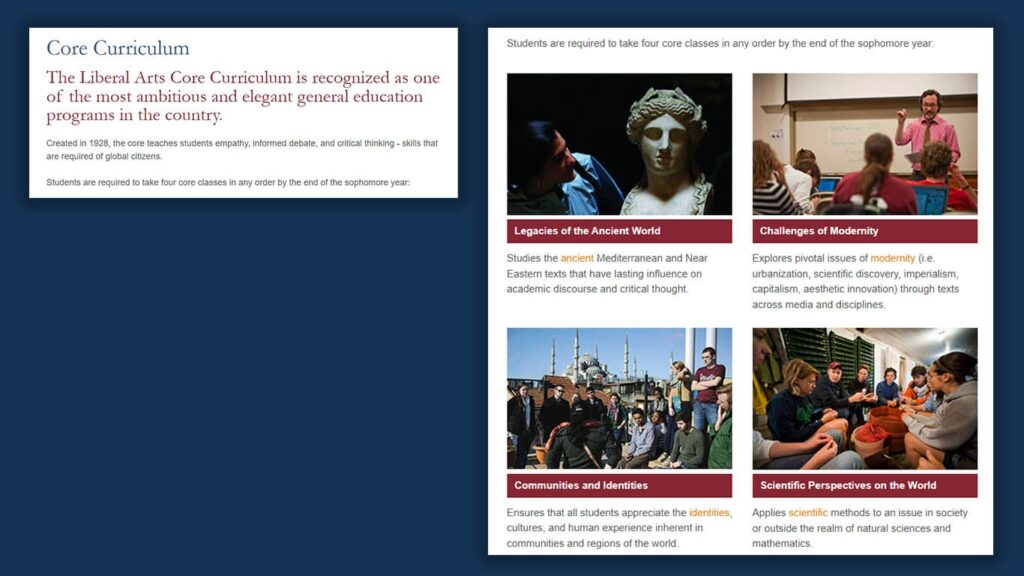
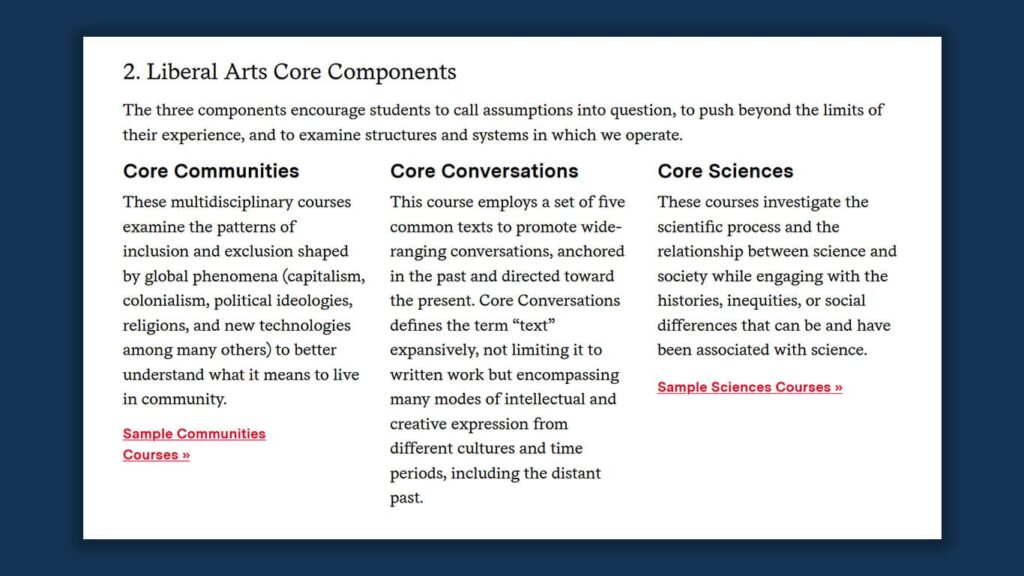
Comic examples aside, I would argue that the changes to the core curriculum at Colgate reflect that same move toward intellectual homogeneity that I witnessed as well, as I can see evidence of this transformation everywhere in North America (and beyond).
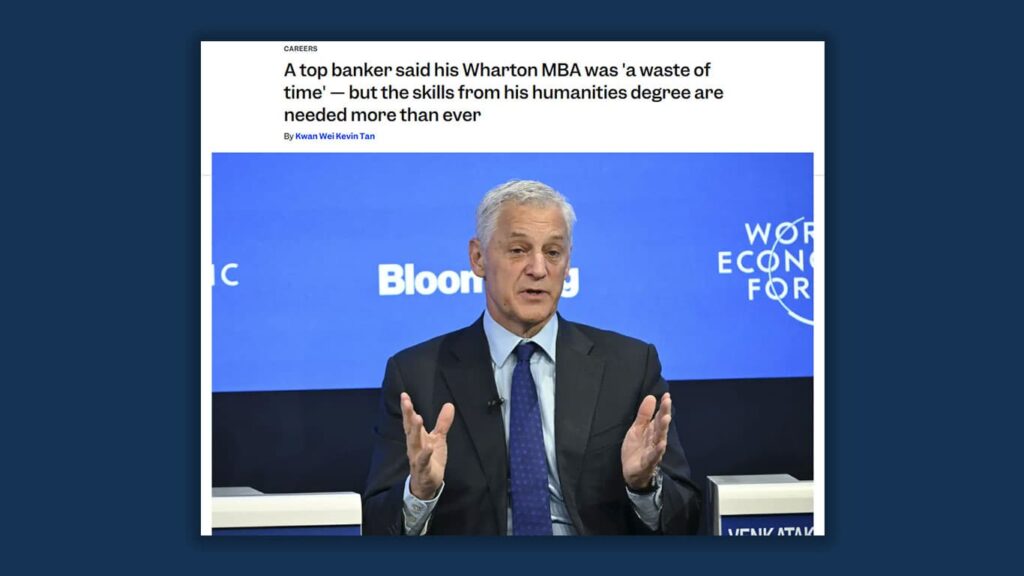
As such, it is getting ever more difficult to argue that universities are a place to go to learn how to think. While Bill Winters might have learned to think at Colgate in 1983 (if so, he was obviously way more mature as an undergrad than I was, but I suppose that such people exist), today I would argue that students there, and at countless other universities, are much more likely to learn a particular way of viewing the world. That’s not thinking. That’s group-thinking. It’s following.
In the end, I don’t think liberal arts programs have ever been the bastions of critical thinking and free thought that they claim to be. Rather than being intellectually curious, most 18-22 year-olds are extremely intent on finding “their group,” and therefore, have a strong incentive while they are at university to follow whatever their group thinks than to want to think independently.
However, independence of thought becomes even harder to achieve in such an environment when universities are intent on producing intellectual homogeneity.
So, no, that article doesn’t convince me. If being able to think is a key skill for success in the AI age, then you are by no means guaranteed to be able to develop that skill in a liberal arts program given the homogenous trajectory that many are now on (there might be exceptions somewhere in the world, but I wouldn’t look to North America for that).
Or, to put it differently, if you are in a liberal arts program like the type I have discussed above and you don’t have serious questions about what you are being taught (and why), then you are not developing that important skill.
Thank you for sending this article, Google, but it didn’t convince me.


Ha! Gender Lady and Foucault Guy, yes they certainly dominate in our history department, but fortunately, I’m safely tucked away in Asian Studies away from them. I may very well LOOK like Gender Lady, but actually I’m just interested in being left alone to read Vietnamese court chronicles and Thai fairytales. Everyone else seems to be teaching that one particular view of the world, when I persist in asking students questions that show up contradictions in their unquestioned beliefs “When does colonialism start?” “Are current Western ideas about moral behaviour universal?” “Should genetic ancestry determine people’s cultural behaviours?” etc. Looking like Gender Lady protects me from the scrutiny of others who would purse their lips at the discussions engendered by such questions.
I must confess that in recent years I have started to think that humanities departments (in the Anglophone world in particular) deserve to be cut simply for having become so ideologically fixated and intellectually narrow. I have even begun to experience a kind of perverse pleasure in watching the paring back of such institutions and the associated outrage, even though cuts to humanities are likely to adversely affect my ability to sit around and read Vietnamese court chronicles and Thai fairytales over the long term.
Thank you, กัดริ, for these comments!!
Yes, that “perverse pleasure”! I definitely experience it too.
And another thing I’ve noticed is that so much scholarship has gotten so dark. I see many people studying genocide, mass killings, sexual violence, and the trauma of all of those things, etc.
I look back and think, geez, I wrote a dissertation about poetry that people wrote because they were happy and excited. . . What is up with people today?
The illiberal promotion of “a specific critical perspective”on how power works in society” has become the norm in so-called “liberal” society – certainly throughout the English speaking world. Frustration with this outlook brought about radical political change in the United States. Competing extremisms rule the moment. Critical thinking comes when you seek out difficult challenging ideas and see what is assimilable and what isn’t. You have to listen to and try to understand people and ideas you don’t agree with. I guess I understand better why you are lying low on another continent.
Thanks for the comment, Tây Bụi. “Lying low” I think implies waiting for something to pass. I don’t see how the current state of things is going to pass and make way for something better, at least not within the core of academia. While the Anglo world is fixated on indoctrinating people, much of the rest of the world is crazy about rising in the global university rankings, which means producing as much (inevitably superficial – because no one can produce at the expected levels) scholarship as possible. And all of this while staring like a deer in the headlights at the AI tsunami coming straight at them.
I’m always more optimistic and hopeful about things at the edge of official academia, and that’s what we also always try to encourage with Engaging With Vietnam, that is, bringing together active and productive people in academia with “amateurs” who do interesting work. We did a couple of “boutique” conferences recently with invited participants, and that went very well. So, the show goes on, it’s just over there under the side tent (with the free bia hoi and grilled squid), not on the main stage (with its high ticket prices and expensive generic refreshments). So, if there’s any chance that you’ll be in Hanoi in December, the bia hoi and grilled squid are on us!! 🙂
So, um, maybe the UH political science department was a bit ahead of the curve. In the late 1990s, the department had Gender Lady, Foucault Guy, plus other critical theorists, all of whom I successfully avoided. I took one course with 1970s Dude. I don’t recall anyone doing anything truly empirical, and the statistics course that I took was a disaster. I learned more political science as an undergrad. This is why you saw me in so many of your courses — I needed and wanted to get up to speed on Southeast Asian stuff.
True story: I took the course with 1970s Dude in my first semester. One night he kept mentioning “Foucault” this and “Foucault” that, none of which made any sense to me. I finally blurted out “You mean the guy with the pendulum?” and got a lot of odd looks. The only Foucault I knew of at the time was Leon Foucault, the French physicist who demonstrated the Earth’s rotation with a large pendulum.
As for core curricula at smaller, mid- and low-tier universities in the USA, I see very little of value. The foremost design principle seems to be job security for faculty in departments that have few to no undergraduate students in the majors they offer (philosophy, religious studies, English lit/composition, art, and yes, history).
Haha, yea, you’re right. I think in the 1990s, a history student had to add Foucault Guy or Gender Lady from political science as an outside member to bring in those approaches.