
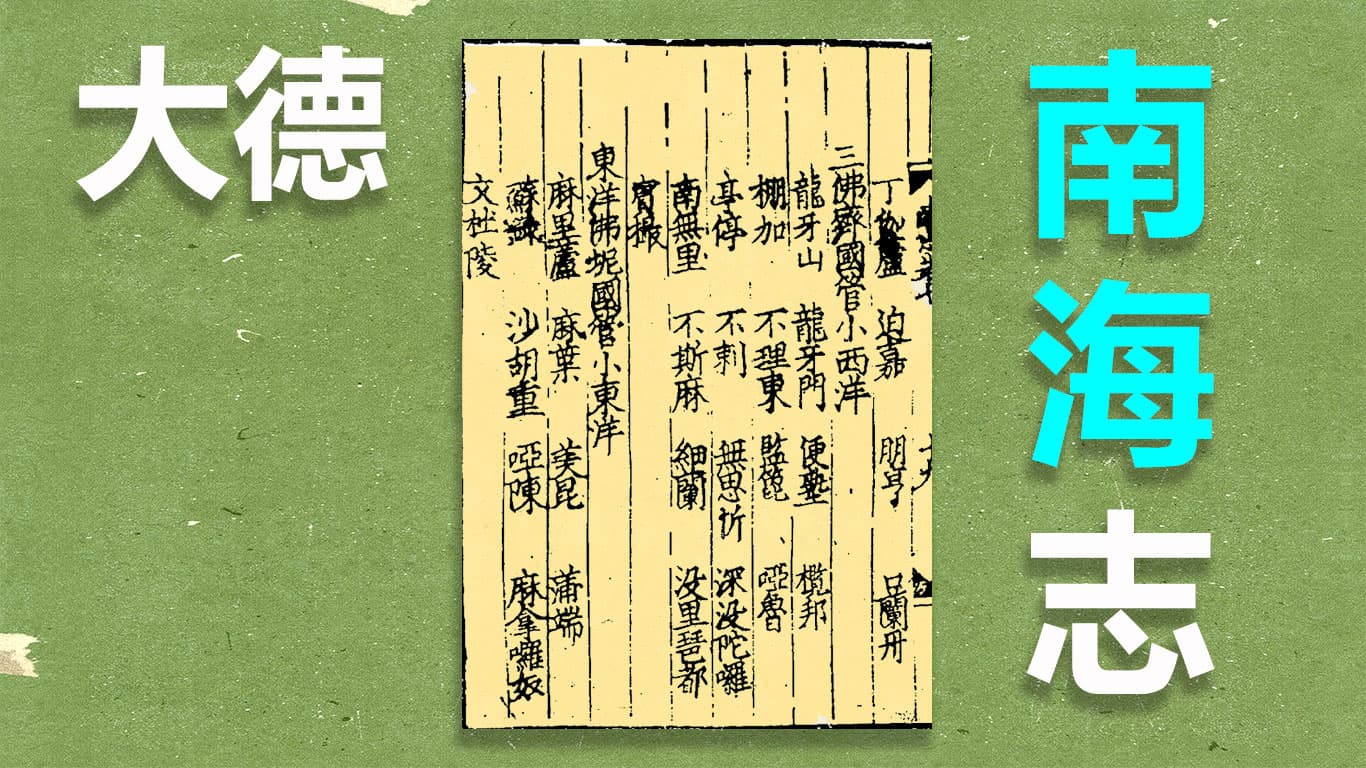
The Gazetteer of the Southern Seas during the Dade Era (Dade Nanhai zhi 大德南海志), also known simply as the Gazetteer of the Southern Seas (Nanhai zhi 南海志) is a Yuan-dynasty local gazetteer for the Guangzhou. It is the earliest surviving printed gazetteer for Guangzhou/Guangdong and an important early Chinese source on maritime trade with Southeast Asia, the Indian Ocean, and beyond.
Compiled primarily by Chen Dazhen 陈大震, it was completed and first printed in 1304, the 8th year of the Dade era. Hence the name.
Unfortunately, today only a portion of that text survives. Fortunately, part of that portion provides a fascinating perspective of what certain Chinese knew about the maritime world of Southeast Asia at that time, and more particularly, how they conceptualized that world.
While scholars have used this work in their writings, I don’t think it has ever been translated. In fact, there is not much to translate, but like I said, the information about maritime Southeast Asia, which I have translated below, is very interesting.
[7/17a] 舶貨 (諸蕃國附)
[7/17a] Shipborne Goods (Appended list of the barbarian kingdoms)
「貨通獅子國」,昌黎嘗有是詩矣。山海為天地寶藏,珍貨從出,有中國之所無。風化既通,梯航交集。以此之有,易彼之無,古人貿通之良法也。廣為蕃舶湊集之所,寶貨叢聚,實為外府。島夷諸國,名不可殫,前志所載者四十餘。聖朝奄有四海,盡日月出入之地,無不奉珍效貢,稽顙稱臣。故海人山獸之奇,龍珠犀貝之異,莫不充儲於內府,畜玩於上林,其來者視昔有加焉。而珍貨之盛,亦倍於前志 [7/17b] 之所書者。今錄其可名之國,附于舶貨之後。
“Goods are traded with the Lion Kingdom”—Changli [Han Yu 韓 愈 (768-824)] once had such a poem.
Mountains and seas are Heaven and Earth’s treasure-houses; rare commodities come forth from them, including things that China the Middle Kingdom not possess. Once customs and moral influence have become connected, shipping routes and sea-lanes converge and gather. Taking what one has to exchange for what the other lacks—this was the excellent method of trade and exchange used by the ancients.
Guang[zhou] is the place where barbarian merchant ships congregate; precious goods collect there in profusion, truly forming an “outer treasury.” As for the island-barbarian kingdoms, their names cannot be exhausted; those recorded in the earlier gazetteer were a little over forty.
Now that the Sacred Dynasty has comprehensively possessed the Four Seas—every place reached by the sun and moon in their rising and setting—there is none that does not present rare treasures as tribute, kowtow and touch the forehead to the ground, and call itself a subject. Therefore, the marvels of sea peoples and mountain beasts, the rarities of dragon pearls, rhinoceros horn, and shell treasures—all of these fill the stores of the inner treasury, and are kept for enjoyment in the imperial parks. What comes in now surpasses what came in former times.
And the abundance of precious goods is likewise more than double what was written in [7/17b] the earlier gazetteer. I now record those kingdoms whose names can be set down, and append them after the section on shipborne goods.
寶物
象牙,犀角,鶴頂,真珠,珊瑚,碧甸子,翠毛,龜筒,玳瑁。
Precious goods:
Ivory; rhinoceros horn; crowned crane; pearls; coral; bidianzi [a blue-green precious stone/bead]; kingfisher feathers; turtle shell [tortoiseshell plates]; hawksbill turtle shell.
布疋
白番布,花番布,草布,剪絨單,剪毛單。
Textiles:
white barbarian cloth; patterned/flowered barbarian cloth; coarse cloth; cut-pile velvet blanket; shorn-wool blanket.
香貨
沉香,速香,黃熟香,打拍香,暗八香,占城,麄熟,烏香, [7/18a] 奇楠木,降香,檀香,戎香,薔薇水,乳香,金顏香。
Aromatics:
agarwood [chenxiang]; “quick incense” [suxiang, a grade of agarwood]; “yellow ripened incense” [huang shuxiang]; dapai incense; anba incense; Zhancheng [Champa]; “coarse ripened incense” [cu shu(xiang)]; “black incense” [wuxiang]; [7/18a] kynam wood [high-grade agarwood]; jiangxiang [dalbergia-type incense wood]; sandalwood; jiexiang; rosewater; frankincense; “golden-face incense” (jinyanxiang).
藥物
腦子,阿魏,沒藥,胡椒,丁香,肉子豆蔻,白豆蔻,豆蔻花,烏爹泥,茴香,硫黃,血竭,木香,蓽撥,木蘭皮,番白芷,雄黃,蘇合油,蓽澄茄。
Medicinals:
borneol [camphor crystals]; asafoetida; myrrh; black pepper; cloves; nutmeg; white cardamom; cardamom flowers; black cutch; fennel; sulfur; dragon’s blood resin; costus root; long pepper; magnolia bark; barbarian angelica; realgar; orpiment; storax oil; cubeb [tailed pepper].
諸木
蘇木,射木,烏木,紅柴。
Woods:
sappanwood; she-wood; ebony; redwood/firewood.
皮貨
[7/18b] 沙魚皮,皮席,皮枕頭,七鱗皮。
Leather/hide goods:
[7/18b] sharkskin; hide/leather matting; leather pillows; qilin pi [“seven-scale hide”].
牛蹄角
白牛蹄,白牛角。
Cattle hoof & horn:
white cattle hooves; white cattle horns.
雜物
黃蠟,風油子,紫梗,磨末,草珠,花白紙,藤席,藤棒,𧴩子,孔雀毛,大青,鸚鵡螺殼,巴淡子。
Miscellaneous goods:
yellow wax; fengyouzi [“wind-oil seeds”]; zigeng [“purple stalks”]; momo [“ground powder”]; caozhu [“grass beads”]; flowered/white paper; rattan mats; rattan canes; bazi; peacock feathers; woad; nautilus shells; badanzi.
諸蕃國
The various barbarian kingdoms.
交趾國管:團山,吉柴。
The kingdom of Jiaozhi oversees: Tuanshan, Jichai
[7/19a] 占城國管:
坭越,烏里,舊州,新州,古望,民瞳矓,賓瞳矓。
[7/19a] The Kingdom of Zhancheng [Champa] oversees: Niyue, Wuli, Jiuzhou [Old Region], Xinzhou [New Region], Guwang, Mintonglong, Bintonglong [Panduranga]
真臘國管:
真里富,登流眉,蒲甘,茸里。
The Kingdom of Zhenla oversees: Zhenlifu, Denglumei, Pugan [Bagan], Rongli
羅斛國。
The Kingdom of Luohu [Lavo, Lopburi]
暹國管:
上水速孤底。
The Kingdom of Xian oversees: Up-river Sugudi [Sukhothai]
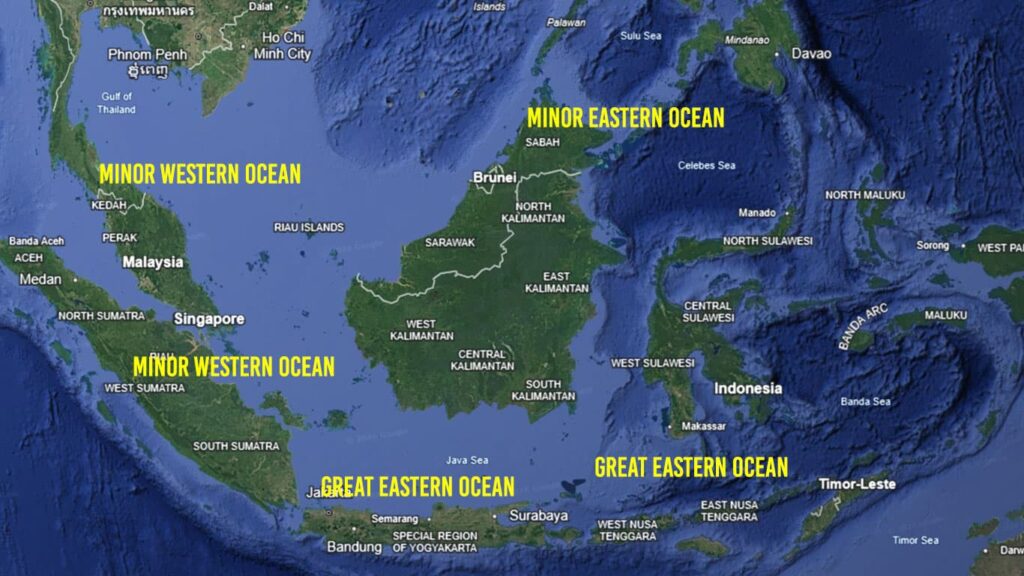
單馬令國管小西洋:
日囉亭,達剌希,崧古囉,凌牙蘇家,沙里,佛囉安,吉蘭丹,晏頭, [7/19b] 丁伽蘆,迫嘉,朋亨,豆蘭丹。 [7/19a]
Danmaling [Tambralinga] oversees the Minor Western Ocean [polities of]: Riluoting, Dalaxi [Jialuoxi/Grahi], Songguluo, Lingyasujia [Lankasuka], Shali, Foluo’an, Jilandan [Kelantan], Yantou, [7/19b] Dingjialu, Pojia, Pengheng [Pahang], Doulandan
三佛齊國管小西洋:
龍牙山,龍牙門,便塾,欖邦,棚加,不理東,監篦,啞魯,亭停,不剌,無思忻,深沒陀羅,南無里,不斯麻,細蘭,沒里琶都,賓撮。
The Kingdom of Sanfoqi oversees the Minor Western Ocean [polities of]: Longyashan [Dragon Tooth Mountain], Longyamen [Dragon Tooth Gate], Bienshu, Lanbang, Pengjia [Bangka], Bulidong, Jianbi [Jambi], Yalu, Tingting, Bula, Wusixin, Shenmeituoluo, Nanmuli [Lamuri], Busima, Xilan [Ceylon], Meilipadu, Binzuo
東洋佛坭國管小東洋:
麻里蘆,麻葉,美昆,蒲端,蘇錄,沙胡重,啞陳,麻拿囉奴,文杜陵。
The Kingdom of Foni [Boni, western Borneo] of the Eastern Ocean oversees the Minor Eastern Ocean [polities of]: Malilu, Maye, Meikun, Puduan [Butuan], Sulu [Sulu], Shahuzhong, Yachen, Manaluonu, Wenduling
[7/20a] 單重布囉國管大東洋:
論杜,三啞思,沙囉溝,塔不辛地,沙棚溝,塗離,遍奴忻,勿里心,王琶華,都蘆辛,囉愇,西夷塗,質黎,故梅,訖丁銀,呼蘆漫頭,琶設,故提,頻底賢,孟嘉失,烏譚麻,蘇華公,文魯古,盟崖,盤檀。
[7/20a] Danzhong Buluo [Tanjung Pulau] oversees the Great Eastern Ocean [polities of]: Lundu, Sanyasi, Shaluogou, Tabuxindi, Shapenggou, Tuli, Biannuxin, Wulixin, Wangpahua, Duluxin, Luowei, Xiyitu, Zhili, Gumei, Qidingyin, Hulumantou, Pashe, Guti, Pindixian, Mengjiashi, Wutanma, Suhuagong, Wenlugu [Maluku], Mengya, Pantan
闍婆國管大東洋:
孫絛,陀雜,白花灣,淡墨,熙寧,[口/羅]心,重伽蘆,不直干, [7/20b] 陀達,蒲盤,布提,不者囉干,打工,琶離,故鸞,火山,地漫。
Shepo oversees the Great Eastern Ocean [polities of]: Suntao, Tuoza, Baihuawan, Danmo, Xining, Luoxin, Zhongjialu [on Java], Buzhigan, [7/20b] Tuoda, Pupan, Buti, Buzheluogan, Dagong, Pali [Bali], Guluan, Huoshan, Diman
南毗馬八兒國:
細藍,伽一,勿里法丹,差里野括,撥的姪,古打林。
Nanpi Maba’er [Malabar] Kingdom: Xilan, Jiayi, Wulifadan, Chaliyekuo, Bodezhi, Gudalin
大故藍國。差里也國。政期離國。胡荼辣國。禧里弗丹。賓陀蘭納。迫加魯。盟哥魯。條𡋥。靼拿。 [7/21a] 闊里株思。加剌都。拔肥離。塗拂。毗沙弗丹。啞靼。鵬茄囉。記施。麻囉華。弼施囉。麻加里。白達。層拔。贍思。弼琶囉。勿斯離。勿拔。蘆眉。甕蠻。弗藍。黑加魯。默茄。茶弼沙。吉慈尼。
Dagulanguo, Chaliyeguo, Zhengqiliguo, Hutalaguo, Xilifudan, Bintuolanna, Pojialu, Menggelu, Tiaocat, Dana, [7/21a] Kuolizhusi, Jialadu, Bafeili, Tufu, Pishafudan, Yada, Pengqieluo, Jishi, Malohua, Bishiluo, Majiali, Baida, Cengba, Shansi, Bipaluo, Wusili, Wuba, Lumei, Wengman, Fulan, Heijialu, Mojia, Chabisha, Jicini
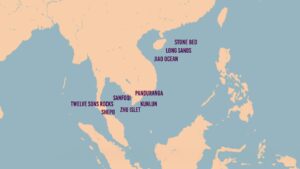
1) The 1225 Zhufan zhi mentions a list of Sanfoqi’s dependencies that extend down the eastern coast of the Malay Peninsula and up the eastern coast of the island of Sumatra, and that list includes Tambralinga and Foluo’an on the eastern coast of the Malay Peninsula.
The Dao Yi zazhi, compiled in the second half of the thirteenth century, indicates that the “lord of the land” of Foluo’an was appointed by Sanfoqi, and it probably originally noted that the “lord of the land” of Tambralinga was appointed by Sanfoqi as well.
We can see this from the following information that it records:
- “Bintonglong is a dependency [li 隸] of Zhancheng. Zhancheng selects a person to serve as the lord of the land [dizhu 地主].”
- “Dengliumei is under the jurisdiction of Zhenla. [The King of Zhenla] selects a person to serve as lord of the land.”
- [Tambralinga] “There is no monarch; there is only a lord of the land.”
- [Foluo’an] “It has a lord of the land, who is also dispatched from Sanfoqi.”
This final statement is important as it says that the lord of the land of Foluo’an “is also dispatched from Sanfoqi” (亦係三佛齊差來), however there is no previous mention of Sanfoqi dispatching a lord of the land to anyplace.
That said, given that the passage on Tambralinga says that there is no monarch, only a lord of the land, it is logical to assume that in an original text it probably indicated that this lord of the land was dispatched from Sanfoqi. Further, there is inscriptional evidence of Cambodia appointing an official in this area.
This being the case, when the Dade Nanhai zhi describes a world in which Tambralinga oversees the eastern side of the Malay Peninsula and Sanfoqi oversees the eastern side of the island of Sumatra, there are a couple of ways that this can be understood.
It could be the case that all of that area was still under Sanfoqi’s influence (i.e., half indirectly through its official at Tambralinga), or it could indicate that a rivalry had emerged.
2) A particularly interesting aspect of this text is that it demonstrates expanded knowledge about the eastern half of Southeast Asia. In the 1225 Zhufan zhi, island Java and places to its east are first mentioned, but only briefly.
While we still do not have details about places in that part of the region in this text, its division of the “Eastern Ocean” into great and minor parts under the authority or influence of different polities is fascinating, and gives some possible sense of the maritime politics of the region.
The “Shepo” that is mentioned as overseeing one part of the Great Eastern Ocean is likely the “Great Shepo” on the island of Java that is mentioned in passing in the 1225 Zhufan zhi in a section on a place called “Sujitan” and which is discussed in a bit more detail in the Dao Yi zazhi.
The Zhufan zhi also mentions a place called Danrong Wuluo 丹戎武囉 which is clearly the Danzhong Buluo 單重布囉 [Tanjung Pulau] in this text that oversees another part of the Great Eastern Ocean.
I am aware that there are scholars who think this might have been located on the southwestern side of Kalimantan. I doubt that is the case.
The places that Shepo oversees in this text appear to be in the area around the island of Java and Bali in the east. My guess would be that Tanjung Pulau was probably someplace to the east of there which had control over places in what is now eastern Indonesian like Maluku.
If I were to guess, I would guess Sulawesi, the homeland of the great mariners, the Bugis.
As such, my guess would be that this division of oceans has probably more to do with political power than geography. Sanfoqi (Kampuchea) either controlled all the seas in the western half of Southeast Asia at this time, or was in a rivalry for control of those seas with a former vassal.
In the eastern half of Southeast Asia, I would guess that Java (Singhasari and then Majapahit), perhaps Gowa on Sulawesi, and Brunei on Borneo would be the best candidates for controlling maritime trade in that region.
Finally, I put the names that we find in the section on “Sujitan” in the Zhufan zhi next to the names that we find in the lists of polities in the Great Eastern Ocean overseen by Shepo and Tanjung Pulau to see if they matched.
Some did. The characters differed, but the sounds were the same. See the matches below in blue and green. The one in yellow (牛論 = 故鸞) is a guess. As can be seen, the matches are primarily with the places that Shepo oversaw. This makes sense as the information in the Zhufan zhi appears to have been mainly about the area of the island of Java.
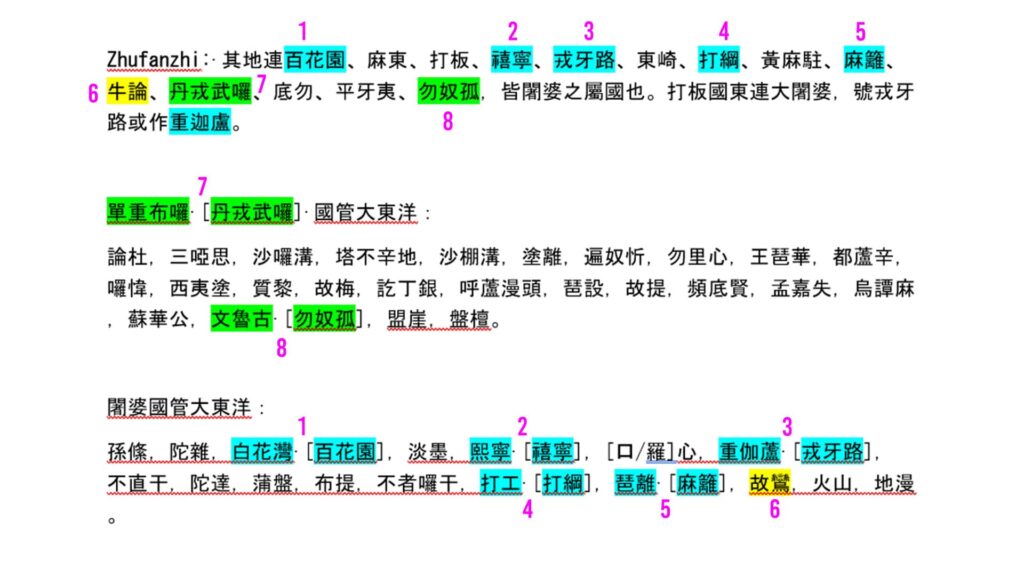
1) Baihuayuan 百花園 – Baihuawan 白花灣
2) Xining 禧寧 – Xining 熙寧
3) Rongyalu 戎牙路 – Zhongjialu 重伽蘆
4) Dagang 打綱 – Dagong 打工
5) Mali 麻籬 – Bali 琶離
6) Niulun 牛論 – Guwan 故鸞
7) Danrongwuluo 丹戎武囉 – Danzhong Buluo 單重布囉
8) Wunugu 勿奴孤 – Wenlugu 文魯古
Re
東洋佛坭國管小東洋:
麻里蘆,麻葉,美昆,蒲端,蘇錄,沙胡重,啞陳,麻拿囉奴,文杜陵。
From Preliminary Thoughts on Mayi and Moyi in Pre-Modern Chinese Records by Johannes L. Kurz said:
Carrie C. Brown: list of places in the Nanhai zhi with Late Middle Chinese and Cantonese transcriptions:
• 麻里蘆 Ma-li-lu; Ma-lei-lo Manila
• 麻葉 Ma-i; Ma-ip Mindoro/Luzon
• 美昆 Mei-kun; Mei-kwan
• 蒲端 P’u-tuan; Po-tuen Paitan NE Borneo
• 蘇錄 Su-lu; So-luk Sulu
• 沙胡重 Sha-hu-chung; Sha-oo-chung Maludu Bay/Serudong river E. Sabah
• 啞陳 Ya-chen; A-chan River Igan in Sarawak
• 麻拿囉奴 Ma-na-lo-nu; Ma-na-lòh-no Malanau people Sarawak
• 文杜陵 Wên-tu-ling; Man-tô-ling Bintulu (Brown 1978: 49-50.)
And “Designations of places in pre-modern Chinese sources often can only be interpreted, but rarely exactly determined. The Gudai nanhai diming huishi 古代南海地名匯釋, a work on place names in Southeast Asia, for example, presents the following identifications for the terms listed in the Nanhai zhi:
• 麻里蘆 Malilu Manila
• 麻葉 Maye Mindoro
美昆 Meikun Manukan (N. Zamboanga, Mindanao)
• 蒲端 Puduan Butuan
• 蘇錄 Sulu Sulu
• 沙胡重 Shahuzhong Siocon (W. Zamboanga, Mindanao)
• 啞陳 Yachen Oton (on southern Panay Island)
• 麻拿囉奴 Manaluonu Maranau people (Sulu and/or Mindanao)
文杜陵 Wenduling Mindanao/Mindoro
***
I’m not a historian or anything, but I think the list here follows a north-south direction…
Some of the placenames here have counterparts in the Shunfeng Xiangsong.
麻里蘆 is Maynila, and 麻葉 is Mait [(Mindoro) There is a Moye-yang/Mait Ocean referenced as Mindoro Strait]. 美昆 sounds to me like a rendering for Vigan in Ilocos [it’s been rendered in various characters in other sources, but the north-south direction means we have to look in the Visayas area]. 蒲端 and 蘇錄 are obviously Butuan and Sulu. Past these are possibly areas in Borneo island.
沙胡重 this one screams Serudong/Seludong. A similar-sounding toponym was found in the Nagarakertagama, ‘Saludhung’. 啞陳. AIs said this can’t possibly be Ogtong. 麻拿囉奴 and 文杜陵 are all possibly in Sarawak area…
Per Carmelea Ang See’s SONG, MING, AND OTHER CHINESE SOURCES ON PHILIPPINES-CHINA RELATIONS, Vigan had been rendered as: 美岸 Bi-Gan in “East West Ocean”; 密雁 Bit-ngan in “Favorable Winds”; and 密岸 Bit An in “Southern Directions”.
Could this 美昆 be another rendering for Vigan too ???
Again, I need to go through all the sources before I can say, but yes, 美昆 phonetically makes more sense as Vigan.
The other thing I would say is that, in general, the sources record a much smaller section of the region than people have previously imagined. This is clear to me for places to the west, and it’s probably the same here. For instance, Malilu, Maye, Meikun, Puduan and Sulu could all be on the route from Luzon to Palawan. I have a sense in the back of my head that it’s just a coincidence that Puduan sounds like Butuan, because Butuan is too far away from everything to be so present in early sources.
For now, however, I’m still trying to put the sources on here, and then I’ll try to take a closer look.