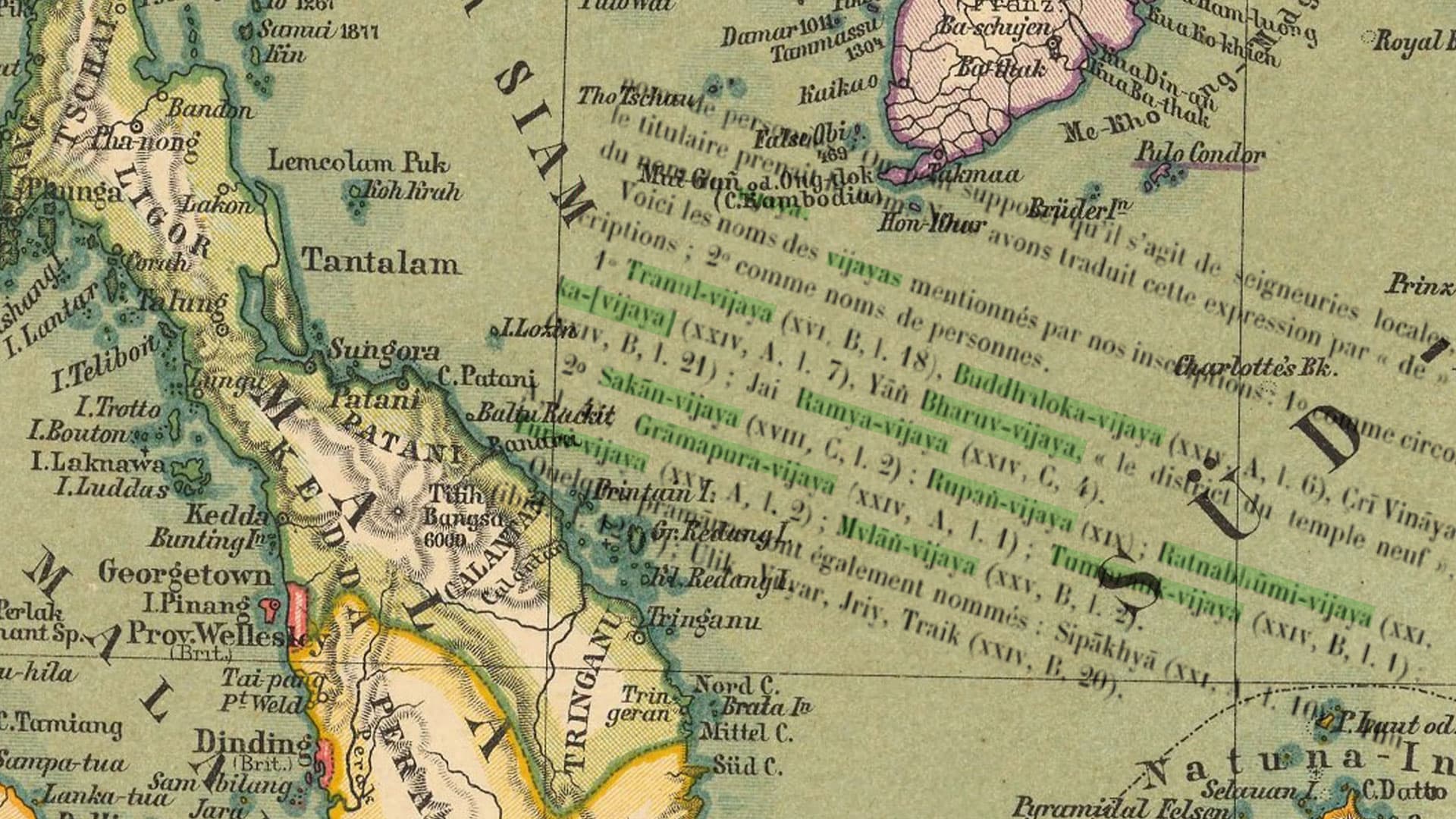
I can see everything clearly now. It all falls into place. It all makes sense. . .
Over the past couple of years, I have provided extensive evidence to overturn the idea that there was ever a maritime kingdom called “Srivijaya.”
This supposed kingdom was “discovered” by French scholar George Cœdès in 1918.
Cœdès made an argument for the existence of this kingdom by bringing together various historical sources, all of which he thought were referring to the same place, a place that he believed was called “Srivijaya,” and was located on the island of Sumatra around the area where Palembang is today.
Over the past couple of years, I have looked at Chinese, Cambodian, Siamese, and Okinawan (Ryukyuan) sources and have found that they do not support the idea that there was ever a kingdom called “Srivijaya” on the island of Sumatra, but instead, demonstrate that information in some of these sources that historians have used to write about “Srivijaya” is actually about “Kambuja,” that is, Angkor/Cambodia.
In addition to the above sources, historians have also looked at other sources, such as accounts in Arabic and inscriptions from southern India. Over the past week or so, I have begun to look at those materials and I can already see 1) where previous scholars have gone wrong, and 2) how these materials fit PERFECTLY with the argument that I have been making.
While I still stand by the statement that I previously made that “no kingdom called Srivijaya ever existed” [2025: I think that no kingdom called Srivijaya at Palembang ever existed], and while I strongly believe that the name “Srivijaya” that appears in some Old Malay inscriptions from the 680s that have been found in southern Sumatra is the name of a ruler and not of a kingdom [2025: No, I have been dissuaded of that. I think it means something like “the royal district” and that it referred to a place in the Songkhla area], there is a term in inscriptions from the Chola kingdom in India – Srivishaya (and perhaps also Srivijaya – not sure yet [2025: Still need to go back and check, but I think both variants are in the Chola inscriptions]), as well as a “Srivijaya” in an inscription from the Malay Peninsula in the area of what is now southern Thailand which. . . I strongly believe point to the presence of Chamic peoples in the area of what is now Songkhla/Patthalung/Kedah roughly 1,000 years ago [2025: Can’t remember what I was arguing. Yes, I think there was a strong Chamic link across that area, but why did I think the name relates? Is it because “shrivishaya/shrivijaya” also appears in Cham inscriptions as an administrative term?].
These Chamic peoples probably did not have a kingdom called “Srivishaya/Srivijaya.” However, an important part of the overland trade empire that they worked through, a place which foreigners referred to by various names, from Yava to Zabeg, was likely also called “Srivishaya/Srivijaya.”
Again this has nothing to do with the “Srivijaya” in a few Old Malay inscriptions in southern Sumatra from the 680s [2025: Not sure why I thought that, as I think it does relate. I think those early inscriptions probably date from a time when the trading center around Songkhla sought to extend its influence down the Malay Peninsula towards Java].
Further, it is completely clear to me that roughly 1,000 years ago, these Chamic peoples who controlled the trans-peninsular trade route, and perhaps who referred to the “royal district” in Songkhla/Sating Pra as “Srivishaya/Srivijaya,” also interfered in Angkor’s trade with the outside world, and that the “Chola invasion of Srivijaya” was an attack on the trans-peninsular trade hub between Kedah and Songkhla/Sating Pra that was carried out to a significant extent by Chamic peoples [2025: I think I was saying this because there is a lot of evidence of Cham peoples involved in trade during the Song period. In particular, Chinese sources frequently mention the “surname” “Pu.” Many scholars have argued that this is an abbreviation of the Arabic “Abu.” I completely disagree and believe that it is a full transcription of the Cham honorific, “Po.”]
As with the previous topics that I have covered, there are many details that have to be discussed and ideas that have to be debunked. That’s going to take time, and I’m busy with a lot of things right now, so it will take time to get that information out, but it does require a new series, so get ready for “Srivijaya 3.0”!!!
Next post: Srivijaya 3.0 (02): The “One Country – One King” Problem in Premodern Southeast Asian History.


I think the cholas attacked angkor
The most detailed source of information on the campaign is the Tamil stele of Rajendra Chola I.[2] The stele states:
(Who) having despatched many ships in the midst of the rolling sea and having caught Sangrāma-vijayōttunga-varman, the king of Kadāram, together with the elephants in his glorious army, (took) the large heap of treasures, which (that king) had rightfully accumulated; (captured) with noise the (arch called) Vidhyādharatorana at the “war gate” of his extensive city, Śrī Vijaya with the “jewelled wicket-gate” adorned with great splendour and the “gate of large jewels”; Paṇṇai with water in its bathing ghats; the ancient Malaiyūr with the strong mountain for its rampart; Māyuriḍingam, surrounded by the deep sea (as) by a moat; Ilangāśōka (i.e. Lankāśōka) undaunted in fierce battles; Māpappālam having abundant (deep) water as defence; Mēviḷimbangam having fine walls as defence; Vaḷaippandūru having Viḷappandūru (?); Talaittakkōlam praised by great men (versed in) the sciences; Mādamālingam, firm in great and fierce battles; Ilāmuridēśam, whose fierce strength rose in war; Mānakkavāram, in whose extensive flower gardens honey was collecting; and Kadāram, of fierce strength, which was protected by the deep sea[2][3]
they way the source describes the city sounds like angkor with its walls and moats surrounded by water. also the gates were described has being covered with jewels just like angkor was.
Yes!!, you are thinking in the right direction. People have struggled to figure out how to translate the opening passage. This translation here implies that “his extensive” city and “Sri Vijaya” (actually, I think its Srivishaya in the original) are two separate places, but Coedes noted way back in 1918 that all of that opening passage could be modifying “Srivishaya.” So, yes, you are very right, I think, to be looking for a heavily fortified location.
My guess, however, is that the opening part is all referring to something like “the royal district” (Srivishaya), and as we would expect of a royal district, it is protected by gates.
As for Angkor, I don’t think that’s right because there are clear references in Chola inscriptions to “Kamboja” (there are people who receive gifts from Kamboja) I think this is the place which Arab accounts refer to as Zabeg, as they say that the place where the “Maharaja” lived was densely populated with buildings. I think this is in the Songkha/Sathing Phra area.
The post I just wrote here should give a sense of how I see all of these things connecting:
https://leminhkhai.blog/srivijaya-3-0-03-angkor-as-an-international-entrepot/
thank you liam. the issue i have with songkhla /sathing phra region is that there seems to be no archaeological evidence of extensive settlements in the area such as roads, temples and canals etc. has a lidar ever been conducted in the area? i would think that area would be very vulnerable to attack as it is surrounded by both sides by sea on a narrow strip. not a very good position to have a major city.
I would imagine that the main city/royal area would have been where Songkhla is, rather than Sathing Phra for all of the reasons you point out.
There is an archaeologist by the name of Janice Stargardt who did work in Sathing Phra many years ago and definitely found evidence of canals and other things that suggested the importance of the area as a trade center (Satingpra 1 : the environmental and economic archaeology of South Thailand, 1983). However, there doesn’t seem to have been much follow-up work, probably in no small part because historians have been imagining that the main trade route was historically through the Straits of Melaka to “Srivijaya.” Indeed, if I remember correctly there was a big effort in the 1980s (?) to find evidence of “Srivijaya” around Palembang, but not much was found. . .
Meanwhile, there has been very little historical work pointing to the importance of trans-peninsular trade (except for in very early times). So, historians have not provided much of a reason for archaeologists to examine that region.
As for lidar, I don’t think it has been conducted, but again, I don’t think anyone has seen a reason to do that.
maybe it was angkor that disrupted trade between the chamic peoples and the chola and the chola launched an attacked as punishment.
I think that the Song Dynasty sources can give us a good sense of how things happened:
https://leminhkhai.blog/srivijaya-3-0-03-angkor-as-an-international-entrepot/
thanks again
https://www.ultra-unlimited.com/blog/srivijaya-the-lost-kingdom-of-gold
Nice AI images!! Going forward, I think AI images are going to transform how people literally “see” the past.