

I was reading a book that was published in 2022 called The Oxford Handbook of Early Southeast Asia. It contains a chapter on “Srivijaya” by Pierre-Yves Manguin.
In that chapter, there is a section on “The Troubled Eleventh Century and the Shift to Jambi” where Manguin writes that “In the last quarter of the eleventh century, Chinese sources clearly indicate that the political center moved from Palembang to Jambi (Wolters 1966).”
A significant portion of the current orthodox history of “Srivijaya” comes from Chinese sources, but many of the scholars who have produced that history, could not/cannot read those Chinese sources, so they have relied on the works of scholars whom they assume were/are able to read those sources. One of the main such figures is the late historian, O. W. Wolters.
The “Wolters 1966” that Manguin cites to support the idea that the capital of “Srivijaya” shifted from Palembang to Jambi in the eleventh century is the following: Wolters, O. W. (1966) “A note on the capital of Srivijaya during the eleventh century,” in Shin, B., Boisselier, J., and Griswold, A. B. (eds.) Essays offered to G.H. Luce, vol. 1, pp. 225– 239. Ascona: Artibus Asiae (Supplementum 23).
In what follows, we’ll get a taste of Wolters’ scholarship, and the work of some others. The key point to know first is that early scholars working on Southeast Asia came to believe that a place mentioned in Chinese sources called “Sanfoqi” was the same as a place mentioned in some inscriptions, “Srivijaya.”
These scholars also came to believe that Srivijaya/Sanfoqi was located on Sumatra, and based at Palembang. However, the point that Wolters tries to make in this article is that in the eleventh century, the center of Srivijaya/Sanfoqi moved to Jambi, to the north of Palembang. The key historical information for making this point is the inclusion in some Chinese sources of a term, “zhanbei,” that is made in relation to Sanfoqi. This term, Wolters and others, believed was a reference to the placename, Jambi.
I looked up that article, and here is a passage from the first page (I’ve changed the Wade-Giles transcription of Chinese names to Pinyin:
“Not until 1918 was Sanfoqi 三佛齊 identified as the Song writers’ transcription of ‘Srivijaya’, but as early as 1876 Groeneveldt recognised the name ‘Jambi’ in the Songshi’s statement that the king of Sanfoqi ‘is styled Zhanbei 詹卑’. In 1904 Pelliot observed that Zhou Qufei, writing in 1178, stated that in 1079 the kingdom of Sanfoqi sent an envoy of the kingdom of Zhanbei to bring tribute, and Pelliot suggested that in both the Lingwai daida and the Songshi ‘Jambi’ was in fact the name of the country of Sanfoqi. Hirth and Rockhill, writing in 1911, noted that Zhou Qufei mentioned a mission from Jambi in 1088 as well as in 1079, but they did not suggest that this information had a bearing on the inclusion by Zhao Rukyuo in 1225 of Balinfeng 巴林馮, or Palembang, among the dependencies of Sanfoqi; instead, they considered that Jambi became the capital of ‘eastern Sumatra’ after the Javanese conquest in or about 1377.” (225)

Did you get that?
Don’t lie. I know that you didn’t!
Be honest with yourself. You do not understand what Wolters was talking about.
Relax! It’s totally ok.
I’m not going to make fun of you.
Because no, it’s not because Wolters was more erudite than you are, so you don’t need to feel bad about yourself.
And no, it’s not because people in the past wrote in a more “intelligent” way than you/we do now.
And no, it’s not because Wolters was an “expert” and you are not.
No, the reason why you don’t understand what Wolters wrote in that passage is because it DOESN’T MAKE ANY SENSE!!!!!
I am familiar with the texts and authors Wolters mentions, and I can intuit what he is trying to say, but the writing is utterly incoherent, and this applies to EVERYTHING Wolters wrote.
Therefore, I cannot rely on what Wolters wrote to understand the topic of his article. And if I can’t do that, then those of you who do not know the Chinese sources he refers to definitely can’t do that!!
So, you don’t need to pretend, because I know that you don’t know what he was talking about. It’s ok. Let’s try to figure it out together.
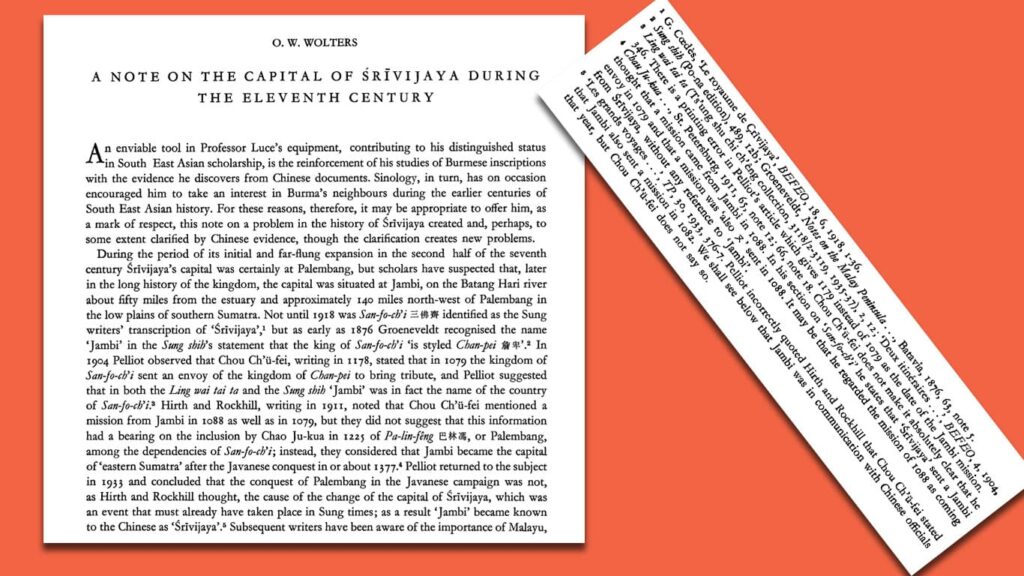
As I said, I am familiar with the sources for this topic, but I still have to follow the footnotes and try to reconstruct what it is that Wolters was trying to say because his writing is complete chaos. However, following the footnotes is when the true tragedy begins. . .
Let’s start with the first sentence cited above: “Not until 1918 was Sanfoqi identified as the Song writers’ transcription of ‘Srivijaya’, but as early as 1876 Groeneveldt recognised the name ‘Jambi’ in the Songshi’s statement that the king of Sanfoqi ‘is styled Zhanbei’.”
This sentence makes no sense to me as the two phrases are about two different topics. . .
In any case, let’s look at his reference to Groeneveldt.
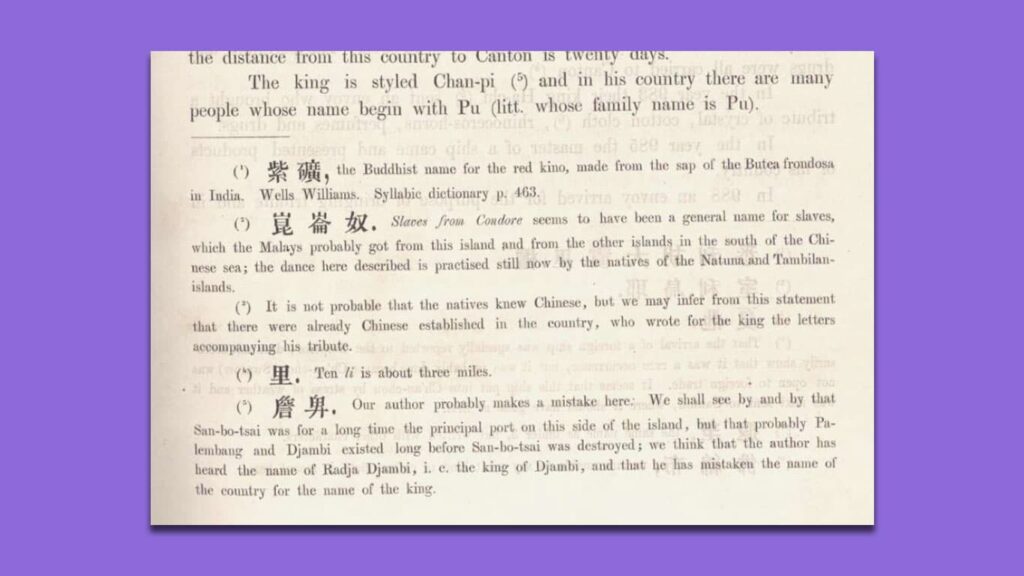
In 1876, Dutch Sinologist W. P. Groeneveldt translated the account of Sanfoqi in the History of the Song (Songshi). In that text, there is a passage that states of Sanfoqi that “its king is called ‘zhanbei’” (其王號詹卑).
Groeneveldt translated this as “The king is styled Zhanbei,” and then stated the following in a footnote:
“Our author probably makes a mistake here. We shall see by and by that San-bo-tsai [Sanfoqi] was for a long time the principal port on this side of the island, but that probably Palembang and Djambi [Jambi] existed long before San-bo-tsai was destroyed; we think that the author has heard the name Radja Djambi [Raja Jambi], i.e. the king of Djambi, and that he has mistaken the name of the country for the king.” (63)
This is what Wolters was referring to when he mentioned Groeneveldt’s work in passing. Wolters implied that Groeneveldt had demonstrated some kind of connection between Sanfoqi and the geographic location of Jambi, however, when we look at what was recorded in the History of the Song and what Groeneveldt actually wrote, we can see that this was not the case.
Groeneveldt saw the passage in the History of the Song that stated that the king of Sanfoqi was called “zhanbei,” and then he dismissed that as a mistake. His logic for doing so was, by our current standards, utterly ridiculous.
Groeneveldt claimed that dynastic historians in China “remembered” the name “Raja Jambi” (a title that does not appear in any Chinese source) but then confused it for the name of a kingdom. This is an absurd claim, and not surprisingly, there is absolutely no historical evidence to support it.
Meanwhile, the way that Wolters made passing reference to Groeneveldt supposedly “recognizing” Jambi in the History of the Song was simply criminal. That’s an example of full-on academic dishonesty.
Rather than providing support for the idea that there was a connection between two places – Sanfoqi and Jambi – this passage in the History of the Song is precisely the opposite. It is evidence that the term “zhanbei” in Song dynasty sources was NOT the geographic location of Jambi, but instead, was the title of a ruler.
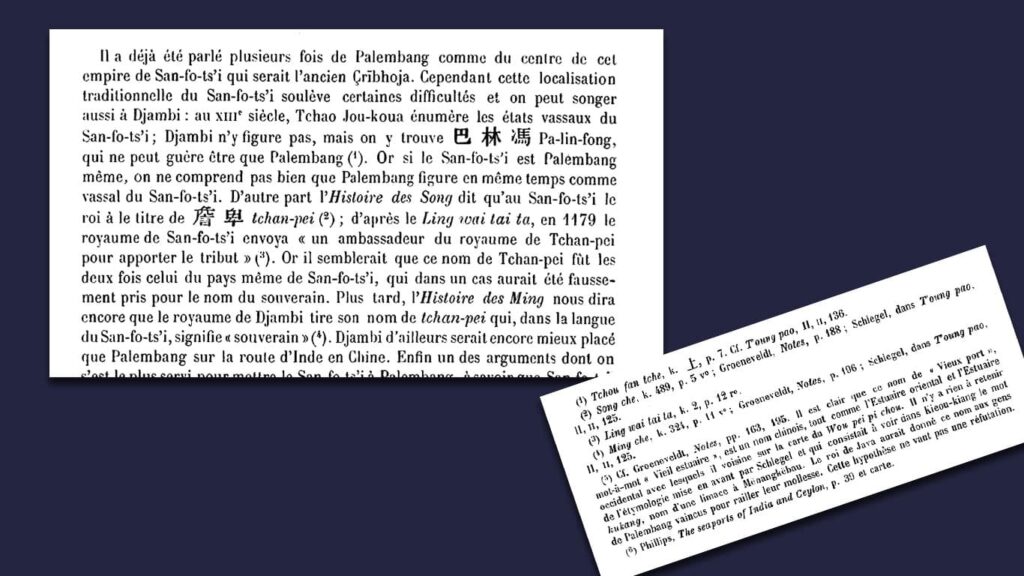
Let us move on to the next statement in Wolter’s article: “Pelliot observed that Zhou Qufei, writing in 1178, stated that in 1079 the kingdom of Sanfoqi sent an envoy of the kingdom of Zhanbei to bring tribute, and Pelliot suggested that in both the Lingwai daida and the Songshi ‘Jambi’ was in fact the name of the country of Sanfoqi.”
This is another confusing sentence. Wolters does not make it clear what the relationship was between Zhou Qufei and the two texts he mentioned. Zhou Qufei wrote a work called the Lingwai daida [Representative Answers about the Area Beyond the Passes], while the Songshi is the official dynastic history of the Song dynasty, the History of the Song.
Here is what Pelliot wrote:
“. . . the History of the Song states that in Sanfoqi, the king holds the title of zhanbei; according to the Lingwai daida, in 1179, the kingdom of Sanfoqi sent “an ambassador from the kingdom of Zhanbei to bring tribute.” Now it would seem that this name of Zhanbei was, in both instances, that of the country of Sanfoqi itself, which in one case would have been mistakenly taken for the name of the sovereign. Later, the History of the Ming will further tell us that the kingdom of Jambi derives its name from zhanbei, which, in the language of Sanfoqi, means “sovereign.” Moreover, Jambi would be even better positioned than Palembang on the route from India to China.” (346)
Ok, so in Zhou Qufei’s Lingwai daida, there is a line that says that “an envoy from the Zhanbei Kingdom was sent to present tribute” (遣詹卑國使來貢). I’ll talk about that below.
Let’s look first though at what Pelliot says about other texts. Unlike Wolters, Pelliot notes that in the History of the Song the king of Sanfoqi “holds the title of zhanbei.” Like Groeneveldt, Pelliot thinks this is a mistake.
Pelliot doesn’t come up with a ludicrous explanation for this mistake, like Groenevedlt did, but he ends up committing a sin of equal seriousness: he makes an inaccurate claim about what an historical text records.
In particular, Pelliot states that “Later, the History of the Ming will further tell us that the kingdom of Jambi derives its name from zhanbei, which, in the language of Sanfoqi, means ‘sovereign.’”
This is completely false!!! In the section on Sanfoqi in the History of the Ming, it states that “subordinates refer to their superior as ‘zhanbei.’ It is also the sovereign” (下稱其上曰詹卑,猶國君也). This is in reference to Sanfoqi, NOT Jambi!!!
There is no “Jambi” here. Instead, this is a similar statement to the one in the earlier History of the Song. Both of these texts make the same point: the ruler of Sanfoqi was called “zhanbei.”
Historical Argumentation
Let us look at the historical evidence mentioned above about this term, “zhanbei,” which Groeneveldt, Pelliot, and Wolters all attempted to associate with the geographical location, Jambi.
1) A section on Sanfoqi in the Lingwai daida states that “an envoy from the Zhanbei Kingdom was sent to present tribute” (遣詹卑國使來貢).
2) The section on Sanfoqi in the History of the Song states that “its king is called ‘zhanbei’” (其王號詹卑).
3) The section on Sanfoqi in the History of the Ming states that “subordinates refer to their superior as ‘zhanbei.’ It is also the sovereign.” (下稱其上曰詹卑,猶國君也)
So, what we see here are two types of information. We see zhanbei as the name of a ruler, and zhanbei in the name of a kingdom.
An historian can go in one of two directions with this information. If the historian thinks that the statements in the Song and Ming histories are correct that the ruler of Sanfoqi was called “zhanbei,” then s/he has to come up with a convincing argument that can explain what the “Zhanbei Kingdom” was.
Alternately, if an historian thinks that the information in the Song and Ming histories is not correct, then s/he has to come up with a convincing argument to demonstrate that point (and this is where Groeneveldt and Pelliot both failed miserably while Wolters avoided discussing the issue entirely – another failure), and ideally to provide some supporting evidence that this “Zhanbei” was actually the Jambi on Sumatra and not some other similarly sounding place name.
Either way, this is the key issue that has to be resolved regarding the supposed relationship between Sanfoqi and Jambi. Because contrary to what Manguin wrote, it is DEFINITELY NOT the case that “Chinese sources clearly indicate that the political center moved from Palembang to Jambi.”
And Wolters 1966 and the sources he cites definitely do not demonstrate that either.
My Own Research
By this point, I have published two articles, a working paper, and numerous blog posts on this issue. What I have concluded, and provided abundant historical evidence to support, is that Sanfoqi was not “Srivijaya,” but instead, “Kambuja.”
One key name for a ruler in the Cambodian world is “somdaech,” a term that can be found in Angkorian inscriptions, and I have made the argument that the way zhanbei was pronounced roughly 1,000 years ago would have been close to “somdaech.”
Another point that I have made regards the sending of tribute to China. Ever since John King Fairbank and Teng Ssu-yu wrote on the “Chinese tributary system” starting in the 1940s, many people have had a rather rigid idea of how foreign relations with the Middle Kingdom were carried out.
The basic idea is that the Chinese would recognize a foreign king and would send an envoy to invest him as king and then after that, the king would send regular tribute to the Chinese court.
The history of Sino-Vietnamese relations follows that “model” pretty well. However, we see something very different when we look at maritime Southeast Asia. For instance, in the case of Sanfoqi during the Song dynasty period, as well as in the early Ming, we can see envoys arrive representing multiple “kings,” some of whom are clearly of different ethnicities, and some of whom clearly are not even “kings.” Most of the time, however, no ruler is mentioned at all.
The Khmer are not a sea-faring people, and Angkor was an inland polity that scholars believe held sway over a “mandala” or “galactic” empire. At the edge of that empire, were ports, like Ha Tien, where I argue the main trade with Kambuja/Sanfoqi took place.
In such a world, and seeing how “flexible” the tribute system was, we can imagine that the tribute delivered from Sanfoqi to China came at times from the ruler at Angkor, but at times from some of its mandala/galactic polities (such as a kingdom called “Shengliu” 生留 mentioned in the section on Sanfoqi in the History of the Song), and at times from rich and powerful merchants trading at Ha Tien.
I have written about this in these two blog posts:
https://leminhkhaiblog.com/here-is-an-example-of-the-problem-with-the-scholarship-on-srivijaya/
https://leminhkhaiblog.com/srivijaya-3-0-03-angkor-as-an-international-entrepot/
In such a context, it would make sense that when tribute was delivered from the “Somdaech’s Kingdom,” that is, from where the Somdaech ruled, that it would be referred to as such, which is why there is a reference in the Lingwai daida to an envoy who delivered tribute from the Zhanbei Kingdom, a term that the Song and Ming histories both say refer to the ruler of Sanfoqi, a place that I have demonstrated and documented in detail was Kambuja, where the rulers were called “somdaech.”
What I have produced is a legitimate historical argument. I don’t ignore or misrepresent information in the historical sources, as Groeneveldt, Pelliot, and Wolters did.
The idea that “In the last quarter of the eleventh century, Chinese sources clearly indicate that the political center moved from Palembang to Jambi (Wolters 1966)” is, like so much of the information in the orthodox story of “Srivijaya” that comes from Chinese sources, not based on a legitimate historical argument.
Further, I have chosen this one small example to make my point, because to address all of the issues concerning the Chinese sources in writings like Manguin’s or Wolters’ or Pelliot’s, etc. would require thousands of pages.
The key point is that this small case here is representative of a much larger problem with the orthodox account of “Srivijaya.”
In reading through The Oxford Handbook of Early Southeast Asia, I was pleased to see the many contributions that archaeologists have made in recent decades, but also so utterly shocked to see the same problematic writings about Chinese sources still getting recycled over and over and over.
Paul Pelliot has long been revered among Southeast Asianists as a great Sinologist who made an important contribution to the study of the region, particularly through this 1904 article that Wolters cited, “Deux itinéraires de Chine en Inde à la fin du VIIIe siècle.”
I have consulted Pelliot’s article many times, and I can say with all honesty that I have learned absolutely nothing from it. Yes, Pelliot eventually became a great Sinologist, but this article was one of his first writings, completed when he was in his twenties.
Sinology is not merely the translation of information in Chinese texts into another language. Instead, Sinology involves developing convincing contextual arguments about how the information in Chinese texts should be understood. That is precisely what the young Pelliot did not achieve in this article (not surprising for a kid in his twenties writing one of his first scholarly works based on difficult sources in a foreign language), and yet it has been cited over and over and over.
And as for Wolters. . .
Finally, as for the idea that Sanfoqi was “Srivijaya” and its capital moved from Palembang to Jambi in the eleventh century. . . there is zero evidence in Chinese sources to support that claim.
![Read more about the article Srivijaya 04: Was Zhenla Cham[ic]?](https://leminhkhaiblog.com/wp-content/uploads/2020/11/9221c-00-fengtuzhi-768x432.jpg)


https://repository.crossasia.org/receive/crossasia_mods_00000319
Working with Song dynasty material I reached a similar conclusion as you did. Wolters is untrustworthy.