In Song dynasty era sources, there is a “surname” that appears in numerous records about tribute missions coming from Southeast Asia (and beyond), and that is “Pu” 蒲. This character appears in the names of envoys from various places.
Over a century ago, there were scholars who proposed that this was the Arabic name “Abu” and that idea is still being followed today (see Li Tana’s 2024 A Maritime Vietnam, for instance). In 2017, Stephen G. Haw did a good job of demolishing this idea in his “Islam in Champa and the Making of Factitious History.”
I must admit, when I first started researching about island Southeast Asia (and before I had read Haw’s article), I tried to get that theory to make sense (and I wrote an early blog post where I tried to get it to work), but the more I looked, the more ridiculous it became.
At the most basic level, it makes absolutely no sense that the name “Abu” would be consistently represented in Chinese as “Pu.” 1) The sound “A” is very easy to produce in Chinese, and 2) I know of no other example in Chinese where the first syllable of a foreign name is dropped.
Haw offers other reasons, based on information in historical sources, for why this theory does not make sense, and then he argues that it is a common Southeast Asian honorific. To quote, he says that:
“Ferrand pointed out long ago that when Pu occurs as the first element of a Southeast Asian name in Chinese transcription, it is very likely to be derived from the common and widespread honorific mPu, Pu, or Po. It is scarcely surprising that many Southeast Asians had names beginning with Pu in Chinese, as this honorific occurs, in similar forms, in more or less every Southeast Asian language.” (9-10)
I agree that this term Pu is not “Abu” and that it is an honorific. However, I do not agree that it was some generalized Southeast Asian term that appeared in the names of people from different places in Southeast Asia who arrived in China to present tribute.
The clearest examples Haw offers are in cases involving Cham people. It is well known that pu/po is a Cham honorific, although as Haw notes, we don’t know much about Cham names 1,000 years ago. Nonetheless, I think that there is an easy way to demonstrate that the Pu that appears in Song era sources is the Cham honorific.
If we look in Song dynasty era sources, we find that the greatest number of Pu’s are recorded in records about Champa. This is followed by Sanfoqi, where in the History of the Song it says that “the people residing in the kingdom are all surnamed Pu” (其國居人多蒲姓).
Understanding that Sanfoqi was Kambuja, this makes complete sense. No, Chinese did not survey the entire population of Kambuja to determine what surname was the most common. Instead, Chinese merchants visited its main port, most likely at Ha Tien, where they found many Cham mariners conducting trade.
That can explain the statement in the History of the Song, and it can also perhaps explain the reason why there are “kampong” along the rivers of Cambodia, and there are islands in the rivers of the Mekong Delta that are called cù lao (pulau), Austronesian terms in and along the rivers of Mon-Khmer territory.
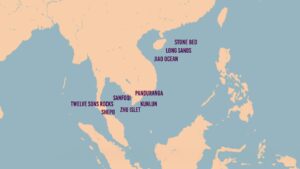
Beyond these two places, the appearance of Pu in the records of other lands is quite sparse. In general, it looks like Cham envoys helped bring some of the initial missions from Shepo (Songkhla area, NOT island Java), Dashi (“Arab world”), and the Chola kingdom. After that it is unclear if they continued to participate, because the records are too sparse.
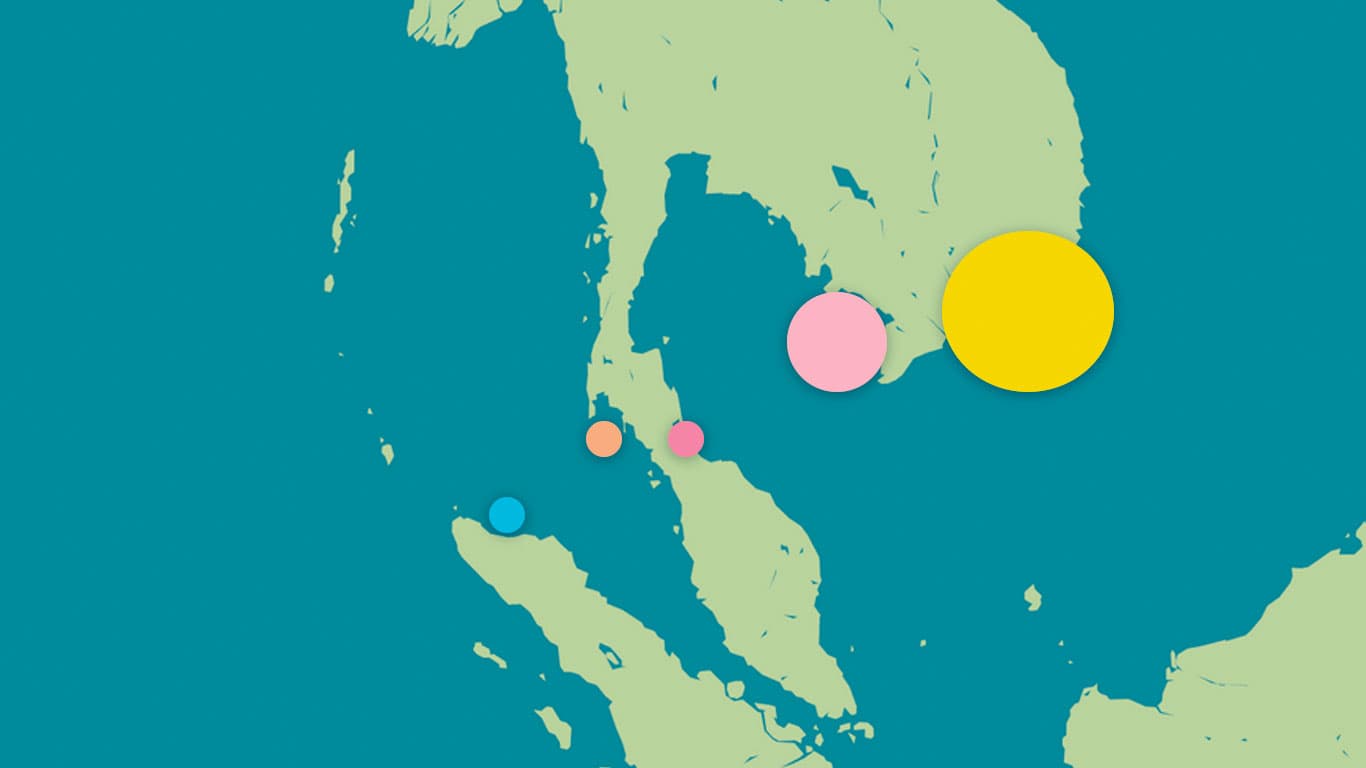
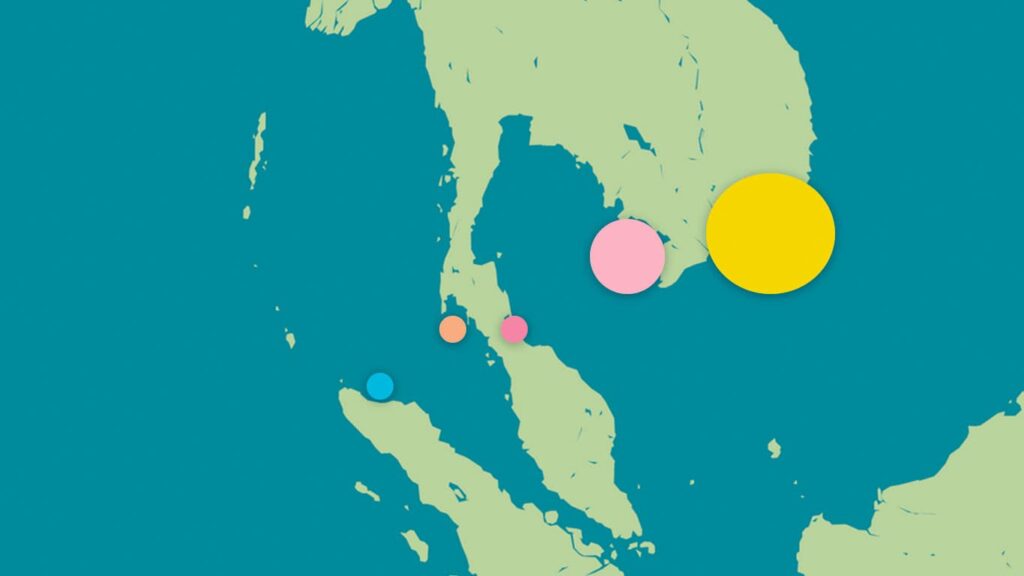
In any case, if Pu was a region-wide surname, we should expect to see a relatively equitable distribution of the name. However, that is not the case. Here is a rough breakdown:

Champa
This is where Pu appears the most, however, there are other characters that appear at the beginning of Cham names/titles that also would have been pronounced the same at that time: , 菩,布, 婆, and 波. I am not saying that every single appearance of these alternate characters was equivalent to “Pu,” only that it is possible that this was the case.
The names/titles below come from the Song Huiyao, as listed in Geoff Wade’s 2005 ARI working paper: “Champa in the Song hui-yao: A draft translation.”
960/61: Pu He-san (菩訶散) and Bu-jun (布君)
963: the king’s wife Bo-liang-pu-mao (波良僕瑁)
971/2: the king’s son Pu-lu-ji-bo-luo (蒲路雞波羅)
972: envoy Pu He-san (蒲訶散), sent by king Bo-mei-shui (波美稅),
973: Bu-ni-qi (布你齊)
973: king Bo-mei-mei-shui-yang-bu-yin-cha (波美美稅楊布印茶)
974: king Bo-li-shui-he-cha (波利稅褐茶)
985: envoy Po-luo-men Jin-ge-ma (婆羅門金歌麻)
986: Pu Luo-e (蒲羅遏) – in a record related to Jiaozhi
999: deputy envoy Pu-sa-tuo-po (蒲薩陁婆)
1007: envoy Bu-lu-die-di-jia (布祿爹地加)
1011: envoy Pu-sa-duo-po (蒲薩多婆), deputy envoy Pu-duo-bo-di (蒲多波底)
1015: envoy Bo-lun-he-luo-dai (波輪訶羅帶),
1053: Pu-si-ma-ying (蒲思馬應) and Pu-sa-wei-ying (蒲薩為應)
1056: envoy Pu-xi-tuo-pa (蒲息陁琶)
1068: Pu Ma-wu (蒲麻勿)
1071: deputy envoy Po-wang-ma-ke-gan-li (婆王麻可筸離)
1086: envoys Bu-ling-xi-tuo-qin (布靈息弛琴) and Pu Ma-wu (蒲麻勿)
1105: envoy Pu-sa-da-pa (蒲薩達琶)
Sanfoqi
961: envoy Pu Mie 蒲蔑
975: envoy Pu Tuohan 蒲陁漢
980: envoy Pu Yatuoluo 蒲押陁羅
988: envoy Pu Yaluoli 蒲押陀黎
1008: deputy envoy Pu Polan 蒲婆藍
1017: envoy Pu Moxi 蒲謀西
1028: envoy Yatuoluoye 蒲押陀羅歇
Shepo
992: chief envoy Tuozhan 陀湛, deputy envoy Pu Yali 蒲亞里, and official Lituona Jiacheng 李陁那假澄
Dashi
977: envoy Pu Sina 蒲思那 [or Pu Sihao 蒲思郝], deputy envoy Mohemo 摩訶末 (i.e., Mohammed), and official Pu Luo 蒲囉
Chola
1015: envoy Suolisanwen (娑里三文, deputy envoy Pushu 蒲恕 (or Pu Jiaxin 蒲加心)
Note: Suo 娑 and Po 婆 are very close. This could have originally been Po Lisanwen.
1033: Pu Yatuoli 蒲押陁離

Looking a bit more closely, we can see similarities in the names/titles of these envoys from Sanfoqi: Pu Yatuoluo 蒲押陁羅 (980), Pu Yaluoli 蒲押陀黎 (988), and Pu Yatuoluoye 蒲押陀羅歇 (1028), with this envoy from the Chola kingdom: Pu Yatuoli 蒲押陁離 (1033).
There are various old Chinese works that attempted to record foreign words. One work from I think the sixteenth century is called the Translated Words from the Various Kingdoms (Geguo yiyu 各國譯語). It contains a list of Chinese renderings of Cham words.
E. D. Edwards and C. 0. Blagden tried to decipher it in 1939 (“A Chinese Vocabulary of Cham Words and Phrases”). They came across one term for an “official” (ya ta lin = yadalin) which they could not identify with any Cham term. However, this looks like it could be the “yatuoli/luo” that we find in the names/titles above.
That said, even if we cannot identify anything beyond the “Pu,” it is quite obvious that this is the Cham honorific. While I have just listed the names/titles here, there are also details in the historical records that make it clear that the Cham were moving around the region.
Finally, one issue that I feel has never been convincingly explained is why Acehnese, the language spoken at the northern end of Sumatra, is a Chamic language. Some people have argued that Cham refugees fled there in the fifteenth century after the Vietnamese attacked Champa.
1) I don’t think a group of refugees can change the language of a place that was already inhabited and had thrived as a trading center for centuries by that time, and,
2) Of all the places to flee to, why would they go all the way to Aceh?
There is clearly a deep historical connection between Champa and Aceh, and I think the distribution of “Pu envoys” in Song dynasty era records points to this. We of course should assume that the Cham were active in places close to their homeland, such as Sanfoqi/Kambuja, but I would argue that they were also clearly active further afield.
Whether they had contact with Aceh through the Straits of Melaka or across the Songkhla/Phatthalung-Kedah/Trang trans-peninsular trade routes, or both, they clearly had contact, and my guess would be that it is there that some Cham were commissioned as envoys to take early Dashi and Chola missions to China, given their knowledge of the seas and the Chinese tributary rituals.
Indeed, what the presence of Pu in Chinese sources indicates, is that there was a time when the Cham ruled the seas.