

In the previous post, I translated information about Southeast Asia in an early fourth-century text entitled Grand Clarity Scripture of Divine Elixir Made from Liquid Gold (Taiqing jinye shendan jing 太清金液神丹經) that is attributed to the Daoist, Ge Hong 葛洪(283–343 CE).
Ge Hong has a long introduction to the section on geography, and I translated some of it, but there is quite a bit more. Essentially must of this preface is a philosophical musing on what constitutes the world. Is the world the area of China? Or is there more beyond it?
In traveling to Funan, Ge Hong became convinced that the world is indeed much bigger than China (he expressed this through various archaic terms), and he wished to explore it, particular a part that he referred to as the “five kingdoms.”
What were the five kingdoms? They were Linyi, Funan, Wulun, Dunxun [or what he writes elsewhere as Dianxun], and Dupo [which he also writes elsewhere as Shepo].
Let us look first at what he wrote, and then we’ll look at where these places were.
奚自扶南、頓遜,逮於林邑、杜薄、無倫五國之中,硃砂、琉黃、曾青、石精之所出,諸導仙服食之藥,長生所保之石實,無求不有,不能復縷,其別名也。稱丹砂如東漚偃之瓦石,履流丹若甄陶之灰壤,觸地比目,不可稱量。而此五國,不見服用之方,莫知長延之道,貴無用以填宇內,遺靈石而不眄。競彫玩之貨,賤流丹之藥,鍊餌不加,真質長隱耳,混雜無親,妙物不顯矣。
How is it that in the lands stretching from Funan and Dunxun [= Dianxun] to Linyi, Dubo [= Shepo], and Wulun, that among these five kingdoms where cinnabar, orpiment, azurite, and rock essence are produced, where the various mineral medicines for guiding the immortals and the stones that ensure long life are abundantly found, there is nothing that cannot be obtained, their alternative names too numerous to recount.
Cinnabar here is as common as tiles and stones in Dong’ou; liquid cinnabar flows like the ashes and soil of the potters. Wherever one steps, they are as plentiful as fish with paired eyes [i.e., omnipresent], beyond all reckoning.
Yet in these five countries, no methods for ingestion or cultivation are known; no one understands the Dao of prolonged life.
They prize the useless for decorating their households, cast aside spirit-nourishing stones without a glance; they compete for carved trinkets and devalue the medicines of flowing cinnabar.
They do not refine or ingest these materials; the true essence thus remains forever hidden. Mixed and muddled, these wondrous things have no affinity with people, and so their marvels go unrecognized.
[. . .]
但此五國,皆是人蹠之所逮,奚足為渺渺哉。是以不嫌其遐,而欲之其邦,不辭其遼,而必到其鄉。
Yet these Five Kingdoms all lie within reach of human footprints. Why should they be regarded as utterly distant or unattainable?
Therefore, I do not shy away from their remoteness, but instead long for their lands. I do not fear the distance, but am determined to reach their regions.
Ok, so where were these five kingdoms. Linyi was in the area that came to be known as Champa, and Funan was in the lower Mekong Region accessible from the southern coast of the Indochinese Peninsula.
That part is easy. For the others, we need to rely on what Ge Hong recorded.
Wulun was “2,000 leagues west of Funan.”
Dunxun/Dianxun was “5,000 leagues south of Funan.”
Dupo/Shepo was to the east of Funan and one had to “sail directly across the sea, and after several tens of days,” one would reach it.
Historian Andrew Chittick has developed an idea that I like, and it is the concept of the “twisted axis.” He says, in referring to some of the writings by a couple of earlier authors, that “Directions given for locations from Funan to the east coast of India are ‘twisted’ a quarter-turn counter-clockwise from the actual direction.”
I don’t know if it is always off by an exact amount, but I agree that the information about the direction between Funan and certain places is on a “twisted axis,” somewhat like what I talked about regarding the directional relationship between China and certain places recorded in the Lingwai daida. See “Geographic Space in the Lingwai Daida.”
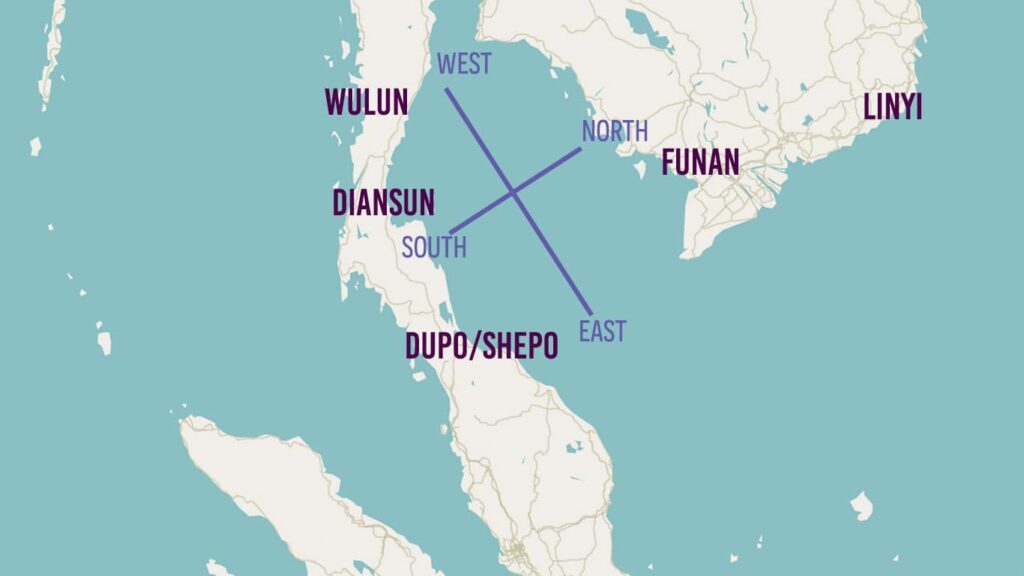
What distinguishes Wulun, Dianxun/Dunxun and Dupo/Shepo, is that they were all on trans-peninsular trade routes.
The defining feature of Wulun was a “great road” with regular rest stops. This could have been a crossing at Chumphon, or perhaps someplace further north.
Dianxun controlled some other polities, including Juzhi, which was at one end of a trans-peninsular route that led to a place called Geying. This, I will argue later, was the Surat Thani – Phang Nga route.
And Dupo/Shepo, is the “Jaba” that I have been writing about for years by now, which was in the area of the Lake Songkhla to Trang and Kedah trans-peninsular routes.
I will write in more detail about all of this, but what I find fascinating, is that Ge Hong went to Funan, a place beyond the “known world” of China, and there he came to form in his mind a understanding that there were “five kingdoms” out there.
Of course, there were many more polities, but it makes sense that he would think of these five. Linyi and Funan were the two most powerful kingdoms on the mainland, and Wulun, Dianxun/Dunxun and Dupo/Shepo were the polities that controlled three main trans-peninsular trade routes.
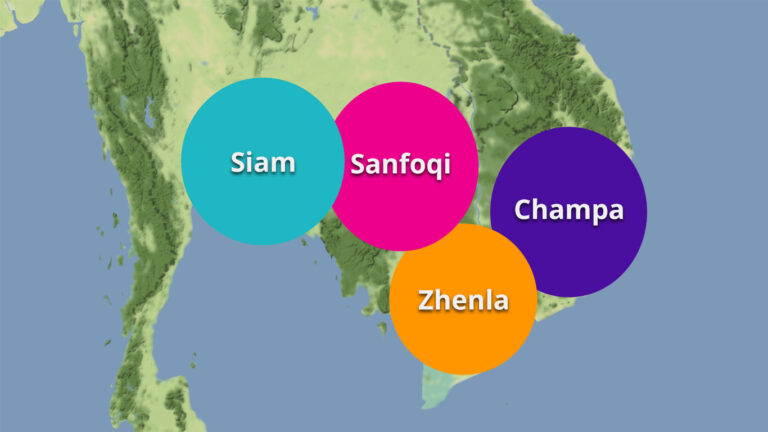
In the twelfth-century Lingwai daida, we see this same world, only by that time, the main story in the region had become one about two big powers: Sanfoqi/Kambuja and Shepo/Jaba, but it was still a story about controlling trade.

Oh. I see. So this is how you equated Dubo with Jaba/Shepo again. If this is correct, could you kindly suggest where these polities were located? Cuz I thought they could be around the Philippines/Eastern Indonesia if we would just be following the standard compass directions.
(1) Zhubo (Java)
諸簿國女{安}子織作白疊花布。
Women of the country of Zhubo weave baidie cotton floral {patterned} cloth.
(2) Botan
諸薄之西北有薄嘆洲,土地出金,常以采金為業,轉賣與諸賈人,易糧米雜物。
Northwest of Zhubo is the land of Botan. The land produces gold, and they usually collect gold as a profession and trade it with all the merchants, exchanging it for grain and rice and miscellaneous articles.
(3) Bishu
諸薄之東南有比攎洲,出錫,轉賣與外徼。
Southeast of Zhubo is the land of Bishu. It exports tin, which is exchanged in foreign lands.
(4) Mawu [YOU’VE ALREADY COVERED THIS]
諸薄之東有馬五洲,出雞舌香,樹木多華少實。
East of Zhubo is the land of Mawu. It produces chicken-tongue aromatic (cloves). The trees have many flowers but little fruit.
(5) Danlan
諸薄之西北有耽蘭之洲,出鐵。
Northwest of Zhubo is the land of Danlan. It produces iron.
(6) Juyan
諸轉薄之東北有巨跡{延}洲,人民無田種芋,浮船海中,截大蚶螺杯往扶南。
Northeast of Zhu(zhuan)bo is the land of Juji (=Juyan). The people have no fields to plant taro; they sail boats on the seas, catching big clams and conchs to send to Funan.
These all came from Maritime Asia in the Third Century CE | A translation and analysis of the Wushi waiguo zhuan and Nanzhou yiwu zhi | Andrew Chittick
No, I don’t think I can place most of these names.
“Zhubo” is, I would argue, the same name as what we see later as “Shepo” (and its variants), and the geographical information about Shepo also places it on the Malay Peninsula.
However, these other terms are ones that only appear once, or which do not have enough information to place them clearly. Also, I think everything here is describing a small-scale area. These could be more “local placenames” rather than identifiable separate polities.