

There is an aromatic that is mentioned in early Chinese sources called the “chicken tongue aromatic” (jishexiang 雞舌香). From what I can tell, everyone who has mentioned it thinks it is a reference to cloves. It’s clear to me, however, that it is not.
One place where it is mentioned is in a text from the period of the Wu Kingdom (222-280 AD) called the Record of Unusual Things from Southern Lands (Nanzhou yiwu zhi 南州異物志) by Wan Zhen 萬, an official who served as governor of Danyang 丹陽 on the island of Hainan.
This is what it states.
諸薄之東有馬五洲,出雞舌香,樹木多華少實。
“To the east of Zhubo is Mawu Islet. It produces the chicken tongue aromatic. The trees have many flowers but little fruit.”
Many historians have associated this Zhubo 諸薄, with references to Dubo 杜薄, Shebo 社薄, and Shepo 闍婆, all of which they see as indicating the name “Java,” and they therefore equate these terms with island Java.
On a side note, there are ways to create the “va” sound in Chinese as “wa” with such characters as wa 哇 and wa 瓦, as in the current name for island Java (that emerged during the Ming dynasty period), Zhuawa 爪哇. However, no character like these appears in early texts. Instead, all of the terms above end with a “ba” sound (the “po” in Shepo would have been pronounced as “ba” in the past). So, phonetically, there is a problem with equating this term with Java.
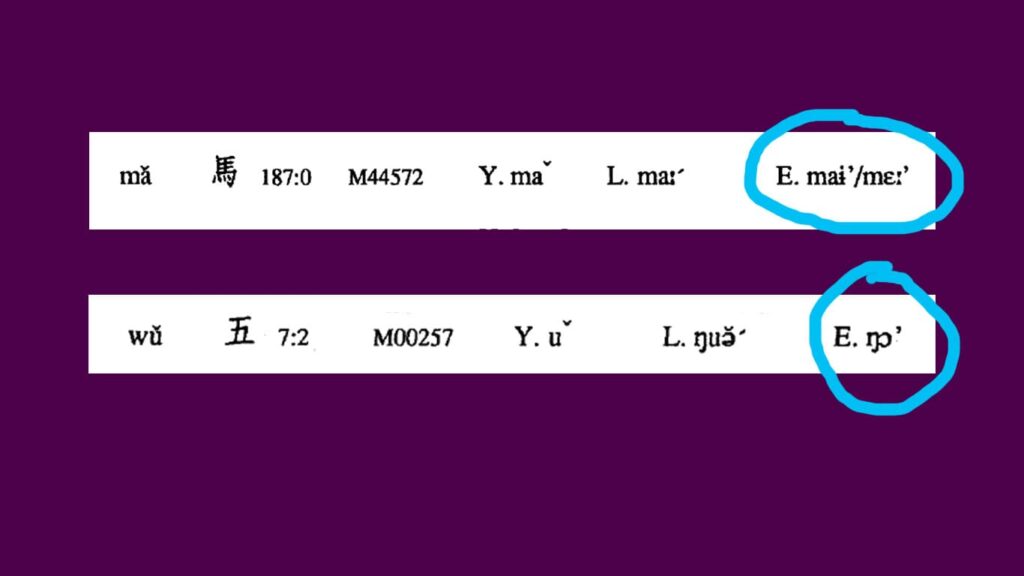
Historians have also equated the name Mawu 馬五 with “Maluku,” the name of the archipelago in what is now eastern Indonesia where the certain islands that historically produced cloves are located.
1) I don’t know when that term emerged, but apparently the first recorded mention of it is in the fourteenth century text in Old Javanese, the Nagarakertagama, which contains a reference to “Maloko.” That’s 1,000 years later than the time we are looking at, and its exact meaning in that text is debated.
2) Then if we look at historical reconstructions, we see that the name Mawu should have sounded closer to something like “Mai-ngo” or “Mei-ngo” in this period.
Then there are historical sources we can consult.
A source that has led people to believe that the chicken tongue aromatic was cloves is a passage in the Etiquette of Han Officials (Hanguanyi 漢官儀) by Ying Shao 應劭 (d. ~203 AD). This work contained the following passage:
桓帝侍中廼存,年老口臰,上出雞舌香與含之。雞舌頗小,辛螫,不敢咀咽,嫌有過,賜毒藥,歸舍,辭決就便宜,家人哀泣,不知其故。僚友求視其藥,出在口香,咸嗤笑之
During the reign of Emperor Huan [146-168 AD], the Attendant-in-Ordinary Nai Cun, being old and having bad breath, was given the chicken tongue aromatic by the emperor to hold in his mouth. The chicken tongue aromatic was rather small and pungent, with a stinging sensation, and he dared not chew or swallow it, fearing it might be inappropriate. [The emperor], suspecting a fault, granted him poison. Returning home, he prepared to die, bidding farewell to his family, who wept mournfully, unaware of the reason. His colleagues and friends asked to see the “poison,” and found it was the mouth aromatic, and all laughed heartily.
This passage has led historians to assume that this man placed a clove, the dried flower bud of the clove tree, into his mouth, and they have argued that cloves resemble the shape of a chicken tongue. Hence, the name.
However, if we look at other texts, we get a different perspective.
Writing in the late third century in his Treatise on Guang (Guangzhi 廣志), Guo Yigong 郭義恭 stated that:
雞舌出南海中,及剽國,蔓生,實熟貫之。
“Chicken tongue comes from the South Seas and the Piao Kingdom, grows as a vine, and when the fruit ripens, it is strung together.”
I think most people see the Piao kingdom as being located somewhere in what is now Myanmar, and that of course is far, far away from the Maluku islands. Also, the statement that it “grows as a vine” (mansheng 蔓生) likewise does not describe a clove tree, however, that is a feature that we find in other texts.
For instance, Ge Hong, in his, fourth-century Grand Clarity Scripture of Divine Elixir Made from Liquid Gold (Taiqing jinye shendan jing 太清金液神丹經), calls this aromatic the “chicken tongue fragrant creeper” (jishe fenluo 雞舌芬蘿).
However, the most detailed information that I have been able to find about the chicken tongue aromatic is in reference to Dubo, the place that started this discussion. There is a passage in a text called the Tang Documents (Tangshu 唐書), probably an early version of the History of the Tang, which states as follows:
杜薄國,在扶南東漲海中,直渡海數十日至。其人色白晳,皆有衣服。國有稻田,女子作白疊華布。出金、銀、鐵、以金為錢。出雞舌香,可含以香人,不見雞舌,其為水也,氣辛而性厲,禽獸不能至,故未可識其樹者。華熟自零,隨水而出,方得之。杜薄洲有十餘國城,皆稱王。
The kingdom of Dubo lies to the east of Funan in the Swelling Sea [Zhanghai 漲海]. A direct crossing over the sea takes several tens of days to reach it.
The people there have light white complexions and all wear clothing. The country possesses rice fields, and its women produce fine white cotton cloth. It yields gold, silver, and iron, and uses gold as currency.
It produces the chicken-tongue aromatic. When held in the mouth, it emits fragrance, though the chicken-tongue itself is never seen, because it is made into liquid. Its scent is pungent, and its nature is intense, so birds and beasts cannot approach it. For this reason, its tree remains unknown. The blossoms fall when ripe and float along the water, and it is only in this way that they are gathered.
On Dubo Island, there are over ten walled city-states, and all their rulers bear the title of “king.”
Following up on the post I just wrote on “Ge Hong’s Five Kingdoms,” this Dubo/Shepo was in the area of the trans-peninsular crossing from Lake Songkhla across to Trang and Kedah. Why would anyone know how many citadels there were? Because you passed by them en route, and one of those citadels has been found at Sathing Phra, but I guarantee you that if the Thais pulled out the Lidar and scanned that region, they would definitely find more.
But back to the topic of chicken tongues, we can see here that the actual aromatic was not in the shape of a chicken tongue. Instead, it was processed into a liquid. That said, you held something in your mouth, so perhaps the original final-processed aromatic during the Han dynasty period was in the shape of a chicken tongue? That’s my only guess.
Finally, there is another passage in the Record of Unusual Things from Southern Lands where Wan Zhen provided yet another source for the chicken tongue aromatic. To quote:
《南州異物志》曰:雞舌出在蘇州,云是草花,可含,香口。
“The Record of Unusual Things from Southern Lands states: The chicken tongue [aromatic] comes from Suzhou 蘇州. It is said that it is a grass flower, you can suck on it and it releases a fragrance.”
This term “grass flower” (caohua 草花) is again indicating a flower that is coming from some kind of plant other than a tree. And as for Suzhou, I only know of one such place, and it’s not in the Maluku islands.
What we can see here is that the “chicken tongue” aspect of this aromatic perhaps came from its earliest processed form, not from the actual substance itself. Further, that actual substance may have even come from different plants, given the difference in location between Suzhou and the Piao kingdom. However, one location where it came from was to the east of Dubo/Shepo.
Where was that?
Following the “twisted axis” discussed in the previous post, I would argue that this Mawu could have been somewhere in the area of the western side of the Malay Peninsula at the end of the Lake Songkhla to Trang and Kedah crossing, or perhaps over on the northern end of Sumatra. Other passages mention a “fire mountain” in relation to Mawu, and that would make Sumatra a good option.
Wherever it was, it was definitely not producing cloves.
P.S. As I write these lines, there is a rooster and some hens next door crowing and clucking. As far as I can tell, they are saying that they agree with my analysis. Thank you guys! I really appreciate it.


Hi, sir. There’s this paper: A Medieval Daoist Drug Geography — The Jinye Shendan Jing as a Novel View on the Circulation of Medical Knowledge in Asia— where the authors suggested this ‘Dubo’ (MC duX‑bak) is actually Touboc, the ancient name for Cotabato. i wonder if this 杜薄國 [Dubo] is different from your proposed Shepo = Jaba/Songkla area. Cuz the passage itself says
‘The kingdom of Dubo lies to the east of Funan in the Swelling Sea [Zhanghai 漲海].’
And many have equated this Swelling Sea [Zhanghai 漲海] with South China Sea. I dont know how geography works in the Chinese court, but if Zhanghai is SCS, and Funan is located in Mainland Asia, then that just means this 杜薄 Dubo is located in the vicinity of the Philippines, Borneo, or Eastern Indonesia. I just find it unfair to associate every ancient written records to the more heavily trafficked Mainland Asia and overlook the possibilities for these to have referred to lesser known polities in eastern Maritime Southeast Asia like the Philippines.
Dear Mark, these are great questions you are asking! I really appreciate it!! I’ll try to do my best to answer them all.
In general, the issue of Puduan/Butuan and the Philippines is a bit of a mystery to me, as I haven’t examined it closely yet.
However, the Swelling Sea is clear. That is the area of the Gulf of Thailand. Going southward from China, the area between Hainan and the Indochinese Peninsula was the Jiao Ocean. Then the area around Pulo Condore was called the Kunlun Sea. And it’s only after that that one reached the Swelling Sea.
As for “East,” somewhere in these posts I talked about Andrew Chittick’s idea of the “twisted axis.” He explains that the directions in early sources need to be “twisted” a bit on the axis for them to make sense. But following that idea, Dupo as a place on the Malay Peninsula would make sense here.
https://storymaps.arcgis.com/stories/987f5e0085c04ec998dc76d2dcced5de