

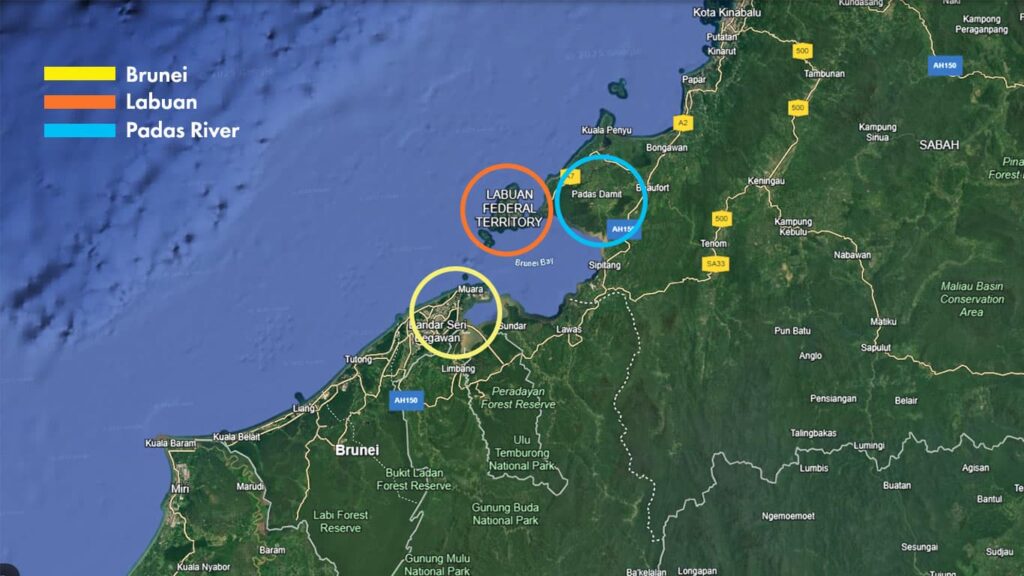
In March of 1881, Charles Cameron Lees, the British governor and consul general of Labuan, a British territory off the northwest coast of Borneo, received a letter from the Sultan of Brunei regarding his plans to launch an attack against certain people in the area of the Padas River.
The Padas River is located near Labuan and at that time, was under the authority of the Sultan of Brunei. It was also home to some Europeans and Chinese. The sultan wanted Lees to ban British subjects from selling arms and ammunition to people in the Padas River area and to ask white men and Chinese in the area to temporarily relocate to Labuan.
Here is what the letter stated:
From His Highness the Sultan of Brunei
To His Excellency C. C. Lees C.M.G.
Governor of Labuan and its Dependencies
and Her Britannic Majesty’s Consul
General for Borneo, 1st March 1881
(Compliments)
I beg leave to inform my friend that I propose to send a reinforcement to attack the people of Padas for disobeying my orders and commands. Three years ago the Padas people quarreled with the Pangeran Abubakar, my nephew, and killed eleven of his men belonging to Padas. I pardoned them because I did not wish to give them trouble, I only fined them to extent of $70.00 to be paid to me as a compensation for the goods chattels etc. which they had plundered and for having killed the buffaloes and cattle. They have to pay this in brass cannon to me.
The Imam Hadji Mahomet Salleh Stia Rajah agreed to do this. I have ordered the Pangeran Abubakar and Temgah not to attack them. They have not paid the above fine up to this time, the balance due is $400.00. They also dispute the duties on goods I have arranged on them, neither will they pay it or obey my order. They wish to be independent. Within these three years, they have killed nine innocent men. Now they are fighting with the Pangeran Bahar and create a disturbance in the Padas river.
Last month I ordered the Datu Imam, my high priest (Bishop) to remonstrate with the Padas people but they will not listen to his advice; while the Imam was there they killed a man to show their obstinacy.
Now I beg my friend to prevent the people in Labuan who are British subjects not to sell arms and ammunition to the people of Padas until this business is over, and also please to issue an order to the whitemen and Chinese who are in Padas to return to Labuan for I am afraid the Padas people will give them trouble.
Written in Brunei 25th of Rabil Akhir
A.H. 1298 – (1st March 1881)
[Prohibition of Export of Arms and Ammunition to the River Padas, North West Borneo. 10 Mar. 1881. MS Records of the British Colonial Office CO 144/55/14. The National Archives (Kew, United Kingdom).]
Lees complied with the request to ban the sale of arms and ammunition, and responded to the sultan as follows:
British Consulate General Borneo.
Labuan.
10th March 1881.
Consul General C. C. Lees to His
Highness the Sultan of Brunei
(Compliments)
I regret much to learn that your Highness thinks it necessary to attack the people of Paddas. I should be glad if the matter could be settled without the use of arms, and the loss of life and property that will follow. I have prohibited as you request the exportation of arms and ammunition to the river Paddas. The prohibition is for three months from yesterday the 9th of March 1881, if it becomes necessary to prolong the period, you should let me know before the time expires. To prevent claims being made on your Highness afterwards it is necessary that your troops should take every care to avoid the loss of life and property of British subjects.
Signed C. C. Lees
Consul General
[Prohibition of Export of Arms and Ammunition to the River Padas, North West Borneo. 10 Mar. 1881. MS Records of the British Colonial Office CO 144/55/14. The National Archives (Kew, United Kingdom).]
Not much is recorded about C. C. Lees, but the little information that is recorded reveals a life of service to the British empire.
C. C. Lees’ father was at one point Chief Justice of the Bahamas. The younger Lees, meanwhile, began his career, in 1854, by serving in the military.
After retiring from the military in 1866, Lees later went on to serve as governor of various colonial possessions: the Gold Coast (1874, 1876 and 1878–79), Labuan (1879-1881), the Bahamas (1881 to 1884), the Leeward Islands (1884 to 1885), Mauritius (1889 to 1892), and British Guiana (1893 to 1895).
Labuan was thus one of his early assignments, but in 1881 he had already served in the position as governor for three years, and was therefore familiar with the region and had ideas about how to respond to such a situation.
In particular, Lees sent Acting Colonial Secretary Peter Leys to Brunei to try to talk with the sultan, and to try to dissuade him from starting a conflict.
On March 13, 1881, follow the visit of Leys, the sultan responded to Governor Lees, thanking him for banning the sale of arms and ammunition in the Padas River region, but stating again his intention to launch an attack, and requesting again that British and other foreign subjects to leave the area in advance.
The letter from His Highness the Sultan
of Brunei to His Excellency C. C. Lees
C.M.G. the Governor of Labuan and
H.B. Consul General at Brunei.
[Translation]
12th Rabil Akhir 1298
(13th March 1881)
(Compliments)
And then we have the honor to inform our friend that we have already received our friend’s letters written on the 10th and 12th March.
We therefore return thanks to our friend for complying with our request and also for having prohibited the sale of arms in the Padas river. We are very glad our friend sent the Acting Colonial Secretary, the Honorable P. Leys, to us; his counsel and advice were very true.
When our Steam Boat comes back to Brunei, we will order it to go to Padas, to make known the circumstances and to call out all the strangers there, and the people who are under the British flag, who wish to go out from the Padas rivers, and their tributaries, our Steam Boat will bring them to Labuan or to Brunei. From the day that our Steam boat arrives at Padas river to call out the people which are under the flag of other nations, two weeks time will be given them to depart from the river, if they do not go out we will not be responsible for their lives and properties.
When the time arrives that we are prepared to attack Padas we will order them to call at Labuan to meet our friend, so that whatever seems good to our friend he may direct accordingly.
May it please our friend to write a letter to Mr. Peltzer at Padas to order him to come out
and come over to Labuan.
[Threatened Disturbance in the River Padas, North West Borneo. 18
Apr. 1881. MS Records of the British Colonial Office CO 144/55/17.
The National Archives (Kew, United Kingdom).]
The sentence “When the time arrives that we are prepared to attack Padas we will order them to call at Labuan to meet our friend, so that whatever seems good to our friend he may direct accordingly” is bit confusing.
However, the way that this was understood on the British side was that the sultan planned to investigate, rather than launch an attack.
In the capital of Brunei where the sultan’s palace was located, the British had established a consulate and it was run by Consular Agent Inche Mohamed Esquire (Inche Muhammad bin Kassim), a Malay man from Melaka.
Inche Mahomet wrote a letter to Governor Lees two days later, on March 15, and stated the following:
The letter from Inche Mahomet Esquire
H.B.M. Consular Agent at Brunei
To His Excellency C. C. Lees C.M.G.
the Governor of Labuan.
[Translation]
15 March 1881
This day His Highness the Sultan’s steam boat came to Brunei from the mouth of the Padas river, bringing six Panguhulu (Chiefs) of the Padas people, first, Stia Rajah Chamang besar, also Imam Srail, Orang Kaya Muda Muralam, Orang Kaya Maharaja Lila, Datoh Sahbansar, and money more or less $300.00.
They came to appear before His Highness the Sultan, to ask forgiveness, and favor, saying they had no wish to be traitors, and the money more or less $300.00 they desired to offer, to pay the sum as compensation for the property of the Pangeran Abubakar which His Highness the Sultan ordered three years ago. They said the traitors are the Muruts at the head of the river Padas, and the news which reached His Highness the Sultan, about the Padas people going to be traitors is untruth, a calumny it is false.
His Highness the Sultan spoke to me with a smile saying “the Padas people will not be traitors it is good.” I saw by his language his kindly feelings to the Padas people. Perhaps His Highness the Sultan will send a royal command to Padas to investigate and to hear who are the men that are traitors and who fight with Muruts, at the head of the Padas. There are 70 men or more who are bad people.
James Clarke, the Engineer in the His Highness’ steam boat told me, the Pangeran Abubakar has sent 2 boats one of Dayaks and one of Muruts of Lawas to go to Padas, and prevent them killing the Mahomedans and the Chinese there. The men in the steam boat have stolen the goods of the people, at the place men had opened shops at Lawas, and also at the other places.
[Threatened Disturbance in the River Padas, North West Borneo. 18
Apr. 1881. MS Records of the British Colonial Office CO 144/55/17.
The National Archives (Kew, United Kingdom).]
Again, the information here is quite confusing. First, we learn that the Padas chiefs arrived and blamed disturbances on the Murut people who lived upriver at the head of the Padas. Then Inche Mahomet stated that “Perhaps His Highness the Sultan will send a royal command to Padas to investigate and to hear who are the men that are traitors and who fight with Muruts,” which implies that the “traitors” were people from the Padas River area, rather than the Muruts themselves.
Finally, the reported comments by the engineer on the sultan’s steam boat, James Clarke, is likewise unclear. From his comment that “the Pangeran Abubakar has sent 2 boats one of Dayaks and one of Muruts of Lawas to go to Padas, and prevent them killing the Mahomedans and the Chinese there,” it is not evident who the “them” is. Was this to prevent people that the sultan might send to investigate from killing Muslims and Chinese?
Similarly, James Clarke’s statement that “The men in the steam boat have stolen the goods of the people, at the place men had opened shops at Lawas, and also at the other places” is likewise unclear.
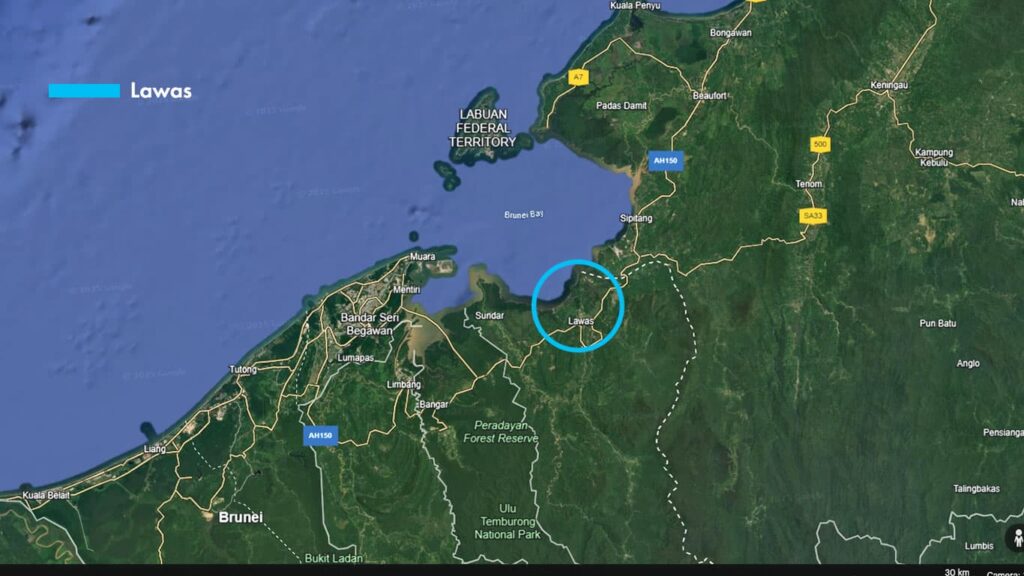
Lawas is between Brunei and the Padas River. Prior to this point, the steam ship had sailed from Padas to Brunei to bring the Padas River chiefs to meet with the sultan. Why would people on the steam ship have “stolen the goods of the people, at the place men had opened shops at Lawas”? This is not explained.
Four days later, the sultan drafted a notification that was translated into English and delivered to Governor Lees. It stated as follows:
Sultan’s Notification
[Translation]
19th March 1881
His Highness the Sri Paduka Mawlana Abdul Mumin Ebni al-Almarhoom Sri Paduka Mawlana Abdul Wahab, who is in possession in the Kingdom of Brunei and all its coasts, make known to all the people who are under the British flag and who are under the flags of other princes, which are in the Padas besar, Padas Damit and Gamas that the people who are in these three rivers, do not follow our jurisdiction and arrangements. So we design to attack these three rivers. We wish those under other flags, to go out quickly and with their properties from that river to Labuan or to Brunei, or to any other places, within two weeks. After the two weeks from the day that this notification was given out we send people to go there to attack the said rivers.
We give notice before, and every one must follow our commands and order, if not if anything be destroyed, or ruined, or anyone wounded or die or lose their properties, we are not responsible.
Written this notice in Brunei the
18th Rabil Akhir 1298. being Friday
or (19th March 1881).
[Threatened Disturbance in the River Padas, North West Borneo. 18
Apr. 1881. MS Records of the British Colonial Office CO 144/55/17.
The National Archives (Kew, United Kingdom).]
So, an attack, rather than an investigation, was the ultimate plan, and on April 5, 1881, Inche Mahomet wrote to Governor Lees to report what he knew.
The letter from Inche Mahomet Esquire
H.B.M. Consular Agent at Brunei
To His Excellency C. C. Lees C.M.G., the
Governor of Labuan.
[Translation]
5th April 1881
I have the honor to inform you, that all the Padas Chiefs are going back to Padas. If your Excellency would like to see them they would be glad to see your Excellency, to tell you what the Pangaran Anak Besar and Datoh Ahmed said to them.
His Highness the Sultan would not have a paper or agreement from them binding themselves for to attack the Muroots at the head of Padas Besar.
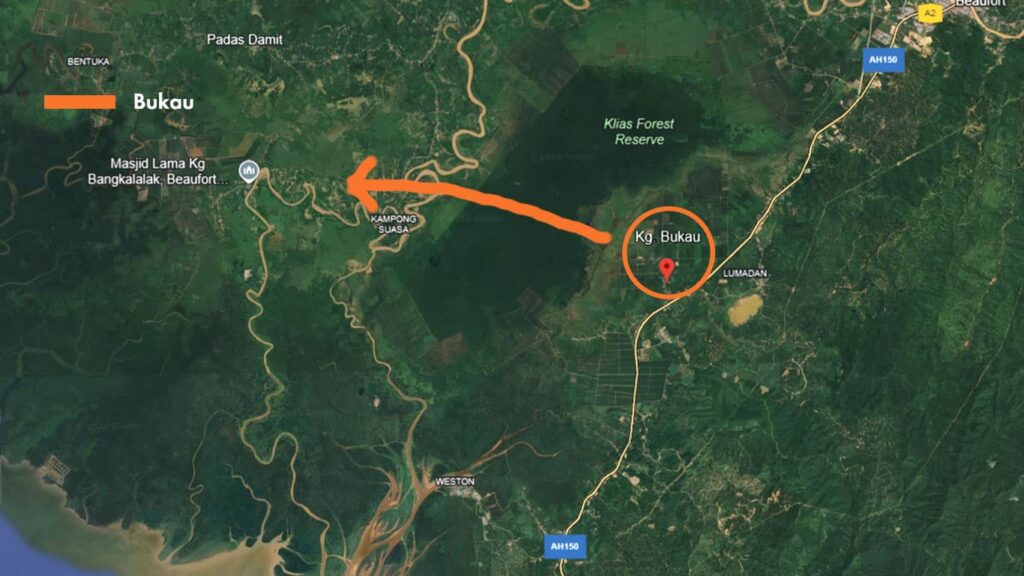
(His Highness the Sultan) ordered the Chiefs of Padas, to deceive the Muroots and bid them make forts, and having done so, that the Blahit people will come (from behind) on foot from Bookow [Bukau] and attack the Muroots. His Highness the Sultan also wants the Chiefs of Padas to join together in the attack – Not to attack the Gamma, Padas Damit, and Padas Besar, only to attack the Muroots Agis, who are the bad people.
The Datoh Ahmed told to the said Chiefs, that they must not frighten themselves, or on their plantations and gardens, poultry, that never will be destroyed and he will stop them.
As to the Datoh Ahmed the Kari (priest) in Brunei, I have not time enough to write, for it is a long word, and all the Chiefs are waiting to go out in a hurry.
The bearer who brought this letter is the Orang Kaya Muda Muralam.
[Threatened Disturbance in the River Padas, North West Borneo. 18
Apr. 1881. MS Records of the British Colonial Office CO 144/55/17.
The National Archives (Kew, United Kingdom).]
Ok, so it looks like there was a plan for an attack, and an attack on a group of Muruts. To do this, another ethnic group, the Blahit, a name I haven’t heard before, was supposed to attack from behind, coming from the interior area of what is now called Bukau.
However, if you look at a map, this seems a bit weird. Bukau is to the east of the head of the Padas, and there is a large forested area in between. Perhaps they had footpaths through that area. But there is something else that is strange.
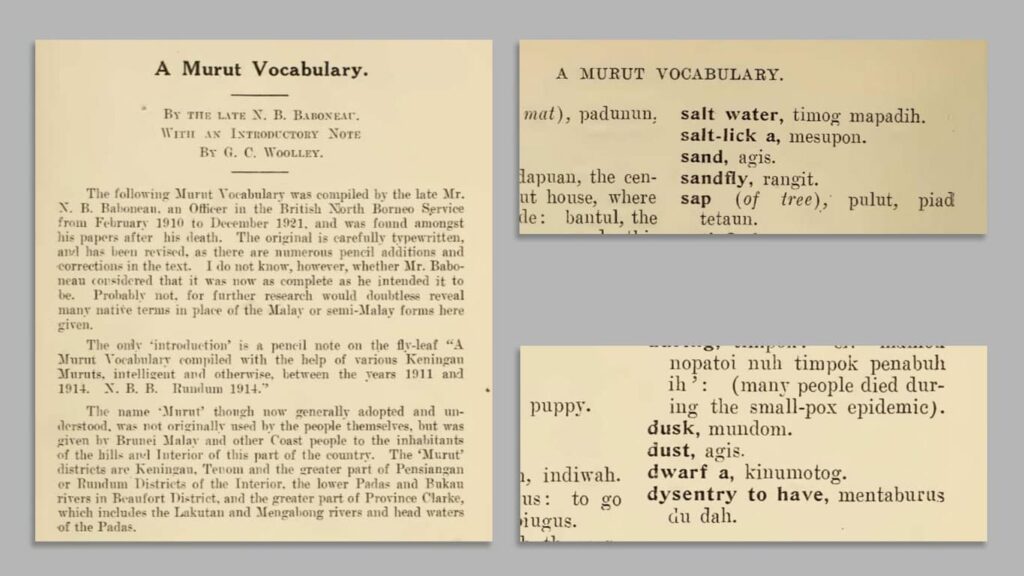
In the above letter, Inche Mahomet indicates that a specific group had been singled out, the “Muroots Agis.” This term “agis” does not seem to be a Malay term, or at least I cannot find any such Malay term.
However, I was able to locate it in a list of Murut words that was compiled at this time, and there it is listed as meaning “sand” or “dirt.” So, could this have been the “Muruts of the sand/dirt”? If so, who might that have been?
By May 16, 1881, the conflict had ended. On that day, Consular Agent Inche Mahomet wrote a letter to Governor Lees in which stated:
From Consular Agent Inche Mahomet to Consul General Lees
Translation
Brunei
16th May 1881
I have the honor to inform Your Excellency that yesterday all the head hunters departed from Brunei to return to their homes paddling and sailing by sea.
The Dyaks gave five dried heads to the Blahits as a mark of friendship. These heads were obtained from Muruts killed at Lubok. The Dyaks were afraid to take the heads with them to Kanowit, as Rajah Brooke has forbidden them.
The Blahits hung the heads with selat leaves at the stems of their prahus in sport, dancing while paddling down the river.
But they did not seem to like it much, for they themselves did not kill and cut throats.
I have been informed that H.H. the Sultan gave them ten or eight gongs, and chawats (waist-cloths) and head-cloths.
Signed – M. B. M. Kassim
[Men of Head Hunting Tribes Have Left Brunei. 27 May 1881. MS Records of the British Colonial Office CO 144/55/34. The National Archives (Kew, United Kingdom).]
Lubok is down by the coast. As such, it looks like the battle that Inche Mahomet initially said was planned against upriver Muruts (or people fighting with the upriver Muruts) did not take place. And instead, a Murut settlement on the coast was attacked. On the sandy coast. . . Is that where the name Muroot Agis came from?
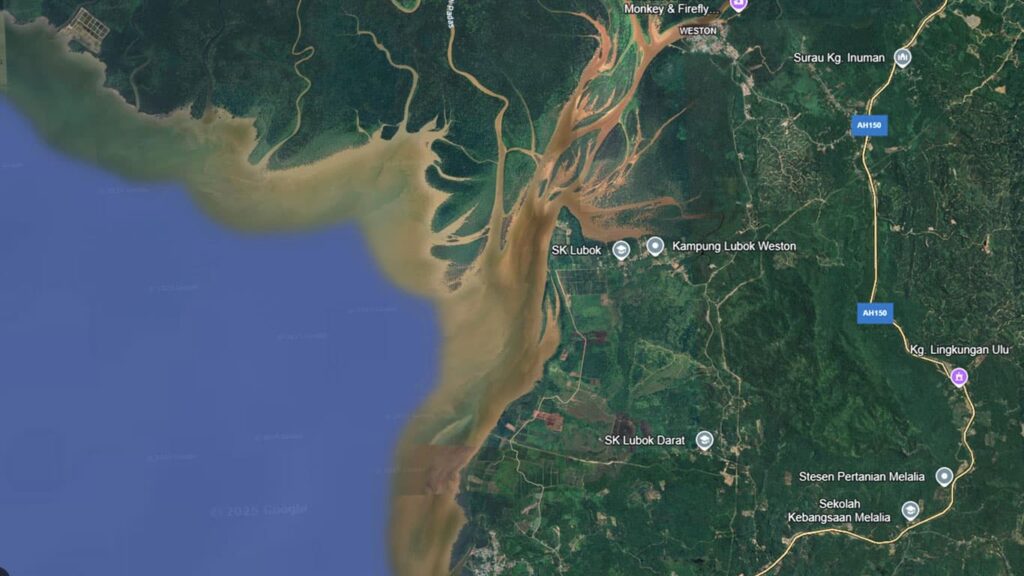
Further, if the Dyaks who instigated the attack were the same Dyaks whom steam boat engineer James Clarke claimed Pangeran Abubakar had brought in to prevent people from “killing the Mahomedans and the Chinese” in the Padas River area. . . then perhaps they had done that too, but it’s not clear.
On the other hand, that the sultan rewarded these Dyaks, suggests that killing Muruts was perhaps their true mission.
Finally, these Dyaks were apparently from Sarawak, which is interesting, as they had journeyed quite far to take on their mission.
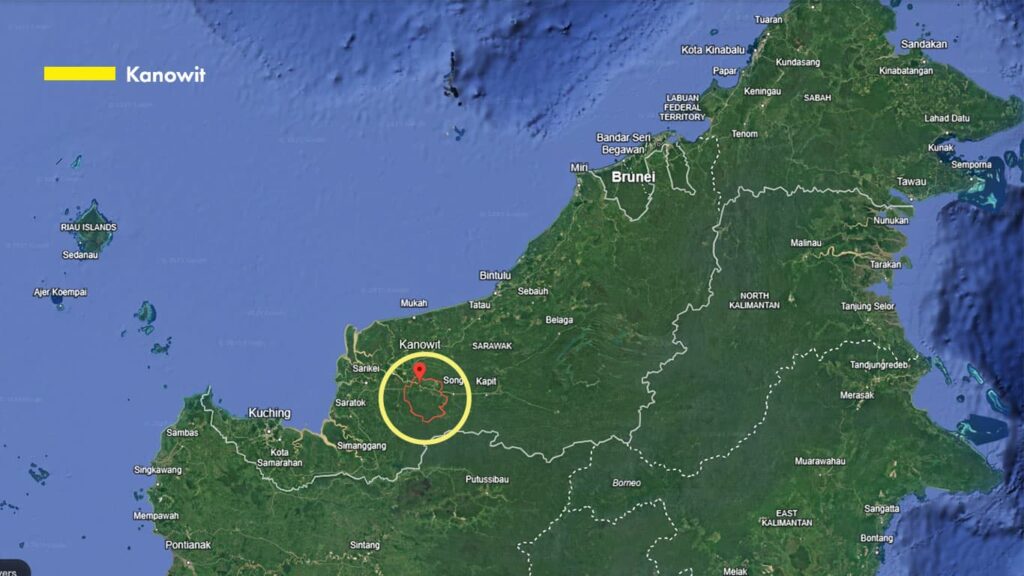
Earlier, on April 18, while the above events were probably transpiring, Governor Lees sent a report to the Foreign Office in which he provided some background information about the Padas River area. To quote,
The Padas people appear to be, from what I could learn, generally loyal to the Sultan and to be industrious beyond the average in agricultural pursuits, but the constant exactions and acts of oppression of the petty Brunei Pangirans or Chiefs who visit the river to collect revenue, sometimes caused partial outbreaks of irritation and resentment, which were reported to the Sultan as acts of insubordination shewing a contempt for his authority.
[Threatened Disturbance in the River Padas, North West Borneo. 18 Apr. 1881. MS Records of the British Colonial Office CO 144/55/17. The National Archives (Kew, United Kingdom).]
Taking all of the above accounts together, what we can see is a great deal of arbitrariness and unclear communication.
It would appear that the Muruts from Lubok who lost their lives had nothing to do with any of the problems in the Padas River area.
It would also appear that the upriver Muruts who were accused by the powerful chiefs in the Padas River area also probably had nothing to do with the issues that the sultan had taken objection to.
The main beef was between the sultan and the chiefs, but the ones who ended up paying the price for that were some Muruts on the coast. The Muruts upriver probably lucked out in being far from the coast, and therefore, more difficult to attack.
Meanwhile, the British side did not seem to have a good sense of what was going on. Whether that was because something got lost in the translation of Inche Mahomet’s letters or was because the consular agent himself did not have a solid grasp of the situation is not clear.
Today, Lubok is a sleepy little kampong. It’s hard to imagine the kind of violence that probably struck there suddenly in 1881.
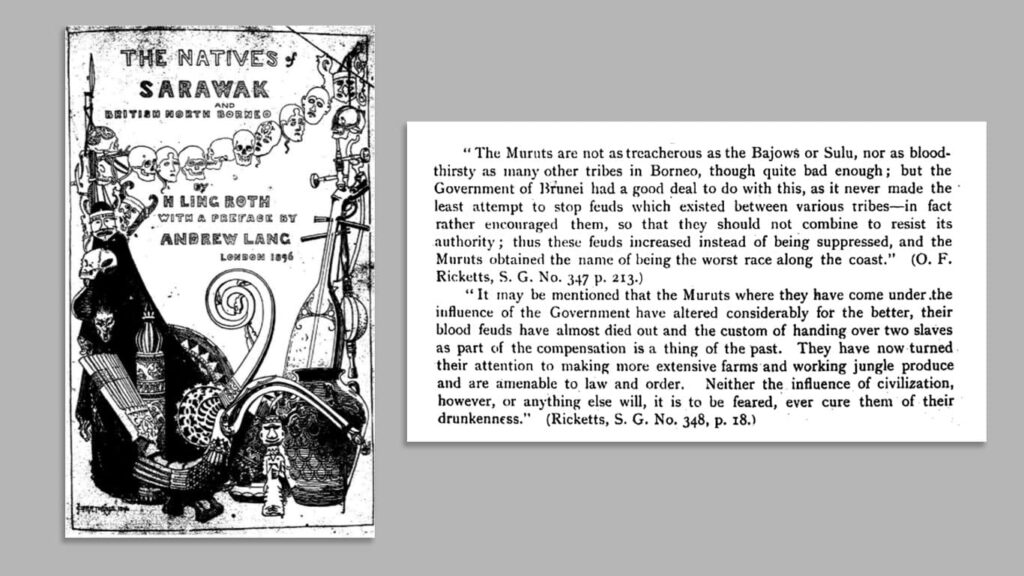
In his 1896 Natives of Sarawak and British North Borneo, Henry Ling Roth cited some writings on the Muruts as follows:
“The Muruts are not as treacherous as the Bajows or Sulu, nor as bloodthirsty as many other tribes in Borneo, though quite bad enough; but the Government of Brunei had a good deal to do with this, as it never made the least attempt to stop feuds which existed between various tribes — in fact rather encouraged them, so that they should not combine to resist its authority; thus these feuds increased instead of being suppressed, and the Muruts obtained the name of being the worst race along the coast.” (O. F. Ricketts, S. G. No. 347 p. 213.)
“It may be mentioned that the Muruts where they have come under the influence of the Government have altered considerably for the better, their blood feuds have almost died out and the custom of handing over two slaves as part of the compensation is a thing of the past. They have now turned their attention to making more extensive farms and working jungle produce and are amenable to law and order. Neither the influence of civilization, however, or anything else will, it is to be feared, ever cure them of their drunkenness.” (Ricketts, S. G. No. 348, p. 18.)
These are the type of comments that so many of us historians today have been trained to see as part of a discourse that enabled colonization. We’re trained to put much of the wording above in scare quotes and to not take it seriously.
However, when one reads the records like the ones shared above, it is difficult to come to a conclusion that is much different from the one in Roth’s book.
Lees and Inche Mahomet did not have enough of a grasp of what was happening to contribute to a discourse.
Indeed, there is something surreal about Inche Mahomet’s letter to Governor Lees in which he says “I have the honor to inform Your Excellency that yesterday all the head hunters departed from Brunei to return to their homes paddling and sailing by sea.”
It was a polite report about events that Inche Mahomet and Governor Lees had no control over, and poor knowledge of.
Meanwhile, from the bits and pieces of information that came through their reports and letters, it’s obvious that a conflict between the powerful turned into a scapegoating of the weak.
