The Tongdian 通典 (Comprehensive Institutions) is a kind of encyclopedia that was compiled by scholar-official Du You 杜佑 (735-812) in the second half of the eighth century and completed in 801 AD, during the time of the Tang dynasty
This text was compiled during the period of the Tang dynasty, but was not printed until the Northern Song period (960-1126). The official histories for that dynasty, the Old History of the Tang (tenth century) and the New History of the Tang (1060) were also completed around that time as well.
It has a section on Linyi. Some of the information is the same as in the section on Linyi in the History of the Jin. I instructed Gemini 3 to keep the same wording in the translation in these places where the text is the same as the text in the History of the Jin.
In checking, it looks like it did a good job. In the past, I’ve done that manually. What a joy to be able to do it now “instantaneously”!!
In any case, here is the translation.
(通典,邊防四,林邑)
林邑國,秦象郡林邑縣地。漢為象林縣,屬日南郡,古越裳之界也,在交趾南,海行三千里。其地縱廣可六百里,去日南界四百餘里。其南,水步道二百餘里,有西屠夷,亦稱王焉,馬援所植兩銅柱,表漢界處也。
([Annotation:] 馬援北還,留十餘戶於銅柱處。至隋有三百餘戶,悉姓馬,土人以為流寓,號曰「馬流人」。銅柱尋沒,馬流人常識其處。林邑國記:「馬援樹兩銅柱於象林南界,與西屠國分漢之南境。」又云:「銅柱山周十里,形如倚蓋,西跨重巖,東臨大海。」屈璆道里記又云:「林邑大浦口有五銅柱焉。」)
後漢末大亂,縣功曹姓區,有子曰連,殺縣令,自號為王,子孫相承。吳時通使。其後王無嗣,外孫范熊代立。熊死,子逸代立。
The Kingdom of Linyi was the territory of Linyi District of the Xiang Commandery during the Qin dynasty. In the Han dynasty, it became Xianglin District, belonging to Rinan Commandery; it is the boundary of the ancient Yuechang. It is located south of Jiaozhi, a journey of three thousand leagues by sea.
Its territory is about six hundred leagues in length and width, located more than four hundred leagues from the border of Rinan. To its south, traveling more than two hundred leagues by water and foot, there are the Xitu barbarians, who also claim the title of king. This is the place where Ma Yuan erected two bronze pillars to mark the boundary of the Han.
([Annotation:] When Ma Yuan returned north, he left behind more than ten households at the site of the bronze pillars. By the Sui dynasty, there were more than three hundred households, all surnamed Ma. The local people considered them to be exiles and called them “Ma Stragglers.” The bronze pillars eventually disappeared, [but] the Ma Stragglers always knew their location.
The Record of the Kingdom of Linyi states: “Ma Yuan planted two bronze pillars at the southern border of Xianglin to divide the southern frontier of the Han from the Xitu kingdom.” It also states: “Bronze Pillar Mountain is ten leagues in circumference and shaped like a leaning canopy; to the west it spans layers of cliffs, and to the east it overlooks the great sea.” Qu Qiu’s Record of Distances further states: “There are five bronze pillars at the Great Estuary of Linyi.”)
At the end of the Later Han dynasty, during the great chaos, [an administrative clerk in] the District Labor Section surnamed Ou/Qu had a son named Lian. [Lian] killed the district magistrate and called himself king, and his descendants succeeded one another.
During the Wu dynasty, they exchanged envoys.
Later, the king had no heir, so his maternal grandson, Fan Xiong, succeeded him. When Xiong died, his son Yi succeeded him.
其國有金山,石皆赤色,其中生金,金夜則出飛,狀如螢火。又出玳瑁、貝齒、古貝、沈木香。古貝者,樹名也,其華成時如鵝毳,抽以績紡作布,潔白與紵布不殊,亦染成五色,織為斑布也。沈木香,土人破斷之,積以歲年,朽爛而心節獨在,置水中則沈,故名曰沈香。次不沈者曰棧香也。又出猩猩獸。([Annotation:] 爾雅云:「肉之美者,猩猩之脣。」) 多琥珀。松脂淪入地,千歲為茯苓,又千歲為琥珀。又云楓脂為之。琥珀在地,其上及旁不生草木,深者或八九尺,大如斛,削去皮成焉,初如桃膠,凝成乃堅。其金寶物產,大抵與交趾同。
The country possesses a Gold Mountain; the stones are all red in color, and gold is produced within them. At night, the gold flies out, resembling fireflies.
It also produces hawksbill turtle [shell], cowrie [shells], cotton [gubei 古貝], and “sinking wood incense” [agarwood].
Gubei is the name of a tree. When its flowers bloom, they resemble goose down. They are drawn out and spun to make cloth, which is pure white and no different from ramie cloth. It is also dyed in five colors and woven into patterned cloth.
As for “sinking wood incense” [agarwood], the locals chop down the wood and leave it in a pile for many years. The wood rots away, leaving only the heartwood and knots. When placed in water, it sinks; hence it is called “sinking incense.” That of the next quality, which does not sink, is called Zhan 棧 incense.
It also produces the Xingxing beast [a human-like ape]. ([Annotation:] The Erya states: “Among the most delicious meats are the lips of the Xingxing.”)
There is much amber. When pine resin sinks into the earth, after a thousand years it becomes fuling [Poria cocos]; after another thousand years, it becomes amber. It is also said that maple resin creates it. Where amber is found in the ground, no grass or trees grow above or beside it. The deepest pieces are found eight or nine chi down and are as large as a bushel. After paring away the [outer] skin, the amber is revealed. Initially, it is like peach gum, but as it congeals, it becomes hard.
Its gold, treasures, and products are, for the most part, the same as those of Jiaozhi.
以塼為城,蜃灰塗之。居處為閣,名曰干闌,皆開北戶以向日,或東西無定。尊官有二:其一曰西那婆帝,其二曰薩婆地歌。其屬官三等:其一倫多姓,次歌倫致帝,次乙地伽蘭。外官分為二百餘部,其長官曰弗羅,次曰阿倫,如牧宰之差也。書樹葉為紙,施椰葉為席。男女皆以橫幅古貝繞腰以下,謂之干漫,亦曰都漫。穿耳貫小鐶。貴者著革履,賤者跣行。自林邑、扶南諸國皆然也。其王戴金花冠,形如章甫,加瓔珞,出則乘象,吹螺擊鼓,罩古貝繖,以古貝為幡旗。國不設刑法,有罪者使象蹋殺之。林邑浦外有不勞山,罪人亦送此山,令其自死。其大姓號婆羅門,嫁娶必用八月。女先求男,由貴男而賤女也。同姓還相婚姻。人性凶悍,果於戰鬥。有弓、箭、刀、槊,以竹為弩。樂有琴、笛、琵琶、五絃,頗與中國同。每擊鼓以警眾,吹蠡以即戎。其人深目高鼻,髮拳色黑。婦人椎髻。四時暄暖,無霜雪。王死七日而葬,有官者三日,庶人一日。皆以函盛屍,鼓舞導從,轝至水次,積薪焚之。收餘骨,王則內金甖中,沈之於海;有官者以銅,沈之海口;庶人以瓦,送之於江。男女截髮,隨喪至水次,盡哀而止。其寡婦孤居,散髮至老。人皆奉釋法,文字同於天竺。王事尼乾道,鑄金銀人像大十圍。
They use bricks to build their city walls and plaster them with clam [shell] lime. Their dwellings are pavilions, called ganlan 干闌 [stilt houses]. They all open windows on the north side to face the sun, or face east or west with no fixed orientation.
There are two high officials: the first is called Xinapodi 薩婆地歌 [senapati], and the second is called sapodige 薩婆地歌 . Their subordinate officials are of three ranks: the first is lunduoxing 倫多姓, the next is gelunzhidi 歌倫致帝 [kurung. . .?], and the next is yidigalan 乙地伽蘭. The outer officials are divided into more than two hundred departments; their chief official is called fuluo 弗羅, and the next is alun 阿倫, similar to the distinction of local officials [in China].
They write on tree leaves as paper and spread coconut leaves to make mats. Both men and women wrap a horizontal width of gubei [cotton] cloth around their waists and below; this is called ganman 干漫, also called duman 都漫. They pierce their ears and thread small rings through them. The nobles wear leather shoes, while the lowly walk barefoot. This is the case from Linyi to Funan and all the various kingdoms.
Their king wears a gold flower crown, shaped like the zhangfu 章甫 cap, and adds strings of pearls and jewels. When he goes out, he rides an elephant, with conch shells blowing and drums beating. He is shaded by a gubei parasol and uses gubei for banners and flags.
The kingdom has no established penal code; those who commit crimes are trampled to death by elephants. Outside the estuary of Linyi there is Bulao Mountain [Bulao shan 不勞山]; criminals are also sent to this mountain and left to die on their own.
Their great families are called Brahmins [Poluomen 婆羅門]. Marriages must take place in the eighth month. The woman’s family first proposes to the man, because they value men and look down on women [note: opposite of what the Jinshu states]. Those of the same surname still intermarry.
The people are fierce by nature and decisive in combat. They have bows, arrows, swords, and lances, and they make crossbows out of bamboo. Their musical instruments include the zither, flute, pipa [lute], and five-stringed instruments, generally similar to those of the Middle Kingdom. Whenever they beat the drums, it is to alert the masses; when they blow the conch, it is to approach battle.
The people have deep-set eyes, high noses, and curly black hair. Women wear their hair in a hammer-shaped bun. The climate is warm throughout the four seasons, with neither frost nor snow.
When the king dies, he is buried after seven days; for officials, three days; for commoners, one day. They all place the corpse in a container. With drumming and dancing leading the procession, the carriage arrives at the water’s edge, where they pile up firewood and burn it. They collect the remaining bones. For the king, they are placed in a gold urn and sunk into the sea; for officials, in a copper vessel and sunk at the seaport; for commoners, in an earthenware vessel and sent into the river.
Men and women cut their hair short and follow the funeral to the water’s edge, stopping only when their grief is exhausted. Widows live alone and let their hair hang loose until old age.
The people all follow the Śākya-dharma [Shifa 釋法], and their writing system is the same as that of India [Tianzhu 天竺]. The king serves the way of the Nirgranthas [Niqian dao 尼乾道], and casts statues of human figures in gold and silver as large as ten arm-spans around.
至晉武帝太康中又來貢獻。成帝咸康二年,范逸死,奴文篡位。奴文昔嘗北至洛陽商貨,因教王作宮室兵車器械,王愛信之,使為將,乃譖王諸子,或徙或奔。及王死無嗣,遂自立為王。乃攻旁國,并之,有眾四五萬。至穆帝永和三年,文率其眾攻陷日南,([Annotation:] 今郡地)。遂據其地,告交州刺史朱蕃,([Annotation:] 交州,今安南府)。求以日南北鄙 ([Annotation:] 今郡地)。橫山為界。初,徼外諸國嘗齎寶物自海路來貿貨賄,而交州刺史、日南太守多貪利侵侮,十折二三,由是諸國怨憤。且林邑少田,故貪日南之地。文又襲九真,今郡地。害士庶十八九。文死,子佛立,猶屯日南。九真太守灌邃率兵討佛,走之,邃追至林邑。時五月立表,日在表北,影在表南九寸一分,自北影之南,故開北戶以向日,此大較也。佛乃請降。其後頻寇日南、九德之郡,([Annotation:] 今安南日南郡界)。殺傷甚多,交州遂至虛弱。至佛曾孫文敵,後為扶南王子當根純所殺。大臣范諸農平其亂,而自立為王。死,子陽邁立。死,其子咄立,復名曰陽邁。([Annotation:] 初其父陽邁母始產,夢人以金藉之。夷人謂金曰陽邁,故為名。至咄纂父業,又名焉)。宋文帝元嘉中,侵暴日南、九德諸郡。([Annotation:]宋九德郡今安南日南郡界。) 宋使振武將軍宗元幹討之,克林邑。陽邁父子並挺身奔逃。所獲珍異皆是未名之寶。又銷其金人,得黃金數十萬斤。其後累代,自宋、齊、梁、陳皆遣使朝貢。
During the Taikang era of Emperor Wu of Jin [280–289 AD], they again came to offer tribute. In the second year of Xiankang of Emperor Cheng [336 AD], Fan Yi died, and his slave, Wen, usurped the throne.
Slave Wen had previously traveled north to Luoyang to trade goods. Because of this, he taught the king how to build palaces, military chariots, and weaponry. The king favored and trusted him, appointing him as a general. [Wen] then slandered the king’s sons, causing them to be either exiled or to flee. When the king died without an heir, [Wen] subsequently established himself as king.
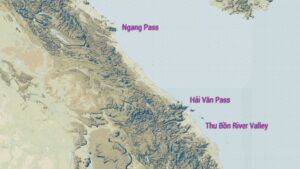
He then attacked neighboring kingdoms, annexing them all, and possessing a multitude of forty to fifty thousand people. In the third year of Yonghe of Emperor Mu [347 AD], Wen led his forces to attack and capture Rinan ([Annotation:] the territory of the present-day commandery). He subsequently occupied the land and notified Zhu Fan, the Inspector of Jiaozhou ([Annotation:] Jiaozhou is the present-day Annam Prefecture), demanding that the Heng/Hoành mountains [i.e., the area of Đèo Ngang, or Ngang Pass, between Hà Tĩnh and Quảng Bình] on the northern border of Rinan ([Annotation:] the territory of the present-day commandery) be established as the boundary.
Initially, the various kingdoms beyond the frontiers used to bring treasures by sea to trade goods and bribes. However, the regional inspectors of Jiaozhou and the governors of Rinan were often greedy for profit; they bullied and encroached upon them, taking a cut of twenty to thirty percent. Because of this, the various kingdoms were resentful and indignant. Moreover, Linyi lacked [arable] land and therefore coveted the territory of Rinan.
Wen raided Jiuzhen ([Annotation:] the territory of the present-day commandery) again, killing eight or nine out of every ten officials and commoners. When Wen died, his son, Fo, was established [as king] and continued to garrison Rinan.
The governor of Jiuzhen, Guan Sui, led troops to punish Fo and put him to flight. Sui pursued him all the way to Linyi. At that time, in the fifth month, a gnomon [observational pole] was erected; the sun was north of the gnomon, and the shadow fell nine cun and one fen to the south of the gnomon. Since the shadow fell to the south, [it confirms] they open windows on the north side to face the sun; this is the general principle. Fo then begged to surrender.
Afterward, they frequently raided the commanderies of Rinan and Jiude ([Annotation:] the border of the present-day Rinan Commandery of Annam). They killed and wounded a great number of people. Consequently, Jiaozhou was rendered weak and depleted.
Coming to Fo’s great-grandson, Wendi, he was later killed by the Funan Prince Dang Genchun. The Great Minister Fan Zhunong quelled the rebellion and established himself as king. When he died, his son Yangmai was established. When [Yangmai] died, his son Duo was established, and he also took the name Yangmai.
([Annotation:] Initially, when the mother of his father, Yangmai, was about to give birth, she dreamed that someone presented her with gold. The barbarians call gold “yangmai,” hence it was used as his name. When Duo continued his father’s enterprise, he also took this name.)
During the Yuanjia era of Emperor Wen of [Liu] Song [424–453 AD], they invaded and acted violently in the commanderies of Rinan and Jiude ([Annotation:] the [Liu] Song commandery of Jiude is the border of the present-day Rinan Commandery of Annam). The [Liu] Song [Emperor] sent the General Who Rouses Martial Power, Zong Yuangan, to punish them. He conquered Linyi. Yangmai and his son both fled with nothing but their lives.
The rare wonders obtained were all unnamed treasures. They also melted down their gold human figures [statues], obtaining hundreds of thousands of jin of gold.
In the subsequent generations, during the [Liu] Song, Qi, Liang, and Chen dynasties, they all sent envoys to offer tribute.
隋文帝既平陳,後遣大將軍劉方率步騎萬餘擊之。其王梵志率其徒乘象而戰。方多掘小坑,草覆其上,因以兵挑之。梵志悉眾而陣,方偽北走,梵志逐之,其象多陷,轉相驚駭,軍遂亂。方縱兵擊,大破之。遂棄城而走。方入其都,獲其廟主十八枚,皆鑄金為之,蓋有其國十八葉矣。方既平其國,班師,故地遂空。梵志收拾遺人,別建國邑。
After Emperor Wen of Sui had pacified the Chen [Dynasty, 589 AD], he later sent the General-in-Chief Liu Fang, leading more than ten thousand infantry and cavalry, to attack them.
Their King, Fanzhi, led his followers to fight riding upon elephants. [Liu] Fang dug many small pits and covered them with grass, then used his troops to challenge them to battle. Fanzhi marshaled all his multitudes to form a battle array. [Liu] Fang feigned defeat and fled. Fanzhi pursued him, but many of his elephants fell into the pits; they turned in terror and startled one another, and the army consequently fell into chaos.
[Liu] Fang unleashed his troops to attack and greatly defeated them. [Fanzhi] subsequently abandoned the city and fled.
[Liu] Fang entered their capital and captured eighteen of their temple tablets; all were cast from gold. This presumably indicated that the kingdom had existed for eighteen generations.
After [Liu] Fang had pacified their kingdom, he withdrew his army, and the old territory was consequently left empty. Fanzhi gathered the remaining people and built a different capital city.
至大唐貞觀中,其王范頭利死,率國人共立頭利女為王。諸葛地者,頭利之姑子。女王獨任,國中不寧。大臣可倫翁定乃立地為王,妻之以女主,其國乃定。諸葛地自立後,遣使可倫因地盤獻火珠,狀如水精,日正午時,以珠承影,取艾衣之,火見,云得之於羅剎國。([Annotation:] 今之環王國主即梵志之後,在日南郡西,陸行二十餘日方至。)
During the Zhenguan era of the Great Tang [627–649 AD], their king, Fan Touli, died. The people of the kingdom collectively established Touli’s daughter as their king.
Zhuge Di was the son of Touli’s paternal aunt [? guzi 姑子]. As the female king ruled alone, the country was not at peace. The Great Minister, Kelun [kurung?] Wengding, thereupon established [Zhuge] Di as king and married the female ruler to him; the country then stabilized.
After Zhuge Di established himself, he sent the envoy Kelun Yindipan to present a “fire pearl.” Its appearance was like crystal. If one took the pearl and caught the sun’s reflection at exactly noon, and then applied mugwort against it, fire would appear. They said it was obtained from the Land of the Rakshasas.
([Annotation:] The current Lord of the Kingdom of Huanwang is a descendant of Fanzhi. The kingdom is located to the west of Rinan Commandery, and one arrives there after traveling more than twenty days by land.)