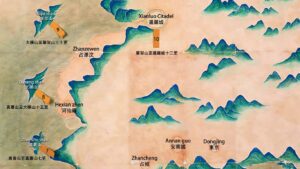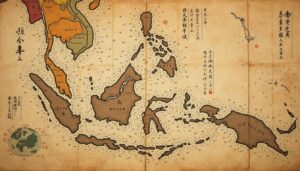

The “Miscellaneous Records of the Island Barbarians” (Dao Yi zazhi 島夷雜誌) is the name of a section within a kind of encyclopedia called the Expansive Record of the Forest of Affairs (Shilin guangji (事林廣記) that was compiled by Chen Yuanjing 陳元靚 in the second half of the thirteenth century
The section contains information about kingdoms in Southeast Asia and places further to the west that was gathered from official records from the Guangzhou Maritime Trade Superintendency (Shibosi 市舶司), Zhao Rukuo’s 1225 Treatise on the Various Barbarians (Zhufan zhi 諸蕃志, 1225), and perhaps other Song maritime and trade accounts.
The earliest edition that is still extant is a woodblock printed edition from 1325 that was reprinted in Japan in 1699. That text can be viewed here. It starts on page 469 of the file.
I’m presenting below a translation of the part of the “Miscellaneous Records of the Island Barbarians” that is about kingdoms in Southeast Asia. I don’t think a full English translation exists anywhere.
There are clearly a few erroneous characters in this edition, and they are generally corrected in later editions. I have put in brackets with “XYJS” what appears in a later edition, the Xiyuan Jingshe 西園精舎 edition of 1330-1333. That edition can be downloaded as a pdf here.
While this text might not seem to offer as much as other works from the period of the Song and Yuan dynasties, there are some details in it that are very important, and I’ll write about that below.
占城國
占城國在海西南。自廣州發舶至諸蕃,惟占城爲近,順風八日可達。國人多姓翁。廣舶到其國,即差蕃官。摺魚[黑]皮爲策,書白字,抄物數。監盤上岸,十取其二,外聽交易。如有隱漏,籍沒入官。若民入山爲虎所噬,或舟行被鰐魚之厄,其家指其狀詣王。王命國師作法,誦咒書符,投民死所,虎鰐即自投赴請命,殺之。若有欺詐誣害之訟,官不能明,令競主過鰐魚潭。其負理者,鰐魚即出食之,理直者雖過十餘次,鰐魚自避云。建隆、元祐間嘗入貢中國。[今大元奄有四海,諸蕃悉皆歸附矣。]
The Kingdom of Zhancheng [Champa]
The Kingdom of Zhancheng is located in the southwest of the sea. Among all the barbarian lands reached by ships sailing from Guangzhou, Zhancheng is the closest; with a favorable wind, one can arrive in eight days. Most of the people in this country have the surname “Weng” 翁.
When an ocean-going ship arrives in the kingdom, barbarian officials are immediately dispatched. They use folded black leather as tablets and write in white characters to record the quantity of goods. They oversee and inventory [the cargo that is] unloaded onto the shore, taking two parts out of ten as tax; the remainder is permitted for trade. If any goods are hidden or omitted from the record, they are confiscated by the officials.
If a commoner enters the mountains and is devoured by a tiger, or if one traveling by boat suffers the calamity of a crocodile, the family reports the circumstances to the king. The king then orders the National Preceptor [State Priest] to perform a ritual, chanting mantras and writing talismans, which are cast into the place where the person died. The tiger or crocodile will then voluntarily come forward to surrender and submit to its life being taken.
If there is a lawsuit involving fraud or false accusations that the officials cannot clarify, the disputing parties are ordered to cross a crocodile pond. For the one who is in the wrong, a crocodile will emerge and eat him; however, the one who is in the right may cross more than ten times, and the crocodiles will reportedly avoid them.
During the Jianlong [960–963 AD] and Yuanyou [1086–1094 AD] eras, they presented tribute to the Middle Kingdom.
[XYJS: Now the Great Yuan possesses the Four Seas, and all the barbarians have submitted.]
賓童龍
賓童龍隸占城,據[占]城選人作地主。出即騎象或馬。打紅繖,從者百人執盾,贊唱曰中打僕[亞或僕]。(番語也。) 以葉承飲。食椰子酒與米酒。歲貢方物於占城。今羅漢中有賓童盧尊者,蓋指此地。今訛爲童龍。佛書所謂王舍城即此地也。人云目連舍基尚存。
Bintonglong [Panduranga]
Bintonglong is a dependency [li 隸] of Zhancheng. Zhancheng selects a person to serve as the lord of the land [dizhu 地主]. When [the lord of the land] travels out, he rides either an elephant or a horse. Red parasols are held over him, and a hundred followers carry shields, chanting “Zhongdapu” [XYJS: “Ya” or “Pu”]. (These are words from the barbarian language.) They use leaves to hold their drinks, and they consume coconut wine and rice wine. Every year, they send a tribute of local products to Zhancheng.
Among the arhats is a figure called the “Venerable One of Bintonglu” [Bin-tong-lu Zunzhe 賓童盧尊者], which likely refers to this place. Nowadays, the name has been corrupted to “Tonglong.” What Buddhist scriptures refer to as Rajagriha [Wangshe cheng 王舍城] is said to be this very place; and people say that the foundation of the house belonging to Maudgalyayana [Mulian 目連] still exists there.
登流眉
登流眉屬眞﨟[臘]。選人作地主。椎髻纏帛蔽形。毎朝蕃主出座,名曰登場,衆蕃皆拜,[拜]罷同座。交手抱兩膊為禮,如中國叉手也。
Dengliumei
Dengliumei is under the jurisdiction of Zhenla. [The King of Zhenla] selects a person to serve as lord of the land. He wears his hair in mallet-shaped bun and wraps himself in cloth to cover his body.
Every morning, when the barbarian ruler comes out to hold court, it is called “ascend the platform” [deng chang 登場]. The barbarian masses bow to him; once the bowing is finished, they sit together. Their formal salutation consists of crossing their hands and clasping their own upper arms, which is similar to the Chinese “crossed-hand” [chashou 叉手] gesture.
眞﨟[臘]國
眞﨟[臘]國,舟行北風十日可到。天氣無寒。每嫁娶,則男歸女舍,最可笑一事。國人生女至九歲,即請僧誦經作梵法。以手指挑損童身,取其紅點女額。其母亦用點額,喚爲利市。云如此則其女他日嫁人,諧好歡洽,宜其室家。凡女滿十歲即嫁。若其妻與客合,夫即喜自詫云:我妻有姿色且巧慧,故人䁥云。國人犯盜,則斬手斷腳,燒火印胷背黥額。犯罪至死,則斬,或削木椓其尻死,令衆以當絞罪。蕃殺害唐人,即依蕃法償死。如唐人殺蕃人至死,即重罰金,如无金,則賣身取金贖。
The Kingdom of Zhenla
The Kingdom of Zhenla can be reached in ten days by boat when sailing with a north wind. The climate has no cold weather. In every marriage, the man joins the woman’s household; this is a most laughable matter. When a girl of the kingdom reaches the age of nine, a monk is invited to chant sutras and perform Sanskrit dharma rituals [Fanfa 梵法]. Using a finger, he takes her virginity, and with the blood, marks the girl’s forehead. Her mother also uses the blood to mark her own forehead, calling it “good fortune” [lishi 利市]. It is said that by doing this, the girl will have a harmonious and joyful marriage in the future, bringing prosperity to her household.
Every girl marries as soon as she reaches ten years of age. If a man’s wife has relations with a guest, the husband is delighted and boastfully says: “My wife has beauty and cleverness, and therefore people are intimately fond of her.”
If the people of the kingdom commit theft, their hands are chopped off and their feet amputated; they are branded on the chest and back with a hot iron and tattooed on the forehead. For capital crimes, the offender is beheaded, or a wooden stake is sharpened and driven into his buttocks until death, and the public is ordered to witness it as equivalent to execution by strangulation. If a barbarian kills a Tang person [i.e., Chinese], they must pay for the death according to barbarian laws. If a Tang person kills a barbarian, they are heavily fined; if they have no money, they must sell themselves into slavery to raise the funds for redemption.
三佛齊國,自廣州發舡,取正南去。冬日乘北風半月連夜,至凌牙門,五日方入三佛齊國。以木作柵爲城。別无產物。國人俱姓蒲。習水陸戰,臨敵敢死。官兵服藥,刀箭皆不能傷,以此覇於諸國。前後每國王,先用金鑄形質,以代其軀。運一室,以金爲器皿,供奉甚嚴。其金像器皿,各鐫誌示後人勿毀,代代如此。近世有一王,見所積金身金器頗多,竊之則罪至死,儲之則不敢開,盡載之舟,至大海沉之。舊傳:其國地面忽然穴,出生牛數萬,人取食之,後用竹木窒其穴,乃絕。國朝屢入貢 [no 國朝 and ends with 於中國]。
The Kingdom of Sanfoqi
The Kingdom of Sanfoqi: Setting off in a ship from Guangzhou, one heads due south. In winter, by riding the north wind for fifteen days and nights, one reaches Lingyamen 凌牙門. After five more days, one enters the Kingdom of Sanfoqi. They use wooden palisades to serve as citadel walls. There are no other [local] products.
The people of this kingdom all take the surname “Pu” 蒲. They are skilled in both naval and land warfare and are fearless in the face of the enemy. Their officers and soldiers ingest medicine so that neither blades nor arrows can wound them, and with this they dominate over the various kingdoms.
Each successive king, upon taking the throne, would first cast his likeness in gold to represent his own body. These were placed in a chamber where gold was also used for all the vessels and utensils, and they were venerated with great solemnity. These gold images and vessels each bore inscriptions instructing future generations not to destroy them, and this practice continued for generations.
In recent times, there was a king who saw that the accumulation of golden effigies and vessels was quite vast. Since stealing them was a crime punishable by death, and in accumulating them, he did not dare to reveal them, he loaded them all onto a boat, took them out to the deep sea, and sank them.
An old legend says: A hole once suddenly opened in the ground of this kingdom, and tens of thousands of live cattle emerged. The people took and ate them. Later, they used bamboo and wood to plug the hole, and the cattle ceased to appear.
[They] repeatedly sent tribute to our current dynasty [XYJS: “the Middle Kingdom” instead of “our current dynasty”].
單馬令
單馬令,唐舡自眞﨟[臘]風帆十晝夜,方到其國。无王有地主。國朝慶元二年,進金三埕、金傘一柄。
Danmaling [Tambralinga]
Danmaling: A Tang [i.e., Chinese] ship sailing from Zhenla takes ten days and nights with a favorable wind to reach this kingdom. There is no monarch; there is only a lord of the land. In the second year of the Qingyuan era of our current dynasty (1196 AD), they presented [as tribute] three jars of gold and one golden parasol.
佛囉安
佛囉安,自凌牙蘇家,風帆四晝夜可到。亦可遵陸。有地主,亦係三佛齊差來。其國有飛來銅佛二尊,名毗沙門王。佛内一尊有六臂,一尊有四臂。每年六月十五日,係佛生日,地人幷唐人迎引佛六尊出殿,至三日復回。其佛甚靈。如有外國賊舡,欲來劫奪佛殿珠寶,至港口即風發,舡不得前。多是就港口搶劫地人,往別國賣,每一人鬻金四兩或五兩。如國内民妻,與人有奸,即罰所奸人金四五兩,還本人。夫即以妻嫁與之。
Foluo’an
Foluo’an: It can be reached from Lingyasujia [Langkasuka] in four days and nights by sail. One can also travel by land. It has a lord of the land, who is also dispatched from Sanfoqi.
In this country, there are two flying bronze Buddha statues named Vaishravana [Pishamen wang 毗沙門王]. Among them, one statue has six arms and the other has four arms. Every year on the 15th day of the 6th lunar month, which is the Buddha’s birthday, the locals and Tang people welcome and escort six statues out of the temple hall; after three days, they are returned. These Buddhas are extremely miraculous. If foreign pirate ships intend to come and plunder the treasures of the Buddha hall, a gale will rise as soon as they reach the harbor mouth, and the ships will be unable to advance.
[Consequently, pirates] mostly resort to kidnapping locals at the harbor mouth to sell them in other kingdoms; each person is sold for four or five taels of gold.
If the wife of a local man commits adultery with someone, the adulterer is fined four or five taels of gold, which is paid to the husband. The husband then gives his wife to that man in marriage.
晏[王/它]蠻國
晏[王/它]蠻國。自蘭无里國去細蘭國,如風不順,飄至一所,地名晏[王/它]蠻,周圍七千里。人身如黑漆,能生食人。舡人不敢艤岸。山内无寸鐵,皆以𤥭璖蚌殼磨銛爲刃。其上有聖跡,用渾金作床,承一死人,經代不朽。常有巨蛇衞護。其蛇毛長二尺,人不敢近。有一井,每歲兩次,水溢流入於海,所過沙石,經此水浸皆成金。舊傳:曾有舶舡壞,舡人扶木飄至此山,潛以水筒盛滿。乘木信風,飄流至南毗國,以獻國王。試之果驗,遂發七舡,欲收併此山,未至,爲惡風所壞。舡人至山,盡爲山蠻所食。
The Kingdom of the Yantaman Savages
The Kingdom of the Yantaman Savages: If one is traveling from the Kingdom of Lanwuli [Lambri] to the Kingdom of Xilan [Ceylon] and the wind is unfavorable, one may drift to a place called Yantaman. It is approximately seven thousand leagues in circumference.
The people there have bodies as black as lacquer and are capable of eating humans alive. Sailors dare not moor their ships on the shore. Within the mountains, there is not a scrap of iron; they use giant clam shells ground sharp to serve as blades.
On [the mountain], there is a holy relic, a bed made of solid gold supporting a deceased person whose body has remained incorruptible through the ages. It is constantly guarded by a giant snake. This snake has hair two chi long, and no one dares approach it.
There is also a well that overflows twice a year, its water flowing into the sea. Any sand or stones soaked by this water turn into gold. An old legend says: A merchant ship once wrecked, and a sailor drifted to this mountain by clinging to a piece of wood. He secretly filled a water tube to the brim [with the well water]. Riding the wood and following the wind, he drifted to the Kingdom of Nanpi [Malabar Coast?] and presented the water to the king. When tested, it proved effective. Consequently, the king dispatched seven ships intending to seize and annex the mountain. Before they arrived, they were destroyed by evil winds. Those sailors who did reach the mountain were all eaten by the mountain savages.
大闍婆國
大闍婆國,名重迦盧。離莆家龍,風帆八日乃至。舊傳:國王係雷震石裂,有一人出,後立爲王,其子孫尚存。人物舉措,一如莆家龍。產青鹽,係海潮入田,曝成顆粒。及產綿羊鸚鵡及眞珠寶物之類。
The Kingdom of Great Shepo
The Kingdom of Great Shepo: Its name is also Zhongjialu. It can be reached from Pujialong in eight days by sail.
According to an old legend: The king originated when a stone was split apart by a thunderbolt; a man emerged from within, who was later established as the king, and his descendants survive to this day. The behavior and manners of the people are exactly the same as those in Pujialong.
The country produces green salt, which is made by letting the sea tide flow into fields and allowing it to dry in the sun until it forms granules. They also produce sheep, parrots, pearls, and various other treasures.
1) This is the first time that we find an entry on “Great Shepo” in a Chinese text. Zhao Rukuo’s 1225 Zhufan zhi mentions briefly this Great Shepo in a section on a place called “Sujitan,” but it is not described.
This is a reference to a polity on the island of Java. That is a region of Southeast Asia that Chinese did not engage with until the thirteenth century, and it slowly comes into view across various texts in this period, starting with the 1225 Zhufan zhi, then this Dao Yi zazhi compiled in the second half of the thirteenth century, then in the 1304 Dade Nanhai zhi, and finally in the 1349/50 Daoyi zhilue.
2) There are some details about political relationships in this text that are important. More specifically, the text mentions the following:
- Bintonglong is a dependency [li 隸] of Zhancheng. Zhancheng selects a person to serve as the lord of the land [dizhu 地主].
- Dengliumei is under the jurisdiction of Zhenla. [The King of Zhenla] selects a person to serve as lord of the land.
- [Tambralinga] There is no monarch; there is only a lord of the land.
- [Foluo’an] It has a lord of the land, who is also dispatched from Sanfoqi.
This final statement is important as it says that the lord of the land of Foluo’an “is also dispatched from Sanfoqi” (亦係三佛齊差來), however there is no previous mention of Sanfoqi dispatching a lord of the land to anyplace.
That said, given that the passage on Tambralinga says that there is no monarch, only a lord of the land, it is logical to assume that in an original text it probably indicated that this lord of the land was dispatched from Sanfoqi.
Further, there is inscriptional evidence of Cambodia appointing an official in this area.
The 1225 Zhufan zhi mentions a list of Sanfoqi’s dependencies that extend down the eastern coast of the Malay Peninsula and up the eastern coast of the island of Sumatra, and that list includes Tambralinga and Foluo’an.
The 1304 Dade Nanhai zhi describes a world in which different parts of the region were under the authority of different polities, and in places the eastern side of the Malay Peninsula under Tambralinga and the eastern side of the island of Sumatra under Sanfoqi.
Given that Sanfoqi previously appointed “lords of the land” to places on the eastern side of the Malay Peninsula, it could be the case that all of that area was still under Sanfoqi’s influence, or it could indicate that a rivalry had emerged.