
The Treatise on the Various Barbarians (Zhufan zhi 諸蕃志), completed in 1225 by Zhao Rukuo 趙汝适 (1170—1231), is a very important work for the study of early Southeast Asian history.
An English translation by Friedrich Hirth and W. W. Rockhill was published in 1911, as Chau Ju-kua: His Work on the Chinese and Arab Trade in the Twelfth and Thirteenth Centuries, Entitled Chu-fan-chï. That translation remained the only English-language translation for over a century until historian Shao-yun Yang published online a new translation in 2020, entitled A Chinese Gazetteer of Foreign Lands: A new translation of Part 1 of the Zhufan zhi 諸蕃志 (1225).
While both of these translations are valuable, I am convinced that they both impose a flawed understanding of key placenames, and in so doing, deeply distort our understanding of the past.
The most important issue concerns two places, Sanfoqi 三佛齊 and Shepo 闍婆. Hirth and Rockhill identified Sanfoqi as “Palembang (Eastern Sumatra)” and Shepo as “Java,” while Yang identifies these two places as “Srivijaya” (following the claim by George Cœdès in 1918 that Palembang was the center of a polity called “Srivijaya”) and “Java.”
I am convinced that these two identifications are wrong, and that conviction has grown stronger and stronger with each passing day in the six years that I have conducted research on this topic.
Pronounced 1,000 years ago something like “Samfutshiai,” Sanfoqi is literally the name “Kampuchea/Kambuja.” As for Shepo, this may represent the sound “java” or something similar to “java,” however it was not island Java. Instead, I argue that it was located somewhere in the middle of the Malay Peninsula around where Lake Songkhla is now located.
This “Java/Jaba” is well attested in Arabic sources as “Zabag.” However, in the 1200-1300s, Arabic and Chinese sources mention “two Javas,” and then finally by the time of the Ming dynasty (1368-1644), there is only one “java,” pronounced as “Zhuawa” 爪哇, which is clearly island Java. (See “The Two ‘Javas’ in Southeast Asia”)
The Zhufan zhi is one of the texts in which we can see “two Javas.” In fact, this work is particularly valuable because it documents how knowledge about island Java began to enter into the Chinese worldview. Let me explain.
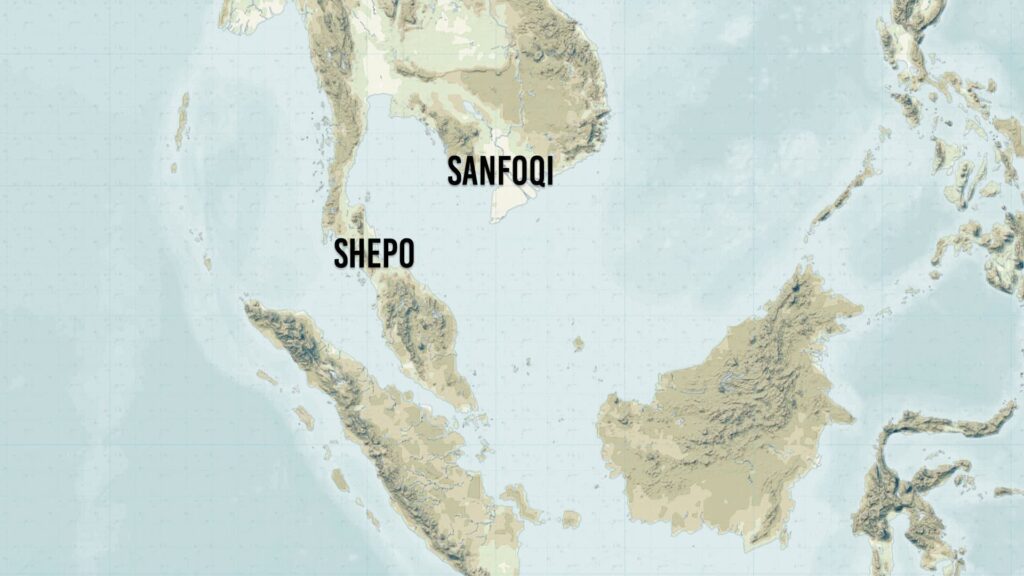
Key to understanding all of this is to first understand that throughout the first millennium AD, most maritime traffic followed the coasts and that overland trade routes across the Malay Peninsula were very important. Only a limited number of large ships, such as those coming from the Middle East, could pass directly from Tioman Island off the coast of the southeastern tip of the Malay Peninsula to the southern coast of what is now Cambodia and Vietnam. The majority of ships sailed around the Gulf of Thailand.
As they did so, they encountered two competing trade centers: Sanfoqi and Shepo. Sanfoqi, or “Kampuchea,” was inland from the coast of what is now southern Vietnam and Cambodia and was likely accessed by river and canals from the area of what is now Ha Tien. Shepo, which I prefer to transcribe as “Jaba” to distinguish it from island Java, was on the other side of the Gulf of Thailand in the area of what is now Lake Songkhla.
Both of these places had direct links to the large ships that came from the Middle East. While those ships could sail directly to what is now Ha Tien from Tioman Island, prior to that point those ships moored at Kedah, which was a short distance by a river and overland trading route to Shepo.
Both of these places appear to have become powerful by the end of the Tang dynasty period (618-907), and we learn from Song dynasty (960-1279) texts, such as the Zhufan zhi, that these two kingdoms were rivals. We also see below in the Zhufan zhi that in 992, Shepo invaded Sanfoqi.
That attack, I argue, was the beginning of Shepo’s ultimate downfall, as it led the Cambodians to form an alliance with the Chola kingdom, leading to a Chola attack on the area around Shepo’s center on the Malay Peninsula, as well as to Tamils taking control of Cambodia’s trade at Sanfoqi (See “The History of Cambodia You Never Knew About”).
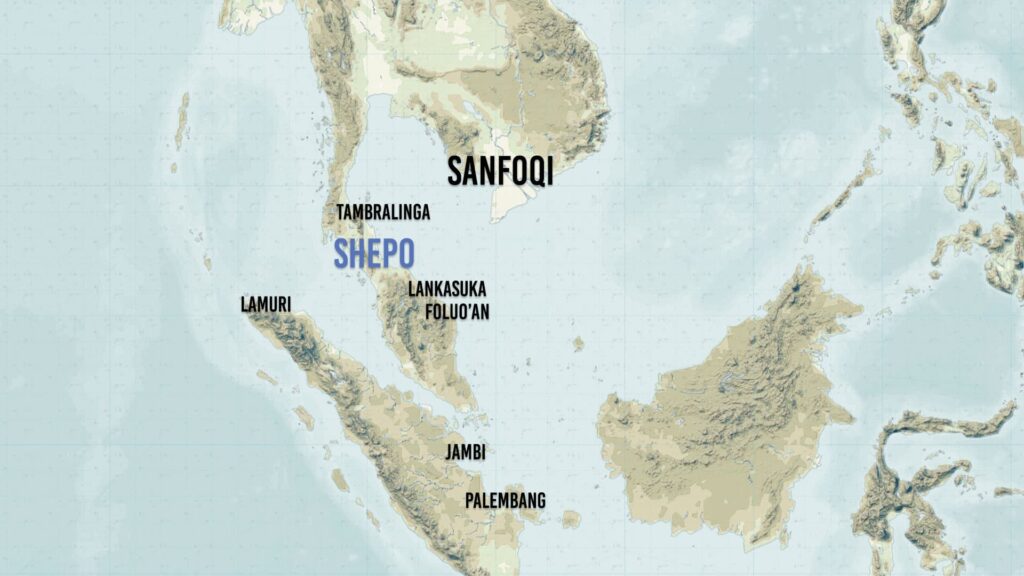
In the aftermath of the Chola attack, I argue that Sanfoqi created an alliance of coastal polities that extended down the east coast of the Malay Peninsula and up the eastern coast of the island of Sumatra, passing/avoiding both the Lake Songkha area and Kedah.
As more ships traveled this route, they gradually came in contact with the maritime world to the east, extending from island Java into the island world of what is now eastern Indonesia. In doing so, they came in contact with “the other Java,” and started to record information about it. This is something that we can see clearly in the Zhufan zhi.
With that as background, let us now examine the text. What is followed is a translation made by Grok. I prepared the text first, then fed it to Grok, and then checked and edited its translation. What has been translated is the part of the first chapter of the Siku Quanshu edition of the Zhufan zhi that deals with Southeast Asia.
While it is important to understand that Sanfoqi was Kampuchea/Kambuja and Shepo was someplace around Lake Songkhla, there are many other placenames that scholars have misunderstood, and we will address those issues in the comments below.
Further, I only comment below on issues that relate to this larger topic of my new understanding of the Chinese sources and the placenames in those sources.
Two final notes: 1) In the translations by Hirth and Rockhill, and Yang, the term fan 番 meaning “barbarian” is translated as “foreign.” Hence, fanshang 番商 becomes “foreign merchants.” I find this confusing because from our current perspective, “foreign merchants” could be seen to include Chinese merchants (since they were also “foreign” to the region), however, that was not the case. Instead, Zhao Rukuo used the term, fan, to refer to non-Chinese peoples, the “barbarians.” I have therefore translated fan as “barbarian” throughout to keep this distinction clear.
2) The Chinese term “guo” 國, with the basic meaning of “kingdom,” can be complex to translate. Ultimately, it almost always refers to a place with a single ruler – a “kingdom.” However, as we will see below, some “guo” were ruled over by a “lord of the land” (dizhu 地主).
I see that Yang solves this problem by simply not translating it, and thus, refers to “Jiaozhi guo” as simply Jiaozhi rather than “the Kingdom of Jiaozhi” or “the Jiaozhi kingdom,” etc. That is one approach.
I have taken another approach. In particular, I have translated guo as “kingdom” throughout, however I have just put that term right after the name (Jiaozhi Kingdom) instead of saying “the Kingdom of Jiaozhi” or “the Jiaozhi kingdom.” This makes for slightly clumsy English but it is meant to signal that the term “guo” is there.
[1a] 交趾國
交趾,古交州。東南簿海,接占城。西通白衣蠻。北抵欽州。歷代置守不絕,賦入至薄,守禦甚勞。皇朝重武愛人,不欲宿兵瘴癘之區,以守無用之土。因其獻款,從而羈縻之。
王係唐姓。服色飲食略與中國同,但男女皆跣足差 [1b] 異耳。每歲正月四日,椎牛饗其屬。以七月十五日為大節,家相問遺,官寮以生日獻其酋。十六日開宴酬之。歲時供佛,不祭先。病不服藥。夜不燃燈。樂以蚺蛇皮為前列。〈案此句未詳,疑有誤宇。〉不能造紙筆,求之省地。〈案省地二字句未詳。〉
土產沉香、蓬萊香、生金、銀、鐵、硃砂、珠、貝、犀、象、翠羽、車渠、鹽、漆、木綿吉貝之屬。歲有進貢。其國不通商。
以此首題,言自近者始也。舟行約十餘程抵占城國。
[1a] Jiaozhi Kingdom
Jiaozhi is the ancient Jiaozhou. To the southeast it reaches the sea, adjoining Zhancheng. To the west it communicates with the Baiyi Savages. To the north it reaches Qinzhou. Successive dynasties have stationed guards without interruption; the tax revenue is extremely meager, and the defense is exceedingly laborious. The imperial dynasty values martial strength and cherishes the people, and does not wish to station troops permanently in miasma-ridden regions in order to guard useless land. Because it offered submission, it was accordingly kept under loose reins [jimi 羈縻].
The king bears a Tang surname. In clothing colors and diet they are roughly the same as in the Middle Kingdom, but men and women all go barefoot, which is the difference. [1b] Every year on the fourth day of the first month, they slaughter oxen to feast their subordinates. They take the fifteenth day of the seventh month as the great festival; families exchange visits and gifts with one another, and the officials and clerks offer birthday presents to their chief. On the sixteenth day a banquet is opened to repay them. Throughout the seasons they make offerings to the Buddha and do not sacrifice to ancestors. When ill they do not take medicine. At night they do not light lamps. For music, python snake skin is used in the front ranks. (Note: this sentence is unclear, suspected erroneous characters.) They cannot make paper and brushes and seek them from the provincial lands. (Note: the two characters “sheng di” [provincial lands] in the sentence are unclear.)
The local products are agarwood, Penglai incense, raw gold, silver, iron, cinnabar, pearls, shells, rhinoceros, elephants, kingfisher feathers, giant clam shells, salt, lacquer, cotton products, and the like. Each year there are tribute presentations. This kingdom does not engage in trade.
This is placed as the first heading, indicating that it begins with the nearest. By boat, traveling about ten or more stages reaches Zhancheng Kingdom.
占城國
[2a] 占城,東海路通廣州,西接雲南,南至真臘;北抵交趾,通邕州。自泉州至本國,順風舟行二十餘程。其地東西七百里,南北三千里。國都號新州,有縣鎮之名;甃磚為城,護以石塔。
王出入乘象,或乘軟布兜,四人舁之 (案宋史外國列傳云,王出,近則乘軟布兜,遠則乘象,或乘一木杠,四人舁之,據此,則布兜下,當脫或乘一木杠五字) 頭戴金帽,身披瓔珞。王每出朝,坐輪,使女三十人持劍盾或捧檳榔從。官屬謁見,膜拜一而止。白事畢,膜拜一而退。婦人拜揖,與男子同。男女犯姦,皆殺;盜有斬指、斷趾之 [2b] 刑。戰則五人結甲,走則同甲皆坐以死。唐人被土人殺害,追殺償死。國人好潔,日三、五浴。以腦麝合香塗體,又以諸香和焚熏衣。四時融暖,無寒暑侯。每歲元月,牽象周行所居之地,然後驅逐出郭,謂之「逐邪」。四月有遊船之戲,陳魚而觀之。定十一月望日為冬至,州縣以土產物帛獻於王。民間耕種,率用兩牛。五穀無麥,有粳、粟、麻、豆。不產茶;亦不識醞釀之法,止飲椰子酒。果實有蓮、蔗、蕉、椰之屬。
土地所出,象牙、箋沉速香、黃蠟、烏樠木、白藤、 [3a] 吉貝、花布、絲絞布、白𣱃簟、孔雀、犀角、紅鸚鵡等物。官監民入山斫香輸官,謂之「身丁香」,如中國身丁鹽稅之類;納足,聽民貿易。不以錢為貨,惟博米、酒及諸食物以此充歲計。若民入山為虎所噬,或水行被鱷魚之厄,其家指其狀詣王,王命國師作法誦咒,書符投民死所,虎、鱷即自投赴請命,殺之。若有欺詐誣害之訟,官不能明,令競主同過鱷魚潭,其負理者魚即出食之;理直者雖過十餘次,鱷自避去。買人為奴婢,每一男子鬻金三兩,準 [3b] 香貨酬之。商舶到其國,即差官折黑皮為策,書白字,抄物數,監盤上岸;十取其二,外聽交易。如有隱瞞,籍沒入官。番商興販,用腦麝、檀香、草席、涼傘、絹扇、漆器、甆器、鉛、錫、酒、糖等博易。
舊州、烏麗、日麗、越里、微芮、賓瞳龍、烏馬拔、弄容、蒲羅甘、兀亮寶、毗齊,皆其屬國也。其國前代罕與中國通,周顯德中始遣使入貢。皇朝建隆、乾德間,各貢方物。太平興國六年,交趾黎桓上言,欲以其國俘九十三人獻於京師;太宗令廣州止其俘,存撫之。自是貢 [4a] 獻不絕,輒以器幣優賜,嘉其向慕聖化也。國南五、七日程,至真臘國。
Zhancheng Kingdom [Champa]
[2a] Zhancheng, to the east a sea route connects to Guangzhou, to the west it adjoins Yunnan, to the south it reaches Zhenla; to the north it touches Jiaozhi, communicating with Yongzhou. From Quanzhou to this kingdom, with favorable wind, boat travel takes more than twenty stages. Its territory measures seven hundred li east to west and three thousand li north to south. The capital is named Xinzhou and has the designations of counties and towns; the citadel walls are built of brick and protected by stone towers.
The king when going out or in rides an elephant, or rides a soft cloth litter carried by four men (According to the “Accounts of Foreign Countries”in the History of the Song, when the king went out, for short distances he rode in a soft-cloth litter, and for longer distances he rode an elephant, or else rode on a single wooden pole [stretcher] carried by four men. On the basis of this, the text below “cloth litter” should delete the five characters “or else ride on a single wooden pole”). On his head he wears a gold cap and on his body, he drapes strings of beads. Whenever the king goes out to hold court, he sits in a carriage with thirty maidservants holding swords and shields or carrying betel nut following behind. When officials and subordinates have audience, they make one full prostration and stop. After reporting their business, they make one full prostration and withdraw. Women’s bowing and saluting is the same as men’s.
Men and women who commit adultery are all put to death; for theft the punishments are [2b] cutting off fingers or severing toes. In battle five men form a unit; if they flee, all those in the same unit sit and await death. If Tang people are killed by natives, the killers are pursued and executed to repay the death.
The people of the kingdom love cleanliness and bathe three or five times a day. They mix camphor and musk with incense to anoint the body and also burn various incenses to fumigate their clothes.
The four seasons are warm and mild; there are no periods of cold or heat. Every year in the first month they lead elephants in a circuit around the inhabited area, then drive them out beyond the suburbs; this is called “expelling evil.” In the fourth month there is the game of touring boats in which fish are displayed for viewing. They fix the full moon of the eleventh month as the winter solstice; prefectures and counties present local products, goods, and silks to the king. In farming the common people mostly use two oxen. Among the five grains there is no wheat; there are non-glutinous rice, millet, hemp, and beans. They do not produce tea and also do not know the method of brewing; they only drink coconut wine. Fruits include lotus, sugarcane, banana, and coconut and the like.
The land produces ivory, jian-chen-su aromatic [3 grades of agarwood], yellow wax, ebony wood, white rattan, [3a] cotton, flower cloth, silk-twisted cloth, white cotton mats, peacocks, rhinoceros horn, red parrots, and similar items. Officials supervise the people entering the mountains to cut incense and deliver it to the government; this is called the “aromatic poll tax,” like the salt poll tax in the Middle Kingdom; once the quota is fully paid, the people are allowed to trade freely.
They do not use cash as currency but only barter rice, wine, and various foodstuffs to meet their annual needs.
If a commoner enters the mountains and is devoured by a tiger, or if one traveling by water suffers the calamity of a crocodile, the family reports the circumstances to the king. The king then orders the National Preceptor [State Priest] to perform a ritual, chanting mantras and writing talismans, which are cast into the place where the person died. The tiger or crocodile will then voluntarily come forward to surrender and submit to its life being taken.
If there is a lawsuit involving fraud or false accusations that the officials cannot clarify, the disputing parties are ordered to cross a crocodile pond. For the one who is in the wrong, a fish [My note: “fish” here should be “crocodile”] will emerge and eat him; however, the one who is in the right may cross more than ten times, and the crocodiles will reportedly avoid them.
When people are bought as slaves or servants, each male is sold for three taels of gold, reckoned [3b] in equivalent value of aromatic wood.
When merchant ships arrive in the kingdom, barbarian officials are immediately dispatched. They use folded black leather as tablets and write in white characters to record the quantity of goods. They oversee and inventory [the cargo that is] unloaded onto the shore, taking two parts out of ten as tax; the remainder is permitted for trade. If any goods are hidden or omitted from the record, they are confiscated by the officials.
Barbarian merchants trading goods use camphor, musk, sandalwood, grass mats, parasols, silk fans, lacquerware, porcelainware, lead, tin, wine, sugar, and similar items for barter.
Jiuzhou, Wuli, Rili, Yueli, Weirui, Bintonglong, Wumaba, Nongrong, Puluo Gan, Wuliangbao, and Pizhai are all its subordinate kingdoms. In previous dynasties this kingdom rarely communicated with the Middle Kingdom; it was only in the Xiande era [954-960 AD] of the [Later] Zhou that it first sent envoys to present tribute. During the Jianlong [960-963 AD] and Qiande [963-968 AD] eras of the imperial dynasty, each time it presented local products. In the sixth year of the Taiping Xingguo era [981 AD], Lê Hoàn of Jiaozhi submitted a memorial wishing to present ninety-three captives [from Zhancheng] to the capital; Taizong ordered Guangzhou to halt the captives and comfort them. From then on, the presentation of [4a] tribute has continued without interruption, and each time they are generously rewarded with vessels and currency in praise of their admiration for sagely transformation.
Five to seven days’ journey south of the kingdom one reaches the Kingdom of Zhenla.
The original text did not have punctuation. As such, when the text lists names of subordinate kingdoms (or “vassals”), it can be difficult to know when one name ends and another begins because many names only appear in this text.
So, for instance, for the last four names, Hirth and Rockhill have Lung-yung (Nongrong), P’u-lo-kan-wu (Puluoganwu), Liang-pau (Liangbao), and Pi-ts’i [should be P’i] (Piqi), and Yang has “Banong (unidentified), Rongpuluogan ( Yan Po Nagar = Kauthara ), Guliang (unidentified), and Baopiqi (Vijaya).”
However, in Rockhill and Hirth’s “Pulouganwu” and Yang’s “Rongpuluogan” I see “Puluo Gan,” which could be “Pulau Cham.” As such, the sections of this text that list subordinate kingdoms are difficult to decipher and what has been written to date is not necessarily accurate.
賓瞳龍國
賓瞳龍國,地主手飾、衣服,與占城同。以葵蓋屋,木作柵護。歲貢方物於占城。今羅漢中有賓頭盧尊者,蓋指此地言之;賓瞳龍音訛也。或云目連舍基尚存。
雍熙四年,同大食國來貢方物。
Bintonglong Kingdom [Panduranga]
Bintonglong Kingdom; the ruler of the land’s hand ornaments and clothing are the same as in Zhancheng. They cover their houses with palm leaves and construct wooden palisades for protection. Each year they present local products as tribute to Zhancheng.
Among the arhats is a figure called the “Venerable One of Bintonglu” [Bin-tong-lu Zunzhe 賓童盧尊者], which likely refers to this place. “Bintonglong” is a phonetic error. Some people say that the foundation of the house belonging to Mulian 目連 [Maudgalyayana] still exists there.
In the fourth year of the Yongxi era [987], together with Dashi Kingdom they came to present local products as tribute.
真臘國
[4b] 真臘,接占城之南,東至海,西至蒲甘,南至加羅希。自泉州舟行,順風月餘日可到。其地約方七千餘里。國都號祿兀。天氣無寒。
其王妝束大概與占城同,出入儀從則過之。間乘輦駕,以兩馬或用牛。其縣鎮,亦與占城無異。官民悉編竹覆茅為屋。惟國王鐫石為室,有青石蓮花池沼之勝,跨以金橋,約三十餘丈。殿宇雄壯,侈麗特甚。王坐五香七寶床,施寶帳,以紋木為竿、象牙為壁。群臣入朝,先至階下三稽首,升階則跪,以兩手抱膊,繞王環 [5a] 坐。議政事訖,跪伏而退。西南隅銅臺上列銅塔二十有四,鎮以八銅象,各重四千斤。戰象幾二十萬,馬多而小。奉佛謹嚴。日用番女三百餘人,舞獻佛飯,謂之阿南;即妓弟也。其俗淫,姦則不問。犯盜則有斬手、斷足、燒火、印胸之刑。其僧道咒法靈甚。僧衣黃者,有室家;衣紅者,寺居,戒律精嚴。道士以木葉為衣。有神曰婆多利,祠祭甚謹。以右手為淨,左手為穢;取雜肉羹與飯相和,用右手掬而食之。厥土沃壤,田無畛域,視力所及而耕種之。米 [5b] 穀廉平,每兩烏鉛可博米二㪷。
土產象牙、暫速細香、粗熟香、黃蠟、翠毛 (此國最多)、篤耨腦、篤耨瓢、番油、姜皮、金顏香、蘇木、生絲、綿布等物。番商興販,用金銀、甆器、假錦、涼傘、皮皷、酒、糖、醯醢之屬博易。
登流眉、波斯蘭、羅斛、三灤、真里富、麻羅問、綠洋、吞里富、蒲甘、窊裏、西棚、杜懷、潯番,皆其屬國也。本國舊與占城鄰好,歲貢金兩。因淳熙四年五月望日占城主以舟師襲其國都,請和不許,殺之,遂為大仇,誓必復怨。慶元己未,大舉入占城,俘其主、戮其 [6a] 臣僕,剿殺幾無噍類;更立真臘人為主。占城今亦為真臘屬國矣。
唐武德中,始通中國。國朝宣和二年,遣使入貢。其國南接三佛齊屬國之加羅希。
Zhenla Kingdom
[4b] Zhenla adjoins the south of Zhancheng, to the east reaches the sea, to the west reaches Pugan, to the south reaches Jialuoxi. From Quanzhou by boat, with favorable wind, more than a month can reach it. Its territory is approximately than seven thousand leagues or more square. The capital is named Luwu. There is no cold weather.
The king’s attire and adornment are generally the same as in Zhancheng, but the retinue when going out or in surpasses it. Occasionally he rides in a palanquin drawn by two horses or using oxen. Its districts and towns are also no different from Zhancheng. Officials and commoners all weave bamboo and cover with thatch to make houses. Only the king carves stone for his residence, possessing the excellence of blue-stone lotus flower ponds and marshes, spanned by a gold bridge about thirty some zhang. The palace halls are majestic and grand, especially extravagant and ornate. The king sits on a bed of precious aromatic wood and treasured materials [literally a “five-aromatic seven-treasure” bed], with a jeweled canopy, using patterned wood for poles and ivory for walls. When the assembled ministers enter court, they first go below the steps and perform three kowtows, then ascend the steps and kneel, embracing their arms with both hands, and sit encircling the king [5a] in a ring. After discussing government affairs they kneel, prostrate, and withdraw.
In the southwest corner on a bronze platform are arrayed twenty-four bronze towers, guarded by eight bronze elephants, each weighing four thousand jin. War elephants number nearly 200,000; horses are many but small.
They serve the Buddha with strict reverence. Daily they employ more than 300 barbarian women to dance and offer rice to the Buddha, called “anan” [Sanskrit “anna”; Tamil “annam” = cooked rice]; these are courtesans. Their customs are licentious; adultery is not inquired into. Those who commit theft face punishments of cutting off hands, severing feet, burning with fire, or branding the chest. Their monks and Daoists’ incantation methods are very efficacious. Monks who wear yellow have wives and families; those who wear red reside in temples, observing the precepts and rules. Daoists use tree leaves as clothing. There is a god called Poduoli 婆多利, whose shrine and sacrifices are performed with great care.
They regard the right hand as pure and the left hand as impure; they take mixed meat broth and combine it with rice, then scoop and eat it with the right hand.
Its soil is fertile and rich; fields have no boundaries and are cultivated wherever their strength reaches. Rice [5b] and grain are cheap and abundant; every two taels of black lead can barter for two dou of rice.
The land produces ivory, fine-grade zhan-su aromatic [2 grades of agarwood], coarse ripe aromatic, yellow wax, kingfisher feathers (this kingdom has the most), fine dunou resin, dunou gourd, barbarian oil, ginger peel, jinyan aromatic, sappanwood, raw silk, cotton cloth, and similar items. Foreign merchants trading goods use gold, silver, porcelainware, imitation brocade, parasols, leather drums, wine, sugar, fish sauce and the like for barter.
Dengliumei, Bosilan, Luohu, Sanluan, Zhenlifu, Maluowen, Luyang, Tunlifu, Pugan, Wali, Xipeng, Duhuai, and Xunfan are all its subordinate kingdoms.
This kingdom formerly maintained friendly relations with Zhancheng as neighbors and annually presented tribute of gold taels. Because on the full moon of the fifth month in the fourth year of the Chunxi era [1177 AD] the ruler of Zhancheng attacked its capital with a naval force, requested peace but was refused, and was killed, they became great enemies and swore to take revenge. In the jiwei year of the Qingyuan era [1199 AD] they launched a major invasion of Zhancheng, captured its ruler, slaughtered his [6a] ministers and servants, and massacred almost to the point that none were left alive; they then installed a Zhenla person as ruler. Zhancheng is now also a subordinate kingdom of Zhenla.
In the Wude era of the Tang [618-626 AD] it first made contact with the Middle Kingdom. In the second year of the imperial dynasty’s Xuanhe era [1120 AD] it sent envoys to present tribute. To the south this kingdom adjoins Jialuoxi, a subordinate kingdom of Sanfoqi.
1) Historians have I think unanimously viewed Zhenla as “Cambodia.” However, it is not that simple. “Cambodia” was not a “country” with a “capital,” but instead, was a typical premodern “mandala” polity, with a powerful center and surrounding subordinate kingdoms or polities. Further, some of those subordinate kingdoms existed within the geographic bounds of what is today “Cambodia.” (See “Zhenlifu (Chen-li-fu) was NOT in Thailand”)
This is a point which scholars have long failed to recognize. Instead, for instance, when they have seen that a place is listed as a subordinate kingdom of “Zhenla,” they have gone through the following mental process: Zhenla = the country of Cambodia, and therefore, this subordinate kingdom must be somewhere outside the geographic bounds of the country of Cambodia.
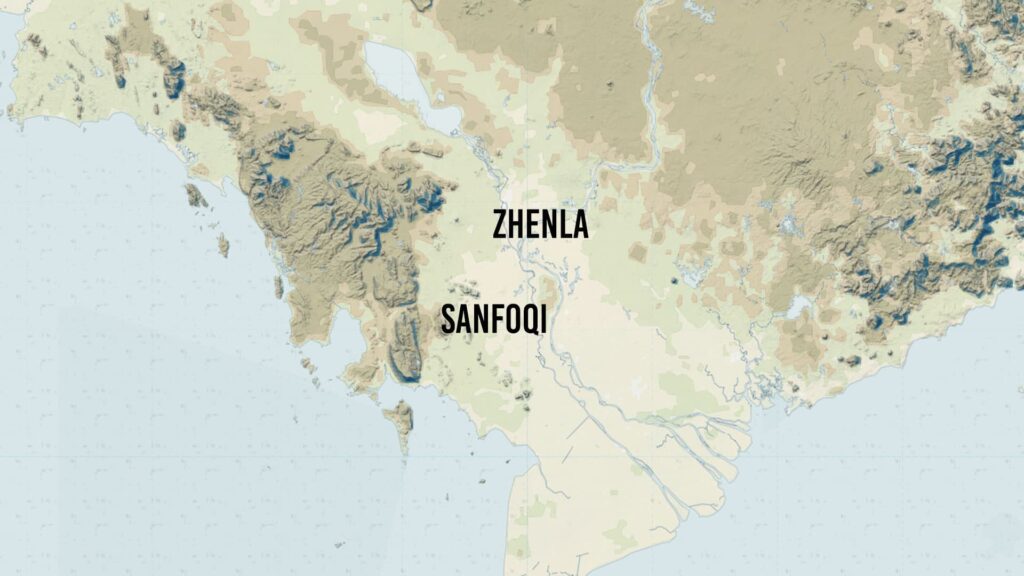
Assuming that Angkor was the powerful center during this period, I would argue that Zhenla and Sanfoqi were both subordinate kingdoms of that powerful center. Zhenla was probably accessed from the east (perhaps up the Saigon River and then by canals and/or overland? or up the Mekong?) and Sanfoqi was accessed from the south, from what is now Ha Tien. Further. Other than the one account of Zhou Daguan in the late thirteenth century, there is no record of Chinese traveling to Angkor.
Further, I would argue that some of the contact and trade with both Zhenla and Sanfoqi actually occurred on or near the coast. Polities were inland from the coast in the past for a reason – safety, and that, I think, is why we have such little information about inland Cambodia in Chinese sources.
2) “The capital is named Luwu.” Yang has here “Its capital is called Lugu ( Nokor = Angkor ).” The two characters here (祿兀) are pronounced “Luwu,” as Hirth and Rockhill transcribed it. Hirth and Rockhill suggested that it could indicate “Lovek” (Longvek), a place to the north of what is now Phnom Penh. However, they noted that Paul Pelliot disagreed, arguing that “the capital of Cambodia” at this time was Angkor.
If I were to guess, then yes, I would guess that Luwu is referencing Longvek, and following what I said in #1 (that we are not looking at “countries” with their “capitals”), it doesn’t matter that the powerful center of the Cambodian mandala was at Angkor, because Chinese did not deal directly with Angkor. They dealt with its subordinate kingdoms of Zhenla and Sanfoqi, and the “capital” of Zhenla could have been at Longvek.
3) There is a lot that we can learn from the lists of “local products” that are included with the descriptions of each kingdom. As we will see below, Sanfoqi essentially did not have local products. Instead, it collected together valuable products from foreign lands. Zhenla, by contrast, did have unique products such as “kingfisher feathers (this kingdom has the most), fine dunou resin, dunou gourd. . . jinyan aromatic.” My guess is that this is because it had access to the forested interior of areas in what is now northern Cambodia, southern Laos, and perhaps even parts of the Central Highlands of Vietnam.
4) Related to this point, we should not take literally the statement that “Pugan” (Bagan) was a subordinate kingdom of Zhenla. Instead, what I think this indicates is that Zhenla had (overland) access to Bagan, and it is through that access that the Chinese were able to obtain certain valuable goods from that distant land.
登流眉國 (案登流眉宋史作丹流眉)
登流眉國,在真臘之西。地主椎髻簪花,肩紅蔽白;朝日登場,初無殿宇。飲食以葵葉為碗,不施匕箸,掬而食之。有山曰無弄,釋涅盤示化銅象在焉。
產白豆蔻、箋沉速香、黃蠟、紫礦之屬。
Dengliumei Kingdom (Note: Dengliumei in the History of the Song is written as Danliumei)
Dengliumei Kingdom is located to the west of Zhenla. The lord of the land wears a mallet-shaped topknot pinned with flowers, red [robe] on the shoulders covering white; at sunrise he ascends the platform, originally without palace halls. For eating and drinking they use palm leaves as bowls, without employing spoon or chopsticks, scooping it up to eat. There is a mountain called Wunong, where a bronze image of Śākyamuni’s nirvāṇa manifestation is located.
It produces white cardamom, jian-chen-su aromatic [grades of agarwood], yellow wax, palash gum, and the like.
I think everyone who has written about Dengliumei has placed it on the Malay Peninsula. It was not. This is an inland dependency of Zhenla. I will write in detail about this later.
[6b] 蒲甘國
蒲甘國,官民皆撮髻於額,以色帛繫之;但地主別以金冠。其國多馬,不鞍而騎。其俗奉佛尤謹,僧皆衣黃。地主早朝,官僚各持花來獻;僧作梵語祝壽,以花戴王首,餘花歸寺供佛。國有諸葛武侯廟。
皇朝景德元年,遣使同三佛齊、大食國來貢,獲預上元觀燈。崇寧五年,又入貢。
[6b] Pugan Kingdom [Bagan]
Pugan Kingdom; officials and commoners all bunch their hair into a knot on the forehead, binding it with colored silk; but the lord of the land specially uses a gold crown. This kingdom has many horses and they ride without saddles. Their custom is to serve the Buddha with especial reverence; all monks wear yellow. When the lord of the land holds morning court, the officials each carry flowers to present; monks recite in Sanskrit to wish longevity, placing flowers on the king’s head, while the remaining flowers are returned to the temple to offer to the Buddha. The kingdom has a Zhuge Wuhou Temple.
In the first year of the imperial dynasty’s Jingde era [1004 AD], it dispatched envoys together with Sanfoqi and Dashi Kingdom to present local products as tribute and obtained the privilege to view the lanterns at the Shangyuan festival. In the fifth year of the Chongning era [1106 AD], it again presented tribute.
Again, how does Bagan get included in a work on maritime Southeast Asia? It is because Zhenla had overland access to it.
三佛齊國
三佛齊,間於真臘、闍婆之間;管州十有五,在泉之正南。 [7a] 冬月順風,月餘方至凌牙門。經商三分之一始入其國。國人多姓蒲。累甓為城,周數十里。國王出入乘船,身纏縵布,蓋以絹傘,衛以金鏢。其人民散居城外,或作牌水居,鋪板覆茅。不輸租賦。習水陸戰,有所征伐,隨時調發;立酋長率領,皆自備兵器、糗糧,臨敵敢死,伯於諸國。無緡錢,止鑿白金貿易。四時之氣多熱少寒,豢畜頗類中國。有花酒、椰子酒、檳榔蜜酒,皆非曲蘗所醞,飲之亦醉。國中文字用番書,以其王指環為印;亦有中國文字,上 [7b] 章表則用焉。國法嚴,犯姦男女悉置極刑。國王死,國人削髮成服;其侍人各願殉死,積薪烈焰,躍入其中,名曰「同生死」。有佛名金銀山,佛像以金鑄。每國王立,先鑄金形以代其軀;用金為器皿,供奉甚嚴。其金像、器皿各鐫誌示,後人勿毀。國人如有病劇,以銀如其身之重,施國之窮乏者,示可緩死。俗號其王為龍精,不敢穀食,惟以沙糊食之;否則,歲旱而穀貴。浴以薔薇露,用水則有巨浸之患。有百寶金冠,重甚;每大朝會,惟王能冠之,他人 [8a] 莫勝也。傳禪則集諸子以冠授之,能勝之者則嗣。舊傳其國地面忽裂成穴,出牛數萬成群,奔突入山,人競取食之;後以竹木窒其穴,遂絕。
土地所產,玳瑁、腦子、沉速暫香、粗熟香、降真香、丁香、檀香、豆蔻,外有真珠、乳香、薔薇水、梔子花、膃肭臍、沒藥、蘆薈、阿魏、木香、蘇合油、象牙、珊瑚樹、貓兒睛、琥珀、番布、番劍等,皆大食諸番所產,萃於本國。番商興販,用金銀、甆器、錦綾、纈絹、糖、鐵、酒、米、乾良薑、大黃、樟腦等物博易。其國在海中,扼諸番舟車往 [8b] 來之咽喉。古用鐵䌇為限,以備他盜,操縱有機;若商舶至,則縱之。比年寧謐,撤而不用;堆積水次,土人敬之如佛。舶至,則祠焉;沃以油則光焰如新,鱷魚不敢踰為患。若商舶過不入,即出船合戰,期以必死。故國之舟輻湊焉。
蓬豐、登牙儂、凌牙斯加、吉蘭丹、佛羅安、日羅亭、潛邁、拔沓、單馬令、加囉希、巴林馮、新拖、監篦、藍無里、細蘭,皆其屬國也。其國自唐天祐始通中國。皇朝建隆間,凡三遣貢。淳化三年,告為闍婆所侵,乞降詔諭本國;從之。咸 [9a] 平六年,上言本國建佛寺以祝聖壽,願賜名及鐘。上嘉其意,詔以「承天萬壽」為額,併以鐘賜焉。至景德、祥符、天禧、元祐、元豐,貢使絡繹,輒優詔獎慰之。其國東接戎牙路(或作重迦盧。)
Sanfoqi Kingdom
Sanfoqi lies between Zhenla and Shepo; it governs fifteen regions and is located due south of Quan[zhou]. [7a] In the winter months with favorable wind, more than a month is required to reach Lingyamen [Lingya Gate 凌牙門]. Only after one-third has been traded does one then enter the kingdom. The people of the kingdom mostly bear the surname Pu. They pile up bricks to make the city wall, which measures several tens of leagues around.
When the king goes out or in he rides a boat, his body wrapped in coarse cloth, covered by a silk umbrella, and guarded by men with gold spears.
His people live scattered outside the city, or they make raft dwellings on the water, laying boards and covering them with thatch. They do not pay land or poll taxes. They practice warfare on both water and land; when there is a campaign of conquest, levies are raised as needed; chieftains are appointed to lead them, and all supply their own weapons and dry rations. When facing the enemy, they fight to the death and are feared by the other kingdoms.
They have no copper cash and only chisel white silver for trade. The climate of the four seasons is mostly hot and rarely cold; the raising of livestock is quite similar to the Middle Kingdom. They have flower wine, coconut wine, and betel-honey wine; none are fermented with yeast, yet drinking them also causes intoxication.
In the kingdom writing is done with barbarian script, sealed with the king’s finger ring as the stamp; they also have Chinese writing, which is used for [7b] memorials and petitions. The laws of the kingdom are strict; men and women who commit adultery are all put to the ultimate penalty. When the king dies, the people of the kingdom cut their hair and wear mourning apparel; each of his attendants voluntarily wishes to follow him in death, piling up firewood into a fierce blaze and leaping into it; this is called “sharing life and death.”
There is a Buddha named Gold and Silver Mountain, which is a Buddha image cast in gold. Whenever a new king is installed, he first casts a gold figure to replace his own body; he uses gold for vessels and utensils, and the offerings are performed with great solemnity. Each gold image and vessel is engraved with an inscription to show that later generations must not destroy them. If a person of the kingdom suffers a severe illness, he donates silver equal to the weight of his own body to the poor and destitute of the kingdom, indicating that his death may be postponed. The custom is to call the king “dragon essence.” [People] dare not to let him eat grain but only give him sago to eat; otherwise, the year will have a drought and grain will become expensive. They bathe him with rose dew; if ordinary water is used there will be the calamity of great flooding.
There is a hundred-treasure gold crown, extremely heavy; at every grand court assembly only the king is able to wear it; no other person [8a] can bear it. When the throne is transmitted, all the sons are assembled and the crown is given to them; the one who can bear it succeeds. It is traditionally said that the ground of this kingdom suddenly split open into a hole from which several tens of thousands of oxen emerged in a herd, rushing and charging into the mountains; the people competed to catch and eat them. Later they blocked the hole with bamboo and wood, and the phenomenon ceased.
The land produces hawksbill turtle, camphor, chen-su-zhan aromatics [3 grades of agarwood], coarse ripe aromatic, lakawood, cloves, sandalwood, and cardamom; in addition there are pearls, frankincense, rose water, gardenia flowers, wanaqi [a marine-animal drug], myrrh, aloes, asafoetida, costus root, storax oil, ivory, coral trees, cat’s-eye gems, amber, barbarian cloth, barbarian swords, and the like; all are products of Dashi and the various barbarian lands, gathered together in this kingdom. Barbarian merchants trading goods use gold, silver, porcelainware, brocade damask, patterned silk, sugar, iron, wine, rice, dried galangal, rhubarb, camphor, and similar items for barter.
This kingdom lies in the middle of the sea and controls the throat of the [8b] passage of all foreign ships and carts. In ancient times an iron chain was used as a barrier to guard against other robbers; it was operated by a mechanism. If a merchant ship arrived, the chain was released. In recent years, with peace and quiet, it has been removed and is no longer used; it is piled up by the water’s edge, and the natives revere it as they would a Buddha. When a ship arrives, they sacrifice to it; if oil is poured upon it the light and flame become as new, and crocodiles dare not cross and cause trouble. If a merchant ship passes by without entering, they immediately launch boats to join battle, resolved to fight to the death. Therefore, the boats of all kingdoms converge here like spokes to a hub.
Pengfeng, Dengyanong, Lingyasijia, Jilandan, Foluoan, Riluoting, Qianmai, Bata, Danmaling, Jialuoxi, Balinfeng, Xintuo, Jianbi, Lanwuli, and Xilan are all its subordinate kingdoms.
This kingdom first communicated with the Middle Kingdom in the Tianyou era of the Tang [904-907 AD]. In the imperial dynasty’s Jianlong era [960-963 AD] it sent tribute three times altogether. In the third year of the Chunhua era [992 AD] it reported that it had been invaded by Shepo and begged that an imperial edict be issued to instruct Shepo; this was granted. In the sixth year of [9a] the Xianping era [1003 AD] it memorialized that the kingdom had built a Buddhist temple to pray for sagely longevity [of the emperor] and requested that a name and a bell be bestowed. The emperor praised its intention and decreed that “Receiving from Heaven Ten Thousand Years of Longevity” be the plaque, and at the same time bestowed the bell. Down to the Jingde [1004-1007 AD], Xiangfu [1008-1016 AD], Tianxi [1017-1021 AD], Yuanyou [1086-1094], and Yuanfeng [1078-1085 AD] eras, the tribute envoys came in unbroken succession, and each time generous edicts of commendation and comfort were issued. This kingdom to the east adjoins Rongyalu (or written as Zhongjialu).
1) In the two articles that I have published to date on “Rescuing History from Srivijaya,” I provide extensive information to support my argument that Sanfoqi was in Cambodia, so I will not repeat that here.
I don’t know exactly where exactly Sanfoqi’s “capital” was, but perhaps it was Angkor Borei. That would make sense, as it would mean that the Chinese were in contact with two important centers outside of the main center of Angkor, that is, Longek (Zhenla) and Angkor Borei (Sanfoqi). And again, I sense that Zhenla was accessed from the east, whereas Sanfoqi was clearly accessed from the south.
What I want to note here about the above passage is that we can see that the people of Sanfoqi were BADASS!!! They come across as the Spartans of Southeast Asia: trained warriors who kicked ass on any ships that tried to pass by without trading (or without letting them confiscate some of the goods).
Taking a step back, and considering the fact that Angkor was at that time one of the world’s largest population centers, and that it would build the most impressive structures in the region, it makes TOTAL SENSE that they would dominate the international trade in the region.
This was essential because Sanfoqi did not have much wealth of its own. Instead, as the text notes, “all are products of Dashi [meaning, in general, the world of South Asia and the Middle East] and the various barbarian lands, gathered together in this kingdom.
Further, we can also see how dynamic this place was, and how much contact it had with China. By contrast, Zhenla was a sleepy backwater. In other words, besides all of the evidence that I have provided in my publications to support the point that Sanfoqi was in “Cambodia,” at a general level we can also see here that this is talking about the most dynamic place in the region, and in this time period, that could only have been the Cambodian world with Angkor at its center.
2) Let us look at the list of subordinate kingdoms: Pengfeng, Dengyanong, Lingyasijia [Langkasuka], Jilandan [Kelantan?], Foluoan [on the Malay Peninsula], Riluoting, Qianmai, Bata, Danmaling [Tambralinga], Jialuoxi [Grahi], Balinfeng [Palembang], Xintuo, Jianbi [Jambi], Lanwuli [Lamburi], and Xilan [Ceylon] are all its subordinate kingdoms.
The first point I would make is that this is the only time that the name “Palembang” Balinfeng 巴林馮 appears in Chinese sources. And nothing is recorded about it. . . Yes, there is another place that is mentioned in later sources, Baolinbang, which scholars have argued is Palembang, but I have provided extensive evidence in my two published articles demonstrating that this is incorrect.
The other point that I would make is that here is where we see an alliance of subordinate kingdoms that extends down the east coast of the Malay Peninsula and up the east coast of the island of Sumatra. This alliance, I argue, was established to circumvent Shepo in the Lake Songkhla area with its close connections with Kedah.
I wrote about this a long time ago in “Srivijaya 13: The Singora-Angkor Rivalry: The Greatest Story of Premodern Southeast Asian History (You’ve Never Heard).”
3) This passage ends by stating that “This kingdom to the east adjoins Rongyalu (or written as Zhongjialu).” Rongyalu/Zhongjialu, as we will see below, was on the island of Java. So, if Sanfoqi was Kampuchea/Kambuja, how can this statement make sense?
First, the location of this statement is suspect. This statement is odd because the passage on Sanfoqi begins with a statement about its location, “Sanfoqi lies between Zhenla and Shepo.” Why would Zhao Rukuo then add a statement about its location at the end as well?
I highly doubt that that the statement at the end was in Zhao Rukuo’s original text. First, it was easiest for later compilers to add information to the beginning and end of passages, and therefore, it’s location makes it suspect for that reason, but also for another.
As we will see below, Zhao Rukuo was confused about the area of island Java. He did not have a clear sense of where or what it was. This is because much of the information he recorded about island Java was information that he recorded for the first time, and as we will see, he clearly did not understand it well.
One has to read my articles to understand this issue, as it is complex, but in the 1600s, Chinese scholars did make a (flawed) connection between Sanfoqi and the area of southern Sumatra. My guess would be that this statement was added after that point.
This would have been easy to do because the Zhufan zhi has not survived as an intact text from the Song dynasty period when it was originally compiled. Instead, in the Qing dynasty period (1644-1911) it was “reconstructed” from citations in the Ming dynasty period encyclopedia, the Yongle dadian 永樂大典.
單馬令國
單馬令國,地主呼為相公。以木柵為城,廣六、七尺,高二丈餘;上堪征戰。國人乘牛,打鬃跣足。屋舍官場用木、 [9b] 民居用竹,障以葉、繫以藤。
土產黃蠟、降真香、速香、烏樠木、腦子、象牙、犀角。番商用絹傘、雨傘、荷池纈絹、酒、米、鹽、糖、甆器、盆缽麄重等物及用金銀為盤盂博易。
日囉亭、潛邁、拔沓、加囉希類此。本國以所得金銀器、糾集日囉亭等國類聚獻入三佛齊國。
Danmaling Kingdom [Tambralinga]
Danmaling Kingdom, the ruler of the land is called His Excellency [xianggong 相公]. They use wooden palisades as the city wall, six or seven chi wide and more than two zhang high; the top is suitable for waging war. The people of the kingdom ride oxen, with tied topknots and barefoot. Official houses and government markets use wood, [9b] common dwellings use bamboo, screened with leaves and tied with rattan.
The local products are yellow wax, lakawood, su agarwood, ebony wood, camphor, ivory, and rhinoceros horn. Barbarian merchants use silk parasols, rain parasols, lotus-pond patterned silk, wine, rice, salt, sugar, porcelainware, coarse heavy basins and bowls and the like, as well as gold and silver plates and bowls for barter.
Riluoting, Qianmai, Bata, Jialuoxi and the like are similar to this. This kingdom takes the gold and silver vessels it has obtained, assembles those from Riluoting and other kingdoms of the same category, gathers them together, and presents them to Sanfoqi Kingdom.
凌牙斯國
凌牙斯國,自單馬令風帆六晝夜可到,亦有陸程。地主纏縵跣足;國人剪髮,亦纏縵。
地產象牙、犀角、速暫香、生香、腦子。番商興販,用酒、米、荷池纈絹、甆器等為貨;各先 [10a] 以此等物准金銀,然後打博。如酒一墱,準銀一兩、準金二錢;米二墱準銀一兩,十墱準金一兩之類。歲貢三佛齊國。
Lingyasi Kingdom [Langkasuka]
Lingyasi Kingdom, from Danmaling with favorable wind and sail it can be reached in six days and nights, and there is also a land route. The lord of the land wraps himself in coarse cloth and goes barefoot; the people of the kingdom cut their hair and also wrap themselves in coarse cloth.
The land produces ivory, rhinoceros horn, su-zhan aromatic [2 grades of agarwood], sheng aromatic, and camphor. Foreign merchants trading goods use wine, rice, lotus-pond patterned silk, porcelainware and the like as merchandise; each first [10a] reckons these items in value against gold and silver, then engages in barter. For example, one deng of wine is reckoned as one tael of silver or two qian of gold; two deng of rice are reckoned as one tael of silver, ten deng are reckoned as one tael of gold, and the like.
Each year it presents tribute to Sanfoqi Kingdom.
佛囉安國
佛囉安國,自凌牙斯加四日可到,亦可遵陸。其國有飛來佛二尊,一有六臂、一有四臂。賊舟欲入其境,必為風挽回,俗謂佛之靈也。佛殿以銅為瓦,飾之以金。每年以六月望日為佛生日,動樂鐃鈸,迎導甚都;番商亦預焉。
[10b] 土產速暫香、降真香、檀香、象牙等。番商以金、銀、甆、鐵、漆器、酒、米、糖、麥博易。歲貢三佛齊。
其鄰蓬豐、登牙儂、加吉蘭丹類此。
Foluoan Kingdom
Foluoan Kingdom can be reached from Lingyasijia in four days, and it is also possible to follow the land route. This kingdom has two flying Buddha statues, one with six arms and one with four arms. If pirate boats wish to enter its territory, they are inevitably turned back by the wind; the custom says this is the Buddha’s spiritual power. The Buddha hall uses copper as tiles and is decorated with gold. Every year the fifteenth day of the sixth month is taken as the Buddha’s birthday; music is played with nao cymbals and ba cymbals, and the welcoming procession is very grand; barbarian merchants also participate in it.
[10b] The local products are su-zhan aromatic [2 grades of agarwood], lakawood, sandalwood, ivory, and the like. Barbarian merchants use gold, silver, porcelain, iron, lacquerware, wine, rice, sugar, and wheat for barter.
It annually presents tribute to Sanfoqi.
Its neighbors Pengfeng, Dengyanong, Jiajilandan are of this kind.
新拖國
新拖國,有港,水深六丈,舟車出入。兩岸皆民居,亦務耕種。架造屋宇,悉用木植,覆以棕櫚皮,籍以木板,障以藤篾。男女裹體,以布纏腰,剪髮僅留半寸。
山產胡椒,粒小而重,勝於打板;地產東瓜、甘蔗、匏、豆茄、菜。但地無正官, [11a] 好行剽掠,番商罕至興販。
Xintuo Kingdom [Sunda?]
Xintuo Kingdom has a harbor with water six zhang deep where boats and carts enter and exit. Both banks are filled with commoner dwellings, and they also engage in plowing and planting. In constructing houses, all use wooden posts, covered with palm bark, floored with wooden boards, and screened with rattan strips. Men and women cover their bodies, wrapping cloth around the waist, and cut their hair leaving only half an inch.
The mountains produce black pepper, with small but heavy grains, superior to those of Daban; the land produces winter melon, sugarcane, gourd, beans and eggplants, and vegetables. But the land has no proper officials, [11a] and [the people are] fond of plundering and robbing, so barbarian merchants rarely come to trade.
監篦國
監篦國,其國當路口,舶船多泊此。從三佛齊國,風帆半月可到。舊屬三佛齊,後因爭戰,遂自立為王。土產白錫、象牙、真珠。國人好弓箭,殺人多者帶符標榜,互相誇詫。五日水路到藍無里國。
Jianbi Kingdom [Jambi]
Jianbi Kingdom, this kingdom lies at the route junction, and many ocean-going ships anchor here. From Sanfoqi Kingdom, with favorable wind and sail, it can be reached in half a month. Formerly it was a dependency of Sanfoqi, but later because of warfare, it established its own king.
The local products are white tin, ivory, and pearls. The people of the kingdom are fond of bows and arrows; those who have killed many people wear talisman badges to display, boasting and showing off to one another. By a five-day water route, one reaches Lanwuli Kingdom.
I don’t see how anyone can look at Jianbi 監篦 and not see Jambi, located a five-day journey by water from Lanwuli [Lamuri] at the northern end of Sumatra. And yet, Hirth and Rockhill have “Kampar (Eastern Coast of Sumatra)” and Yang has “possibly Kampar.”
Jianbi is Jambi! It’s Jambi!!
藍無里國
藍無里國,土產蘇木、象牙、白藤。國人好鬪,多用藥箭。北 [11b] 風二十餘日,到南毗管下細蘭國。自藍無里風帆將至其國,必有電光閃爍,知是細蘭也。
其王黑身而逆毛,露頂不衣,止纏五色布,躡金線紅皮履;出騎象或用軟兜,日啖檳榔。煉真珠為灰。屋宇悉用貓兒睛及青紅寶珠、瑪瑙、雜寶妝飾,仍用藉地以行。東西有二殿,各植金樹,柯莖皆用金,花實并葉則以貓兒睛、青紅寶珠等為之。其下置金椅,以琉璃為壁。王出朝,早升東殿、晚升西殿,坐處常有寶光。蓋日影照射琉璃,與寶樹相映,如霞光 [12a] 閃爍然。二人常捧金盤從,承王所啖檳榔滓。從人月輸金一鎰於官庫,以所承檳榔滓內有梅花腦并諸寶物也。王握寶珠,徑五寸,火燒不煖,夜有光如炬;王日用以拭面,年九十餘,顏如童。國人肌膚甚黑,以縵纏身,露頂跣足;以手掬飯。器皿用銅。有山名細輪迭,頂有巨人跡,長七尺餘。其一在水內,去山三百餘里。其山林木低昂,周環朝拱;產貓兒睛、紅玻瓈、腦、青紅寶珠。
地產白豆蔻、木蘭皮、麄細香。番商博易,用檀香、丁香、腦子、金、銀、甆器、 [12b] 馬、象、絲帛等為貨。歲進貢於三佛齊。
Lanwuli Kingdom [Lamuri]
Lanwuli Kingdom’s local products are sapanwood, ivory, and white rattan. The people of the kingdom are warlike and frequently use poisoned arrows. With a north [11b] wind, after more than twenty days one reaches the Xilan Kingdom under the jurisdiction of Nanpi.
When sailing from Lanwuli and the ship is about to reach that kingdom, there will surely be flashes of lightning, and one knows it is Xilan.
Its king has a black body with bristling hair. He goes bareheaded and unclothed, wrapping only a piece of five-colored cloth around himself and wearing red leather shoes threaded with gold. When he goes out, he rides an elephant or is carried in a soft litter. He chews betel nut every day and refines pearls into ash.
The buildings are all decorated with cat’s-eye gems, blue and red precious pearls, agate, and various jewels; the ground is also paved with them for walking upon. To the east and west there are two halls, each with a golden tree planted in it. The branches and trunks are all of gold; the flowers, fruits, and leaves are made of cat’s-eye gems, blue and red precious pearls, and the like. Beneath them are placed golden chairs, and the walls are of liuli (colored glass/crystal).
When the king holds court, he ascends the eastern hall in the morning and the western hall in the evening. The place where he sits always has a precious radiance, because the sunlight shines on the glass and reflects off the jeweled trees, flickering like [12a] rosy clouds.
Two men constantly follow him holding golden plates to receive the betel-nut dregs he spits out. The attendants monthly deliver one yi of gold to the official treasury, because the betel dregs they receive contain plum-blossom camphor and various precious objects.
The king holds a precious pearl five inches in diameter. When placed in fire it does not grow warm, and at night it emits light like a torch. The king uses it daily to rub his face; though he is more than ninety years old, his complexion remains like that of a youth.
The people of the kingdom have very dark skin. They wrap their bodies in coarse cloth, go bareheaded and barefoot, and scoop up their rice with their hands. Their vessels and utensils are made of copper.
There is a mountain named Xilundie 細輪迭. On its summit is a giant’s footprint more than seven chi long. One of these footprints is in the water, more than three hundred li from the mountain. The mountain’s forest trees, both low and tall, surround it and bow toward it as if paying homage. It produces cat’s-eye gems, red glass, camphor, and blue and red precious pearls.
The land produces white cardamom, magnolia bark, and coarse and fine incense. Foreign merchants trade with sandalwood, cloves, camphor, gold, silver, porcelain vessels, [12b] horses, elephants, silk fabrics, and the like.
Every year it sends tribute to Sanfoqi.
Yang breaks this section into two parts, “Lanwuli (Lamuri)” and “Xilan (Sri Lanka), whereas Hirth and Rockhill label this section “Lambri. Island of Ceylon.”
I, by contrast, think that it is important to see that this information about Lamuri, a place at the northern end of Sumatra, is blended together with the information about Sri Lanka. This blending together of foreign places is something that we see with the term Dashi 大食 as well.
The northern tip of the island of Sumatra was a place where merchants from South Asia and the Middle East congregated. As such, it came to some extent to represent those distant lands in the Chinese imagination as well. This is a point that will become clear in our discussion of the next section.
闍婆國
闍婆國,又名莆家龍,於泉州為丙巳方;率以冬月發船,蓋藉北風之便,順風晝夜行,月餘可到。東至海,水勢漸低,女人國在焉;愈東則尾閭之所泄,非復人世;泛海半月,至崑崙國。南至海三日程,泛海五日至大食國。西至海四十五日程,北至海四日程。西北泛海十五日,至渤泥國;又十日,至三佛齊國;又七日至古邏國;又七日至 [13a] 柴歷亭,抵交趾,達廣州。國有寺二,一名聖佛、一名捨身。有山出鸚鵡,名鸚鵡山。
其王椎髻,戴金鈴,衣錦袍,躡革履,坐方床。官吏日謁,三拜而退。出入乘象或腰輿,壯士五、七百輩執兵以從。國人見王皆坐,俟其過乃起。以王子三人為副王。官有司馬傑、落佶連,共治國事,如中國宰相;無月俸,隨時量給土產諸物。次有文吏三百餘員,分主城池、帑廩及軍卒。其領兵者歲給金二十兩。勝兵三萬,歲亦給金有差。土俗婚聘無媒妁 (案聘字原脫,今依宋史補入), [13b] 但納黃金於女家以取之。不設刑禁,犯罪者隨輕重出黃金以贖;惟寇盜則置諸死。五月遊船、十月游山,或跨山馬,或乘軟兠。樂有橫笛、皷板,亦能舞。山中多猴,不畏人,呼以「霄霄」之聲即出。投以果實,則有大猴先至,土人謂之猴王;先食畢,群猴食其餘。國中有竹園,有鬪鷄、鬪猪之戲。屋宇壯麗,飾以金碧。賈人至者,館之賓舍,飲食豐潔。土人被髮,其衣裝纏胸,下至於膝。疾病不服藥,但禱求神佛。民有名而無姓,尚氣好鬪;與三佛齊有讎,互 [14a] 相攻擊。
宋元嘉十二年,嘗通中國;後絕。皇朝淳化三年,復修朝貢之禮。其地坦平,宜種植。產稻、麻、粟、豆、無麥,耕田用牛。民輸十一之租 (案十一二字原本誤、今依宋史改正)。煮海為鹽,多魚、鱉、雞、鴨、山羊,兼椎馬、牛以食。果實有大瓜、椰子、蕉子、甘蔗、芋。出象牙、犀角、真珠、龍腦、瑇瑁、檀香、茴香、丁香、荳蔻、蓽澄茄、降真香、花簟、番劍、胡椒、檳榔、硫黃、紅花、蘇木、白鸚鵡,亦務蠶織,有雜色繡絲吉貝綾布。地不產茶。酒出於椰子及蝦猱丹樹之中;此樹華人未曾見。或以 [14b] 桄榔、檳榔釀成,亦自清香。蔗糖其色紅白,味極甘美。以銅、銀、鍮、錫雜鑄為錢;錢六十準金一兩、三十二準金半兩。番商興販,用夾雜金銀及金銀器皿、五色纈絹、皂綾、川芎、白芷、朱砂、綠礬、白礬、鵬砂、砒霜、漆器、鐵鼎、青白甆器交易。此番胡椒萃聚,商舶利倍蓰之獲,往往冒禁潛載銅錢博換。朝廷屢行禁止興販,番商詭計,易其名曰蘇吉丹。
Shepo Kingdom
Shepo Kingdom is also named Pujialong. In relation to Quanzhou, it is in the bingsi [south-southeast direction. Ships usually depart in the winter month, relying on the convenience of the north wind. With favorable wind they sail day and night and can reach it in more than a month.
Eastward to the sea the water’s force gradually lessens; the Kingdom of Women [Nuren Guo 女人國] lies there. Further east is the place where the converging waters [weilu 尾閭] drain away — no longer the world of men.
Sailing the sea for half a month one reaches Kunlun Kingdom. Southward to the sea is a three-day journey; crossing the sea for five days one reaches Dashi Kingdom. Westward to the sea is a forty-five-day journey; northward to the sea is a four-day journey.
Northwest, crossing the sea for fifteen days one reaches Boni Kingdom; and in ten days one reaches the Sanfoqi Kingdom; and in seven days one reaches Guluo Kingdom; and in seven days one reaches [13a] Chailiting; and arrive at Jiaozhi, and make it to Guangzhou.
The country has two temples, one named Shengfo [Holy Buddha] and one named Sheshen 捨身 [to abandon oneself (to something)]. There is a mountain that produces parrots, named Yingwu Shan [Parrot Mountain].
Its king wears his hair in a mallet-shaped topknot, adorns himself with gold bells, dresses in a brocade robe, and wears leather shoes. He sits on a square bed. Officials and clerks visit him daily, make three bows, and withdraw.
When he goes out or returns, he rides an elephant or is carried in sedan chair, with five to seven hundred strong warriors bearing arms in attendance. When people of the country see the king they all sit down and only rise after he has passed. He appoints his three sons as deputy kings. The chief officials are Simajie 司馬傑 and Luojilian 落佶連; they jointly administer the affairs of the state like the chancellors in the Middle Kingdom. They receive no fixed monthly salary but are always given measured amounts of local products and various goods.
There are more than three hundred civil officials who divide responsibility for the citadels, treasuries, and troops. Those who command troops receive twenty taels of gold each year. There are thirty thousand crack troops who also receive gold in varying amounts each year.
In local custom there are no matchmakers for betrothal (Note: the character “pin” [betrothal] was originally omitted; now supplied according to the History of the Song). [13b] One simply pays gold to the girl’s family and takes her.
There are no fixed penal laws. Criminals redeem themselves with gold according to the lightness or severity of the offence; only robbers and thieves are put to death.
In the fifth month they go boating; in the tenth month they tour the mountains, either riding mountain horses or carried in soft litters.
Their music includes transverse flutes, drums, and clappers; they can also dance.
In the mountains there are many monkeys that do not fear humans. When called with the sound “xiaoxiao” they come out. When fruit is thrown to them, a large monkey arrives first; the locals call it the monkey king. It finishes eating first, after which the troop of monkeys eats what remains.
The kingdom has bamboo gardens and holds cockfights and boar fights. The houses and buildings are grand and splendid, decorated with gold and green. When merchants arrive, they are lodged in guest houses where food and drink are abundant and clean.
The locals wear their hair loose. Their clothing wraps the chest and reaches to the knees. When ill they take no medicine but only pray to gods and Buddhas. The people have personal names but no surnames.
They value courage and love to fight. They bear a grudge against Sanfoqi and [14a] attack each other.
In the twelfth year of Yuanjia era [435 AD] of the [Liu] Song, they once had contact with the Middle Kingdom; later it was severed. In the third year of the imperial dynasty’s Chunhua era [992 AD] they again restored the rites of tribute.
The land is level and flat, well suited to planting. It produces rice, hemp, millet, and beans, but no wheat. Fields are plowed with oxen. The people pay a one-tenth rent (Note: the characters “eleven” were originally mistaken; now corrected according to the History of the Song). They boil seawater to make salt. There are many fish, soft-shelled turtles, chickens, ducks, and mountain goats. They also slaughter horses and oxen for food. Fruits include large melons, coconuts, bananas, sugarcane, and taro.
[The kingdom] produces ivory, rhinoceros horn, pearls, dragon-brain camphor, hawksbill shell, sandalwood, aniseed, cloves, cardamom, cubeb pepper, lakawood incense, patterned mats, barbarian swords, black pepper, betel nuts, sulfur, safflower, sapanwood, and white parrots. They also engage in sericulture and weaving, producing multicolored embroidered silks and cotton patterned cloth.
The land does not produce tea. Wine is made from coconuts and from the xianao-dan 蝦猱丹 tree; Chinese people [Huaren 華人] have never seen this tree. It can also be fermented from [14b] sugar palm and betel palm; it is naturally clear and fragrant. Sugarcane sugar is red or white in color and extremely sweet and delicious in taste.
They cast coins from a mixture of copper, silver, brass, and tin. Sixty coins equal one tael of gold; thirty-two coins equal half a tael of gold. When barbarian merchants engage in trade, they use mixed gold and silver, gold and silver vessels, five-colored patterned silks, black damask silk, chuanxiong, angelica, cinnabar, green vitriol, white vitriol, borax, arsenic, lacquerware, iron cauldrons, and blue-and-white porcelain vessels in exchange.
This barbarian [land/people] gathers black pepper in great quantity, so merchant ships reap double or triple profits. They often secretly carry copper coins in violation of the prohibition to trade. The court has repeatedly issued bans on such trade, but the barbarian merchants use the ruse of changing its name to Sujidan.
This opening passage describes a place from which the sea can be reached in the four directions, and many other locations can be reached as well. In attempting to locate such a place in Southeast Asia, the area around Lake Songkhla became the most obvious location, and my subsequent examination of numerous sources has confirmed that it was somewhere in that area.
The statement that “Southward to the sea is a three-day journey; crossing the sea for five days one reaches Dashi Kingdom” has long confused scholars, but when we consider how information about Lamuri and Sri Lanka were mixed together in the preceding passage, I think this statement is easy to understand. It is describing a three-day passage across the Malay Peninsula, perhaps to Kedah, and then a further five-day journey by sea, probably in a small local boat, to Lamuri, or another location on the northern end of Sumatra where people from “Dashi” congregated.
If we understand Shepo to be in the general area of Lake Songkha, then all of the information here makes sense except the statement about Boni being to the northwest. “Northeast” would be correct, and such mistakes are easy to make in copying texts. Meanwhile, if try to locate Shepo on the island of Java, then statements like “Southward to the sea is a three-day journey; crossing the sea for five days one reaches Dashi Kingdom” make no sense. We know from Arabic texts that ships from the Middle East sailed to the area of northern Sumatra and Kedah.
Further, in earlier texts we can see that in sailing around the Gulf of Thailand, mariners came to see the middle of that body of water as a vast and dangerous area. The mythical statements that “Eastward to the sea the water’s force gradually lessens; the Kingdom of Women [Nuren Guo 女人國] lies there. Further east is the place where the converging waters [weilu 尾閭] drain away — no longer the world of men” is also expressing that idea.
Again, the norm was to travel along the coasts. Only select large ships crossed the waters between the southern end of the Malay Peninsula and the Indochinese Peninsula.
Finally, the above description provides details about the interior that only make sense if someone had actually travelled in the interior, such as this statement: “In the mountains there are many monkeys that do not fear humans. When called with the sound ‘xiaoxiao’ they come out. When fruit is thrown to them, a large monkey arrives first; the locals call it the monkey king. It finishes eating first, after which the troop of monkeys eats what remains.”
I would argue that we have information like this about Shepo precisely because there were Chinese who traveled across its trans-peninsular trade routes.
蘇吉丹
[15a] 蘇吉丹,即闍婆之支國;西接新拖,東連打板。有山峻極,名保老岸。番舶未到,先見此山。頂聳五峰,時有雲覆其上。
其王以五色布纏頭,跣足;路行蔽以涼傘,或皂、或白。從者五百餘人,各持槍劍、鏢刀之屬;頭載帽子,其狀不一:有如虎頭者、如鹿頭者,又有如牛頭、羊頭、雞頭、象頭、獅頭、猴頭者,旁插小旗,以五色纈絹為之。土人男剪髮、女打鬃,皆裹體跣足,以布纏腰。
民間貿易,用雜白銀鑿為幣,狀如骰子,上鏤番官印記;六十四隻准貨金一兩, [15b] 每隻博米三十升或四十升至百升。其它貿易悉用是,名曰闍婆金;可見此國即闍婆也。架造屋宇,與新拖同。地多米穀,巨富之家,倉儲萬餘碩。有樹名波羅蜜,其實如東瓜、皮如慄殼、肉如柑瓣,味極甘美。亦有荔支、芭蕉、甘蔗,與中國同。荔支曬乾,可療莉疾。蕉長一尺、蔗長一丈,此為異耳。蔗汁入藥,醞釀成酒,勝如椰子。地之所產,大率於闍婆無異。胡椒最多。時和歲豐,貨銀二十五兩可博十包至二十包,每包五十升。設有凶歉、宼攘,但易 [16a] 其半。採椒之人,為辛氣熏迫,多患頭痛,餌川芎可愈。蠻婦搽抹,及婦人染指甲、衣帛之屬,多用朱砂。故番商興販,率以二物為貨。厚遇商賈,無宿泊飲食之費。
其地連百花園、麻東、打板、禧寧、戎牙路、東崎、打綱、黃麻駐、麻籬、牛論、丹戎武囉、底勿、平牙夷、勿奴孤,皆闍婆之屬國也。打板國東連大闍婆,號戎牙路(或作重迦盧)。居民架造屋宇,與中國同。其地平坦,有港通舟車往來;產青鹽、綿羊、鸚鵡之屬。番官勇猛,與東邊賊國為姻。彼以省親為名,番 [16b] 舶多遭劫掠之患;甚至俘人以為奇貨,每人換金二兩或三兩,以此商貨遂絕 (賊國,丹重布囉、琶離、孫他、故論是也) 。打綱、黃麻、駐麻、籬牛論、丹戎武囉、底勿、平牙夷、勿奴孤等國,在海島中;各有地主,用船往來。地罕耕種,國多老樹,內產沙糊,狀如麥麵。土人用水為圓,大如綠豆;曬乾入包,儲蓄為糧。或用魚及肉,雜以為羹。多嗜甘蔗、芭蕉。搗蔗入藥,醞釀為酒。又有尾巴樹,剖其心,取其汁,亦可為酒。土人壯健凶惡,色黑而紅;裹體文身,剪髮跣足。飲食不用器皿,鍼 [should be 緘] [17a] 樹葉以從事,食已,則棄之。民間博易,止用沙糊;準以升㪷,不識書計。植木為棚,高二丈餘;架屋其上,障蓋與新拖同。土產檀香、丁香、豆蔻、花簟、番布、鐵劍、器械等物。內丹戎、麻籬、武囉尤廣袤,多蓄兵馬,稍知書計。土產降真、黃蠟、細香、玳瑁等物;丹戎武囉亦有之。率不事生業,相尚出海,以舟劫掠,故番商罕至焉。
Sujidan
[15a] Sujidan is a branch kingdom [zhiguo 支國] of Shepo. To the west it adjoins Xintuo; to the east it connects with Daban. There is an extremely steep mountain named Baolao’an. Barbarian ships see this mountain before they reach the country. Its summit towers with five peaks, often shrouded in clouds.
Its king wraps his head with five-colored cloth and goes barefoot. When traveling on the road he is shaded by a cool umbrella, either black or white. He is followed by more than five hundred attendants, each carrying spears, swords, javelins, or knives. On their heads they wear hats of different shapes — some like tiger heads, deer heads, ox heads, sheep heads, chicken heads, elephant heads, lion heads, or monkey heads — with small flags of five-colored figured silk inserted at the sides.
The men of the country cut their hair short; the women wear buns. All wrap their bodies and go barefoot, with cloth bound around the waist.
For trade among the people, they chisel mixed white silver into coins shaped like dice, engraved with the seal of barbarian officials. Sixty-four coins equal one tael of gold in value. [15b] Each coin buys thirty sheng of rice, or forty to one hundred sheng. All other transactions use these coins, which are called “Shepo gold.” From this it is clear that this kingdom is indeed Shepo.
They build houses in the same manner as in Xintuo. The land produces abundant rice and grain. Very wealthy families store more than ten thousand shi in their granaries.
There is a tree called “boluomi” 波羅蜜 [jackfruit] whose fruit is like a winter melon. Its skin resembles a chestnut shell; its flesh is like tangerine segments and extremely sweet and delicious. It also produces lychees, banana, and sugarcane, the same as in the Middle Kingdom. Dried lychee can cure dysentery. The bananas grow one chi long and the sugarcane one zhang long — these are the only differences. Sugarcane juice is used as medicine and fermented into wine, which is superior to coconut wine.
The products of the land are in general no different from those of Shepo. Black pepper is especially abundant. In years with good weather and a plentiful harvest, twenty-five taels of silver can buy ten to twenty packages, each package containing fifty sheng. In years of famine or banditry, one can only obtain half [16a] that amount.
Those who gather pepper are often afflicted with headaches from the pungent vapors; eating chuanxiong cures it. The savage women use cinnabar for makeup, and the women dye their fingernails and color their silks with it. Therefore, barbarian merchants who come to trade always bring these two items as cargo. Merchants are treated generously; they pay nothing for lodging or meals.
This land is connected to Baihuayuan, Madong, Daban, Xining, Rongyalu, Dongqi, Dagang, Huangmazhu, Mali, Niulun, Danrongwuluo, Diwu, Pingyayi, and Wunugu — all of which are dependent kingdoms of Shepo.
Daban Kingdom connects in the east with Great Shepo [Da Shepo] which is called Rongyalu (sometimes written Zhongjialu). Its people build houses in the same style as in the Middle Kingdom. The land is level and flat, with a harbor that allows boats and carts to come and go. It produces green salt, sheep, and parrots. Its barbarian official is fierce and brave and has intermarried with the bandit kingdoms to the east. Using the pretext of visiting relatives, [16b] they frequently plunder barbarian ships. Some even capture people and sell them as valuable goods — each person fetches two or three taels of gold. Because of this, merchant traffic has completely stopped. (The bandit kingdoms are Danzhongbuluo, Pali, Xunta, and Gulun.)
The kingdoms of Dagang, Huangma, Zhuma, Li Niulun, Danrongwuluo, Diwu, Pingyayi, and Wunugu lie among the sea islands. Each has its own ruler and they travel by boat. The land is rarely cultivated; the islands contain many old trees that produce sago, which looks like wheat flour. The locals mix it with water to form round pellets the size of mung beans, dry them in the sun, pack them in bags, and store them as grain. They also mix it with fish or meat to make soup. They are very fond of sugarcane and bananas. They pound sugarcane for medicine and ferment it into wine. There is also a tail [weiba 尾巴] tree [nipa palm?]; they split its heart and extract the sap, which can likewise be made into wine.
The people are strong, healthy, fierce, and cruel. Their skin is black with a reddish tint. They wrap their bodies, tattoo themselves, cut their hair short, and go barefoot. They do not use utensils for eating; [17a] they fold tree leaves to hold their food, then throw the leaves away after the meal.
For trade among the people they use only sago, measured by sheng and dou. They know neither writing nor arithmetic. They plant wooden posts to make platforms more than two zhang high, then build houses on top. The roofing is the same as in Xintuo.
The local products include sandalwood, cloves, cardamom, patterned mats, barbarian cloth, iron swords, and weapons.
Among them, Danrong, Mali, and Wuluo are especially large and extensive. They maintain many troops and horses and have some knowledge of writing and accounting. Their products include lakawood, yellow wax, fine incense, and hawksbill shell. Danrongwuluo also produces these.
The people generally do not engage in occupations. They prefer to go to sea and engage in piracy. Therefore, barbarian merchants rarely visit these places.
This is a very important section. It contains the earliest detailed information about certain places on the island of Java. Further, it is clear that Zhao Rukuo was unsure of this information. It was new to him, as it was about places that had not been written about before.
Yang divided this section on “Sujidan,” a placename that only appears in this text, into sections on “Sujidan (‘Sukadana’),” “Daban (Tuban),” and “Pirate states.” Again, I think that it is important to keep the information in the same form that we see in the text.
What we can see in this passage is that Zhao Rukuo saw something “Shepo” about this information, but there was already a place called “Shepo,” so what was this other “Shepo”?
This is precisely when the issue of “two Javas” started to emerge. What is clear is that up until the Song dynasty period, Chinese did not have significant contact with island Java. That is something that began around the time Zhao Rukuo compiled his text, and we can sense the newness of that area, and the reasons why mariners did not venture there, in his account.
The term “Java” is documented in inscriptions on the island of the Java from at least the eighth century, if I remember correctly, and prior to the point that Chinese mariners started to venture into this region during the Song dynasty period, they had been familiar with the same or a similar sounding term, “Shepo/Jaba/Java,” that referred to a place on the Malay Peninsula.
Zhao Rukuo found information about “Shepo” in accounts about these two areas and tried to reconcile that information. Further, we can see the moment when he made a connection in his mind. It was when he discussed the form of currency used in “Sujidan.” To quote, he stated that “For trade among the people, they chisel mixed white silver into coins shaped like dice, engraved with the seal of barbarian officials. . . All other transactions use these coins, which are called ‘Shepo gold.’ From this it is clear that this kingdom is indeed Shepo.”
Ok, so the first thing that we see is that Zhao Rukuo makes it clear that he did not know what this place was, and had to use the term “Shepo gold” to figure that out. However, in the section on Shepo, the currency that Zhao Rukuo described was different from the currency in Sujidan. To quote, he stated that “They cast coins from a mixture of copper, silver, brass, and tin.”
Nonetheless, from the connection he makes through the use of the term “Shepo gold,” Zhao Rukuo claimed that “Sujidan is a branch kingdom [zhiguo 支國] of Shepo.” This is the only time I have ever come across the term and concept of a “branch kingdom.” Here again, we see a sign that Zhao Rukuo was attempting to make sense of information that did not make sense to him because it was new and unfamiliar.
Finally, this passage mentions a “Great Shepo,” but does not provide information about it. This, I argue, was the “Java” that would eventually become known as “Zhuawa” in later Chinese sources. However, at this point, it was still largely unknown, and Zhao Rukuo employed the familiar term, “Shepo,” to transcribe this similar-sounding name.
There are certain later texts that document the gradual emergence into the world of Chinese knowledge of this “Shepo/Java,” and I will write about this soon.
There are still some more places that are mentioned later in the chapter, like Boni. I will get to that soon.

Great work again, as usual, professor! I was wondering though if you’re also gonna cover the rest of Maritime Southeast Asia? I can see the contents are still loading though, but I think it freezes at the Sujidan part. Wonder if you’re gonna do the rest… Cheers. [I’ll be checking your replies to my other comments by the way. Thank you so much for responding!!!]
Yes, it’s there now. Enjoy!!
Just a few thoughts after reading your post. As far as the relevant literature goes evidence for large ships from the Middle East sailing to Cambodia and Vietnam is non- existing for the period you are surveying. As far as memory serves, ships from the western Indian Ocean stopped in Kalah to avoid sailing any further and traded their products there from the 9th to 10th centuries. Similarly, Sanfoqi and Shepo being visited by ships from the Middle East seems an exaggerated claim, unless as you suggest yourself Dashi covers India as well.
The documentary evidence for the alleged Chola attack is minimal. It is not recorded in Chinese texts, and the main text hat could be interpreted to refer to such an invasion is found in a temple in southern India.
Guo is a very flexible character, and very often only means country, and not necessarily kingdom.
You translate mumian jibei as cotton products, but jibei is not cotton; wanaqi so far has not been identified satisfactorily, suggestions range from civet cat to reproductive organs of the Japanese seal, but since at one point a Central Asian country submitted this to the Song court, it must be something else.
Yes, the people in Sanfoqi were badass – pirates.
I think I have seen the anecdote about the monkeys in Youyang zazu from the Tang dynasty, but may be mistaken.
Lastly, Marco talks about two Javas, too, which may be a translation error, but one that occupied medieval Europe minds for some time.
Thank you for the comments!!
1) “evidence for large ships from the Middle East sailing to Cambodia and Vietnam is non- existing for the period you are surveying” – Thank you for that. I will keep looking at this, but if this is the case, then it definitely strengthens my argument that the Kedah-Lake Songkhla area was of great importance in this period for trans-peninsular trade.
2) The Chola attack is definitely recorded (albeit indirectly) in Chinese sources. I wrote about that here:
https://leminhkhaiblog.com/the-history-of-cambodia-you-never-knew-about/
But, yes, I totally agree that for something of that nature there would have to be evidence in more sources than an inscriptions in southern India, and in this case, there definitely is.
3) Guo – I find it difficult to translate this as “country” in many cases because that imposes a sense of equal space that I don’t think existed. We don’t call the polities in premodern mandala kingdoms “countries” because the sense of their space is not clear. They are centers, with a single ruler, surrounded by something, but that part is often vague.
Further, whenever Chinese express a bit more information about a guo, they invariably talk about things like what the ruler wears. “Guoren” often refers to “the [important] people of the capital,” etc. . . So, it’s a very leader/power/government/capital-centric concept of a “country.”
Scholars who work on Thai/Tai history, usually leave the term “meuang” untranslated. Doing the same with “guo” would make sense to me too. I almost did that here, but then changed my mind. I might start doing that though.
4) Jibei – I actually spent quite a bit of time trying to figure out how to translate that (and this is by no means the first time that I’ve struggled with that term). In the end, I more or less gave up and just put “cotton,” as this was some form of a “cotton-like” product. But, yes, I would love to be able to translate this with a term that is more accurate.
Chapter two of the Zhufan zhi has an entry on Jibei which says:
“Jibei (吉貝): The tree resembles a small mulberry; its calyx resembles hibiscus. The floss is about half an inch long, rather like goose down, and it has several dozen seeds. People in the south take this soft floss and, using iron chopsticks, crush it to remove the seeds; then they grasp the floss in their hands and spin it directly into thread, without the trouble of plying and twisting.
When woven into cloth, the firmest and thickest kind is called Duluo cotton-cloth (兠羅綿); the next is called “barbarian cloth” (番布); the next mumian cloth (木棉布); and the next ji-cloth (吉布). Sometimes it is dyed in mixed colours, with striking patterned designs; some bolts are as wide as five or six chi.”
吉貝,樹類小桑、萼類芙蓉。絮長半寸許,宛如鵝毳,有子數十。南人取其茸絮,以鐵箸碾去其子,即以手握茸就紡,不煩緝績。以之為布,最堅厚者謂之兠羅綿,次曰番布,次曰木棉布,又次曰吉布。或染以雜色,異紋炳然,幅有闊至五、六尺者。
I have no idea what to call this. Some people translate it as “kapok,” but I’m not sure if that’s correct. Others say that the term comes from the Sanskrit term for cotton, karpasa. In which case, is the plant being described an indigenous plant or a plant that was introduced? Or was the technique of making “karpasa” from “kapok” introduced by outsiders?
Finally, to use the terminology of post-structuralism, I’m also not sure if the signified that this signifier signifies remained the same over time, or if it ended up being more of a “category term” that similar plants were placed under. Were, for instance, Duluo cotton-cloth (兠羅綿), barbarian cloth (番布), mumian cloth (木棉布), and ji-cloth (吉布) all the products of the same variety of plant? Or do we have kapok and cotton here?
I have no idea. So, maybe I should just call it something like “tree cotton,” a vague category term. 🙂
5) wanaqi – glad to hear that this has not been identified satisfactorily, as I certainly could not figure it out. That said, when I looked it up and found translations ranging from “fur seal genitals” to “civet cat,” I definitely got the sense that people have not identified it satisfactorily. . .
6) Thanks for the tip about the monkeys. I will check that.
7) Ibn Battuta has the two Javas as well. So, I feel like this is one issue that we can be fairly confident that Marco Polo did not hallucinate.
Thank you again for the helpful comments!!!
As a tangent, I would like to share a story with you, Prof. Recently, I have encountered a recent Vietnamese translation of Zhufan zhi. I can’t help feeling disappointed with the book. Translation-wise, apart from not explicitly including the Han-character version (this might be too high a standard, but I feel insisted to set up in this day and age), the authors claim to rely on both the recent English translation by Yang Shaoyun and the Chinese version edited by Yang Bowen (in 1996). The problem is that, in many paragraphs, they rely on the English text too much (same structures, same annotations, same editorial choices -> borderline copying), while in other paragraphs they do consult the Chinese text (perhaps some authors are more principled than others). Still, the book has some upsides: it translates the whole Zhufan zhi (卷上 and 卷下) and it annotates with a lot more information for lay readers. Ideology-wise, apart from the common Vietnam-centric bias and nationalism, unsurprisingly the authors continue to promulgate the standard Srivijaya narrative.
Upon reading the book (along with your translation) until the chapter of Daban, I have come across some tangential questions / comments as follows:
1) The book’s authors raise a hypothesis of Bosilan (in the chapter of Zhenla) = Srok Khleang (Soc Trang). Could you assess this?
2) I’m eager for your hypothesis of the location of Dengliumei (in case you have not written in any post).
3) Could we assume that there was a mistake somewhere during the compilation of the (Chinese) text in the distant past that resulted in the Sunda (probably in present-day Java) chapter being placed at that location?
4) While looking up a possible reference of Java (as 葉調 Yetiao. Btw, is this Java or Jaba or not?) in the Hou Han Shu (chapter 6 and 86) – perhaps the earliest Chinese reference of Java / Jaba, I have run into this document https://scholarhub.ui.ac.id/cgi/viewcontent.cgi?article=1315&context=wacana from which I believe Prof. could extract some information about current historiography and historical scholarship of SEA.
5) As Prof. seems to care about Wikipedia editors and their interests, I have found a gem of Wikipedia editor regarding Indonesia: https://commons.wikimedia.org/wiki/User:Gunkarta . Particularly, I can’t help feeling envy of Indonesia for having a great illustrator like him for its medieval history. Regardless of the shaky historical ground, these graphics is indeed superb:
Thank you Prof. for your translation above and your patience with my tangent 🙂
Thank you for the comments, and good to hear from you again!!
Bosilan – There is not enough evidence to link this name with any current place. It was in the “Cambodian world,” but beyond that, it’s impossible to know where exactly it was.
Dengliumei – I haven’t written directly about that, but I feel like I’ve written something, and AI told me this:
Le Minh Khai (một nhà nghiên cứu lịch sử Đông Nam Á) đã thảo luận về Dengliumei (Đăng Lưu Mi – 登流眉), một thực thể địa lý cổ được đề cập trong các văn bản Trung Quốc thời Tống/Nguyên. Các bài viết trên blog của Le Minh Khai tập trung phân tích vị trí thực sự của nó (thường được cho là thuộc Chân Lạp/Campuchia) dựa trên các tài liệu như Chư phiên chí.
Các điểm chính từ blog của Le Minh Khai về chủ đề này:
Vị trí Dengliumei: Các tài liệu như Đại Đức Nam Hải chí (1304) và Lĩnh ngoại đại đáp liệt kê Dengliumei là một chư hầu/khu vực thuộc Chân Lạp.
Tranh luận lịch sử: Le Minh Khai phân tích các tài liệu này để làm rõ địa danh, phản biện các quan điểm cho rằng Dengliumei nằm ở Thái Lan.
Bối cảnh: Đây là một phần trong các nghiên cứu rộng hơn của ông về địa lý lịch sử Đông Nam Á và cách các văn bản Trung Quốc cổ đại ghi chép về khu vực.
I will try to write something about this, but yes, it was in the Cambodian world. That’s about all we can say.
3) I don’t know how they wrote about the Sunda area in the Vietnamese translation, but Yang Shaoyun changed that part and added a section on the “pirate islands” or something like that.
I’ve written about this a lot but the gist is that the Zhu fan zhi is unique because it contains information about “Shepo,” a place on the Malay peninsula (and that is what the section on Shepo is), but then in the section on “Sujitan” (a name that never again appears in Chinese sources), the author concludes that Sujitan is also “Shepo” because the people there use a currency that they call “Shepo gold.”
What we can see from this is that the author did not know what Sujitan was, and he had to guess that it was somehow connected to Shepo. However, in later texts, you get more information about the island of Java, and eventually it is talked about as Zhuawa/Zhaowa. But in this intermediary period when the first information about Java started to appears in Chinese sources, it was referred to as Shepo (which sounded something like “jaba/java).
4) It’s impossible to know what Yetiao was. However, given that I don’t see any evidence of Chinese sailing down to the area of Java until the 1200s, I think it is up on the Malay Peninsula, probably in the area of Lake Songkhla, where some names like “java/jaba” also existed.
5) Thank you for pointing this person out.
Thank you for the reply, Prof.!
I have made a typo on the 3) point: what I mean is Xintuo. Yang Shaoyun and you, and many others guess that is Sunda, which is probably true. Then, let’s say one follows the “standard” narrative, the chapters first go through mainland SEA (bar the Malay peninsula, ending in Pagan), then the Sanfoqi chapter is placed first as the main polity of the peninsula and Sumatra island. Vassal states are then placed in the order of travel (eastern Peninsula down to southern Sumatra, to even western Java, and up northwest along the strait). As the standard narrative is wrong, I hypothesize that the placement of chapters was determined by either confused Zhao Rukuo or wrongly-interpreting Ming-Qing scholars much later when they recompiled the text. In fact, Zhao indeed confusingly combined the info of Shepo and Java in the Shepo chapter.
I think the list of kingdoms in the Zhufan zhi is documenting the situation in Southeast Asia after the Chola had attacked in the early 11th century.
Prior to that time, Shepo (Songkhla?) and Sanfoqi (Longvek? in Cambodia) had been rivals. Shepo had controlled trans-peninsular trade and attacked Sanfoqi in the late 10th century (probably taking control of its trade). Arabs and other foreigners all went to Kedah, and then many of their goods went overland to the Songkhla area before being shipped further.
The Chola collaborated with (or were supported by) the Cambodians to destroy Shepo. In the aftermath, people from the Chola kingdom were put in charge of trade at Sanfoqi, and I think they are the ones who developed a line of “vassals” around the Malay Peninsula, bypassing Shepo (which never seems to have recovered from the Chola attack).
So, here then is the logic of the way the places are ordered:
Mainland
Jiaozhi (Vietnam)
Zhancheng (Champa)
Bintonglong (Panduranga)
Zhenla (in Cambodia)
Dengliumei (in Cambodia)
Pugan (Bagan, but accessed overland from Cambodia)
Sanfoqi (in Cambodia)
2) Malay Peninsula and Sumatra (all places that are vassals of Sanfoqi, and they are along a trade route down the east coast of the Malay Peninsula and up along the east coast of Sumatra, and then to Sri Lanka)
Danmaling (Tambralinga = Nakhon Si Thammarat)
Langyasijia (Langkasuka = Pattani)
Foluo-an (I think this is on the overland route from Langkasuka to the Bujang Valley/Kedah. It could be where the Yarang archaeological site is)
Sintuo (Sunda)
Jianbi (Jambi)
Lanwuli (Lamuri, northern tip of Sumatra)
Xilan (Sri Lanka)
3) Malay Peninsula (but not a vassal of Sanfoqi)
Shepo (perhaps Songkhla)
4) Java
Sujitan (and it mentions a lot of other places under this title)
As you can see, it’s basically all about CAMBODIA, but given that this was when Angkor was at its peak. . . that’s what we should expect to see.