
In developing the idea that Chinese sources provide evidence of a kingdom called “Srivijaya” at Palembang on the island of Sumatra, a placename called “Longyamen” 龍牙門, meaning “Dragon Teeth Gate,” has played an important role.
It goes like this: 1) scholars have argued that a kingdom mentioned in Song-Ming dynasty sources as “Sanfoqi” was “Srivijaya,” 2) there is a passage in a fourteenth-century text called the Brief Account of the Island Barbarians (Daoyi zhilue 島夷志略) that places Dragon Teeth Gate near Sanfoqi, and 3) in seventeenth-century navigational texts like the Voyage with a Tail Wind (Shunfeng xiangsong 順風相送), we can find a Dragon Teeth Gate near a place called “Danmaxi” 單馬錫, which many scholars have argued is “Temasek,” a name for an early settlement on the island of what is now Singapore.
All of that sounds like it perfectly supports the idea that Sanfoqi was Srivijaya, a polity on the island of Sumatra. . . until we start looking at the details. So, let’s do that here.
This is the key information in the 1349/50 Daoyi zhilue:
三佛齊
自龍牙門去五晝夜至其國。人多姓蒲。習水陸戰,官兵服藥,刀兵不能傷,以此雄諸國。。。
Sanfoqi
From Dragon Teeth Gate it takes five days and five nights to reach this kingdom. Many of the people are surnamed Pu. They practice warfare on both water and land. Their officers and soldiers take a certain medicine so that blades and weapons cannot wound them; by this means they dominate all the surrounding kingdoms. . .
龍牙門
門以單馬錫番兩山,相交若龍牙狀,中有水道以間之。田瘠稻少。天氣候熱,四五月多淫雨。俗好劫掠。昔酋長掘地而得玉冠。歲之始,以見月為正初,酋長戴冠披服受賀,今亦遞相傳授。男女兼中國人居之。多椎髻,穿短布衫。繫靑布捎。
地產粗降眞、斗錫。貿易之貨,用赤金、靑緞、花布、處甆器、鐵鼎之類。蓋以山無美材,貢無異貨。以通泉州之貨易,皆剽竊之物也。
舶往西洋,本番置之不問。回船之際,至吉利門,舶人須駕箭稝,張布幕,利器械以防之。賊舟二三百隻必然來迎,敵數日。若僥倖順風,或不遇之。否則人為所戮,貨為所有,則人死係乎頃刻之間也。
Dragon Teeth Gate
The strait is formed by the two mountains of the Danmaxi 單馬錫 barbarians, which intersect each other in the shape of dragon teeth, with a waterway running between them. The fields are barren and rice is scarce. The climate is hot; in the fourth and fifth months there are frequent heavy rains. The customs favor plundering and robbery.
In former times the chieftain dug in the ground and obtained a jade crown. At the beginning of the year, they take the first sighting of the moon as the start of the first month. The chieftain dons the crown and draped robes to receive congratulations; this practice is still handed down successively today.
Men and women, together with Chinese, dwell here. Most wear mallet buns, put on short cloth shirts, and fasten them with blue cloth sashes.
The land produces coarse chen-zhen incense and dou tin. Goods used in trade are red gold, blue satin, flowered cloth, Chuzhou porcelain vessels, iron cauldrons, and the like.
It is probably because the mountains have no fine timber and there are no rare goods for tribute that in exchange for the merchandise that comes from Quanzhou, everything consists of plundered loot.
When ships proceed to the Western Ocean, this barbarian land pays them no attention. On the return voyage, when they reach the Gate of Auspicious Luck [Jilimen 吉利門], the sailors must rig arrow screens, stretch cloth awnings, and prepare sharp weapons in order to defend against them. Two or three hundred pirate vessels will inevitably come out to intercept them and fight for several days. If by good fortune there is a favorable wind, or if they do not encounter them, then all is well. Otherwise, the men will be slaughtered and the goods seized as their own; thus, a man’s life hangs upon a single instant.
班卒
地勢連龍牙門後山,若纏若斷,起凹峯而盤結,故民環居焉。田瘠,穀少登。氣候不齊,夏則多雨而微寒。俗質,披短髮,緞錦纏頭,紅紬布繫身。
煮海為鹽,釀米為酒,名明家西。有酋長。地產上等鶴頂、中等降眞、木綿花。貿易之貨,用絲布、鐵條、土印布、赤金、甆器、鐵鼎之屬。
Banzu
Its terrain adjoins the back mountains of Dragon Teeth Gate. The ridges run on, as if winding, as if broken, coiling and knotting around a concave peak; therefore, the people live in a ring around it. The fields are poor and thin, and grain harvests are small. The climate is uneven: in summer there is much rain and a slight chill.
The customs are plain and unadorned. People wear their hair cut short; they wrap their heads with satin and brocade, and tie red silk cloth around their bodies.
They boil seawater to make salt, and ferment rice to make wine, called mingjiaxi 明家西. There is a chieftain. The land produces top-grade heding, medium-grade jiangzhen aromatic, and kapok/cotton flowers. For trade, their goods are exchanged using items such as silk cloth, iron bars, locally printed cloth, red gold, ceramics, and iron tripods, and the like.
Ok, now let’s look at a couple of passages in the History of the Yuan that also reference Dragon Teeth Gate.
元史/本紀 凡四十七卷/卷二十七 本紀第二十七/英宗 碩德八剌
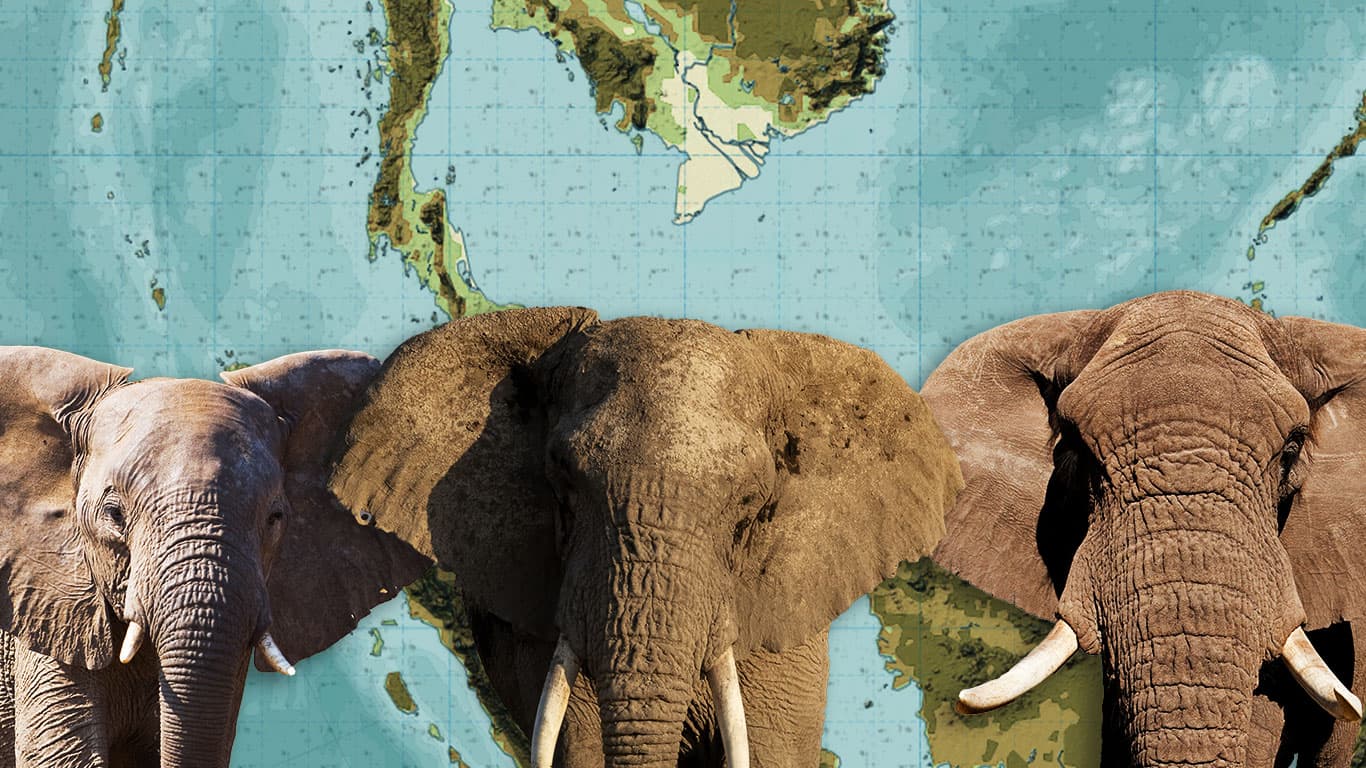
In 1320, emperor Yingzong of the Yuan, “dispatched Mazhaman and other envoys to Champa, Zhenla, and Dragon Teeth Gate, to request trained elephants” (遣馬扎蠻等使占城、占臘、龍牙門,索馴象。).
元史/本紀 凡四十七卷/卷二十九 本紀第二十九/泰定帝 也孫鐵木兒 一/泰定二年
In the 5th lunar month of 1325, “On the guichou day, the savages of Dragon Teeth Gate sent envoys who presented a memorial and offered tribute of local products” (癸丑,龍牙門蠻遣使奉表貢方物。).
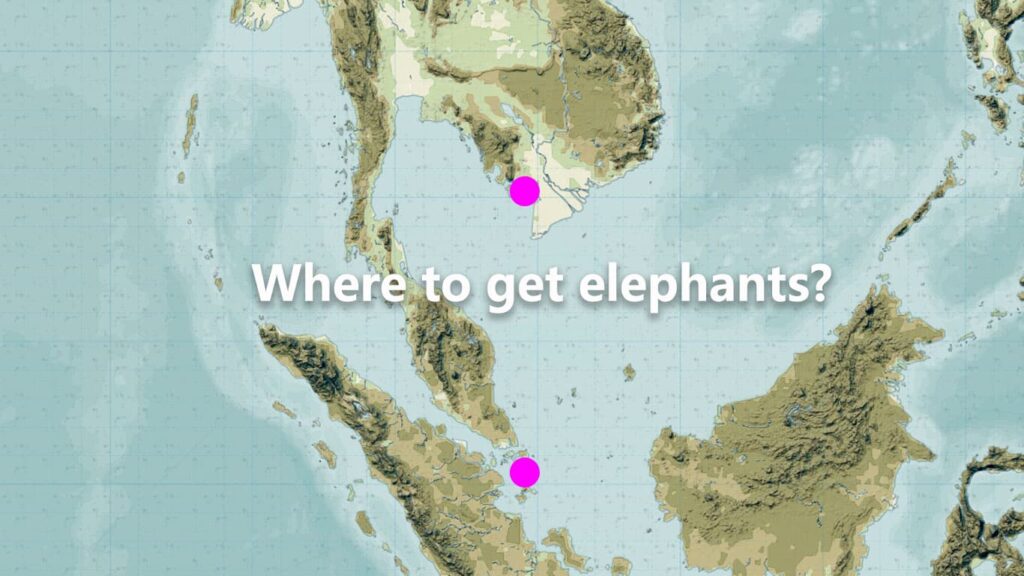
Now, let’s first ask ourselves a basic question. When the Indochinese Peninsula was home to thousands upon thousands of elephants, why would Chinese sail all the way down to a tiny island between Singapore and Sumatra where “the fields are barren and rice is scarce” and where “the mountains have no fine timber and there are no rare goods for tribute” to obtain elephants?
And when they were already visiting Champa and Zhenla, both on the Southeast Asian mainland where elephants were plentiful, why would they then cross a vast body of water and take on all the additional risks of transportation to get elephants from island Southeast Asia?
Was it really the case that they could not obtain enough on the mainland?? Even if we imagine that was true, why would they get the elephants from a tiny island? Why not go to Siam or a place on the Malay Peninsula?
Or perhaps it was the case that the island was barren because elephants had eaten all the vegetation and were now starving, and therefore, this was really a rescue mission, a previously overlooked but key early milestone in the global development of animal rights. . .
In any case, I think from this point onward I will refer to the place near Sanfoqi as
Second, while the Daoyi zhilue refers to Dragon Teeth Gate as “the two mountains of the Danmaxi 單馬錫 barbarians,” who then were “the savages of Dragon Teeth Gate” who presented tribute in 1325, just a few years after the Chinese had visited there in search of trained elephants?
We can see from another passage in the Daoyi zhilue, on Xian 暹 (Suphanburi), that Danmaxi had a citadel, so if anyone presented tribute from that area, it should have been Danmaxi. To quote:
近年以七十餘艘來侵單馬錫,攻打城池,一月不下。本處閉關而守,不敢與爭。遇爪哇使臣經過,暹人聞之乃遁,遂掠昔里而歸。
In recent years [Xian] came with more than seventy ships to attack Danmaxi 單馬錫, assaulting its walls and fortifications; even after a month they did not take it. The place closed its ports and defended itself, not daring to contend with them. When envoys from Java [Zhuawa 爪哇] happened to pass through, the Xian people, hearing of it, fled; they then plundered Xili 昔里 and returned home.
Dragon Teeth Gate is a generic term that describes a geological formation. As a generic term, it can be used to refer to more than one place. I am positive that this was the case during the Song and Yuan dynasty periods.
In describing the route from Guangzhou to Sanfoqi, the 1225 Zhufan zhi records that “In the winter months with favorable wind, more than a month is required to reach Lingyamen [Lingya Gate 凌牙門]. Only after one-third has been traded does one then enter the kingdom. The people of the kingdom mostly bear the surname Pu. . .” (冬月順風,月餘方至凌牙門。經商三分之一始入其國。國人多姓蒲。)
It could be that the Dragon Teeth Gate (Longyamen) that was associated with Sanfoqi was originally called by a name that resembled Longyamen – Lingyamen, and that later it came to be referred to by a term that sounded very similar but had meaning attached to it, Dragon Teeth Gate.
I have previously argued that this Lingyamen/Longyamen was one of the geological formations that jut out of the water near Ha Tien. In doing so, I argued that two of the three mentions of Dragon Teeth Gate in the Daoyi zhilue are about that Dragon Teeth Gate, while the third mention, the one actually entitled “Dragon Teeth Gate” and mentioning the Danmaxi barbarians, is about the one between Singapore and Sumatra.
I did not previously make reference to the two passages from the History of the Yuan, however, those two passages provide strong support for my argument that Sanfoqi was “Kampuchea/Kambuja” and that one reached it by heading inland from the area around what is now Ha Tien, where there was a place which Chinese referred to first as Lingyamen, and then alter as Longyamen, “Dragon Teeth Gate.”
That coastal area is a much more likely place to pick up a shipment of trained elephants than a tiny island between Singapore and southeastern Sumatra, and given that Sanfoqi did not present tribute to the Yuan, it is understandable that some people on the coast would take advantage of that “power vacuum” to do so.
Finally, I had never noticed until now the passage about Xian attacking Danmaxi and then fleeing when this became known to people from Zhuawa, that is, island Java. However, this fits perfectly with the larger history that I have presented in my publications and here on the blog of a conflict between Siam and Java over control of Cambodia, a conflict that we can see taking place in the second half of the fourteenth century in the Ming shilu.
This incident between Xian, Danmaxi, and Zhuawa was a precursor of a much bigger conflict that was about to break out.
As a result of that conflict, Sanfoqi and its outlet to the sea at Ha Tien fell into decline. It is therefore not surprising that the Dragon Teeth Gate in that area would not be mentioned in seventeenth century navigational texts.
However, the unique geological formations in that area would soon be written about again. As Ming refugees settled in the area of what is now Ha Tien later in the seventeenth century, one of them compose a set of poems about the landscape of that area known as the “Ten Verses of Ha Tien” (河仙十詠), the first of which, The Golden Isle that Blocks the Waves (金嶼攔濤), begins as follows:
島崔嵬奠碧漣,橫流奇勝壯河仙。 波濤勢截東南海,日月光迴上下天。
A towering island stands firm amid blue-green ripples,
A marvelous scene across the current, bringing magnificence to Ha Tien.
The force of the waves is checked, cutting off the sea to the east and south;
Sun and moon turn their light, echoing between heaven above and below.
This poem may or may not be about the Dragon Teeth Gate that was known centuries earlier, but clearly there were important geological formations in that area which people attributed importance to.
And again, it was a much better place for Chinese to get elephants than far down in island Southeast Asia.



Thank you for this essay, it helps to further emphasize the incorrect assumptions about early Singapore history and setting the record straight(er), as J. Kurz had begun doing with his “Deconstructing Banzu and Longyamen” article.
Thank you for pointing this out. I haven’t actually read that article because 1) it is behind a paywall and 2) Sci-Hub hasn’t stollen it. So, for a poor boy like me, that means it doesn’t exist.
My apologies, was not aware of the paywall.
Oh, no worries!!