
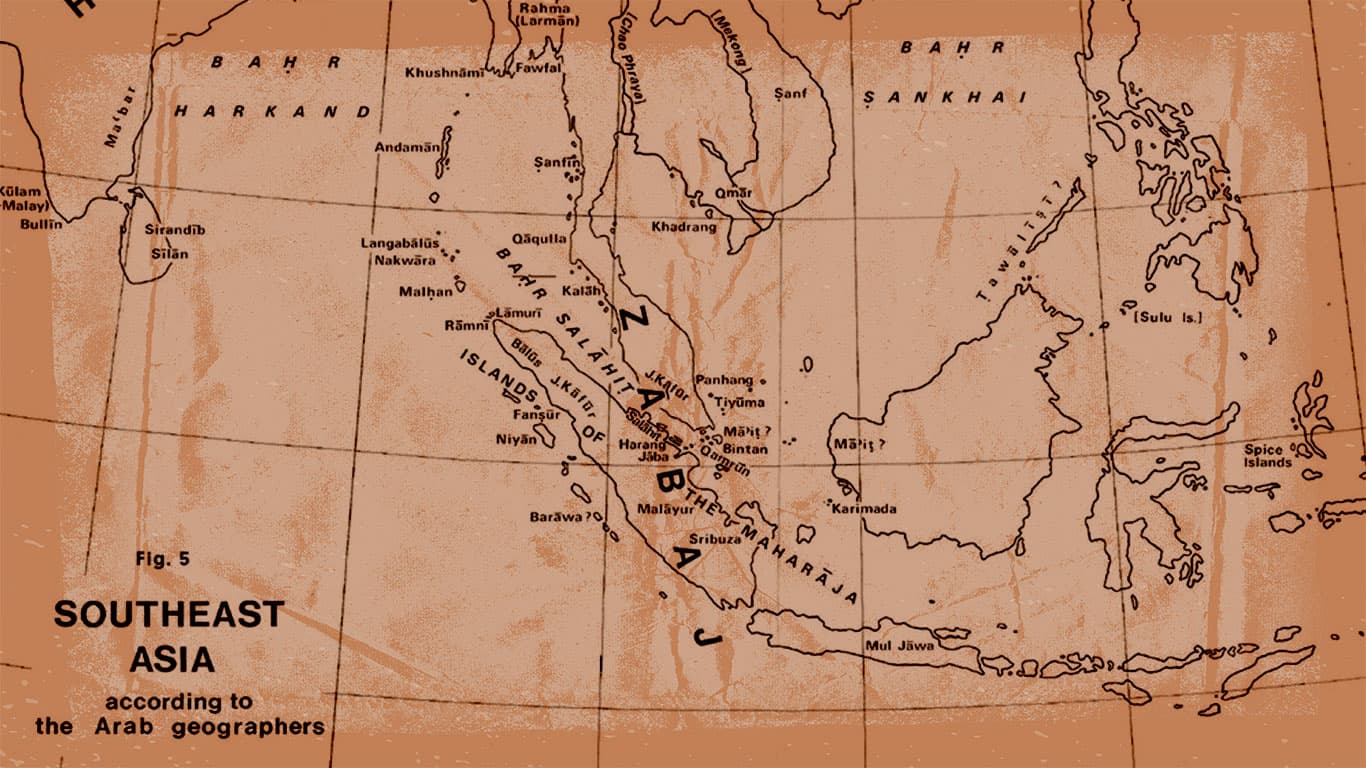
In recent posts, I have been talking about information in Arabic texts. There are a group of texts in Arabic that provide information about Southeast Asia starting in the ninth century.
I can’t read Arabic, so I have to rely on translations, and there are a couple of main translations that scholars like myself rely on.
In 1913-14, French scholar Gabriel Ferrand published two volumes of translations of passages from Arab, Persian, and Turkish texts that contained information about the geography of Asia (Relations de voyages et textes géographiques arabes, persans et turks relatifs à l’Extrême-Orient du VIIIe au XVIIIe siècles).
Then in 1979, British scholar Gerald Randall Tibbetts published English translations of excerpts from Arabic texts that contain information about Southeast Asia (A Study of the Arabic Texts Containing Material on Southeast Asia).
The texts in this book are largely the same texts that Ferrand translated, however, Tibbets translated less, so whereas Ferrand translated passages from texts, Tibbets translated parts of those passages from texts. Nonetheless, it is a helpful work.
Tibbetts’ book is difficult to find and it is out of print. I finally came across a copy after not being able to find one online, so to help out others, I’m uploading the book here. Even though I have problems with Tibbett’s analysis, the translations are still a very important source for Southeast Asian history and the book should be available for scholars to work with so that our knowledge about the past can advance.
01 The Arab Geographers – The Texts
02 The Arab Geographers’ Conception of Southeast Asia
05 Arab Navigational Treatises – The Texts
06 The Navigators’ Conception of Southeast Asia
These Arabic texts have certain limitations. Most of the texts were written by people who had not actually traveled to Southeast Asia, but instead, contain information that certain authors learned from mariners who visited Southeast Asia. Also, many of the later texts repeat information that was in earlier texts.
That said, I think a bigger problem with these texts has to do with the translators. Ferrand decided what the best way to transcribe place names was, and I don’t always agree with the decisions he made.
So, for instance, there is one name that Ferrand transcribes as “Tiyūma” and he says that it indicates Tioman island off the southeastern coast of the Malay Peninsula. However, each time we encounter that name in his translations, it is followed by a footnote, and when you read the footnotes you see that what was written in the text was something different from “Tiyūma” and that Ferrand had “corrected” what was actually written in the text.
You find the same thing for other terms as well, like “Sribuza.” The good thing here is that at least Ferrand made note of the fact that there were variations in the text, as Tibbetts generally did not do that.
The reason why I think that this is a problem is because these translations present a false sense of certainty. In reality, I think that there is a lot that Ferrand and Tibbetts got wrong, and the way to see that is by going through the translations oneself, and by keeping in mind that the names and the places that Ferrand and Tibbetts said those names indicated are not always correct.