

I have made the argument that there was a trans-peninsular empire/polity in the area of Songkhla – Kedah that foreigners referred to by the name “Java/Jaba,” and that it was only in the thirteenth century that foreign traders recorded information about island Java, at which point, there were “two Javas” in Chinese and Arabic sources for a while.
Then, in the fifteenth century, Ayutthaya conquered the area of Songkhla, bringing to an end that “Java.” Meanwhile, the Mongol attack on Java in the late thirteenth century and the Ming establishment of tributary relations with Java in the fourteenth century brough island Java into Chinese historical records as “Zhuawa.”
I have come to this conclusion based on various pieces of evidence, but certainly one important piece of evidence is the existence of “two Javas” in Arabic and Chinese sources in the thirteenth century, as well as in the writings of Marco Polo.
However, I more recently came to realize that there is earlier evidence of “two Javas” in Chinese historical sources.
We can see this easily in translations that Geoffrey Goble made in 2014 as part of the Nalanda-Sriwijaya Centre Working Paper series. His working paper is entitled “Maritime Southeast Asia: The View from Tang-Song China.”
Goble translated information about maritime Southeast Asia in the Old History of the Tang (945) and the New History of the Tang (1060).
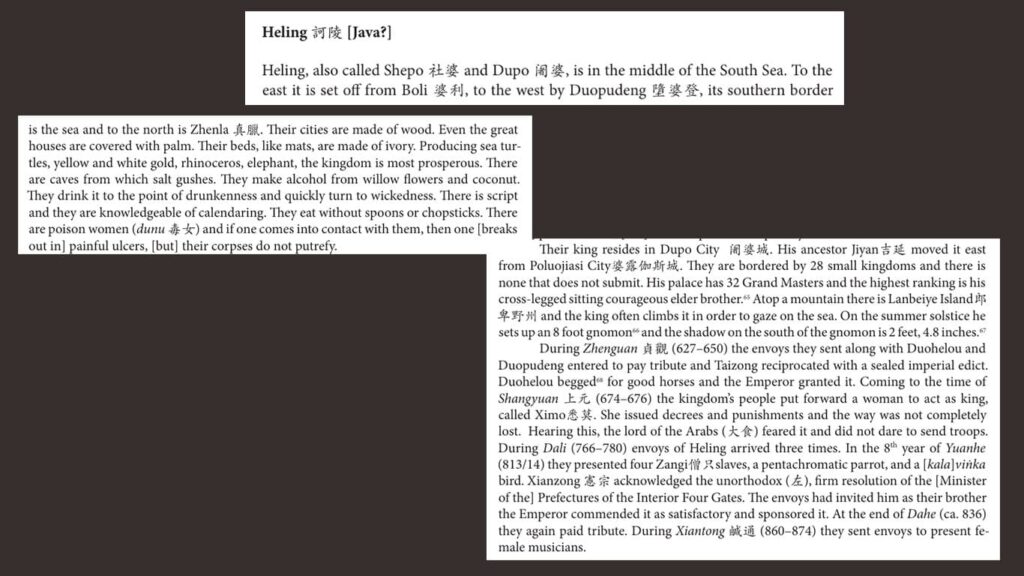
In both of these histories of the Tang dynasty, there is an entry for a place “Heling” 訶陵. Goble has “Java?” after this name, indicating that he thinks it might be Java, but is not sure.
In the New History of the Tang, other names are recorded as equivalent to Heling. Goble translates that information as follows:
“Heling, also called Shepo 社婆 and Dupo 阇婆, is in the middle of the South Sea” (訶陵,亦曰社婆,曰闍婆,在南海中).
I’m not sure why Goble used the simplified version of 闍, but this character has two pronunciations: du and she. Given that the preceding name is “Shepo,” it’s logical to assume that the second name is also “Shepo.” And although it is difficult to see from this modern pronunciation, 1,000 years ago this would have been pronounced something like “Java” or “Jaba.”
In the account of Heling/Java/Jaba, information is recorded about the place, and then information is recorded about tributary relations.
The New History of the Tang then has an entry for another place, this one called Touhe 投和, which Goble mistakenly transliterates as “Tuohe.”
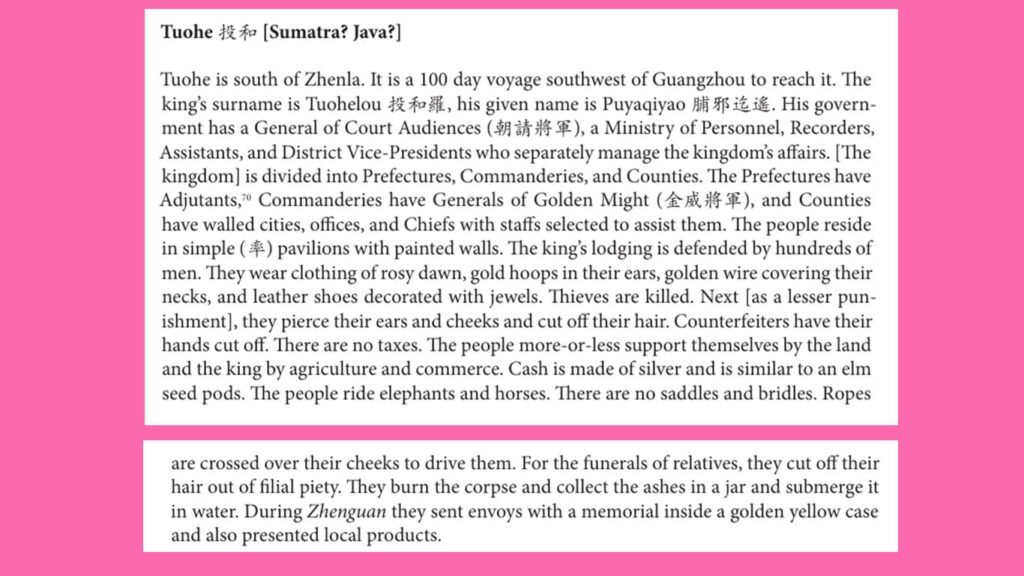
In this account, information is provided about Touhe, and we can see that it was a significant kingdom. However, there is only one record of a tributary mission.
So, where was it? Goble suggests “Sumatra? Java?”
Actually, if we look at how Tuohe would have been pronounced 1,000 years ago, we get something like the following:
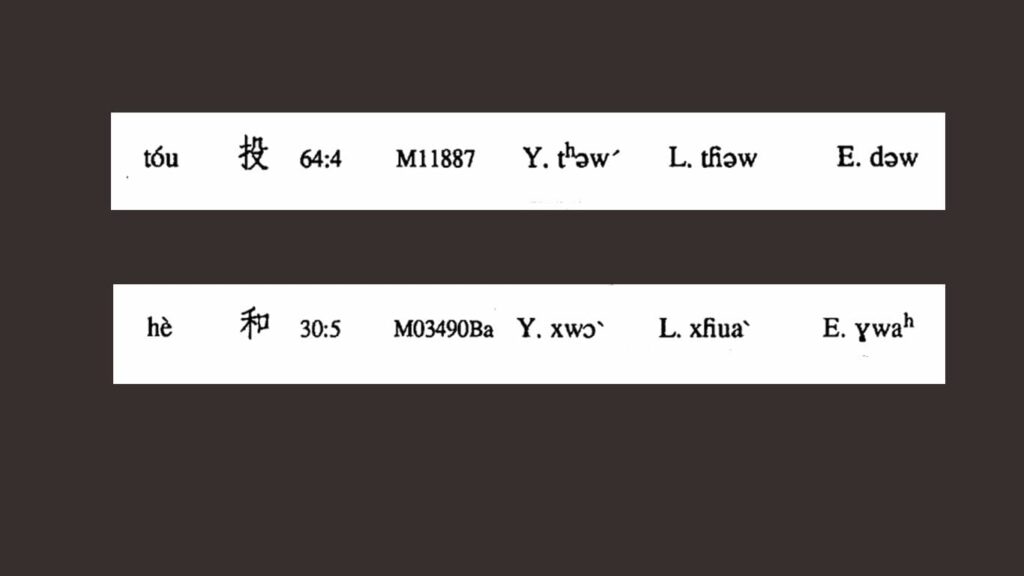
Something like “Thaw-hwa” (I can’t reproduce the exact phonetic symbols) certainly looks like “Java” to me. If it’s not, then what else could have been this sizable kingdom of “Thaw-hwa”? And what happened to it?
Clearly this is “Java,” and clearly we have here in the eleventh century evidence of the “two Javas” in the New History of the Tang.
One of these Javas, the one based around Songkhla, was in regular official contact with the Chinese, and the other one, on island Java, only sent one mission.
When more direct and regular contact did eventually take place, under the Mongols and the Ming, this Touhe 投和 would be written as Zhuawa 爪哇, the name by which island Java is still known in Chinese today. And with that new name, people would fail to recognize that this same land had previously appeared in Chinese sources as Touhe 投和.
The account of Zhuawa in the History of the Yuan (the history of the Mongol period) begins by stating that “no information can be found about its customs or products” (其風俗土產不可考). Actually, some information can be found. It’s the information about Touhe in the New History of the Tang.
More importantly, however, is that this again supports the points that I have been making over and over and over. Sanfoqi was Kambuja, Shepo was in the trans-peninsular crossing around Songkhla, and island Java didn’t fully enter the Chinese historical record until the thirteenth century.



You jump to conclusions too quickly and are very quick to jump to another conclusion that’s not only based on the facts, but that and the previous conclusion you hastily came up with.
Thank you for the comment.
Without providing examples of what you are trying to say, I have no way of understanding what you are trying to say.
By this point, when I write a blog post, there is no way that I can start from scratch each time and explain every background detail. If you have not followed what I have been writing for the past five years, and more importantly, if you have not read the three pieces that I have published at this point, then there is no point in having a discussion.
Please read and understand what I have written, then I’ll be happy to engage in a discussion.
1) https://www.academia.edu/83822426/Rescuing_History_from_Srivijaya_The_Fall_of_Angkor_in_the_Ming_Shilu_Part_1_
2) https://www.academia.edu/102690878/Revisiting_the_Chinese_Sources_on_Early_Southeast_Asian_History
3) https://www.academia.edu/127729148/Rescuing_History_from_Srivijaya_The_Fall_of_Angkor_in_the_Ming_Shilu_Part_2_
The second piece has documentation that demonstrates that Shepo was not island Java. Meanwhile, these two blog posts talk about the “2 Javas” problem, an issue which many people have noted, but have not been able to explain:
https://leminhkhaiblog.com/srivijaya-3-0-10-the-two-javas-in-southeast-asia/
https://leminhkhaiblog.com/srivijaya-3-0-11-why-there-were-two-javas-in-the-1200s-1300s/
And with regard to your disbelief that this topic can be understood in new ways, please read this recent blog post. It should help you understand why the extant scholarship is so deeply flawed and why the people who produced it, had no way of seeing in the sources what I have.
https://leminhkhaiblog.com/the-myth-of-jambi-as-a-capital-of-srivijaya/
For instance you say “Baolin” and “Fuluo’an” are attempts to replicate the Khmer word “phnom”. I looked at middle Chinese reconstructions for those words and neither sounded like “phnom”. For the rest of the article you assume Baolin polity = Phnom Penh. That’s really far fetched.
Honestly if your theory were that sound people would’ve accepted them and began writing about it.
I suggested that Fuluo’an and Baolin might be Phnom Penh in the first article, and in the second article I make it clear that I don’t know exactly where the Baolin Polity was.
Either way, it doesn’t matter as it doesn’t affect my overall argument. I haven’t built a house of cards. One side detail like that doesn’t affect the overall argument, as it is not central to the argument. What IS critical is understanding that Old Harbor, the Baolin Polity (wherever it was), and Sanfoqi were NOT THE SAME PLACE, as Ma Huan and Fei Xin claimed. That statement in their works has been THE central piece of support for the “Srivijaya = Old Harbor = Palembang” theory, and I clearly document in the two articles that this is false (particularly in Part II).
So, how am I reading the Rekidai Ho’an and the Ming shilu wrong? Those texts date from the early fifteenth century (when Ma Huan and Fei Xin were active) and they clearly demonstrate that these were not the same place. Meanwhile, there is also evidence that the versions of Ma Huan’s and Fei Xin’s texts were edited/altered in later years (I address this in Part II as well). Issues like THESE are what you have to address if you want to challenge my argument, not that a side detail may or may not be incorrect.
This is an enormous topic, and in writing about it, I have to address multiple side issues, since so much has already been written on this topic. I may not have all of the side issues right (I am, after all, mortal), but I am confident that I have the core argument right. So, saying “Baolin” and “Fuluo’an” might not be Phnom Penh. . . yea, of course. I’ve already written that. Who cares? It doesn’t affect the overall argument.
Focus instead on core elements of my argument, like the point that Sanfoqi, Old Harbor, and the Baolin Polity were not the same place. The equation of those places is absolutely critical for the “Srivijaya theory.” It literally IS the Srivijaya theory. So what is wrong with my argument?
In your comment, you are simply trying to use character assassination (implying that I’m incompetent) to avoid having to deal with the actual argument.
Alternately, if you truly think that I am incompetent and what I have written has no merit, then why bother reading what I have written, and writing comments that are rude and have nothing to contribute? Just ignore me and go off and enjoy your life. You’ll obviously be much happier.