

I have recently been examining a fourth-century text Daoist text, the Grand Clarity Scripture of Divine Elixir Made from Liquid Gold (Taiqing jinye shendan jing 太清金液神丹經) attributed to Ge Hong 葛洪 (283–343 CE), that has information about some parts of Southeast Asia. I have translated those parts here.
I have never seen anyone ever use this text to write about Southeast Asian history. As far as I can tell, historians of the region are unaware that this text contains valuable historical information (And I never knew this until last week. . .).
Ge Hong apparently visited Funan, and he recorded some information that I have not seen in any other text. For instance, take the following:
扶南,在林邑西南三千餘里。自立為王,諸屬國皆君。長王號炮到大國,次王者號為鄱歎小國,君長及王之左右大臣,皆號為崑崙也。
Funan is located over 3,000 leagues southwest of Linyi. It established its own kingship, and all its vassal states are ruled by local lords. The senior king is titled Paodao [or Baodao or Pudao] Great Kingdom 炮到大國, while subordinate kings are titled Potan Small Kingdom 鄱歎小國. The local lords and the senior king’s chief ministers are all called Kunlun 崑崙.
While I have not seen some of this information in any other text, in fact, Ge Hong probably didn’t write these lines, even though he claims to have visited Funan.
In the third century, a scholar official based on Hainan island by the name of Wan Zhen 萬震 compiled a text called the Record of Unusual Things from Southern Lands (Nanzhou yiwu zhi 南州異物志), and much of what we see in Ge Hong’s text appears to come from Wan Zhen’s earlier work.
The Record of Unusual Things from Southern Lands is lost, but sentences from it are cited in later works, such as in Tang-Song dynasty era encyclopedias, where we can find the following:
《南州異物志》曰:扶南國在林邑西三千餘里,自立為王,諸屬皆有官長,及王之左右大臣,皆號為昆侖。
The Record of Unusual Things from Southern Lands states: Funan is located over 3,000 leagues southwest of Linyi. It established its own kingship. Its vassal states all have officials, and the king’s chief ministers are all called Kunlun 昆侖.
What we have here is a condensed version of the same information, however the wording is almost exactly the same.
In other words, this encyclopedia entry is a condensed version of what Wan Zhen originally wrote, while the information in Ge Hong’s text is a fuller version, or perhaps is the exact same as what Wan Zhen originally wrote.
As for the terms that he mentions, “kunlun” could be “kuruṅ,” a Khmer term meaning “city, town; king, realm” (See Philip N. Jenner, A Dictionary of pre-Angkorian Khmer, 54.)
Meanwhile, “potan” could have sounded something closer to “pa-than” (see Pulleyblank), which makes it a possible rendering of the Khmer title “mratāñ,” meaning “lord” (Jenner, 381).
Ok. So far so good, as these are terms that were used in the titles of Khmer officials.
Then we get “baodao” or “paodao” or “pudao.”
I can’t think of a Khmer term that can match this sound. If anyone can think of one, please let me know.
The only word that comes to my mind is. . . “patau,” the Cham word for a king. . .
Was Funan ruled over by a Cham king?
I don’t know, but given that trade was a source of wealth and power, and given that the Cham were the ones who were sailing around the region. . .

Wow you’re on a roll and one hell of a reseacher well done x
Thank you very much!!
It’s actually not very difficult to “get on a roll.” All you have to do is look at primary sources. Too few people actually do that, so it’s easy to find things that people have never seen or realized.
Michael Vickery, in his scathing review on Kenneth Hall textbook, “Maritime Trade and State Development in Early Southeast Asia.1985.” and “Funan Reviewed: Deconstructing the Ancients” have simply described the presence of Malay and Cham words as usages of convenience. Since there were more interaction with the Chinese, Cham, Malay traders, the Chineses writer might prefer to use the Cham and Malay title and words, that they are familiar with.
https://angkordatabase.asia/publications/funan-reviewed-deconstructing-the-ancients
http://michaelvickery.org/vickery1987maritime.pdf
It is obvious when you read the “The Empire Looks Down”, that there are a lot of Malay words in usage, even if there a Khmer equivalent. Similar to Hokkien words in Southeast Asian today. The Khmer word for gold came from the Austronesians. Kenneth Hall mistakenly believed that Funan was Malay, but it is easily countered that Funan being a cosmopolitan port area, would have more different ethnicities.
“Should we assume, perhaps, that because Funan was a maritime power, and the great navigators of the day were Austronesian, that Funan must also have been Austronesian?
No doubt, like most maritime societies, the port cities were very mixed, and Mon, Cham, and Malay would have been the main groups in addition to the Khmer, but on present evidence it is impossible to assert that Funan as an area and its dominant groups were anything but Khmer. ”
In any case, a king of Zhenla who ruled Sambor and Wat Phu, could justifiably called himself a Cham king due to his matrimonial linage. His father is a Khmer king, Isanvarman I and his mother is a Cham princess, thus making him heir to two kingdoms. The Chams passed down inheritance via the female line. The Khmer kings can ruled as Cham kings or vice versa if allowed.
If Linyi is Cham-speaking, and Ge Hong guides are Cham, they can conveniently used the Cham title to refer to the Khmer king, without him being Cham. Just like an a Kaizer does not have to be a Roman Caesar.
Thank you for the comment!!
I don’t have access to The Empire Looks South. So, I don’t know what he says there, but I just looked at the account of Zhenla in the History of the Sui and posted a translation here: https://leminhkhaiblog.com/zhenla-was-cambodian/
I see Michael Vickery as somewhat of a tragic figure. He had ideas/doubts about various things, and in making his arguments, he relied on information in Chinese sources, but. . . he couldn’t read them, nor could Coedes, whom he in many ways was in dialogue with. . . and so both relied on what they saw in Pelliot, and both talked in circles because what Pelliot wrote in not sufficient to understand the Chinese sources.
https://www.amazon.com/Empire-Looks-South-Perceptions-Cambodia/dp/6162151964
“The Empire Looks South: Chinese Perceptions of Cambodia before and during the Kingdom of Angkor” wasn’t written by Michael Vickery. It is written by Peter Harris. It contains the new translations Peter Harris made.
Vickery made his arguments of Pre-Angkorian society from Old Khmer epigraphy rather than Chinese sources and his linguistic background.
On your article that you linked, I found this part very problematic:
“On the issue of curd, Aspell wrote in a footnote, “Milk products are not part of the traditional Khmer diet and this mention of milk curd may reflect the author’s observation of a highly Indianized element of Zhenla’s society.”
No, there are far too many elements in the above account that are South Asian (including probably the titles of the officials). The curd eating was not some affectation of a highly Indianized group of Cambodians. It was the normal diet of the South Asian ruling elite who were in control.
This is so obviously describing a South Asian ruling class. And there are clear connections with a place called Chitu, the description of which I will also argue describes a South Asian ruling elite.”
You and Aspell seems to suggest that the Khmers are homogenized. At the present day, coconut milk is favored in some parts of Cambodia cuisine in the north and disliked in the south or vice versa. So did hot spicy food. Their northeastern food from the East of the Mekong are different in flavor from the West of the Mekong. That’s not a suggestion that Zhenla or Funan are South Indian. Lots of redneck Americans loved Mexican food.
These curd-eating could have been a ritual affair.
Thanks for the comment.
I didn’t say that The Empire Looks South was written by Vickery. I merely said that I do not have access to it.
As for Vickery, Chinese sources were ESSENTIAL for his scholarship. That was his biggest problem. Look at his dissertation. He concludes that the earliest accounts in the Cambodian chronicles are “fiction” precisely because he could not find any corroboration in Chinese sources. Why couldn’t he find any corroboration in Chinese sources? 1) Because he couldn’t read those sources, and 2) because other scholars all claimed that Zhenla was Angkor/Cambodia, and there is nothing in the dynastic accounts about Zhenla that we can clearly equate with Angkor.
I cover this issue in Part 3 of my article on the fall of Angkor in the Ming shilu (whenever I get around to editing it. . .). Chinese sources about Sanfoqi (not Zhenla) definitely corroborate information in the Cambodian chronicles. This is because Sanfoqi was the core of “Cambodia,” whereas Zhenla was not.
See:
https://www.academia.edu/83822426/Rescuing_History_from_Srivijaya_The_Fall_of_Angkor_in_the_Ming_Shilu_Part_1_
https://www.academia.edu/127729148/Rescuing_History_from_Srivijaya_The_Fall_of_Angkor_in_the_Ming_Shilu_Part_2_
https://www.academia.edu/102690878/Revisiting_the_Chinese_Sources_on_Early_Southeast_Asian_History
Throughout his career, Vickery continued to try to get information in Chinese sources to support whatever information he was looking at in inscriptions. It never did. Because he was looking at Zhenla.
This is why I said that he was a tragic figure. He needed decent scholarship on the Chinese sources, but all he had was the work of the likes of O. W. Wolters and George Coedes.
I have read “The Empire Looks South”, and “The Empire Looks South”, like Le Minh Khai, recognizes that the writings attributed to Ge Hong are a useful source of information about Funan, and quotes from the writings attributed to Ge Hong at length.
“The Empire Looks South” is skeptical about the idea that the writings attributed to Ge Hong were written by Ge Hong, but “The Empire Looks South” also incorrectly claims that Jainism is a heretical type of Buddhism rather than a religion rivalling Buddhism, so “The Empire Looks South” is not infallible in its conclusions.
Thank you for the comment!!
Oh, there is no question but that some of Ge Hong’s text comes from an earlier work, Wan Zhen’s 萬震, Record of Unusual Things from Southern Lands (Nanzhou yiwu zhi 南州異物志).
Wan Zhen’s work is no longer extant, but passages from it that are quoted in later works are word-for-word the same as passages in Ge Hong’s later work.
What’s wonderful about Ge Hong’s text, however, is that it is “complete.” It may contain a complete version of what Wan Zhen wrote, but that is still much more helpful that trying to make sense of the scattered sentences from Wan Zhen’s work that appear in later writings.
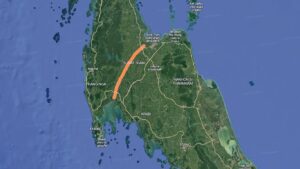
I wrote about that here:
https://leminhkhaiblog.com/the-surat-thani-phang-nga-crossing-in-the-third-fourth-centuries/
“The Empire Looks South” is skeptical about the idea that the writings attributed to Ge Hong were written by Ge Hong not in the sense that Ge Hong was merely quoting from another source, but rather in the sense that writings attributed to Ge Hong may have, at least in part, been written by some other person and then attributed to Ge Hong.
I am not saying it is infallible or that it is conclusive, but as of yet, it’s the most comprehensive compilations of Chinese records regarding ancient Cambodia translated to English, with syntheses of the research from Khmer epigraphy.
Since Prof. Kelly was figuring out the history of this region through the lens of Chinese records, he would be well-served by looking at the previous works and interpretations that have been done before. And I am also looking forward to alternative explanations.
I much prefer the translation of Zhou Daguan by Uk Solang and his wife, more than Harris anyway. So I am aware of his limitations, but he also aware of it and make no pretension that it did not exist.
Thank you again for the comments and suggestions.
As far as I can tell, the Harris book is only available in print (please correct me if I’m wrong). It costs $65, and getting it sent to where I live would add another $42 on top of that.
Personally, I now live in the 21st century. I make all of my work available online at Academia.edu, and I have shared tons and tons of my ideas and information/sources on this blog for 15 years for free.
As I see it, there is absolutely no excuse for scholars not doing this, as publishers all allow some pre-print form of an article/chapter to be archived on a personal site (or a site like ResearchGate or Academia.edu or a university archive). Yes, one can’t put an entire book online, but one can upload the dissertation that it is based on (as is the case with Harris), as I did with my dissertation so many years ago.
If the Harris book ever gets “stolen” by libgen or Anna’s Archive, I’ll take a look at it, but I’m definitely not spending $100 on it, especially when I don’t need to consult its translations.
As for the synthesis, I can also do that on my own from the extant works, but I’m not planning on doing that because 1) I have the sense/fear that the work on the inscriptions is problematic, and 2) I don’t have the ability to read them, and 3) even if I did, people are still working from transcriptions made by Coedes in the last century.
I see capable people re-going through the inscriptions in the island world, but that hasn’t made it to Cambodia yet, as far as I can tell. It looks like the EFEO has a project to digitize Cambodian inscriptions, so hopefully one day it will be possible to engage with the actual inscriptions (and cross-check text in a database), and I look forward to seeing what people do then, but until that day, I think whatever synthesis people try to do is going to be of limited value.
One of the biggest problems with Southeast Asian history, I would argue, is that synthesis took place before people had a decent grasp of the primary sources. When the field developed in the Anglo world in the post-colonial era, it desperately needed a new generation of Sanskritists, Sinologists, etc., but that didn’t happen. Instead, there were very few people in that generation who even got good at vernacular languages. The result is that by the 1980s there was a turn towards “synthesis” and a focus on the Early Modern period when one can use European sources, and flawed ideas have been circulating ever since.
I don’t want to contribute to that. I am trying to make what we know about the Chinese sources solid enough so that they can later be synthesized. I’m not going to try to synthesize them with information in inscriptions that I can’t read.
I’ve long felt that what we need is “all” of the Chinese sources (not just for Cambodia, but for all of Southeast Asia – there is a lot you learn by looking beyond the place you are focusing on) translated in one place (and available for free), without the translator telling people what s/he thinks (like “Sanfoqi is Srivijaya”). Just the sources, so that a reader can go through them and make his/her own discoveries/conclusions. With AI, that has become manageable, and I’m working on that right now. I’ll be sharing it as I make it very soon here on this site.
I know what you meant. I bought it on sale for 30 dollars, and carry it on my airplane. Definitely not going to buy it at 65. I have trouble with all “synthesis” books too, but I still think they can be “quicker” as introductions especially since they are often chronological. Most people and I like reading in chronological orders. But academic books and articles are scarce at that. Also thank you for showing Anna’s Archive in your earlier comment. You can’t imagine my joy not to having to shell money to read about Bagan.
Ah, yes, it’s very true about scholarly works just jumping into the weeds and not helping readers understand the larger picture. This is one thing I can see AI is good at. It can give us the general/received view of things, and can write much more clearly than many academics.
A few years ago, before AI, I was working with a student who was a non-native speaker and was just beginning to explore the world of scholarship. I searched endlessly for books/articles that could clearly explain academic theories. I would find something like “Edward Said’s Orientalism Made Easy!!” and I’d think “Great! That’s just what I’m looking for!!”
Then I would start reading and it would invariably say something like: “Edward Said’s Orientalism posits that the West’s epistemological and discursive construction of ‘the Orient’ operates as a hegemonic apparatus of knowledge-power, whereby the Orient is not an ontologically autonomous entity but a semiotically overdetermined Other, constituted through the West’s taxonomizing regimes of representation. . .
I just had AI create that text above, and here is how it can summarize the book clearly in one sentence:
“Edward Said’s Orientalism argues that Western scholars and writers created a distorted image of the East to justify colonial domination, portraying it as exotic, backward, and fundamentally different from the West.”
Yes!! Finally!! 🙂
I hope that you do not mind if I use a new comment for this remark. I reconsulted the book ”The Empire Looks South”, and on page 47, the author claims that Ge Hong never leaved China. He cites as a basis for this claim, in an endnote on page 319, ”Campany, “To live as long as heaven and Earth, 13-17””, which apparently deals with Ge Hong’s general experiences in southern China towards the end of Ge Hong’s life. Based on my pseudonym, you may guess correctly that I have very little understanding of or knowledge of Daoism, so I am not sure how accurate these claims are about how widely traveled Ge Hong was. Still, you may want to consider that Ge Hong, or the person waiting under Ge Hong’s name according to the book “The Empire Looks South”, was at best merely reporting what other people had said about Funan. Such would still be valuable as a resource, though, as “The Empire Looks South” acknowledges.
Thanks for pointing this out. I’m a super fan of Robert Campany’s scholarship. I looked this up, and those pages are about Ge Hong’s biography and they say nothing about Funan, but they do show that he collected a lot of information about the places where you could get the ingredients. There are parts of Ge Hong’s text that are exactly the same as an earlier work by Wan Zhen, so that seems totally clear that Ge Hong just copied Wan Zhen’s text. However, the part about him being young and traveling to Funan, I haven’t seen that anywhere else. Perhaps Wan Zhen wrote that too. I think that most people think that Wan Zhen never went to Funan, because the only information about him indicates that he served as an official on the island of Hainan. But perhaps he did. In general, I don’t see evidence that Chinese just made up stuff like that. However, they definitely did include other people’s writings in their own and not always indicate that. So, I think someone who went to Funan wrote that first part, and if I were to guess, it would probably be Wan Zhen, meaning that everything in Ge Hong’s text about Funan probably comes from his early (and now no-longer extant) text. Thanks again for pointing to that book.