
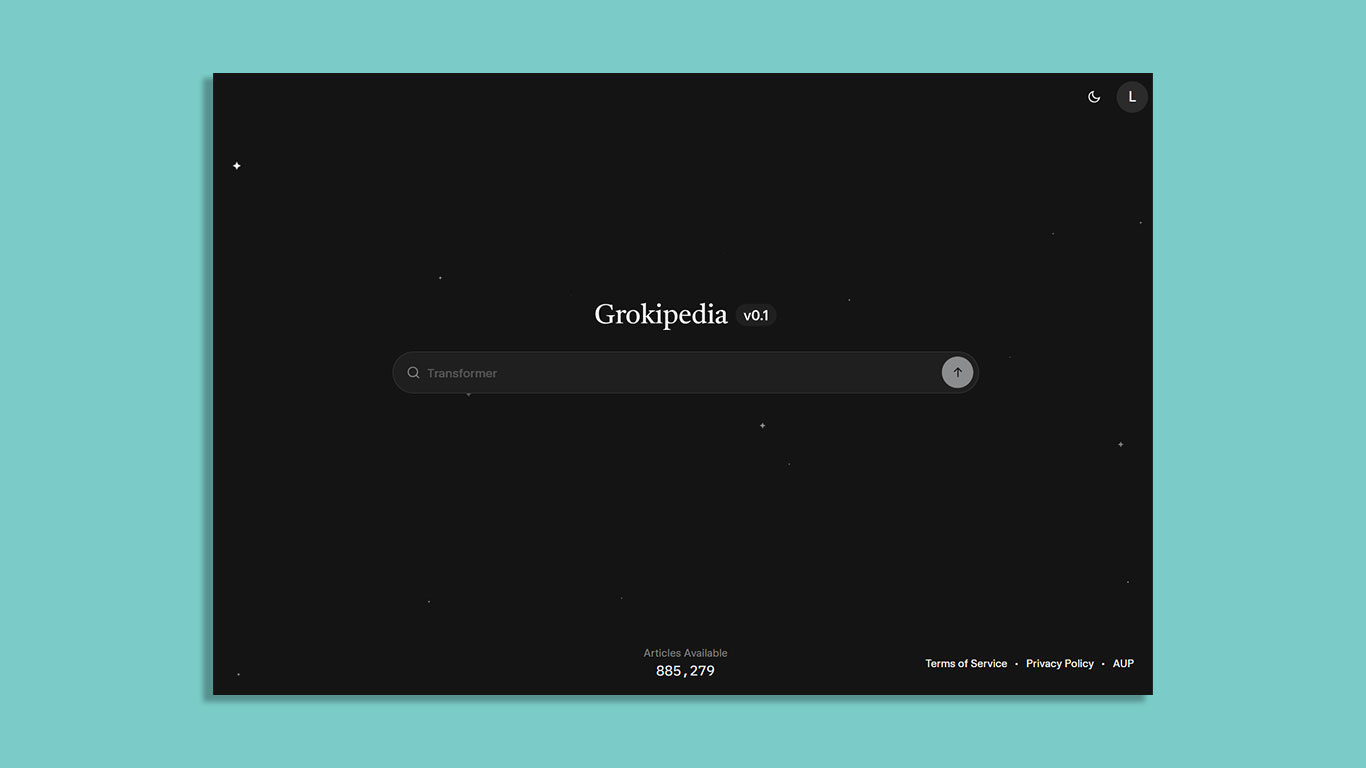
On October 27, 2025, Elon Musk’s company xAI released the first version (version 0.1) of an alternative to Wikipedia, called Grokipedia.
It appears that the creation of Grokipedia was the result of an offhand comment made at an event Musk participated in this past September, the All In Summit. At that event, Musk was talking about how the next version of the AI chatbot, Grok, was being developed. He said that it wasn’t just going to be based on information that was scraped from the Internet. Instead, to quote:
“So, we’re running a lot of, using a lot of, inference compute and reasoning to look at all of the source data which is really the corpus of human knowledge and then uh thinking about each piece of information and then adding mod adding what’s missing um and correcting mistakes and removing falsehoods from the from that training data.”
In other words, rather than just grabbing information and training AI on it (garbage in, garbage out), xAI is apparently trying to evaluate the information that it obtains, and if needed/possible, to improve it first.
Musk then gave an example of what that would look like in the case of a Wikipedia page, at which point, one of the hosts, David Sacks, suggested to Musk that he should use this approach to create an alternative to Wikipedia, Grokipedia.
Now, less than two months later, we have Grokipedia version 0.1.
Grokipedia and the Hồng Bàng Dynasty
After Grokipedia was released, the first thing I did was to check its “history of Vietnam” page. Reading the overview at the top of the page, I found an error, but in general, I was pleased to see how neutral the wording was.
I then turned to the section on the “Legendary Hồng Bàng Dynasty,” as I have written on this topic.
After giving a summary of what is written in historical sources, this is what it says:
Scholarly analysis regards the Hồng Bàng accounts as a medieval construct rather than verifiable history, emerging post-independence from Chinese rule (after 939 AD) to fabricate a deep antiquity for Vietnamese statehood, akin to Chinese dynastic precedents but localized with dragon-fairy motifs.[27] The “Biography of the Hồng Bàng Clan,” a key textual source from 15th-century anthologies like Việt điện u linh tập, traces a genealogy from cosmic origins to the Hùng era, yet lacks corroboration from contemporary records or inscriptions.[28] Archaeological findings from the region, including Neolithic sites like Phùng Nguyên (ca. 2000–1500 BC) and Bronze Age Đông Sơn culture (ca. 1000–1 BC), indicate advanced societies with rice farming and metallurgy but no evidence of centralized kingship or the specific institutions attributed to the Hùng rulers.[26] Premodern Vietnamese historians accepted the legend provisionally while questioning chronological implausibilities, such as the dynasty’s improbable span aligning with biblical timelines critiqued in 19th-century analyses.[24]
I was pleased to see that first sentence, because that is my argument, and indeed, footnotes 27 and 28 are both linked to my article, on ResearchGate and JSTOR, respectively.
While I have uploaded the article to ResearchGate, the version on JSTOR link is behind a paywall, and perhaps not surprisingly, there is a mistake in the sentence that references that version as the “Biography of the Hồng Bàng Clan” is not in the Việt điện u linh tập, but instead, is in the Lĩnh Nam Chích Quái.
The final sentence is a bit weird and unnecessary, but it is linked to this blog, and I find that significant.
Finally, the second-to-last sentence, about archaeological findings not matching with what is written in historical accounts, is credited to an article by a Vietnamese scholar that was published in a journal based at a university in the Philippines, but that article doesn’t actually talk about archaeology (although the statement in Grokipedia is valid).
So, we have some issues here, but this is version 0.1, and it was produced in less than two months. This should be the worst version of Grokipedia that we will ever exist. I heard Elon Musk state in another interview that he expects that when Grokipedia reaches 1.0, it will be a hundred times better.
Now, I can guarantee you that when people in the Western academic world eventually comment on Grokipedia, most will make dumbass comments like these: “I’m never going to use something made by that f’ing billionaire!!” “It’s right-wing propaganda!!” “He just stole everything from Wikipedia!!” “Elon Musk is a fascist!!” Etc.
I, however, try my best in life not to be a dumbass (it’s hard, but I give it my best), so when I see the emergence of Grokipedia, the rationale behind it, and what the AI is attempting to do, I take it seriously, and try to learn more about it, and to think about the implications for myself, my profession, and for the world of knowledge.
The Problem with Wikipedia
While we don’t know what exactly happens when an AI chatbot responds to our prompts, when it comes to topics like history, it seems clear to me that Wikipedia serves as a kind of scaffolding for the information it obtains and sends back to us.
You can sense this when you see the “thinking” process where it will briefly say “searching Wikipedia” as well as now when it will link to Wikipedia in its answer.
This is not surprising given that Wikipedia always ranks at the top of Google searches, as through its references and the links to Wikipedia, it has become a high-ranked website. Hence, there is obviously a connection between the information structure of the Internet and the information structure of Large Language Models (LLMs).
The problem with Wikipedia, as Musk just said in the recent interview linked above, is that it is a “bad product.” It’s uneven (some pages are good, others are not). It’s created by people who are not always experts. And when it comes to topics that historians write about, it does not always reflect the current state of the field.
Finally, it’s a body of knowledge that is up to the whim of volunteers to decide whether or not they want to contribute to or update the content. And by now, I see pages that have gone years without any updates.
When Wikipedia first came out, scholars ridiculed it and dismissed it. Before long, I think everyone consulted it. I have always used it.
Now, like I said, it appears to be an important framework for what makes it into the responses to prompts in LLMs.
What I believe this meant prior to Grokipedia is that if a scholar’s scholarship/ideas were not on Wikipedia, then their ideas were less likely to make it into a response, unless someone specifically asked questions about that person’s work. This is at least what I have seen from working with LLMs to date.
So, prior to Grokipedia, what I imagined the situation going forward would be is that LLMs would continue to rely on Wikipedia, and that this would mean that between the work that scholars produced and the information that actual humans accessed through LLMs would be this “weak link” of Wikipedia with all of its limitations.
And for most scholars, that would mean that their life’s work would be irrelevant because it would never be linked or mentioned on Wikipedia, and if it was behind a paywall, then it would be even more unknown. . .
The Promise of Grokipedia
What I see Grokipedia attempting to do, is to address that weak link. So, it appears to be asking itself questions like, “What other reliable information on the Hồng Bàng Dynasty in Vietnamese history is out there?” And it then looks for what it can find.
Humility aside, my ideas about the Hùng Kings should be on a Wikipedia/Grokipedia page. The article I wrote made major claims. No one since has provided a strong evidence-based argument to overturn it, and various scholars have cited it in agreement.
If Wikipedia functioned following the norms of academia (that existed prior to the emergence of mass scholarly publishing in the 2010s, I’ll get to that below), you would have to acknowledge my position on the Hùng Kings, because a reviewer would demand that you do so, given that it is the “state of the field” on that topic.
However, Wikipedia doesn’t follow those norms because the people who contribute to it are not compelled to adhere to professionally-agreed positions. It’s more a case of reaching an agreement between whoever volunteers to contribute to a Wikipedia page.
Sometimes that works, and that is why there are good Wikipedia pages, but at other times it doesn’t.
Again, this is what Grokipedia is attempting to address.
The Key Question
Grokipedia (and the version of Grok that is in training) is an extremely significant development. As I see it, it is a major attempt to move beyond the “garbage in, garbage out” model of LLMs up to this point.
So, for those of you out there who are not suffering from Elon Musk Derangement Syndrome, please take a look at Grokipedia and start thinking about it, because I’m sure other companies will follow this model (minus creating their own version of Wikipedia) or some variation of it.
Sam Altman of OpenAI just stated this past week that ChatGPT will be able to serve as a research assistant in 2026 and conduct research on its own by 2028. I have no idea what OpenAI is actually doing, but here again, what we see is an effort to train LLMs to evaluate information.
The key question for me is: What information is Grokipedia going to consider valid?
Starting in this century, but really taking off in the 2010s, there has been an explosion of new journals. As is well known, there have been countless predatory and scam journals, but there are also many “grey zone” journals.
The journal from the Philippines that I mentioned above is an example of that. It’s a legitimate journal based at a reputable university however you can see from the information about the journal that it does not have the expertise to handle a paper on a topic like the Hùng Kings.
Its editors include a sociologist who researches about health issues, a professor of political science and development studies, a professor in the field of public health, and a scholar with a PhD in English literature who works in the area of postcolonial studies and cultural/critical theory.
These scholars are undoubtedly capable of knowing who to send for review papers in certain topics in health and development and postcolonial studies, and would be able to evaluate the responses of the reviewers, but the Hùng Kings is clearly far from their areas of expertise.
Meanwhile, their journal is ranked Q1 in Scopus, higher than the Journal of Vietnamese Studies (Q2), where editors would definitely know how to handle any paper in Vietnamese history.
Further, many “grey zone” and predatory/scam journals are open source, while “traditional” journals like the Journal of Vietnamese Studies are behind a paywall.
So, how will Grokipedia treat this massive body of knowledge that has emerged globally in the past two or more decades in the countless “grey zone” and predatory/scam journals of the world? What information or metrics, for instance, will it use to differentiate between journals?
This will be interesting to see.
Finally, of course, as more academic publishers make deals with AI companies, then works that are now behind paywalls will get added to the mix.
What will Grokipedia look like then?


As a self-proclaimed EMDS non-patient, I think I would take Grokipedia seriously at the same time as I probably acknowledge what its creators’ ulterior motives are. So, in a way, I would use it with the similar mindset as I use Wikipedia: as a decent jumping point for some topics, and as a snapshot of some groups’ concensus for some other. E.g. you have convinced me that I could use Grokipedia for history topics as I haved used Wikipedia for hard science topics.
Thank you for the comments, and I’m glad to hear that your brain is functioning properly!!
When Google came out with NotebookLM, I put one of my articles in it and asked it to make a podcast.
While it made a few errors (particularly when at one point, it brought in information from outside the article), in general, I found it to be much more neutral, and much more capable of understanding what I actually wrote, than many human readers.
I have had many conversations over the years with people who do not like what I wrote, and in those conversations, I can see that these people didn’t actually understand what I had written.
When you have ideas that are different/counter to what the group thinks, there are members of the group who instinctually want to refute what you say. That instinct, I would argue, is more powerful than logic, and it ends up blinding those people as they become incapable of calmly reading a document and understanding what it says and seeing the evidence that it is based on.
Again, I’ve had so many conversations where I’ve had to point out “But I didn’t say that. That’s what you assume I must think. Look at what I actually wrote!”
It could be the case that AI has the potential to improve upon this issue. It doesn’t have a dog in the fight, so it doesn’t have to take a side, and it’s not going to get upset if someone comes along and presents an evidence-based argument that counters what it has previously written.
Professor, can you talk about the billionaires oligarchs take over of America and their ongoing Nazification of the US?
Sure. The US has always been controlled by the rich. The only difference now is the number of zeros, but that is a result of economic scale in our globalized economy. Lobbying is an institutionalized form of control by the rich, and Big Pharma’s ownership of the media is one of their many tools for influencing the public to focus on dumbass and meaningless concepts like “Nazification,” rather than to pay attention to the deep institutionalized corruption that has long been at the core of the government.
And by the way, why aren’t you brave enough to reveal your actual name when you make snarky comments like this? What are you afraid of? Leaving comments as “anon” is the online equivalent of protesting with a mask on.
I’m old enough to remember how professors (I was one of them) regarded student use of Wikipedia — an unreliable, “unscholarly” tool that facilitated plagiarism. I’m also old enough to remember hand-copying text from the World Book Encyclopedia for essays in elementary school. The former: crowd-sourced information curated by “amateurs,” who in some cases were knowledgeable about topics even though they lacked the expected credentials. The latter: information curated by “experts” that other experts thought was basic but reliable/in agreement with the generally accepted view.
To return to one of your frequent themes, if the work of curation at an expert level can be automated, where does that leave the actual experts and the venues that have traditionally disseminated their output (which have always been difficult or impossible for the public to access)?
OH, I did that in elementary school too. . . 🙂
“where does that leave the actual experts and the venues that have traditionally disseminated their output (which have always been difficult or impossible for the public to access)”
While it’s still very, very early, I think Grokipedia points in a more positive direction than anything I have seen previously.
What I saw previously: you have the traditional academic world producing knowledge in the more or less the same way since the analog age – some of that info makes it onto Wikipedia – when normal people look for information, they turn to AI, and in retrieving information, Wikipedia plays an influential role in determining what will be returned to the person.
What I see now: you have the traditional academic world producing knowledge in the more or less the same way since the analog age – some of that info makes it onto Grokipedia which has been created by analyzing additional information, such as scholarly information on ResearchGate and Academia.edu – when normal people look for information, they turn to AI, and if they use Grok, potentially more thorough information will be returned to the person, information which potentially could better reflect what the scholarly work on the topic has demonstrated.
In other words, right now there appears to be a “middleman” (Wikipedia) between scholarly output and what LLMs provide to answer questions. xAI is trying to create a better middleman, one that will more accurately represent the state of scholarly knowledge.
I think that’s good news for people who produce scholarly knowledge (“good news” in a world where everything goes to AI and no one beyond small scholarly communities actually reads the books/articles that scholars produce). Again, there are a lot of questions I have about how scholarly publications will be evaluated/understood, but it’s good that they are being included/examined.
I have a question on the usage of Chu Han in Vietnam. Can I ask do you have any works or can recommend any works on the decline of Chu Han usage in Vietnam? Like when did the Vietnamese government stopped using Chu Han?
Thanks for the comment.
I’m not aware of any works that document the decline of chu Han (If anyone does, please feel free to let us know). People have written about the rise of Quoc Ngu, but they don’t specifically write about chu Han usage.
Nguyen dynasty officials continued to use chu Han throughout the colonial period, and I’ve seen land contracts from the 1950s that were still in chu Han.
While not specifically about that topic, I recently published an article on “Sinology in Vietnam” which indirectly covers this topic. If you are interested, you can access it here:
https://www.academia.edu/104064351/Sinology_in_Vietnam
So then was there by the end of Nguyen rule a usage of both Quoc Ngu and Chu Han by the government?
I don’t know the answer to this. And I don’t know of anyone who has carried out a study on this topic either.
Annam and Tonkin were French protectorates. I’ve seen Han versions of French documents during Khai Dinh’s rule (1917-1925). I would assume that this continued during Bao Dai’s reign, but in that time I’ve also seen Quoc ngu documents.
A year ago I was briefly in Archives IV in Dalat, and there were definitely documents in Han from the period of Bao Dai’s rule.
So, by the late colonial period, there seems to have been documents in three languages: classical Chinese, modern Vietnamese, and French. However, I don’t know exactly which languages were used in which contexts, etc. That would be really interesting to know.
Well, professor, I suppose that definitively proves that juvenile plagiarists can (at least occasionally) sometimes grow up to be excellent researchers & talented scholars…
But, World Book? Really??? I’m shocked, professor! I was far too arrogant (not to mention elitist!) as a child to even consider plagiarising from World Book. At the time, I thought World Book was somewhat pedestrian and a bit declassé; besides, I was lucky enough to have a full set of the 1963 edition of the Encyclopedia Britannica, which I much preferred (my father & I had found it in a large cardboard box, marked “FREE”, in an alley on the U of M campus in Ann Arbor). If I had not also been too arrogant to plagiarise in any case, I’d have probably used that. I had such an absurdly excessive faith in my own intellectual capabilities then, and was such a sardonic, derisive little prick, that I used to get kicked out of class regularly for correcting the teacher (yes, most of those teachers absolutely hated me). I spent the last half of fifth grade permanently exiled because that teacher refused to let me back into class; neither she nor any other teacher ever dared challenge me on the merits though! The librarian at that school was a sweet, kind lady who interceded with the principal so I could spend the remainder of the year in the library rather than the disciplinary punishment chairs outside the school office. In the interest of full disclosure, though, when my younger brother had to write a term paper on the Viet Nam conflict during his last year of high school, he simply asked me a few questions, while typing, on the morning of the day the paper was due, adding a bunch of meaningless nonsense to pad the page count. We knocked it out in about an hour while drinking our morning coffee & having our morning smoke. While he finished getting ready for school, I made up an entire bibliography of totally fake books for him. He got an A+ on the paper, and the teacher never noticed that none of those books existed, which we found extremely amusing. Believe it or not, he used the same paper again as an undergrad, and totally got away with it that time as well! My brother is now an extremely wealthy and successful attorney, and I am just a weird, old, uneducated musician living in poverty in the so-called ghetto, hahaha…
The problem with Grok, Wiki and all related technologies is not the technologies themselves, at least in my view. I don’t have any issues with them, and I myself often use Wikipedia to double-check dates, look up a précis of the career of some historical figure with whom I am unfamiliar (most recently Czar Alexander I of Russia), or to cut & paste proper Quốc ngữ so I don’t have to say “Ho Chi Minh” when I am referring to “Hồ Chí Minh”. I do not, however, trust any information whatsoever (especially historical information) which I have not checked against a hard-copy book or other physical source. Occasionally I have no choice but to refer to a scan of either a rare book or a journal article, but even that does not carry the same weight (to me, at least) as a hard copy. One might consider this excessive caution, and one might even be right, but from my perspective it is merely perfectly normal (indeed traditional) and easily justifiable prudence…
The primary issue with AI generally (and with even Wikipedia, though to a lesser degree) is that it greatly exacerbates the already massive problem of people reading less & less (and being less capable of reading) by encouraging these same people to also think less & less- which will inevitably further attenuate their ability to think. The most dire problem facing our society in the U.S. is the fact that a large and growing number of people here are willfully ignorant (in other words, they actively choose to be ignorant) about virtually everything, and many of them actually think this is funny or cute. Most people born in the U.S. not only have no knowledge of any language other than English, but in most cases can neither speak, read nor write at anything beyond a grade-school level even in English. Due largely to these difficulties, most of these people display an almost total lack of comprehension even when they do attempt to read, and, unsurprisingly, the vast majority will simply not read at all unless they have no other choice. We are well beyond the “T.V. baby” era now, and these issues have become far, far worse than they were 30 or 40 years ago. Those of you who function largely in academia may, at best, see the tip of the iceberg with regard to this problem, but I see essentially the whole damned thing. My wife & I encounter so many incompetent, semi-literate college graduates (who are both willfully ignorant and almost totally incapable of the most basic reasoning) with such regularity (i.e. nearly every day) that it has long since become no longer shocking, but rather just an unpleasant reality we simply take for granted. Most of the people I deal with are not well educated; sadly, most of them have no idea that they are, at best, semi-literate and horrifyingly ignorant as well. My wife’s job is, in effect, to be the sole competent adult in the room for a crew of mostly affluent, willfully ignorant, incorrigibly lazy overgrown children- most of whom get paid more than she does, because they somehow got a degree in whatever. A few years ago I was reading a lot of urban design/urban planning books & papers (urban studies generally, of course, are extremely relevant in Detroit; also I was, and am, fascinated by the work of the late C.A. Doxiadis). By chance, I happened to read one particular doctoral dissertation on Academia.edu that was so bad I was actually laughing out loud; it was basically a graduate-student version of “what I did for my summer vacation”. The young woman who wrote it not only received her doctorate, but she was then quickly appointed as director of parks & recreation here in Detroit! Although I shook my head when I saw that news, I was not exactly surprised, and there is thankfully little real harm to be done in such a position.
Please allow me to point out here that my standards are not, by any reasonable evaluation, ridiculously high. Practically everyone else who reads Professor Kelley’s blog has far more education than I do; I am, in effect, the slowest student in this particular “class”. Specifically, my academic credentials are as follows: I just barely obtained a high school diploma via adult ed. (night school), and have not quite one semester’s worth of college credit (mostly theatre arts courses). That is all. I am literally one of those guys you may see carrying boxes across the loading dock behind your university library.
Look, I may joke about being a Luddite, but when I do so I am only being facetious. I am not advocating that we go back to the way it was when I was in school, and ban the use of every electronic device right down to calculators (much less fail students who would otherwise pass solely because their “scratch paper” doesn’t meet some notional standard of rectitude). This brings me to the second major issue with AI and associated technologies. Computers can only do math. Let me re-phrase that. Computers cannot think. They cannot reason. They can only calculate. They can do so incredibly quickly, and extremely accurately- much more so than humans. But they are still, at best, only calculating probabilities. You can call it AI or anything else, but it is still only a very fast and powerful calculating machine. When we teach people (or allow them) to use calculating machines in lieu of using their brains to think for themselves, we are not only abrogating our responsibilities as teachers, but indeed abrogating our resposibilities as members of society. This is far worse even than “dumbing-down” textbooks, which has already done significant damage to our educational system in the U.S. during the last 40 years. It isn’t such a problem for those of us who were already adults before the “internet age”- most of us can read in at least one language (or more), and had developed a reasonable level of comprehension by the time we were grown. After all, we don’t really need Grokipedia (or even Wikipedia). The 20th century is much more my particular interest, but if I want to learn about the Hồng Bàng Dynasty I am perfectly capable of reading Professor Kelley’s paper (or others I may find), checking the footnotes, following those footnotes to other sources, and looking up any unfamiliar terms in one of the several dictionaries sitting behind me as I type this. That may not be the case for a current undergraduate (born in the late 2000s), who quite possibly has never learned to do any of those things.
In his book ‘Cosmic Religion’ (1931), Albert Einstein said “Imagination is more important than knowledge. For knowledge is limited, whereas imagination embraces the entire world”. AI (or any computer system) cannot imagine; it can only calculate based on whatever “knowledge” it can access. Leaving aside the GIGO problem, which I still have seen no evidence of anyone solving or even substantially ameliorating as yet, this is still a major issue for anything purported to be “intelligent”. Computers also cannot make mistakes, as such- they can only make errors. Only sentient beings, like humans, can make mistakes. Here is an example: several years ago, I belatedly read a book most of you probably first read as undergraduates, the late Benedict Anderson’s ‘Imagined Communities’. I was, and still am, fairly impressed with both the book and with Professor Anderson himself. He was, obviously, absolutely brilliant. Nevertheless, he made a mistake, which I noticed. The mistake is in the footnote on page 117 of the 1991 edition. Do I know for certain that it was his mistake, and that it was not an editor or typist who was responsible? Of course I don’t; on the other hand, I would be willing to bet that he proof-read his own work, and therefore would take responsibility for it even if he himself didn’t know for certain how it happened. My first reaction, of course, was to doubt myself- surely this legendary scholar would not make a mistake that even I would notice, would he? For a more recent book I would simply presume that any proof-reading was done by AI, and would likely not give it much thought. But Benedict Anderson, for all his enormous talent as a scholar, was most definitely human; I therefore looked it up so as to be sure whether or not I was correct. I was, in fact, but that turned out to be of secondary importance at best. You see, that error had the effect of not only pointing me at an extraordinarily fascinating book of which I had been previously unaware, it also ended up giving me a new lens through which to view the history of 20th century South-East Asia, from an entirely new angle which I had not seen before. It is really quite funny- clearly Professor Anderson was such a brilliant scholar that even his mistakes were brilliant!
Computers, whether called AI or some other term, cannot do either of those things. They can neither make a mistake, nor profit from the mistake of someone else. They cannot go off on tangents just to see where they might lead. They have no imagination. These things are the very essence of scholarship. Serendipity has no meaning to AI, because it is not mathematically quantifiable. Of course, scholarship (or even facilitating scholarship) is not the purpose of AI. The purpose of AI, not to put too fine a point on it, is to get rid of as many employees as possible, thus maximising profits. This is why anyone parroting lines like “Elon Musk is a fascist!!” is a “dumbass”, at least in Professor Kelley’s view. After all, in a world with practically no workers, where virtually all work is done by AI and/or other machines controlled by AI, fascism, too, would be obsolete. On the other hand, we live in a world populated by many idiots who say “fascist” when they mean “authoritarian”, and who are too ignorant to understand the definition either term & too lazy to learn.
AI is merely a simulacrum, a shiny new distorted mirror reflecting the collective mind of the societies by whom it was developed. Failing the invention of some new technological marvel approximating Asimov’s “positronic brain”, our computers will remain capable only of reflecting this utter mediocrity we have learned to accept as the inevitable norm.
Thank you for the comments, Liam!!
If you could produce a paper on Vietnamese history with a morning coffee and smoke when you were young, I wonder what power(s) you now rely on to pump out all these comments. 🙂
I had to confess, I wasn’t sure which encyclopedia we had, but in looking it up, sure enough, it was the “World Book 1968 Complete Set Green and Beige,” which you can now get on ebay for $168. . . This was in rural Vermont, so yea, pedestrian was as good as it got. 🙂
However, that story is a great reminder that cheating/plagiarism didn’t begin with AI, which is a fact that tends to get buried in the current hype.
As for getting footnotes wrong. . . I remember getting a job as a editorial assistant for a journal when I was in graduate school. Much to my shock, I found that there seem to be a direct relationship between how badly the footnotes were messed up and how high a prof’s position and status were. . .
But as for the idea that a flawed footnote can open a door to a world of discoveries, that’s an interesting point. LLMs will always suggest ways to continue the conversation/journey, and you can always change the direction of things by asking a question, but is there a difference between the places that an LLM will take you through such means and the places you would go by “following the footnotes” on your own.
Most of my discoveries have been through “following the footnotes,” so I agree that doing so is incredibly helpful/important. Will that now be lost? Will “following the LLM” be comparable? I don’t know and haven’t thought about that, but I’m going to start doing so now. So, thanks for bringing up that point!!
For the record, professor, I was also being facetious with the initial comments (maybe an even better descriptor would be ‘silly’); what I said is absolutely true, but I wasn’t seriously faulting your childhood taste in encyclopedias! I sort of forgot about that half-way through the comment, when I adopted a more serious tone (the intended audience shifted, too, obviously). I sometimes forget that my (admittedly strange) sense of humour comes through even worse when written than when spoken. That paper was basically a joke, also- it was literally 20 pages of absolute nonsense interspersed with a few references to historical dates and persons. We had a lot of fun writing it, and were cracking up the entire time. At that time (1990-91), I had just recently read Stanley Karnow’s ‘Vietnam’ & John Mecklin’s ‘Mission In Torment’, so the paper was also probably excessively focused on the Diem era, hahaha! For added context, a couple of years after this some of our schoolmates liked to say that my brother Ian & I were “like Beavis & Butthead with brains” when we were teenagers…
I’m glad you picked up on one of the main points I was trying to make though! One of the things I most enjoy about reading your work is that it is exceptionally easy for me to follow your thought processes, as your “method”, so to speak, is so much like mine. It is really fun for me to watch you (figuratively) running off in every direction at once, following footnotes and tangents wherever they lead, and more often than not getting real, usable scholarship done along the way. Like I said, though- it’s easy for us to do that. After all, we are almost exactly the same age and grew up in close proximity to college campuses- I’m sure that, like myself, you have essentially been doing the same thing, on some level at least, since childhood. You and I, professor, belong to the last generation to reach adulthood in the “electro-mechanical” era. The years between the introduction of the Windows operating system and the modern internet, call it 1994-2004, were a technologically-driven inflection point in human history that neither academia nor society at large have really come to grips with yet; we still haven’t fully grasped the implications of that drastic change. Another way of looking at this is through education. Benedict Anderson was one of the very last people to receive a full 19th century style education (i.e. he was studying both Latin & Greek by the age of seven); you and I both likely received what I would consider a reasonably normal 20th century education. The distance between Professor Anderson’s experience and ours is no greater than the distance between our experience and that of some kid born in 2007. In other words, those skills we both take for granted, which we have been practicing since childhood, are as esoteric to kids today as Anderson’s knowledge of ancient Greek & Latin was to us. I mean, how’s your Latin these days? Mine is abysmal; but when I on occasion make reference to a word having a Greek or Latin root, even college-educated younger people look at me as though I’m performing a necromantic ritual or something. They are overly impressed because that is completely outside their experience. After all, practically none of them have ever seen anyone so much as diagram a sentence, never mind done it themselves…
P.S.: The successor to that set of Britannicas (those disappeared a long time ago) was, believe it or not, the 1968 World Book (mine had the green & white binding). I found those ones in a box, also in an alley, on the Wayne State University campus in the mid-1990s, right around the time my co-workers and I were moving all the boxes of books into the new undergrad library across the shiny new loading dock…
No need to apologize. I totally understood.
In the 1990s, when I was in grad school, postmodern/theoretical scholarship was all the rage, so my brain got pretty used to reading words that didn’t really make sense. It is in that context that I read Anderson’s “Imagined Communities,” and compared to a lot of the stuff that was popular then, it was pretty understandable.
Then around 2010 or so, I remember listening to a graduate student complain about how hard it was to understand. I went and looked at it again, and yea, this time I found it really frustrating.
I came to realize that it is as if Anderson wrote to an audience that had a British boarding school education (which most people reading his book did not have). Your calling it a “19th-century education” works too. I think I was ok with the Latin in it, because even if I didn’t understand it (To answer your question, my father was a Latin teacher, I took one year of Latin with a different teacher and got a D, so I gave up rather than to continue to shame the family. . .), that was at least something still relatively common in writings in the 1970s-80s. However, the references to 19th-century British poetry, etc. . . That’s where I got lost (and later frustrated).
It was also somewhere around 2010 that I decided to use Michael Herr’s Dispatches (1977) in a class that I was teaching. I remembered reading it in high school in the early 1980s and thinking it was cool. However, I ended up regretting assigning it because I found that even I couldn’t understand a lot of it anymore.
So, my point is that, yes, the educational differences are huge, but I think that we ourselves have also changed, and even the stuff we were raised on can be difficult for our brains to access anymore too (more on this in my response to your comment about LP liner notes). This is an element of that “technologically-driven inflection point in human history that neither academia nor society at large have really come to grips with yet.”
For years, prior to the emergence of LLM’s, I often tried to write in a way on this blog that I hope would enable Google Translate to render my writing into other languages with the least amount of distortion, or that would enable people with different levels of English-language proficiency to understand. We can think of this as “writing to optimize for scale,” which is very much a “post-technologically-driven inflection point” way of writing. So that means emptying the writing of references to culturally-specific points (like references to 19th-century British poems).
Anderson and Herr definitely did not write in that manner. And years of writing like that probably does something to your brain. . .
R.e. “is there a difference between the places that an LLM will take you through such means and the places you would go by “following the footnotes” on your own”, yes, of course there is. You know that at least as well as I do. To reference the Einstein quote again, albeit obliquely, an LLM is by definition a finite space- your brain, and mine, encompass the world and beyond. That’s precisely what I meant when I said calculating machines cannot follow tangents. We, on the other hand, can- that is precisely how we think (and how you, at least, largely work). I have at this point roughly 1000 books on Indo-China, mostly right here in this room- I absolutely guarantee that at least 25-30% of them are unavailable online, and therefore unavailable to LLMs. That is one specialty in one field of study in one discipline. Think about that. Remember the conversation a few years ago about KMT army politics at the end of WWII? I couldn’t find that Chinese professor’s (French-language) book anywhere online, remember? That book was published in the late 1980s or early 1990s.
Another thought that comes to mind is- I bet you read LP liner notes too, hahaha…
From about age 10-16, LP liner notes is pretty much all I read. My older brothers collected used records and then went off to school/work, leaving somewhere around 500 LPs at home with me. . . I would also spend hours upon hours in record stores reading the backsides of albums.
Not only did I read them. . . I memorized them. I knew every song on every album, and the order/side they appeared on, who wrote them, what the publisher’s name was, and of course who all the musicians were. Into the 1990s, I still had it all in my head, but now I’ve lost much of it.
Little Feat’s Waiting for Columbus starts with “Join the Band,” then “Fat Man in a Bathtub” and then. . . It’s gone now!! Yea, I know “Dixie Chicken” and “Willin” and “All That You Dream” are there somewhere, but I no longer know where.
And the band is Lowell George, ?? Payne (keyboards), Kenny Gradney? (bass), the other guitarist (curly hair, often wore a hat), the drummer (thin moustache), and then the percussionist. . . Oh, man!! My brain is fried!!!
But on LLMs vs following the footnotes, yes, many discoveries come from seeing things “around” the information you are looking for (while you’re flipping through the book to find what you are looking for, or when your eyes drift over to the other side of the page or the paragraph above or below, etc.). LLMs don’t show you that.
[Update from 10 minutes later] Billy Payne!!! Bill Payne!!! This came to me while boiling eggs. The shape of an egg does kind of resemble Bill Payne’s balding head in more recent years. Maybe that triggered something in my brain. Again though, that’s clearly a sign of how important visual communication has now become in the “post-technologically-driven inflection point” age. . .
Great post, I also read some of your other posts, and they seemed pretty insightful as someone who is ethnically Chinese-Vietnamese (Hoa).
And as someone who has made/written content about Vietnamese history, I have a question about explaining to laymen the ancient identity of those living in the Red River Delta. I feel like if I were to just claim that referring to the Trưng sisters as Vietnamese is anachronistic or incorrect, most Vietnamese people would instinctively push back against that line of reasoning.
In this case, would it be fine to use an analogy-based argument? For instance, I could point out that saying the Trưng sisters were Vietnamese is like saying that Julius Caesar was Italian, or that Vercingetorix was French.
Thanks for the comment, Ryan,
Yes, what you are proposing is completely logical and reasonable, but I can predict that you will still get instinctive pushback against that line of reasoning, in large part because people just don’t understand the distinction you are pointing to, and can’t therefore understand how that distinction could apply to Vietnamese history, and even if they did, many people will still want to think that the Vietnamese case is different.
So, yes, you line of reasoning is completely logical and valid, but good luck convincing people!! 🙂
In fairness to Vietnamese, it should be pointed out as well that they are hardly unique in doing so. I hear that during the French era, Vietnamese schoolchildren were taught about «Nos ancêtres les Gaulois»…
https://doinghistoryinpublic.org/2025/05/12/nos-ancetres-les-gaulois-national-histories-and-the-misuse-of-history/
Well done, Saigon Buffalo! Bravo!!! I’ve been trying to find a way to use that for years, hahaha! I’m not even slightly surprised you beat me to it, though. I can’t even remember where I first read about that- possibly Jean Lartéguy or Lucien Bodard, but I suspect it might have been Anthony Grey’s ‘Saigon’. I remember at least one of the RVN military officers mentioned that in his memoirs, as well. I believe it was either Nguyễn Cao Kỳ or Lâm Quang Thi, but I can’t remember for sure off the top of my head.
In reference to your point, I absolutely agree. As always, I immediately see parallels between Vietnamese nationalism & Irish nationalism in this regard. For that matter, it seems common among formerly colonised peoples generally for there to be a tendency to somewhat overly define the “nation” in often anachronistic historical terms (cf. not only the métis & Hoa in Viet Nam, but also “Indos” in Indonesia, the mulatto population in Angola, Vietnamese in DK, and sadly too many others to mention). Even Professor Anderson left Ireland at least in part because his own (Anglo-Irish) family was part of the “ascendancy class”, and there was (and is) a certain amount of discrimination toward “West Brits” (not really a racial slur as such, but definitely not polite).
Obviously, that sort of thing is inherently problematic. To use my own family as an example, my great-grandmother Agnes Janie Stewart told me as a small boy to never forget that I am an Irishman. The progenitor of the Stewart family, as is well-documented, was Alan fitz Flaad, a Breton who ultimately entered the service of the king of Scotland around the beginning of the 12th century. My branch of the family moved down through the West Highlands of Scotland and ultimately to Donaghadee, Co. Down in Ireland where my great-grandmother was born. Obviously, this begs the question of whether or not we are legitimately “Irish” at all, despite a centuries-long family tradition of Irish nationalism. The term “Scots-Irish” has frankly repulsive political connotations, and I usually avoid the issue by describing my ancestry as “DálRiadan” (which is, admittedly, obviously anachronistic and only partially true). The late Edward MacLysaght, in his influential work ‘Irish Families’, claimed there were no Stewarts in Ireland prior to 1600, which is questionable at best (I don’t yet have the evidence to disprove this, but I am confident I eventually will!). In any case, all of this illustrates how fraught ethnic nationalism can be in any country (right back to ‘Imagined Communities’, hahaha!). I have to admit, though, that when I read Hồ Chí Minh had carried a copy of ‘Michael Collins’ Own Story’ in his ruck-sack for years, all over Northern Viet Nam, my heart fairly swelled with pride…
(More later, professor, et al., I’m a bit fried at the moment…)
In these brief comments, you made me realize that I know damn little about “my people”. . . I gotta get to work.