
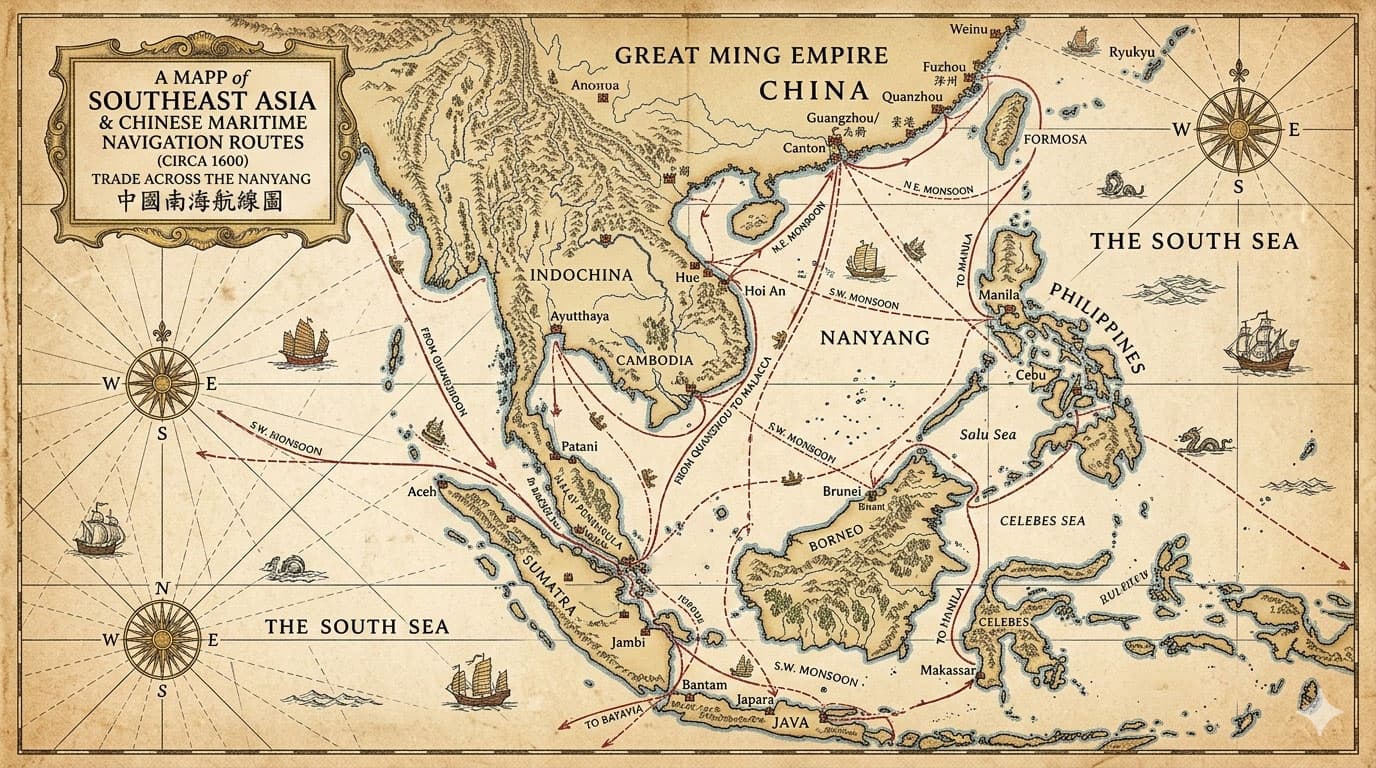
The Shunfeng xiangsong 順風相送 [Voyage with a Tailwind] is an early Chinese nautical navigation manual. It’s not clear when this text was created, however, one manuscript version of this text dates from the early seventeenth century, and it probably represents knowledge that was developed over time, starting at least in the sixteenth century.
I have made a “draft LLM” translation of this text with ChatGPT 5.2 Thinking. By “draft LLM,” I mean that I used ChatGPT to translate it, and then essentially did nothing else other than indicate in some places what certain placenames referred to. That said, I did give ChatGPT instructions on how to interpret and translate the nautical directions.
The translation is 164 pages long, so rather than try to post it here, I am making it available as a World document and as a PDF file.
As far as I know, the Shunfeng xiangsong has never been translated. There are scholars who have cited it in their research, but only to a limited degree.
What I have come to realize is that regardless of what one thinks of LLMs, they have the potential to usher in a new age, one in which people don’t have to rely on what a handful of scholars in the world occasionally mention in their publications about certain historical texts.
Instead, we can simply spend a few hours to get an LLM to translate a text, and then even if that translation is imperfect, it is still going to be immensely more beneficial than the limited references that we can find in extant scholarship, and much better than waiting for. . . god knows how many years before someone produces a “professional” translation.
So, it is from that belief and in that spirit, that I present here a “draft LLM” translation of the Shunfeng xiangsong. Enjoy!!


Thanks for teaching ChatGpt this text. First year of the Yongle era refers to early 1405 to early 1406, the latter being the date when the so-called treasure fleet sailed. So I would think is that the anonymous author had access to the records of these voyages and amended them with his observation. Other than for technicalities of sailing, this text is basically a rutter, which may be of interest to ‘specialists’ only. It has been mentioned in connection with the Selden map that gives one a good idea about trade routes in Asia. The map is available online here https://seldenmap.bodleian.ox.ac.uk/.
Thanks or the comments! Yongle 1 would be 1402-03, right? So that would be a couple of years before the voyages.
Beyond that, all we have in this preface is that statement. Further, I haven’t seen any scholar argue that this work dates from that time. Instead, they place it in the late 1500s.
In premodern Vietnam, geomantic (fengshui/phong thuy) texts were often associated with the Tang dynasty administrator Gao Pian, who was seen as the progenitor of geomantic mastery. They have prefaces where people claim to have access to the knowledge (or to a secret text containing that knowledge) that Gao Pian discovered centuries earlier.
This might represent something like that, where the time of the Zheng He voyages were seen as the moment when the nautical knowledge of the region was mastered by. . . the unnamed person in this preface.
And, yes, this text is niche, but it’s also very interesting.
The Selden map is interesting, as it lists a port between 六坤 (Ligor) and 大泥 (Patani) as 佛頭郎 (Patalung). This suggests Patalung was still an ocean port, before the formation of Satingpra peninsula, hence the lake, and was considered perhaps more prominent than Singora at the time.
Thanks for pointing this out!!
There are several maps from the seventeenth century that have Satingpra as an island: https://leminhkhaiblog.com/the-lost-water-route-between-songkhla-and-nakhon-si-thammarat/
Meanwhile, I strongly believe that overland trade was a constant throughout history, and a place like Phatthalung would have been at the end of one such route, coming across from Trang. I kind of picture a scenario where Songkhla/Singora could control what was coming across the peninsula when it was powerful, but when it was not, people could probably pass by it and go closer to the source.
Omg!! This is gonna be so helpful! Thank you so much, professor!!!