
One of my scholarly heroes has long been the Taiwanese scholar Chen Ching-ho (Chen Jinghe 陳荊和). Trained at Keio University and the École française d’Extrême-Orient in Hanoi in the 1940s, Chen went on to produce foundational scholarship about a wide variety of topics in premodern Vietnamese history.
For years, I’ve wondered how it was possible for a Taiwanese in the first half of the twentieth century to set off on that trajectory. I recently came across an extremely fascinating article that answers part of that question. It also sheds light on a connection between Japanese-controlled Taiwan and scholarship on Southeast Asia that I previously knew nothing about.
The article is entitled “The Chair and Specialization in South Seas history at Taihoku Imperial University and its Postwar Legacy (1928–1960).” Published in 2018, it was written by National Taiwan University (NTU) historian Chou Wan-Yao 周婉窈.
“Taihoku” is “Taipei” (i.e., Taibei 台北) in Japanese, and “Taihoku Imperial University” (Taihoku teikoku daigaku 臺北帝國大學) was established in Taipei in 1928, when Taiwan was under Japanese colonial rule. Chou wrote the article as NTU prepared to celebrate its ninetieth anniversary in 2018. NTU counts its history from 1928, but Chou argues that the break in 1945 was larger than the continuity.
Chou’s article reconstructs the creation, disappearance, and partial later revival of “South Seas history” (Nan’yō shigaku 南洋史學) at Taihoku Imperial University and its postwar successor, National Taiwan University, from 1928 to 1960. She says herself that her ambition is modest: she wants to use the archives to clarify where this field sat in the university’s history, what survived after the war, and how the scholarly link was later reconnected.
The term “South Seas” (Nan’yō) is roughly the equivalent of what we now refer to as “Southeast Asia,” but the match is not exact. At Taihoku, South Seas history meant Taiwan plus today’s Southeast Asia. In practice it concentrated on the sixteenth and seventeenth centuries, when Japanese, Chinese, Spanish, Portuguese and Dutch traders met in the waters around Taiwan, the Philippines and Indonesia. Today much of it would be called early modern East Asian maritime history.
Her main argument is that South Seas history was a distinctive and substantial field, created as part of the colonial university’s mission to study Taiwan, East Asia, and Southeast Asia. After 1945, that field was largely dismantled as NTU was reorganized around Chinese history. A few scholars sustained parts of the earlier tradition, but their departures produced a long institutional break of twenty-six years.
Chou draws mainly on two kinds of archives: the Japanese cabinet papers that founded the university, held in the National Archives of Japan, and NTU’s own archives. The NTU material includes curriculum and faculty records, student applications and transcripts, graduation theses, job-hunting forms and personnel files. She adds oral histories and memoirs, as well as earlier scholarship by Li Tung-hua 李東華 and Yeh Pi-ling 葉碧苓. This lets her reconstruct both the formal structure of the field and the lives of some of its teachers and students. The student records are patchy, so she uses individual cases to put flesh on the structure rather than attempting a full survey.
Taihoku Imperial University was founded in 1928 to serve Japanese colonial rule, and its creation was not a given. Proposals for a university in Taiwan go back to 1899, and the plan became realistic after Den Kenjirō, the first civilian governor-general, took it up in 1919. The name was changed at the last minute. The university had been planned as “Taiwan Imperial University,” and the February 1928 cabinet papers show the character for “wan” (灣) in “Taiwan” crossed out and the character for “pei” (北) in “Taipei” [Wade-Giles = pei; Pinyin = bei] written over it. The library had already cut a “Taiwan Imperial University” seal and stamped it on books. Cao Yonghe later guessed that the name was changed because “Taiwan Imperial University” might suggest an empire of Taiwan. Chou cannot confirm this, but she notes that Korea’s university was renamed Keijō (Seoul) Imperial University for a similar reason.
The university’s official rationale assigned it a regional scholarly role unusual among Japan’s imperial universities. Taiwan’s geographical position between southern China and the South Seas was presented as the reason it should study “Taiwan, the Orient, and the South Seas.” The aim was explicitly imperial: to equip Japanese subjects for southern expansion, establish Japan’s scholarly authority in the colony, and draw students from China and Southeast Asia into Japan’s sphere of influence. The founding statement also had a domestic purpose. It said that Taiwanese who studied in Japan saw only the dark side of Japanese society and picked up harmful ideas, while those who went to China absorbed anti-Japanese and communist ones. A university in Taiwan would give them “sound” thinking instead.
Within the Literary-Political Faculty, “South Seas history” was both a research chair (kōza 講座) and a teaching specialization (senkō 專攻). The specialization appears in the university’s regulations from 1928. The chair was added by a revision in December 1928, and teaching began in April 1929. Chou carefully explains that a Japanese imperial-university chair was not merely a course. It was a formally authorized research unit, created by imperial ordinance and generally organized around a professor, sometimes with associate professors, assistants, staff, and a library or research apparatus.
The teaching structure was separate: under the Department of History, students selected a specialization. Taihoku Imperial University offered Japanese history, Oriental history, and South Seas history. Whereas metropolitan imperial universities normally had Western history as their third historical specialization, Taihoku replaced it with South Seas history. Keijō Imperial University had done the same in 1926, replacing Western history with Korean history.
What I have translated here as “Oriental” (Tōyō 東洋) is a term that encompassed China, Korea, Manchuria, Mongolia, and often Inner Asia and India. Essentially, it is what we today think of as “Asia” minus Japan and Southeast Asia.
The South Seas history chair was well staffed, with one professor, one associate professor and one assistant. Murakami Naojirō was professor from 1929 to 1935. Iwao Seiichi was associate professor from 1929, and succeeded Murakami as professor in 1936. Yanai Kenji began as an assistant, became a lecturer in 1936 and an associate professor in 1938. The university had invested heavily in its staff. Professors-to-be were sent abroad before the university opened, and Murakami spent eight months in the Netherlands, England, Spain, Portugal and Java in 1928 and 1929. Their scholarship concentrated on the sixteenth- and seventeenth-century maritime world: Japan’s relations with Iberian and Dutch powers, the VOC, Taiwan, Japanese communities in Southeast Asia, the Philippines, and East Asian maritime exchange. In contemporary terms, much of this work would fall under early modern East Asian maritime history, Taiwan history, or Southeast Asian history.
The training was unusually demanding. South Seas history students took courses in Japanese, Oriental, and Western history, geography, ethnology, and anthropology. More importantly, their research was tied to language study. Students normally had English and German from their earlier education and took French at university. South Seas history students also studied Spanish and Dutch. Murakami, Iwao, and Yanai themselves taught the introductory classes in these languages. The connection was direct: students working on the Philippines needed Spanish, while those studying the Dutch East Indies or the VOC needed Dutch.
Chou sees this language training, combined with the undergraduate thesis requirement, as one of the major strengths of the program. The students’ own memories were more dramatic than the records. Nakamura Takashi recalled that about half of the South Seas students needed four or five years to graduate because of the languages. Chou checked the records and found this exaggerated: of fifteen graduates who wrote theses, only three took four years, and seven finished in three.
Between 1931 and 1943, the History Department produced only thirty-three graduates, but sixteen specialized in South Seas history, more than in either Japanese history or Oriental history. The first South Seas graduates appeared in 1933, and in some years there were no history graduates at all.
So where did the students come from? Almost all of them were Japanese, either from Japan itself or from the Japanese community in Taiwan. Of the thirty-three graduates, only two were registered as Taiwanese: Ke Shexie 柯設偕, who studied Oriental history, and Zhang Liangbiao 張樑標, the only Taiwanese to specialize in South Seas history.
The founders had hoped that the graduates of Taihoku Higher School would fill the university, but only 8 of its first 74 graduates applied to the arts faculty in 1928. Of the 20 students admitted that year, only three were Taiwanese. Because enrollment from the higher school stayed low, the university opened its own preparatory course in 1941. By 1945, the university had 351 Taiwanese students out of 1,767, and the Taiwanese students were concentrated in medicine. The founding documents had also expected students from China and Southeast Asia, but Chou says reality did not match this, and she names none in the South Seas program.
The known undergraduate theses show the character of the field. Chou lists fifteen of the sixteen. They treated Spanish colonial rule in the Philippines, Japanese communities in Luzon, Christianity in the Philippines, the causes of the Philippine Revolution, “tribute” in the Philippines, Zheng Chenggong’s (鄭成功) conquest of Taiwan, seventeenth-century trade through Taiwan, Spanish and Dutch missionary work in Taiwan, Javanese rice, Sulu’s foreign relations, Banten, VOC tribute systems in Java, and relations between Manila and Macao. None of them deals with mainland Southeast Asia.
Chou points out that several theses were extremely substantial handwritten works, approaching 100,000 Japanese characters and using English works, Chinese sources, and sometimes Spanish materials. She argues that their topics remained strikingly innovative when viewed against the later development of Taiwanese historiography. She is also frank that these were undergraduate works. They may have been somewhat rudimentary, and the students had not yet made full use of Dutch or Spanish sources.
Chou gives particular attention to Nakamura Takashi 中村孝志 (1910–1994). Nakamura was born in Hengchun, in southern Taiwan, to a Japanese family whose registered home was in Fukushima. He went through schools in Hsinchu and Taipei before entering the university in 1932. He finished in three years, so the languages did not slow him down. He took five courses with Murakami and three with Iwao, and studied French for two years. His thesis was on Spanish and Dutch missionary work in Taiwan. Afterwards he stayed on as an assistant in the university’s Taiwan historical materials survey office, and in 1939 he moved to Tokyo to work for the South Manchuria Railway’s East Asia Economic Research Bureau. After the war he taught at Tenri University and became an important scholar of Dutch-era Taiwan. Chou also uses his job-hunting papers. The recommendation letters written for him described him as gentle and steady in his thinking, and added that he was good at basketball. The graduate roster shows where some of the others ended up. Zhang Liangbiao, for example, was working for a research unit of the Japanese army in South China in 1939.
The wartime years disrupted this academic world severely. Using students’ grade cards and enrollment records, Chou shows how conscription and accelerated graduation hollowed out the field. From October 1943, male humanities students aged twenty or over could be drafted almost immediately. Some entered in October and were sent to military service by December; their records contain little or no coursework. Others received provisional graduation or took degree examinations without writing theses. South Seas history was still the most popular specialization. In most intakes from 1942 on, its students were more than half of the history students.
Chang Mei-hui (張美惠; in Japanese colonial records, 長谷川ミヱ/Hasegawa Mie) was the most important exception. She entered the South Seas history specialization in October 1944 and was one of three Taiwanese women among the nine women formally admitted to Taihoku Imperial University. The daughter of a Catholic doctor in Taipei, she had studied at the Sacred Heart women’s college in Tokyo and had written for the magazine Minzoku Taiwan. The anatomist Kanaseki Takeo noticed her writing and suggested she apply to Kyoto Imperial University, but neither Kyoto nor Tokyo admitted women. She was interested in Japan’s early modern foreign relations, had cited a paper by Iwao Seiichi in a class report, and knew that Iwao had just won the Imperial Academy Prize. On her application, South Seas history was her first choice, ahead of Japanese history and Oriental history. She alone among the six students in her cohort left a substantial academic transcript. Her training included English, German, French, Dutch, and Spanish, as well as Japanese, Chinese, and Taiwanese. She learned Dutch from Iwao, Spanish from Yanai, and French from a teacher at the Taipei economics college during the war. Chou calls this a high benchmark for the program.
After 1945, Chang remained at the reorganized university, renamed National Taiwan University, and became a third-year student. She studied Dutch with Iwao until he went back to Japan in December 1946, and then turned to East–West contacts with Kuwata Rokurō. In June 1947 she submitted a thesis on Ming–Siam relations in the Dongxiyang kao (東西洋考). Chou’s wording is that she was the first graduate of NTU’s History Department and the only graduate of the first Faculty of Arts class. She was then hired as an assistant in the History Department and worked in the South Seas history research office. She researched Taiwan history, Catholic missions in Asia, and Sino-Siamese trade. Under the pen name Xin Jingnong 辛逕農, she published an early postwar study of Guo Huaiyi’s (郭懷一) revolt against the Dutch in the first issue of Taiwan Fengwu, drawing on Dutch materials. Chou thinks this was probably the first piece in postwar Taiwan to use Dutch sources. She became a lecturer in 1954 and taught a course on Thai history. Chou presents her, following Li Tung-hua, as the person best placed to continue the old South Seas-history tradition within postwar NTU.
That continuation did not last. In her workplace Chang met Bu Xinxian (卜新賢), a native of Zhejiang and a history and geography graduate of Jinan University (暨南大學) in Shanghai. Bu had come to Taiwan around the end of the war to work as an assistant at NTU’s South China Humanities Research Institute (Huanan renwen yanjiusuo 華南人文研究所).
The institute’s origins are tied to the Pacific War. Taihoku Imperial University created a Southern Humanities Research Institute (Nanpō jinbun kenkyūjo 南方人文研究所) in 1943. Alongside a Southern Resources Science Research Institute (Nanpō shigen kagaku kenkyūjo 南方資源科學研究所), it formed part of the university’s wartime academic mobilization for Japan’s southward expansion. Its work was meant to focus on the humanities of southern China and Southeast Asia. Li Tung-hua says NTU renamed it the South China Humanities Research Institute after 1945, but Chou is not convinced. The archives show both institutes working at the same time in early 1946, so she says their relationship needs further study.
The South China Humanities Research Institute was directed by Zhou Xianwen (周憲文), an economist who taught at Jinan University and was also dean of NTU’s College of Law. He appointed two Jinan graduates, Zhu Jiagui (朱家貴) and Bu Xinxian, as assistants. Jinan had a strong tradition of overseas-Chinese and Southeast Asian research, which gives the appointments some logic. The institute was short-lived. In November 1946 NTU decided that it should “temporarily cease work,” and it was dissolved. Zhu returned to China, while Bu remained at NTU and transferred to the History Department’s South Seas History Research Office.
Chang was hired into the same office in August 1947, and the two became a couple. In December 1947, Bu disappeared from his dormitory one evening. NTU wrote to the Taiwan Garrison Command asking about him, and in February 1948 the Command replied that he had been arrested for taking part in the Communist Party and that his case had gone to the courts. NTU dismissed him. He was released in February 1949, and Chang and Bu married that May. In 1953, Father Arturo Rodriguez recommended her for a Spanish government scholarship intended for a married couple. She resigned from NTU effective January 1955.
In her resignation letter, Chang wrote that she wished to study South Seas history in Spain. Chou reports other reasons. According to Chang herself, she was unhappy that the library lacked new books, and a professor had taken her work. She had hoped to take leave instead of resigning. The delay before she could leave interrupted her scholarship and left the couple struggling. In 1956 she completed doctoral coursework at the University of Madrid. She then worked as an unpaid researcher at an academic institution, while Bu worked at the ROC embassy. By 1972 she and Bu were lecturers at Madrid, in Japanese studies and Chinese studies respectively.
When Spain recognized the People’s Republic of China in 1973 and broke relations with the ROC, the embassy closed and both lost their teaching posts. They supported themselves by operating a Chinese restaurant in Spain from 1974 until 1994.
Chang had worked hard to succeed in the Japanese system. She once said she wanted to be a Japanese “no worse than the Japanese.” After 1945 she automatically became a citizen of the Republic of China. In old age she said that everything had gone smoothly until the war ended, and that her life went wrong from the moment she became “Chinese.” Chou suggests this made her postwar disappointments especially painful.
Chou’s other major postwar figure is Chen Ching-ho (陳荊和, 1917–1995). He was not a graduate of Taihoku Imperial University, and he had no tie to it. He was born in Longjing, near Taichung, and his father, the gynecologist Chen Maoti, went to Keio University’s medical school to do research. Chen grew up and was educated in Japan. He entered Keio in 1936 and studied under Matsumoto Nobuhiro, a leading Japanese scholar of Vietnam. He learned French, including at night classes in Tokyo. After graduating, he worked at Keio’s newly founded Language Research Institute, studying Vietnamese, and from 1943 to 1945 he was an exchange student at the École française d’Extrême-Orient in Hanoi. In Hanoi he met and married Đặng Thị Hòa, an ethnic Chinese woman from Vietnam.
Chen joined NTU in December 1946 as a lecturer, became an associate professor in 1950, and a full professor in 1956. At first he taught Asian history and selected readings in South Seas history alongside the Japanese scholars. After they were repatriated, he taught Southeast Asian history, Vietnamese (“Annam”) history, Southeast Asian topics, and overseas Chinese history. Chou, quoting Li Tung-hua, regards Chen as the scholar who most strongly preserved the substance of the Japanese historical tradition. Yet he, too, left. Huế University was founded in 1957 and invited him as a visiting professor in 1958. He took unpaid leave from NTU in 1958 and 1959, and in 1960 he resigned, because Huế wanted him to help set up a Sinology institute. He also taught in Saigon and Đà Lạt, moved to Hong Kong in 1962, received a Keio doctorate in 1966, and after retiring in 1981 taught at Soka University. He died in Saigon in 1995. His departure, following Chang’s, ended the short-lived postwar continuation of South Seas history at NTU.
The larger explanation lies in the transformation of the university after 1945. Chou argues that NTU was not simply a seamless successor to Taihoku Imperial University. The Chinese government’s takeover was completed on November 15, 1945. At first many Japanese scholars were retained, including Iwao, Kuwata, Obata Atsushi and Nagaoka Shinjirō, and the acting president grouped them under the South Seas chair. Iwao, Obata and Nagaoka left in December 1946, and the other Japanese scholars were repatriated later. The new History Department abolished the former Japanese-, Oriental-, and South Seas-history specializations. The 1947 curriculum became centered on Chinese history, Chinese historical geography, Chinese historiography, and modern Chinese history; Western history remained present, but South Seas history lost its institutional basis. A South Seas History Research Office continued to exist for some years, but only as a small research room. The only faint echoes of Taihoku were the required thesis and electives in folklore, archaeology and anthropology.
Politics also changed the university. After the February 1947 uprising, Lin Mao-sheng, the acting dean of the arts college, was taken away on March 11 and never seen again. Chou follows Li Tung-hua in seeing officials tied to Governor Chen Yi’s administration, who held posts at NTU, as a likely reason for his fate. From 1947, mandatory ideological courses, especially Three Principles of the People, marked another sharp difference from the imperial university. The course was required of all students until 1964, when it was renamed, and it was abolished in 1993. A Kuomintang party branch operated on campus from 1950. Chou therefore treats the postwar “Sinicization” of the university as a major intellectual as well as political break. In 1966 a Southeast Asian history course returned to the department, but it was taught by a Malaysian-Chinese scholar who had no link to the Japanese tradition.
The article concludes with Cao Yonghe (曹永和, 1920–2014) as the figure who later re-established a connection. Cao was not trained at Taihoku Imperial University. He entered the NTU Library in 1947 and audited Kuwata Rokurō’s course on East–West exchange. Only three students were formally enrolled, and two soon turned to archaeology, so Cao recalled that he, the auditor, was the most diligent. He educated himself through languages and archival work, learning German, French, Spanish, and especially Dutch. He sent articles to both Kuwata and Iwao. Iwao invited him to Japan, and from 1965 to 1966 Cao studied old Dutch with Iwao in the Tōyō Bunko meeting room on Thursdays, when the library was closed. Iwao had never trained a Taiwanese successor apart from Zhang Liangbiao, and regretted it. He hoped that Cao would become his scholarly heir in Taiwan, and Nakamura Takashi told Cao the same.
Cao had no university degree, so he stayed in the library. Only in August 1984, when he became an adjunct researcher at Academia Sinica, could NTU History hire him as an adjunct professor. He retired from the library in 1985 and continued teaching at NTU until June 2010. Chou therefore identifies a twenty-six-year gap between Chen Ching-ho’s final NTU Southeast Asian courses in 1958 and Cao Yonghe’s appointment in 1984. Cao’s work on Dutch Taiwan and maritime history reconnected NTU, though only partially and belatedly, with the scholarly tradition of the old South Seas-history chair.
Chou ends cautiously. In recent years NTU has added Southeast Asian language courses, starting in 2008 with Thai, Vietnamese, Malay, Indonesian and Filipino, followed by Dutch in 2009, and in 2016 its first Southeast Asian history course aimed at more than the overseas Chinese. This looks like a return to the founding mission of “Taiwan, the Orient, and the South Seas.” But she thinks the Southeast Asian side is still mostly teaching rather than research. She also leaves aside the colonial ideology behind the old chair. I would add my own thought on that. South Seas history was created within Japanese imperialism, for Japanese students, and it served colonial ambitions. Yet it also built a serious research infrastructure: a historical specialization, language training, source-based research, and an intellectual map that located Taiwan within East and Southeast Asian worlds. The postwar university inherited the buildings but largely lost that orientation. For Chen Ching-ho, the article is valuable because it shows that his NTU teaching was not an isolated episode in Vietnamese studies. It was a late branch of Japanese scholarship that arrived by way of Keio, and it disappeared from the university for decades.
Prior to coming across this article, I knew virtually nothing about any of this. This article is such an eye-opener on so many levels and topics.
Thank you Professor Chou for researching and writing this wonderful article!!!
Chou, Wan-Yao 周婉窈. (2018). Taibei diguo daxue Nanyang shixue jiangzuo, zhuangong ji qi zhanhou yixu (1928–1960) 臺北帝國大學南洋史學講座・專攻及其戰後遺緒(1928–1960) [The chair and specialization in South Seas history at Taihoku Imperial University and its postwar legacy (1928–1960)]. Taida Lishi Xuebao 臺大歷史學報, 61, 17–95. https://doi.org/10.6253/ntuhistory.201806_(61).0002
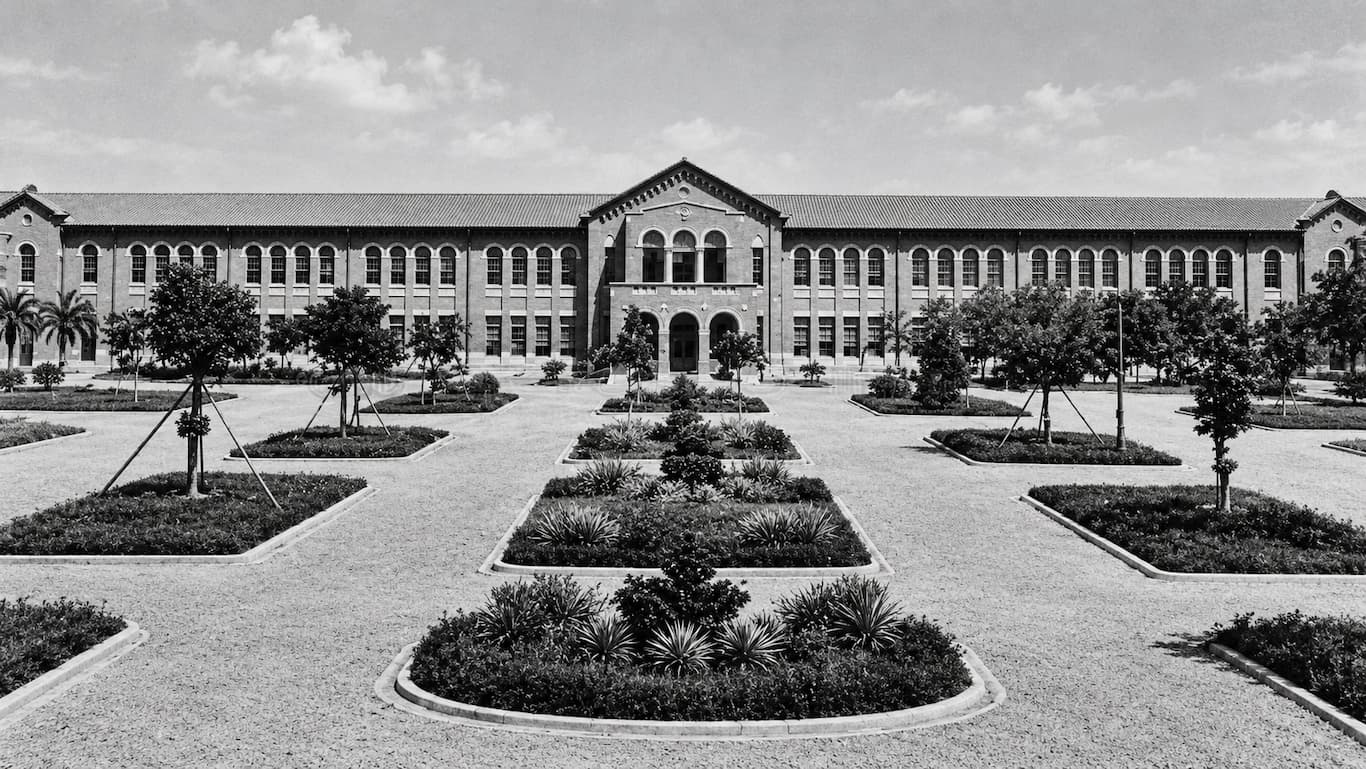
The image at the top is an AI-restored version of this picture: https://zh.wikipedia.org/zh-tw/%E8%87%BA%E5%8C%97%E5%B8%9D%E5%9C%8B%E5%A4%A7%E5%AD%B8#/media/File:Cca110001-hp-pb1397568p021-i.jpg