
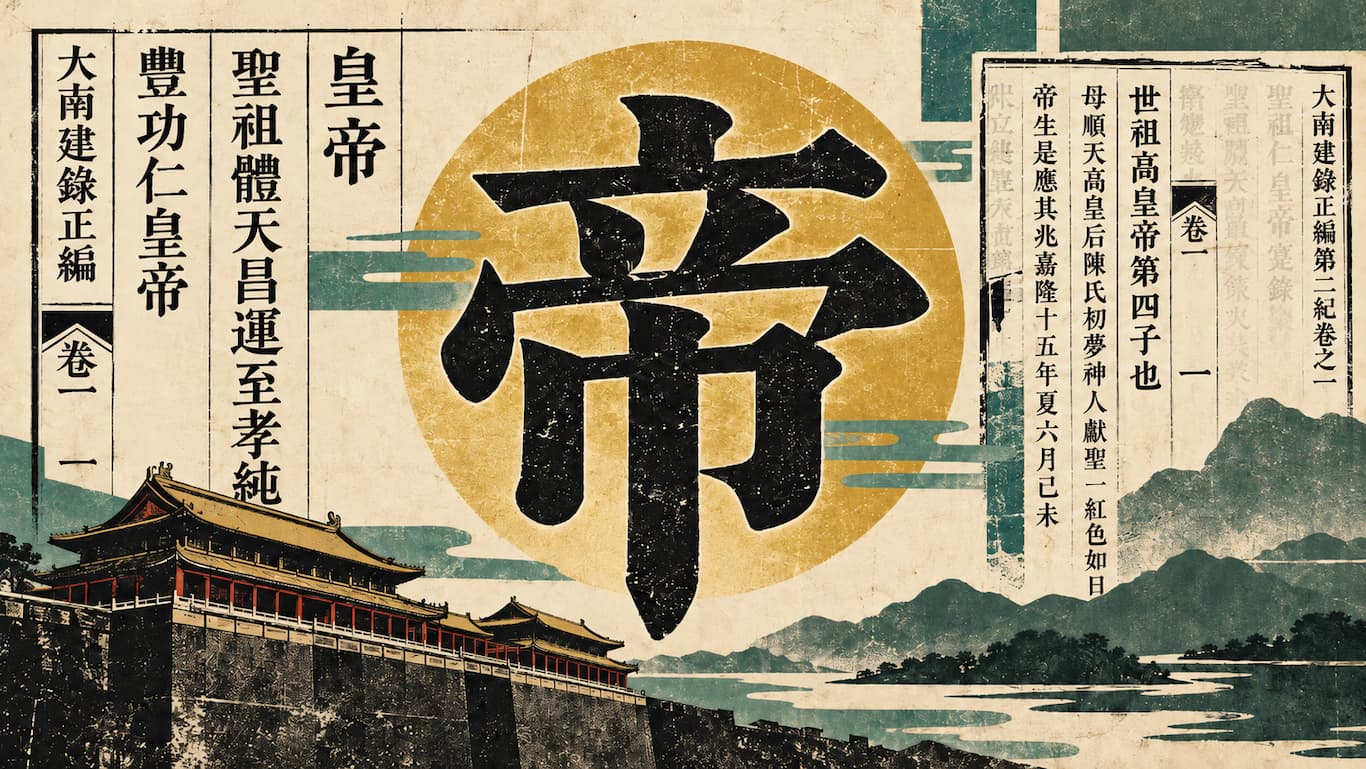
For years now, I keep coming across articles in English written by Vietnamese scholars in which Vietnamese rulers in the past are referred to as “kings.”
King Gia Long, King Minh Mạng, King Lê Thánh Tông, etc.
Those men were not “kings.” They were EMPERORS!!!
Kings (vương 王) were not the same as emperors (hoàng đế 皇帝, or đế 帝).
It is from the perspective of Chinese courts, using the hierarchical language of the tributary system, that Vietnamese rulers were referred to as “kings.” However, those rulers themselves referred to themselves as “emperors.”
Further, the term “vương” was used in Vietnam in two ways. First, it was used to refer to the rulers of polities that were subordinate to Vietnamese courts in the same way that Vietnamese dynasties were subordinate to Chinese courts in the logic of the tributary system.
Second, it was used in titles granted to princes or other privileged members of the nobility (as was also the case historically in China).
So, why do Vietnamese keep referring in English to their emperors as “kings”? It’s because of “the evils of quốc ngữ.” The people who translated works like the Đại Nam thực lục rendered “hoàng đế” as “vua,” a general Vietnamese term for a ruler, and people rely on such translations rather than the original sources in classical Chinese.
Depending on the context, “vua” could be translated as “king,” “emperor,” “ruler,” or “monarch,” as it is a general term that encompasses all of those different English terms.
So, what is critically important is THE CONTEXT. And in the context of, say, Nguyễn dynasty Vietnam, the sources make it extremely clear by repeatedly using the term “đế” (and all of the hierarchical language and rules associated with that term) that the rulers of that dynasty saw themselves as “EMPERORS.”
So, please, everyone, stop calling Vietnamese EMPERORS “kings”!!!
LMK: It is from the perspective of Chinese courts, using the hierarchical language of the tributary system, that Vietnamese rulers were referred to as “kings.” However, those rulers themselves referred to themselves as “emperors.” (…) So, why do Vietnamese keep referring in English to their emperors as “kings”? It’s because of “the evils of quốc ngữ.” The people who translated works like the Đại Nam thực lục rendered “hoàng đế” as “vua,” a general Vietnamese term for a ruler, and people rely on such translations rather than the original sources in classical Chinese.
——————————————————————————
There are at least two American historians of Vietnam who know classical Chinese and who have nevertheless opted to refer to Vietnamese monarchs as kings rather than emperors. Keith Weller Taylor, for instance, has explained the decision to do so in a response to Bruce Lockhart’s review of his HISTORY: “Lockhart prefers to call Vietnamese rulers emperors while I call them kings. He thinks the demotic word vua has both meanings. Vietnamese rulers accepted a place of vassalage within the Sinic imperial hierarchy. I view their closet pretentions to emperorship as a local conceit. From my perspective, the word vua is different from both “king” and “emperor”: something like “father-king”.”
https://share.google/wTVbKm7SxTiqzQUIL
Decades earlier, in ANTICOLONIALISM, David Marr has also been explicit about his use of the term “vua”: “Finally, there is the matter of whether the Vietnamese monarch’s royal prefix should be Emperor or King. Fortunately the question is not central to the subject, since an answer would involve unraveling some extremely subtle cultural attitudes and the court diplomacy of three countries—Vietnam, China, and France. Except in direct quotes, I have used King, since the Vietnamese people on all but formal occasions seem to have referred to their monarch as vua rather than hoang-de (Emperor).”
It can be argued that ordinary Vietnamese have recognized the pretension to emperorship by their premodern rulers for what it was: a local conceit. Đại Việt, Việt Nam or Đại Nam was way too small a polity to offer a credible basis for the idea that its rulers possessed a status similar to that of their counterparts in China. This lack of credibility might also account for the utter failure by certain Vietnamese authors to imitate Chinese võ hiệp/wuxia novels. Vietnamese readers, much to their credit, just decline to suspend their disbelief when confronted with such monstrosities. I myself have never managed to read Hoàng Lê nhất thống chí, for the simple reason that I regard it as a poor man’s Tam quốc chí diễn nghĩa. The struggle for power in 18th century Đại Việt seemed petty when compared with that which was unfolding amid the collapse of the Han Empire further to the North many centuries before. I do, however, thoroughly enjoy historical studies of the Tây Sơn era conducted by Tạ Chí Đại Trường, among others.
Thanks for the comment!!
I just read a fascinating study by Taga Yoshihiro: “Economic Aspects of Court Rituals and Ceremonies in Nineteenth Century Hue.” (https://toyo-bunko.repo.nii.ac.jp/records/7405)
Everything that Taga talks about here, from ritual to economics to foreign relations, only makes sense if we understand that the Nguyễn dynasty was an East Asian (or “Sinosphere”) empire and the rulers were East Asian emperors. First, the rituals he discusses were for emperors, not kings. Second, by tracing the human and economic aspects of those rituals, he shows that this was not a “conceit.” It was real.
Tell the governor of Hai Duong who was punished for delivering oranges that contained a snake in one of the boxes to Hue for the ceremony marking the Empress Dowager’s birthday (thánh thọ tết 聖壽節), a ceremony that was also held by the Qing dynasty, that he was living a “conceit.”
Between the Đại Nam thực lục and the Khâm định Đại Nam hội điển sự lệ, two key repositories of information for the 19th century, there is a veritable iceberg of information about the “imperial world” of Nguyễn dynasty Vietnam that scholars have never touched even the tip of.
Hence, my response is: People need to READ THE SOURCES. Then when they have done that and processed the information, like Taga has been doing, they can try to theorize. But from my vantage point, the more I read the sources, the less I can accept Taylor and Marr and the more I see things like Taga does in this article: that is, a world in which there was an East Asian emperor with all of the associated rituals and practices, rituals and practices that then impacted the lives of people across the entire realm and beyond.
That is not a “conceit.” Was Vietnam smaller than China and the Roman empire? Of course, but so what? You have to look at how it actually functioned. That is what Taga makes the effort to do in this study. I think he did a great job, but there is still so much more that can be said.