
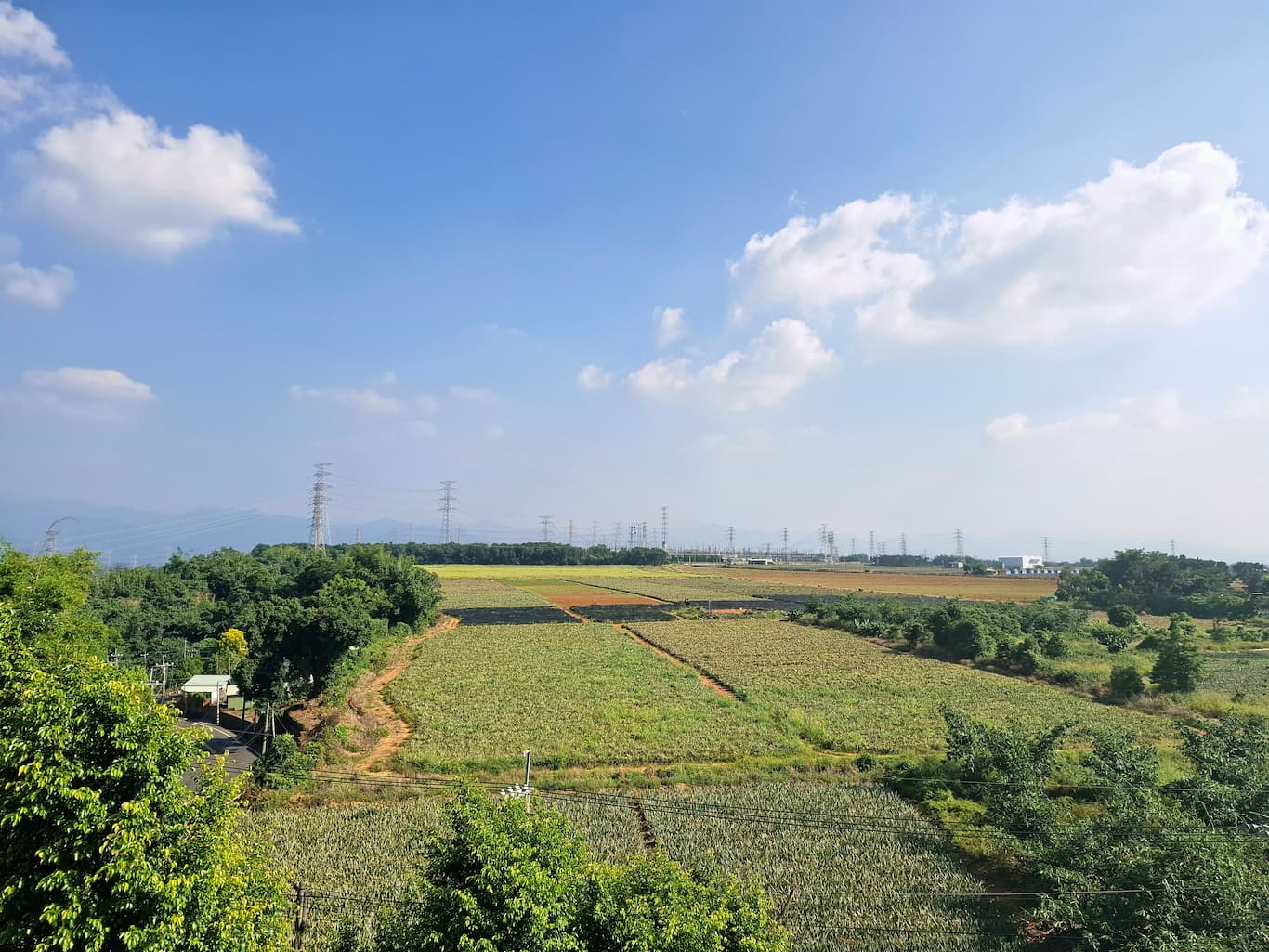
A couple of months ago I moved to Taiwan. Or perhaps I should say, I moved “back” to Taiwan, as I spent six years here back in the 1990s, and at that time, Taiwan definitely felt like a second home to me.
It’s been 25 years since I last lived here though, so it’s a home that I haven’t seen in a long time. Further, I previously lived in the north, in the middle of a big city, and now I live in the south, next to a pineapple field.
What follows are some “random writings from a pineapple field” (Fenglitian suibi 鳳梨田隨筆), some of which relate to Taiwan, some of which don’t.
Language
After getting fairly good at Russian in college, I moved to Taiwan where I ultimately studied Chinese to an advanced level (and completely forgot Russian) and established a solid foundation. Further, in six years of living in a Chinese-speaking environment (although lots of people around me spoke Taiwanese a lot of the time), I feel like Mandarin really seeped into my brain.
In the 25 years since I last lived in a Chinese-language environment, I’ve interacted with the Vietnamese-language world. And I have struggled endlessly with that language, and I have kept wondering why it just doesn’t “click” or “stick.”
I’ve come up with lots of possible explanations.
1) For most of those 25 years, I never actually lived in Vietnam. – That’s been true until recently, when I did spend a couple of years there, and yes, that did help.
2) The linguistic diversity of Vietnam (think accents) is just too diverse. – Also true.
3) Maybe I’m just getting older and it’s harder to learn languages. – Could be true but I’ve never wanted to believe that.
4) My hearing has gotten too bad, and it’s really difficult to hear in Vietnam because virtually everywhere you go is noisy. – Also true.
5) I just haven’t made the effort to really study and learn it. – Yeah, that’s true too. . .
So, year after year as I’ve found myself in situations where people are speaking Vietnamese and I have no idea what they are saying, I’ve kept going through these explanations to try to understand what is happening, then I came here after 25 years and. . .
It’s all SO EASY!!! Understanding people, regardless of who they are (blue/white collar class) or where they are from, is not difficult at all. OK, there are situations, like when the cell phone company person offers you a “24 4 99” plan (NT$499 a month for 24 months), and you go “What???” But in general, there is minimal friction.
But then I noticed something new. Basically everyone I talk to speaks a pretty standard form of Mandarin. That was not the case 25 years (and more) ago. When I was here before, there were two forms of Mandarin on a spectrum: “standard” Mandarin (or what I would call “southern Mandarin” as it is the same pronunciation that you find in many places in southern China and Southeast Asia) and “Taiwanese” Mandarin (that is, Mandarin that is spoken by people with varying degrees of a Taiwanese accent).
Taiwanese Mandarin seems to be much less prevalent now. Yes, there are people who speak Taiwanese, but when they speak Mandarin, it is now much closer to the standard/common version of Mandarin spoken in Taiwan than was the case in the past.
This made me reflect on the situation with Vietnamese.
I remember seeing someone in the early 20th century say that there was a need for a Vietnamese national language (quốc ngữ). By quốc ngữ, this person did not mean the Romanized script. Instead, he meant a new form of Vietnamese that would be intelligible to people in the different parts of the country, and he gave the specific example of people from Hanoi and Saigon not being able to understand each other.
In other words, this person saw the need to do something more than simply create a Romanization system. He felt that you needed to create a common language and teach it to people.
That didn’t happen under French colonial rule, and then the country was divided. Then after 1975, as far as I know, nothing quite like that happened either. Yes, there were teachers from the north who went to the south to teach, but as far as I know, there wasn’t a national policy to get everyone in Vietnam to speak Vietnamese the same way (i.e., with the same vocabulary and pronunciation).
By contrast, for the 38-year period of martial law (1949–1987) under the Kuomintang, a strict monolingual policy was enforced in Taiwan, and students were punished for speaking other languages.
That said, there is of course an important distinction here. Mandarin and Taiwanese are mutually unintelligible, whereas the Vietnamese spoken by someone in Hanoi and someone in the western part of the Mekong Delta can be more like the difference between American English and Irish/Scottish English, meaning that at first it can be difficult for people to understand each other, but given time, they can both more or less figure out what the other person is saying.
I first came to Taiwan in 1989, right after the martial law period had ended. Yes, the forced monolingual policy had largely “worked,” but the Mandarin that people spoke was spread out over a spectrum, from Mandarin with a heavy Taiwanese accent mixed with Taiwanese words and phrases to a form of “standard” Mainland Chinese Mandarin.
In other words, the Mandarin in Taiwan in 1989 was kind of like the Vietnamese that I have encountered over the past 25 years, yet for some reason, over that same time period, and even without a forced unification policy, that spectrum of types of Mandarin has narrowed dramatically.
How did that happen? Is it the influence of the media? If so, is this same process going to happen to Vietnamese? If not, what will prevent that from happening?
Is what has happened to Mandarin in Taiwan the after-effect of a 38-year monolingual policy? If that’s the case, then perhaps the linguistic diversity in Vietnam will continue, despite whatever power the media has.
Taiwanese, Japanese, and Mainland Chinese Scholarship on Vietnam
When I was here in Taiwan 25 years ago, there was only a very small number of people who researched about Vietnam, and most of those people had only recently developed that interest.
Scholars of Chinese literature Chan Hing-ho, Wang San-ch’ing, Cheng A-tsai, and Chen Yi had published in the late 1980s and early 1990s two series of books that contained the original classical Chinese texts of certain Vietnamese writings. Historian Hsu Wen-tang, among his many other areas of interest and expertise, was writing some about Vietnamese history, and sociologist Hong-zen Wang was investigating the new phenomenon, at that time, of “Vietnamese brides.” Then you had scholars like historian Cheng Wing-sheung who had earlier written about premodern Vietnamese history.
That was basically it.
In the years since, I have periodically “checked in” to see what people have been up to. One of the most prolific and influential scholars in the years that followed has been Chen Yiyuan, a specialist on Chinese literature. However, numerous other scholars have joined him in researching and writing about Vietnam in the years since, say, 2010.
When you are in the midst of researching and writing, you often only have time to read works that directly relate to your own research. That has been the case with me in recent years, and that is why I haven’t really paid much attention to the scholarship produced in Taiwan as it has been on different topics than the ones I’ve been working on.
Now, however, since I’m here in Taiwan looking out at a beautiful pineapple field, and since being here feels like some path in life has come full circle, I’ve decided to explore and read the scholarship that has been produced here in recent years.
This has led me to also explore what Japanese scholars and scholars in Mainland China have been up to as well.
I am going to try to write about this in the months ahead, but the gist is that a lot of really solid scholarship, particularly on premodern Vietnam, has been produced in Taiwan, Japan, and Mainland China in the past 15 years.
What I particularly like about the works I have read is that they are solidly grounded in the original sources in classical Chinese.
The Anthropic Folks are Nuts, but LLMs can Make You Reflect
I’m tired of hearing/reading whatever people from AI labs say. A few weeks ago we were told we’re all going to die, now we’re told that Claude is conscious. . .
Further, I don’t engage in long discussions with LLMs. I use them to get a job done, and if they talk too much in the process (that would be you, ChatGPT), I tell them to stop yapping and to focus on the job at hand.
Nonetheless, it is interesting to discover things about the world and yourself as you work with LLMs.
One thing that LLMs have repeatedly pointed out to me, when I upload a writing and ask them to assess it, is that my initial impulse in the way I write is to be. . . kinda mean.
An LLM will say “Do you really want to say it that way?” “Just FYI, you might end up alienating some readers if you keep that sentence there. But it’s your call.” Etc.
This has led me to reflect (usually while I’m waiting for an LLM to respond) on where that impulse comes from. Assuming that it comes from “nurture” and not “nature,” the best explanation that I can find is that it comes from me growing up in a sports environment.
For the first 20 years of my life, I was always involved in some type of team or individual sport, and particularly when you play team sports, there is really no time or room to be nice or understanding.
When you are in a hockey game and every time someone passes the puck to Jimmy, he loses it to the other team, you don’t pull him over and calmly say “Hey, Jimmy, look, I know that you’re dealing with the generational trauma from your ancestors’ experience in the Irish potato famine, so don’t sweat it. You just go ahead and focus on yourself. We understand. After all, what is a hockey game in the grand scheme of things?”
No! You say, “Dude!! Get your $%^^ together!! If you keep screwing up like this, we’re going to lose the game!!!”
And then the next time someone passes the puck to Jimmy and he doesn’t lose it, everyone feels great, including Jimmy, and they all say, “Good job, Jimmy!!!”
Alternatively, if he loses it again, then it becomes obvious to everyone that Jimmy is simply hopeless. The coach will notice, and replace him with someone else. Meanwhile, no one will be angry anymore, because the anger is just a tool to push someone capable to do a better job. If Jimmy is actually incapable, well, then there’s nothing to get upset about anymore. Just get him out of the game, and hopefully through practice he will gradually get better.
I really like that kind of “confrontational” environment, and I think it works great in other settings where you have a group of capable people who are determined to do/achieve something better. What I have noticed, however, is that in my lifetime, the academic world has moved far, far away from that approach.
When I was a graduate student, it still existed. For instance, I remember getting yelled at by my advisor in the middle of a seminar (and he was right). But, boy oh boy, nothing like that can happen anymore. Everyone has to be polite and considerate to everyone else at all times.
That, I strongly believe, has a negative effect on knowledge and scholarship. Everyone needs pushback, and watered-down polite pushback is precisely that, watered-down.
One of the things I have “liked” about this blog is all of the commenters who (sometimes angrily) have disagreed with me. Of course, I don’t like it when I read it, and there have been plenty of such comments that I immediately know I can counter, but then there are those that make you think, and that is what pushes us to be better.
Personally, nothing has motivated me more than people telling me that I don’t know what I’m talking about. The easiest way to get me to provide stronger evidence to support what I’m saying, and more evidence to demonstrate that other people have been wrong, is just to tell me that I don’t know what I’m talking about.
That, however, doesn’t happen when everyone is always nice. Meanness is therefore important.
So, I appreciate learning from LLMs that I’m kinda mean, but there’s a reason for that. I want Jimmy to get his $%^^ together so that we don’t lose the game.
Heritage
I really need someone to explain to me what is going on with Vietnam and heritage. Decades ago, there were people in Vietnam who figured out that if something is declared as a UNESCO World Heritage Site, then there is $$$ to be made.
All of this was eventually explained and theorized clearly by scholars like Oscar Salemink.
These days, heritage has gone digital, so people are now talking about things like “digital heritage” and “digital sovereignty,” etc.
I can’t make heads or tails out of all of this. It’s obviously super important, but I can’t wrap my head around what actually is happening and why (and where all of these ideas come from). And it’s not just Vietnam. Some variation of this is taking place in many places, but each place is unique.
Pineapple Fields
Until recently, I had never lived next to a pineapple field, but I now know that pineapple fields are interesting. For one, they emit certain smells sometimes, such as a kind of musty smell.
Second, I think they might be conscious. Last night, I couldn’t sleep well. At 3am I woke up and could hear this chorus of “voices” outside. At first, I thought it was chickens calling to each other, but there were too many sounds.
And it sounded like people. For a while, I thought it was people shouting in pain, but then I couldn’t be sure.
Then I woke up again around 5am and clearly heard roosters, so I know that what I heard earlier was not chickens. So, what was it?
The first night I slept here I had a nightmare. Someone was standing next to my bed looking over me, and I woke up screaming.
So, it’s possible that we have ghosts here, but I’m also thinking that it might just be that the pineapples are conscious. I’ll try to find out more, and I’ll report back in a future “Randon Writings from a Pineapple Field.”