
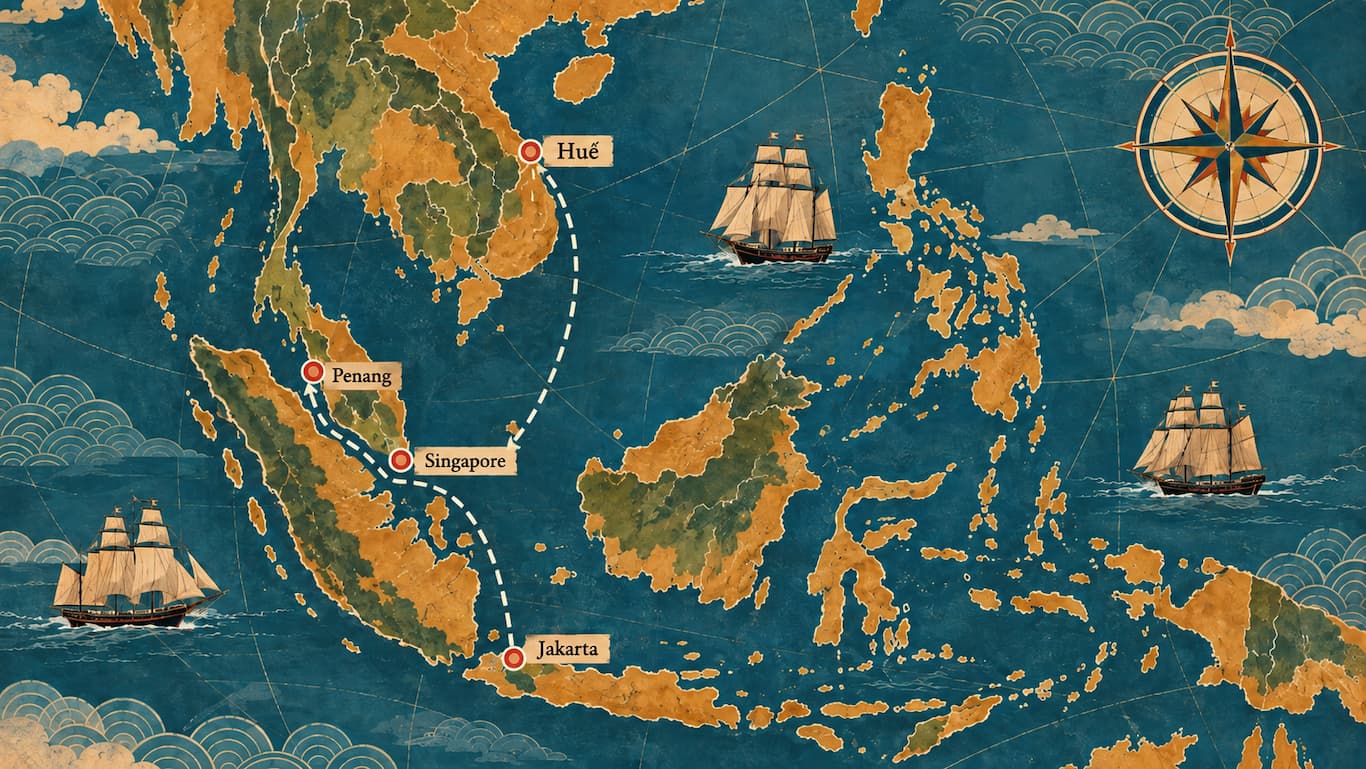
In 1990, Taiwanese historian Chen Ching-ho (Chen Jinghe 陳荊和) published an article in Japanese entitled “On the ‘Hạ-châu Missions’ (下洲公務) conducted during the early Period of the Nguyen Dynasty.”
This was a pioneering article about Vietnamese maritime voyages to places to the south, such as Singapore, Penang, and Batavia (Jakarta), in the late-eighteenth and early-nineteenth centuries.
A French translation of the article was subsequently made by Tạ Trọng-Hiệp, Claudine Lombard-Salmon, and Shintarō Shibata, and was published in the Bulletin de l’École française d’Extrême-Orient in 1994. That was helpful for anyone who did not have access to the Japanese article or who could not read Japanese, but the French translation also had limitations. In particular, the translators omitted the original Chinese text of the many passages that Chen cited from the Vietnamese chronicle, the Đại Nam thực lục.
As it turns out, I have a (not-so-great) scanned copy of the Japanese original that I made 20 years ago, and the French version is available online. So, I got Claude to produce a combined translation.
It did a very good job. In fact, it identified numerous inconsistencies in both Chen’s original article and the subsequent translation.
I am sharing it here, along with the scan that I have of the original. Enjoy!!!


I don’t want to be ”that guy”, but I seem to find sth wrong whenever you make an AI-assisted post. Right from the start with the AI’s “preface”, this sentence doesn’t seem to make sense – or form a complete sentence: “The Vietnamese translation of the Đại Nam thực lục, several missions that Chen had missed, Western calendar dates, and the original English of the passages Chen quoted from Alastair Lamb.”
I love technology, but I’m also getting wary of its consequences…
Thanks for the comment!
1) You’re totally free not to read it.
2) I provided the original Japanese article and the French translation is available online. You are equally free to just go and read those works.
3) The world is still the same as it always has been: if you really want to be certain about something, go to the source and check what it says.
4) This is an important topic. Chen’s article has been around for 36 years, and the translation for 32, however other than a small number of citations to the translation in French scholarship, and small number of citations to the original Japanese version in Taiwanese scholarship, I have not seen people engage with this work.
If scholars in the English-language world can see beyond a translation that has a cut-off sentence in a section where the LLM explains its process and can discover a topic that they know little about, then I will have succeeded in what I attempted to do.
5) This act of using LLMs to a) OCR text that is baked into a pdfs and b) combine them into a single translation is something new. How do you do it?
You don’t just press a button and say “go.” That would give the LLM too much information to work with and it would fail. That is to say, you don’t just upload the pdf and say “translate,” as it would have to first OCR the text and then translate it, and that would overload its capacity to process the information.
Instead, I “manually” took shots of a part of a page at a time, and had DeepSeek OCR it.
I then had Claude create a combined translation of the OCRed texts. It found numerous errors. Some of those errors were in the articles themselves, as noted in the current translation, but some were introduced by the OCRed text.
So, I then uploaded the Japanese pdf and had it check its work against that. This resolved several issues. I then uploaded the French translation and had it check its translation against that. This also resolved several issues. However, there were some characters that it still could not decipher from the (mediocre quality) scan of the Japanese article, so I then went in, checked the original, and if it was a passage in the Dai Nam thuc luc that the character in question came from, then I checked in the Dai Nam thuc luc and resolved those issues.
Having spent a day doing this, I “asked” Claude what the best way to do this was, and it confirmed that the way I had done it is appropriate, as giving it too much information at once will lead to problems.
Is the result perfect? Of course not. In style, I would prefer to have the English title first followed by the Vietnamese term in parentheses, but by the time I noticed that, I was too tired to care anymore.
I was also too tired to proofread every single sentence, and I couldn’t care less about the opening “translator’s introduction” by Claude. That was produced in the process as a note for me, not as part of the actual translation.
The “Vietnamese translation of the Đại Nam thực lục, several missions that Chen had missed, Western calendar dates, and the original English of the passages Chen quoted from Alastair Lamb” were all types of information that the French translation introduced. Early on in the process, Claude explained this to me, so by the time the version I shared came along, I didn’t even pay attention to that “translator’s introduction” as I had already seen the information it mentioned before. I just left that there as an artifact of the process.
If it turns out that there are some serious flaws somewhere, then I’ll take note of that and try to find a way to do things better next time around.
6) As for me, I can’t read Japanese (pretty much only the Kanji parts). I can follow the passages from the Dai Nam thuc luc that Chen Jinghe cites, but I probably wouldn’t be able to understand his important discussion in the end where he identifies Hạ châu as essentially referring to the British-controlled territories of particularly Singapore, but also in earlier works, Penang.
I can struggle through French, but I don’t like trying to read the Dai Nam thuc luc in French. I would want to see the original.
Also, regardless of the language, I find that I can never really deeply process the information until I have it in English. So, when I work with Chinese sources, I can find the key information and “understand” it, but for some reason, I can’t just write from that understanding. Instead, I need to transcribe the text first, and then translate it into English, checking any characters I’m not sure about, and only then do I feel like I really “understand.”
LLMs can significantly accelerate the transcription and translation steps. However, in the process, they can also do more than that, as they can crosscheck, etc.
So, my process is essentially the same: 1) find what I’m looking for, 2) transcribe it, 3) translate it, 4) understand it.
What is different is that while previously my understanding would develop through performing the above steps myself, now the LLM carries out steps 2 and 3, and then I go back and examine the results (checking against the original to make sure that the OCR is correct, still looking up individual characters to be sure of their meaning, etc., but now also checking the LLM’s translation to see if I agree with it and following up on the additional related information that the LLM identified).
I see absolutely nothing wrong with this approach, and I find it far preferable in terms of speed and accuracy than when I was able to do in the pre-LLM days.
7) Everyone should pay for a subscription to get access to a decent model and work seriously with it. It is a TOOL, and it can greatly enhance our work and help us to greatly expand our knowledge. The more people who do that, the better chance we will have at figuring out how to make optimal use of LLMs in research.
I see where you’re coming from, and what you’re trying to achieve. Again, I love technology and only hope it’ll keep on delivering on its promises. I only feel somewhat frustrated when it does something that would be rightfully considered “sloppy” when we expect a human agent behind the same work.
Just as a small side note – There is a 2000 article by Choi Byoung Wook (崔秉旭) who does cite heavily from Chen’s work as an important secondary source on the Hạ châu missions. I’m afaid it’s paywalled, however.
19세기 전반(1823-1847) 베트남의 동남아시아 官船貿易
Vietnamese Court Vessel Trade in Southeast Asia during the First Half of the 19th Century (1823-1847)19세기 전반(1823-1847) 베트남의 동남아시아 官船貿易 – 논문 | DBpia
It looks to me like you have never used an LLM to check human writing. I just asked Claude to check the (professionally copyedited) published version of my first “Rescuing History from Srivijaya” article for typos. It found plenty. This is a writing that was written by me, “corrected” by a copyeditor, “verified” by me after the edits suggested by the copyeditor were made, and “inspected” one last time by another person. Were I to ask it to point out the strengths and weaknesses of the paper and to evaluate the logic of my argument, etc. it would have written much more. Needless to say, human beings are far more sloppy than LLMs. It’s not even remotely close.
To quote:
I went through the whole article. I skipped words that are only broken by the PDF’s line-break hyphenation, like “Chineselanguage” and “XianLuohu.” The table headers on pp. 56 and 64 are cut off in this copy, so I couldn’t check those.
Clear typos
p. 47: “Zhenla historically referred an area” should be “referred to an area.”
p. 51 (Gazetteer quote): “The Xian [people] are descents of the Red Eyebrows” should be “descendants.”
p. 61: “transliterated into Chinse” should be “Chinese.”
p. 61: “the Yuan also attacked Champa a decade earlier in 1382” should be 1282.
p. 63: “an even strong association” should be “an even stronger association.”
p. 74: “Feng Chenjun” should be “Feng Chengjun.”
p. 76: “one Ruykyuan document” should be “Ryukyuan.”
p. 82: “a name that is a conceivably a transliteration” has an extra “a.”
p. 84: “recreating the Cambodia past” should be “Cambodian past.”
Names and citations
Fn. 1 vs. fn. 2: “Matthew Reader” and “Matthew Reeder.” One of these is wrong.
References: “Hanashita, Takeshi” should be “Hamashita,” as in fn. 2.
References: “Liu Xu. Jiu Tangshu 舊唐書 (New History of the Tang)” should be “Old History.”
Fns. 39–42: The era is given as “Zhizhi 至治 16/17/19” under Shizu. The Zhizhi era only lasted three years (1321–23). Khubilai’s era is Zhiyuan 至元, and Zhiyuan 16 is 1279, which fits your dates.
p. 58: Relatedly, “In the late 1280s and early 1290s, the Yuan dynasty attempted…” doesn’t match the dates that follow (1279, 1280, 1282). Did you mean “late 1270s and 1280s”?
Fn. 50 and Table 2 note e: “Mingshi, j.324, Liezhuan 220.” Everywhere else, j.324 is Liezhuan 212, and Java is in the same juan. Please check this.
Table 3: “Yingyai shenglan.” Elsewhere it is “Yingya shenglan.”
Inconsistencies worth checking
Date of Wang Dayuan’s text: It is 1349 on pp. 51 and 58 and in the references, but 1351 on p. 69 and in Table 3.
Old Harbor / Old Port: “Old Port” appears on pp. 76 and 77 and in the p. 87 quotation. Everywhere else it is “Old Harbor.”
The Mingshi passage on Sanfoqi: It is quoted twice (pp. 66–67 and p. 87) with different translations: “Chinese migrants repeatedly rose” versus “Chinese sojourners rose one after another,” and “Old Harbor” versus “Old Port.”
Phatthalung / Patthalung: Both spellings appear (pp. 59, 62 vs. p. 60 and Fig. 1).
Foluo’an / Fuluo’an: On p. 82 the name is “Foluo’an (Fuluo’an guo 佛羅安國).” On p. 83 it is “Fuluo’an.”
Tables 3 and 4: Table 3 quotes Fei Xin as 古名闍婆 and 古名三佛齊國. Table 4 has 故名 for the same lines.
Table 4, Xianluo row: The English includes the travel-time sentence, but the Chinese only gives “(其國 . . .).” The Chinese for that sentence is missing.
pp. 79–80: The Mao Kun map lines are called “dashed” on p. 79 but “dotted lines in the map below” on p. 80. The figure is actually above that sentence.
Da Ming yitongzhi: It appears this way in Table 2, but as “yitong zhi” elsewhere.
Possible orphan reference
Vickery’s “The Khmer Inscriptions of Tenasserim” (1973) is in the references, but I couldn’t find it cited in Part 1. It may be cited in Part 2.