
The period of Nguyễn dynasty rule in the nineteenth century, particularly the reign of Emperor Minh Mạng (1820–1841), is richly documented in the official dynastic chronicle, the Đại Nam thực lục 大南寔錄 or “Veritable Records of Đại Nam.”
By contrast, the modern scholarship on that period is quite limited. Why is that?
I think the answer is simple. The Đại Nam thực lục is difficult to read. Yes, it has been translated into modern Vietnamese, but a lot of the information there is difficult to fully understand without checking the original text in classical Chinese.
Then finding the correct passage in the original text can be difficult as the modern translation does not include the page numbers in the original. So, it takes time to find passages in the original text, and then you of course still have to look up terms to be sure you fully understand the passage, etc.
As such, using the Đại Nam thực lục is a lot of work, and is time-consuming, and as a result, it’s not surprising that it hasn’t been used anywhere close to its potential.
Way back in 2015, someone set up a Wikisource page for the Đại Nam thực lục and uploaded a little bit of the first part of that work (the “preliminary annals”). Over the years, I periodically checked in to see if any more text had been added, but the site remained the same.
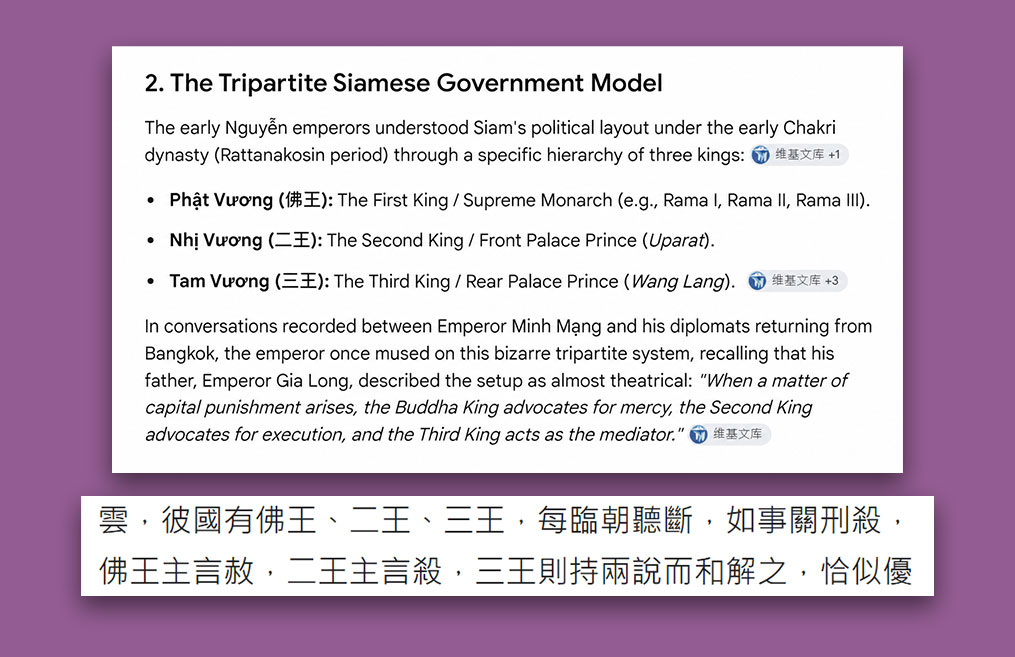
Over the past year or so, I’ve gotten more accustomed to asking Google basic questions to see what the AI snippet says. Recently, I’ve noticed that it can provide information from the Đại Nam thực lục. In examining the source of its information, I see that it is coming from that Wikisource page.
On further investigation, it turns out that someone uploaded the rest of the Đại Nam thực lục in July–August 2025. Google has clearly “ingested” that information, and can now effortlessly respond to questions about 19th-century Vietnamese history with evidence from the Đại Nam thực lục.
Indeed, Google now “knows” more about the contents of that text than any human being.
Pause and think about that.
Whoever OCRed the text says that it has not been fully proofread and can contain errors. Upon hearing that, I am sure that there are people who will immediately assume that the text must be a mess.
Reality check: OCR errors in 2025/2026 are nothing like OCR errors just a few years ago.
Whoever OCRed the text used a Chinese OCR tool called Kandianguji 看典古籍. I tried this a couple of years or so ago and it was very good. I would have been happy to keep using it, but for some reason I could no longer do so (Did it start asking for a Chinese telephone number to get access?).
Recently, I used DeepSeek to OCR some of the Đại Nam thực lục. It is also very good. It was getting perhaps one character wrong every seven pages or so, and when I compared that with the Wikisource version, the Wikisource version had everything correct.
So, the Wikisource version may not be perfect, but it’s surely damn close to perfect, and I can guarantee you that it is far better than any version that human beings could have ever created.
Further, it is without question perfectly adequate for Google to respond to questions about 19th-century Vietnamese history with evidence from the Đại Nam thực lục that no modern historian has ever written about before.
Ladies and gentlemen, we are definitely not in Kansas anymore. . .